Saturday, 3 October 2020

(432) Bass of Rangemore Hall and Byrkley Lodge, baronets and Barons Burton

Bass family
The Basses are a classic example of a family which rose from modest origins to great wealth and a seat in the House of Lords through entrepreneurial skill in a manufacturing industry. Their story begins with William Bass (c.1721-87) of Hinckley (Leics), who appears to have possessed a flair for business. He inherited a smallholding and then moved into the carrying trade, at first in partnership with his elder brother John, but later on his own. With the growth of the brewery trade around Burton-on-Trent, the carriage of beer became an important part of his business, but when he realised there was better money to be made from making beer than from moving it, he sold his business to a rival concern and invested the profits in buying a brewery in the High Street at Burton. He was already sixty years of age when he embarked on his new venture, but he threw himself into it with vigour, exploiting his understanding of transport infrastructure to develop a profitable new market for his product in Russia. He was succeeded by his sons Michael and William, but the latter was not a businessman by temperament and sold his interest to Michael Bass (1759-1827) in 1795. Michael expanded the Russian and domestic markets, and when war with France disrupted the overseas trade, he developed a new type of beer, Indian Pale Ale, which was suited to the needs of British officers and civil servants in the Indian sub-continent and could stand the long journey to its market.

Michael Thomas Bass was succeeded as head of the firm by his son and namesake, Michael Thomas Bass (1799-1884), who not only inherited the entrepreneurial gene but added to it a phenomenal energy. He joined the firm in 1817 and by the time he died sixty-seven years later, he had made the firm the largest brewery in the world, operating from three plants at Burton and producing more than a million barrels of beer a year. Although he remained actively engaged in the business until his death, from about 1850 he delegated more to his partners and managers and made time for a political career as MP for Derby, 1848-83. His growing wealth enable him to move out of the town of Burton and to lease first Byrkley Lodge and later Rangemore Hall (which he rebuilt), as well as a shooting lodge in Scotland where he took his annual holiday. His wealth also supported wide-ranging philanthropic projects, especially in Derby and Burton, and the industries associated with those towns. He is reported to have turned down both a baronetcy and a peerage, and at his death his wealth was estimated at £1.8m, making him one of the richest commoners in the country. 

The younger Michael Bass left two sons, Michael Arthur Bass (1837-1909) and Hamar Alfred Bass (1842-98), although only the former was judged to have the temperament for business, and took over the management of the brewery. Both men also had political careers, although Hamar's principal focus was on horse-racing and breeding. In 1882, while his father was still alive, Michael accepted the baronetcy which his father had rejected, and it was probably because this was a vicarious honour for his father that the patent included a special remainder to Hamar and his descendants. Although the brewing industry generally faced difficult trading conditions in the late 19th century, with declining demand as a result of the temperance movement and a more hostile legislative climate, Bass continued to do well by offering a premium product, and Sir Michael's munificent gifts to his home town were on an even larger scale than those of his father. In 1886, he was advanced to the peerage, as 1st Baron Burton, and in 1897, since he had no son to succeed him, he was granted a second barony with a very similar title, with a special remainder to his daughter. With the peerage came a whole new social standing, and Lord Burton invested heavily in his properties to ensure they reflected his status. In London, he acquired Chesterfield House - one of the grandest of the Mayfair town houses - as his residence, and filled it with paintings by 18th century British masters. He bought the freehold of Rangemore in 1886 and more than doubled it in size in 1898-1901 ahead of a visit by King Edward VII in 1902. The King also visited his leased estate at Glenquoich in Scotland, where he enlarged the lodge at the same time as work was in progress at Rangemore. With the death of Lord Burton in 1909, the brewery company passed out of family control, but his peerage and property passed to his daughter, Nellie Lisa Bass (1873-1962), Baroness Burton, whose first husband was Col. James Evan Bruce Baillie (1859-1931) of Dochfour. They had two sons and one daughter, and on Lady Burton's death the peerage passed to their descendants. Lady Burton sold Chesterfield House in London in about 1920, but kept Rangemore until 1949, when she moved to a smaller house on the estate and sold the big house to Staffordshire County Council, which turned it into a residential school for the partially sighted.

Lord Burton's younger brother, Hamar Alfred Bass (1842-98), purchased Byrkley Lodge after his father's death and rebuilt it on a much larger scale to the designs of Col. R.W. Edis in 1887-91. At his death it passed to his only son, William Arthur Hamar Bass (1879-1952), who in 1909 inherited Lord Burton's baronetcy under the special remainder of 1882. Sir William saw military service during the Boer War and First World War, but had no involvement with the management of the brewery and did not follow his father into politics. He invested in the nascent British film and cinema industry, but his chief love was horse-racing, and he filled many roles in that sport, including being a steward of the Jockey Club. His marriage to a daughter of the 14th Earl of Huntingdon was childless, and at his death he bequeathed Byrkley Lodge to her nephew, who promptly sold it, and it was demolished shortly afterwards.

Rangemore Hall, Staffordshire

The first house on the site was a small Georgian house called Rangemore House of 1822, which was evidently replaced or incorporated within a two-storey Italianate mansion with tall dormer windows breaking through the parapet to light an attic storey, built in about 1850 for John Barton. This was described, when the lease was sold in 1853 after Barton's death, as "delightfully situated on a rising lawn in Rangemoor Park, commanding views of the immediate park scenery, comprising a fine lake of ornamental water, rich greensward aud noble oakwoods".  The accommodation consisted of a spacious entrance hall, drawing room, dining-room, library, numerous principal and secondary edrooms and dressing rooms, together with the usual "domestic offices, stabling, coach houses, and granaries upon an extensive scale". The architect is unknown. 

Rangemore House: the house built for John Barton in about 1850. Image: Chris Pywell.

Rangemore House: a side by side comparison of the 1st and 2nd edition 25" maps of 1881 and 1901
shows how much the house was enlarged by Lord Burton.

The house was monstrously enlarged and internally redecorated by Col. Robert William Edis (1839-1927) for Lord Burton in 1898-1901, when it was more than doubled in size to accommodate a visit by King Edward VII, who came in 1902 and again in 1907. The overall style remains loosely Italianate, but the external elevations lack coherence and the many different facades created by running out wings in several different directions do not relate meaningfully to one another. 

Rangemore Hall: the house as massively enlarged for Lord Burton in 1898-1901 by Col. R.W. Edis.

Rangemore Hall: a detail of the elevation demonstrates the cavalier juxtaposition of irregular elements.
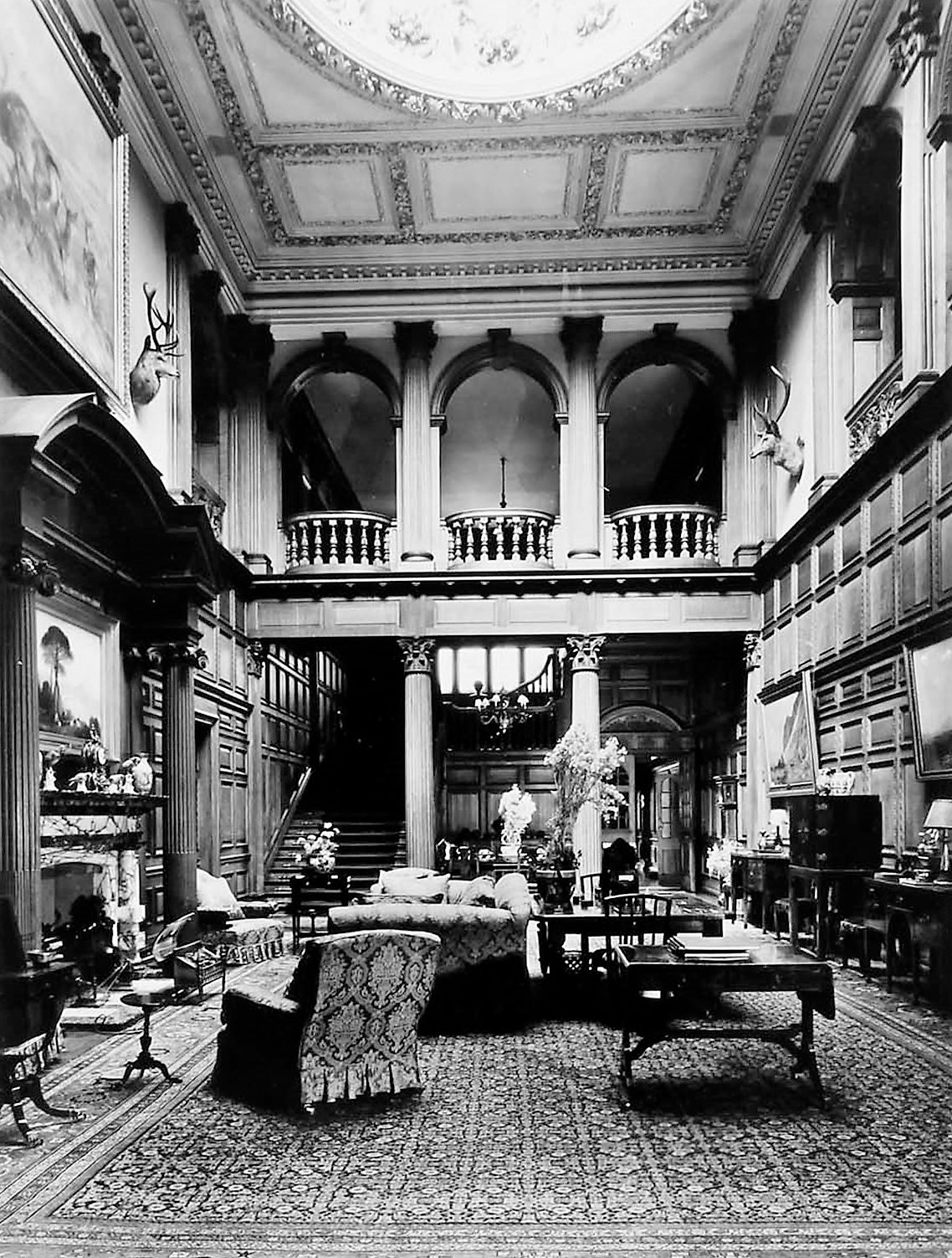
The interior is much better, with richly detailed and beautifully executed plasterwork and woodwork in a generally mid-18th century style. Lord Burton is said to have spent £200,000 on the place, but this seems an excessive estimate, even considering the scale and the quality of the internal finish.

Rangemore Hall: the drawing room and dining room of one of the apartments into which the house has been divided.

Rangemore Hall: the principal staircase is an example of the excellent Edwardian craftsmanship.
The roadway adjoining the house was moved to allow the enlargement of the gardens at the time of the 1850s rebuilding, but a more extensive landscaping was commissioned from Edward Milner in 1875. In the grounds are the stables, dated 1895, and a large brick-lined ice house approached by a long tunnel, with a pit said to be eighteen feet deep, which is a survival from the Georgian landscape. In Victorian times, there was an extensive complex of more than forty glasshouses, including an orchid house, which were heated by three large boilers and three and a half miles of pipes.

Descent: Duchy of Lancaster leased to John Rigby (fl. 1834); lease sold by 1835 to Henry Barton (1806-52) and then to Michael Thomas Bass (1799-1884); the Duchy sold the freehold after his death to his son, Sir Michael Arthur Bass (1837-1909), 1st bt. and 1st Baron Burton; to daughter, Nellie Lisa (1873-1962), 2nd Baroness Burton, wife of Col. James Evan Bruce Baillie (1859-1931) of Dochfour, and later of Maj. William Eugene Melles (d. 1953); she sold it 1949 to Staffordshire County Council, which operated it as Needwood School for the partially deaf, 1954-85; subsequently sold and divided into eight self-contained houses.

Byrkley Lodge, Rangemore, Staffordshire. 

In the medieval period, the estate formed part of Needwood Forest, and the first house here was a hunting lodge built in the 13th century. The property became part of the Duchy of Lancaster lands and was favoured as a royal hunting preserve by King James I and others. In the late 17th and 18th centuries the timber trees were harvested and much of the Forest was converted to pasture, and Byrkley Lodge was rented to Lord Townshend, whose wife had inherited the nearby Tamworth Castle estate. He seems to have engaged William Wyatt (1734-80) to rebuild the house on a somewhat larger scale as an occasional residence; the grounds were also landscaped at the same time, and included a cascade. A series of late 18th century drawings show the house with a one-and-a-half storey neo-classical front of three wide bays and two-storey service range behind, while a long detached stable block is visible behind. Edward Sneyd made improvements in the 1790s, perhaps including a long curving wall or covered passage linking the house to the stable block. There was also considerable internal remodelling in the 1820s, and further landscaping work in the grounds: the two pools south-east of the house were created in 1826. When advertised to let in 1834, the house contained “an eating room, library and drawing room, seven bedrooms, two with dressing rooms, five servant’s rooms, housekeeper’s room, and all other domestic offices”, and in 1852 the main reception rooms were still the hall, drawing room, library and dining room.

Byrkley Lodge: detail of a watercolour by John Spyers of 1786, showing the house designed by William Wyatt for Lord Townshend.
Image: British Library Maps K.Top.38.49.a

Byrkley Lodge: entrance front as rebuilt by R.W. Edis for Hamar Bass, 1887-91. Image: Historic England/Knight Frank & Rutley BB83/4292
The Georgian house was replaced by a large Elizabethan-style hous
e designed by R.W. Edis for Hamar Bass, the brother of the 1st Lord Burton, and built in 1887-91 by Walker & Slater of Derby, builders, reputedly at a cost of £150,000. The new house was constructed of intensely red Ruabon brick with Hollington stone dressings. The main block was planned around a central hall, with a service wing attached to one corner. The quality of the internal fittings and decoration - which ranged from the Jacobethan to neo-Adam in style - was uniformly high.

Byrkley Lodge: the central hall in the early 20th century. Image: Historic England/Knight Frank & Rutley BB83/4297

Byrkley Lodge: the library in the early 20th century. Image: Historic England/Knight Frank & Rutley BB83/4298
From the beginning the house had six bathrooms on the principal bedroom floor - an early example of such generous provision - and when advertised for sale in 1913, it was said to contain ‘a beautiful hall, 52ft by 43 ft, [a] suite of magnificent entertaining rooms, including the ballroom, study, boudoir, drawing room and library; well-lighted bedrooms and dressing rooms; and eleven bathrooms’, as well as the service accommodation.  

The house was put on the market in 1913 but failed to sell, although much of the estate was sold off, two farms going back to the Duchy of Lancaster. The house then remained the property of Sir William Bass until his death, but was sold and demolished soon afterwards. The site is now occupied by St George's Park National Football Centre.

Descent: Duchy of Lancaster leased 1754 to Field Marshal George Townsend, 4th Viscount Townshend; sold 1786 to Arthur Chichester (d. 1799), 1st Marquess of Donegall; sold in 1790s to Rear Admiral Edward Sneyd (d. 1832), who acquired the freehold; to widow, Maria Sneyd (d. 1848); to daughter, Mary Emma Sneyd (d. 1858), who leased it in 1850 to Michael Bass (1799-1864) and later sold to Col. Francis William Newdegate (1822-93); sold 1886 to Hamar Alfred Bass (1842-98); to son, Sir William Arthur Hamar Bass (1879-1952), 2nd bt.; to nephew by marriage, Peter Hastings (later Hastings-Bass) (d. 1964) who sold 1952; demolished soon afterwards.

Glenquoich Lodge, Invernesshire

In 1838 Edward Ellice MP bought the western half of the McDonnell estate from the impoverished lairds of the clan, who had already 'cleared' their tenantry from the estate through programmes of assisted, and later forced, emigration to Canada. Ellice (d. 1863), who was a 53-year old widower, was deeply influenced by the Romantic enthusiasm for Scotland, encouraged by Sir Walter Scott and later by Queen Victoria, and perhaps by his own early experiences in Canada. He built a modest shooting lodge in this wild and remote corner of the Highlands, on the shores of Loch Quoich. 

Glenquoich Lodge: the house as first built for Edward Ellice. Image: Chris Pywell.

Glenquoich House: two watercolours of the original shooting lodge, showing the simple exterior and spartan interior in the 1840s,
from Janie Ellice's album of sketches.

As first built, it was a one-and-a-half storey building with dormer windows lighting the upper floor, sash windows and a slate roof. The interior, recorded in a number of family sketches from the 1840s, was sparsely and simply furnished with cane-bottomed chairs and iron bedsteads, suggesting that simple living was part of the attraction of highland life at this time. 

On Edward Ellice's death in 1863, the estate passed to his son of the same name, who later the same year purchased the eastern half of the former McDonnell estate, around Invergarry. He commissioned a new house there (Invergarry House) from David Bryce and made it his principal home. Glenquoich was let from 1873 to Michael Arthur Bass, later 1st Lord Burton, who had been brought up on holidays in the Highlands, and enjoyed stalking, shooting and fishing from an early age. 

Glenquoich Lodge: the house as enlarged and remodelled by Alexander Ross c.1900.
At first, he seems to have been content with the rather spartan conditions of Glenquoich Lodge, but after he became friends with Edward, Prince of Wales in the 1890s, he transformed the house into a luxurious highland mansion to the designs of Alexander Ross. The work was carried out at the same time as he was doubling the size of Rangemore Hall (Staffs), also with a view to royal visitors. At Glenquoich, the improvements (to what was still only a rented estate) went far beyond the enlargement of the house. Lord Burton laid out 130 miles of roads and carriage drives on the estate, and even bankrolled the construction of the Invergarry and Fort Augustus railway (opened in 1903) to provide access to it, via the station at Invergarry. King Edward VII came to Glenquoich in 1904 and 1905, but after the King's second visit Lord Burton gave up the lease. The lodge survived until 1955, when the construction of a new dam turned Loch Quoich into a much larger reservoir. The house was demolished and the site was flooded later that year. Any remains now lie several fathoms deep.

Bass family of Rangemore, baronets and Barons Burton


Bass, William (c.1721-87). Second son of William Bass (1695-1732) of Hinckley (Leics), plumber, glazier and smallholder, and his wife Hannah Fish, born about 1721*. He succeeded to his father's smallholding, and later established a carrying business between London and Manchester with his elder brother, John Bass. John withdrew from this concern in 1755, and after William's marriage he moved to Burton-on-Trent, where he was increasingly concerned with the carriage of beer from the town's growing brewery industry. In 1777 he sold his carrying business to Pickfords, and invested the proceeds in a house and brewery in the High St. at Burton-on-Trent (Staffs), from which he produced a premium quality beer for the English market. In 1784 he began exporting a strong warming ale to Russia via the River Trent and the port of Hull, and this remained an important market for the firm until the Napoleonic Wars. He married, 4 December 1757 at St Michael, Wood St., London, Mary Gibbons (d. 1786), the daughter of a London publican, and had issue:
(1) Michael Thomas Bass (1759-1827) (q.v.);
(2) William Bass (b. 1763), baptised at Burton-on-Trent, 2 July 1763; partner with his brother in the Bass brewery, Burton-on-Trent, 1787-95, but then sold his interest to his brother; his later career has not been traced.
He lived at Hinckley until 1758 and thereafter at Burton-on-Trent.
He was buried at Burton-on-Trent, 2 September 1787. His wife was buried at Burton-on-Trent, 2 March 1786.
*Some sources state he was born in 1717 but his parents were only married (at Derby) in that year, and he was their second son.

Michael Thomas Bass (1760-1827) 
Bass, Michael Thomas (1759-1827).
Elder son of William Bass (c.1721-87) and his wife Mary Gibbons, born 23 July and baptised at Burton-on-Trent, 26 July 1759. He and his brother inherited his father's brewery at Burton-on-Trent in 1787, but he bought out his brother in 1795, and 
entered into partnership with John Ratcliff (d. 1834) the following year. He continued to develop the Baltic trade with Russia and North Germany, exporting via the River Trent and Hull, and in 1799 he built a second brewery at Burton. After the decline in his export trade caused by the Napoleonic Wars, he and his son developed Indian Pale Ale for the south Asian marketHe married, 2 January 1794 at Burton-on-Trent, Sarah (1763-1837), daughter of Abram or Abraham Hoskyns of Newton Solney (Derbys), and had issue:
(1) Mary Bass (1795-1879), baptised at Burton-on-Trent, 7 August 1795; married, 4 October 1843 at Barton-under-Needwood (Staffs), Walter Joseph Gisborne (1797-1887) of Yoxall Lodge (Staffs) and Lingen, Presteigne (Radnors), but had no issue; died 20 December 1879; administration (with will annexed) granted, 13 February 1880 (effects under £8,000);
(2) Sarah Bass (1796-1858), baptised at Burton-on-Trent, 11 January 1797; lived at Derby; died unmarried, 17 December, and was buried at Burton-on-Trent, 22 December 1858; will proved 2 February 1859 (effects under £7,000);
(3) Frances Bass (1798-1881), baptised at Burton-on-Trent, 26 October 1798; married, 26 June 1837 at Barton-under-Needwood (Staffs), Archibald Fox (1800-71) of Derby, and had issue one son; lived latterly at 7 Vanbrugh Park, Blackheath (Kent); died 17 July 1881; administration of goods (with will annexed) granted 3 September 1881 (effects £14,874);
(4) Michael Thomas Bass (1799-1884) (q.v.);
(5) William Bass (1801-80), born 20 July 1801 and baptised at Burton-on-Trent, 13 January 1802; educated at Middle Temple (admitted 1839; called 1843); barrister-at-law; from 1852 land agent to Francis Dukinfield Palmer Astley of Dukinfield Lodge; lived at The Lakes, Dukinfield (Ches) and later at Duffield (Derbys); died unmarried, 23 September and was buried at Duffield, 27 September 1880; will proved 8 November 1880 (effects under £12,000);
(6) Abraham Bass (1804-82), of Moat Bank, Burton-on-Trent, born 23 February and baptised at Burton-on-Trent, 20 July 1804; solicitor; an amateur cricketer who played three first class matches and was chiefly responsible for the formation of Burton Cricket Club; married, 11 May 1852 at Stapenhill (Derbys), Margaret Jane (1816-78), daughter of Rev. George Wood Lloyd DD, vicar of Gresley (Derbys), and had issue one son; died 15 August 1882 and was buried at Stapenhill; will proved 14 December 1882 (estate £17,991);
(7) Rev. Roger Bass (1805-44), born 15 April and baptised at Burton-on-Trent, 31 July 1805; educated at Repton and Trinity College, Cambridge (matriculated 1826; BA 1830; MA 1834); ordained priest, 1836; vicar of Austrey (Warks), 1839-44; married, 17 August 1835 at Burton-on-Trent, Anne (1795-1859), daughter of William Worthington of Burton, but had no issue; died suddenly while riding, 8 April, and was buried at Austrey, 9 April 1844; will proved 15 February 1845.
He lived at Burton-on-Trent.
He died 9 March and was buried at Burton-on-Trent, 14 March 1827; his will was proved 14 February 1828. His widow died 22 August and was buried at Burton-on-Trent, 28 August 1837.

Michael Thomas Bass (1799-1884)
Image: Parliamentary Archives.
Bass, Michael Thomas (1799-1884).
Eldest son of Michael Thomas Bass (1759-1827) and his wife Sarah, daughter of Abraham Hoskyns of Newton Solney (Derbys), born 6 July 1799. Educated at Burton on Trent Grammar School and later at Nottingham. As a young man he was an officer in the Staffordshire Yeomanry Cavalry (Lt., 1824), and assisted in putting down riots before the passage of the Great Reform Act in 1832. He entered the family brewery business at Burton-on-Trent in 1817 and succeeded his father as head of the firm in 1827. When he joined the firm it was not flourishing because the Napoleonic wars had disrupted sales to its important Russian market. To substitute for this trade, a beer (the famous Indian Pale Ale) was developed for export to south Asia, which was the salvation of the firm. Between 1830 and 1880 
Bass and his partners (two generations of Ratcliffs and Grettons, and later his sons) expanded the business until it was the largest brewery in the world, eclipsing the major London brewers and producing about 1,000,000 barrels a year by the latter date. Bass increasingly delegated the day-to-day operation of the firm to his partners and managers, and became an advocate for the brewing trade in general, and this led him into politics. He served as Liberal MP for Derby, 1848-83, and although opposed to the hostile policy of his party on licensing, he was in other respects a committed Liberal, advocating free trade, low taxation, and improved working-class living standards. As his wealth grew in proportion to the success of the brewery, he became a generous benefactor to both Burton-on-Trent and Derby, and in the latter town he paid for a new library, art gallery, recreation ground, and swimming-baths. No doubt as a result of this generosity, he was enormously popular with his electorate. His growing wealth allowed him to assimilate to the landed elite, and he was JP and DL for Staffordshire from 1852, and a keen field sportsman, hunting until just a few years before his death. From the 1840s, he spent between four and six weeks a year in Scotland to shoot grouse, stalk deer, and catch salmon, latterly leasing Tulchan Lodge, Strathspey. He married, 8 December 1835, Eliza Jane (1812-97), daughter of Maj. Samuel Arden of Longcroft (Staffs), and had issue including:
(1) Sir Michael Arthur Bass (1837-1909), 1st bt. and 1st Baron Burton (q.v.);
(2) Emily Frances Anne Bass (1841-1915), baptised at Burton-on-Trent, 28 May 1841; married, 30 September 1862 at Tatenhill, Sir William Chichele Plowden KCSI (1832-1915) of Aston Rowant (Oxon), and had issue one daughter; died 29 November 1915; administration of goods granted 23 March 1916 (estate £15,518);
(3) Hamar Alfred Bass (1842-98) (q.v.);
(4) Alice Jane Bass (1843-1919), born 1 August and baptised at Yoxhall (Staffs), 16 December 1843; married, 21 October 1868 at Rangemore, Sir George Chetwode (1823-1905), 6th bt., and had issue two sons and three daughters; died at Lucerne (Switzerland), 27 November 1919; will proved 27 January 1920 (estate £4,385);
(5) Mary Arden Bass (1846-89), born 2 December 1846 and baptised at Barton-under-Needwood, 6 April 1847; she seems to have been excluded from the family circle and lived as a boarder with families in the London area, latterly at Sutton (Surrey), although she was not completely ostracized as her father bequeathed her an annuity; she died unmarried and was buried at Norwood Cemetery, 7 March 1889.
He lived at Brewery House, High St., Burton-on-Trent until 1848 and then leased Byrkley Lodge, where he lived during the 1850s. He leased Rangemore Hall from about 1853 and moved there in about 1860.
He died 29 April 1884, and was buried at Rangemore; his will was proved 27 May 1884 (effects £1,830,291). His widow died 7 August 1897; her will was proved 16 September 1897 (effects £5,406).

Sir Michael Arthur Bass (1837-1909),
1st Baron Burton. Image: NPG.
Bass, Sir Michael Arthur (1837-1909), 1st bt. and 1st Baron Burton. 
Elder son of Michael Thomas Bass MP (1799-1884) and his wife Eliza Jane, daughter of Maj. Samuel Arden of Longcroft (Staffs), born 12 November 1837 and baptised at Burton-on-Trent, 20 April 1838. Educated at Harrow and Trinity College, Cambridge (matriculated 1856; BA 1860; MA 1864). On leaving university he entered the family brewing business of Bass, Ratcliff and Gretton at Burton-on-Trent, eventually succeeding his father as Chairman in 1884, and ensuring that the business continued to thrive by offering a quality product at a time of increasing competition and decreasing demand for beer. He was also Deputy Chairman of the South-Eastern Railway, JP and DL for Staffordshire and Hon. Col. of 6th battalion, North Staffordshire Regiment (retired 1881). He entered politics as Liberal MP for Stafford, 1865-68, East Staffordshire, 1868-85, and Burton-on-Trent, 1885-86, and became a personal friend of Gladstone, although he joined the Liberal Unionists in 1894 in protest at the Liberal party's growing hostility to the brewing interest. His father having declined both a baronetcy and a peerage, he was created a baronet in his father's lifetime, 1882, and this explains why he was able to secure a remainder to his younger brother and the latter's heirs male. He was later raised to the peerage as Baron Burton of Rangemore and Burton-on-Trent, 13 August 1886. As he had no male issue, this peerage died with him, but he obtained a new grant as Baron Burton of Burton-on-Trent and Rangemore, 29 November 1897, with a special remainder to his daughter. A genial man, he became a personal friend of the Prince of Wales (later King Edward VII), who stayed at Rangemore, his London house, and Glenquoich, and who appointed him KCVO, 1904. He was a freemason from a young age and became a prominent contributor to masonic charities, and well as continuing the tradition established by his father of munificent benefactions to the town of Burton, where his major projects including the new town hall (£65,000), St Paul's church (£120,000 and a £40,000 endowment) and a bridge across the River Trent (£30,000). He formed a notable art collection of works by the leading English 18th century painters (which were housed in 18th century surroundings at Chesterfield House) and also collected the work of contemporary artists (which was kept at Rangemore). He married, 28 October 1869, Harriet Georgina (1842-1931), fourth daughter of Edward Thornewill of Dove Cliff (Staffs), and had issue:
(1) Nellie Lisa Bass (1873-1962), 2nd Baroness Burton (q.v.).
He inherited the lease of Rangemore Hall from his father in 1884, purchased the freehold in 1886, and doubled it in size in 1898-1901 in anticipation of a visit by the Prince of Wales: it was estimated that the works cost £200,000. He bought Chesterfield House, Mayfair in about 1880, and also leased an estate in Scotland (Glenquoich Lodge) from 1873-1905, employing Alexander Ross to make additions to it c.1900, laying out 130 miles of roads and carriage drives on the estate, and even bankrolling a railway to provide access to it (from Invergarry station).
He died following an operation, 1 February 1909, when his was succeeded in his baronetcy by his nephew, Sir William Bass, 2nd bt. (q.v.) and in the 1897 barony by his daughter; his 1886 barony became extinct on his death; his will was proved 11 March 1909 (estate £1,000,000). His widow died 21 January 1931; her will was proved 12 May and 30 September 1931 (estate £207,027).

Bass, Nellie Lisa (1873-1962), 2nd Baroness Burton. Only child of Sir Michael Arthur Bass (1837-1909), 1st bt. and 1st Baron Burton, and his wife Harriet Georgina, fourth daughter of Edward Thornewill of Dove Cliff (Staffs), born 27 December 1873. She succeeded her father as 2nd Baroness Burton of Burton-on-Trent and Rangemore, 1 February 1909. She married 1st, 31 January 1894, Col. James Evan Bruce Baillie (1859-1931) of Dochfour, and 2nd, 25 July 1932 at St George, Hanover Sq., London, Maj. William Eugene Melles (d. 1953), eldest son of Joseph William Melles of Gruline, Isle of Mull (Argylls), and had issue two sons and one daughter by her first husband [for whom see my post on that family].
She inherited Rangemore Hall from her father in 1909, and on the death of her first husband inherited his estates at Dochfour (Inverness-shire) and Redcastle and Tarradale (Ross & Cromarty) for life. She sold Rangemore Hall to Staffordshire County Council in 1949 but to replace it she purchased Needwood Hall from her cousin, Sir William Bass. She inherited Chesterfield House from her father but sold it to Lord Lascelles in about 1920.
She died 28 May 1962; her will was proved 15 June 1962 and 2 May 1963 (estate £215,230). Her first husband died 6 May 1931; his will was confirmed in Scotland and sealed in England, 23 June 1931 (effects £33,669). Her second husband died 20 February 1953; his will was proved 26 August 1953 (estate £25,644).

Bass, Hamar Alfred (1842-98). Second son of Michael Thomas Bass MP (1799-1884) and his wife Eliza Jane, daughter of Maj. Samuel Arden of Longcroft (Staffs), born 30 July and baptised at Yoxhall (Staffs), 30 September 1842. Educated at Harrow. He was a director of Bass, Ratcliff, Gretton & Co., brewers, of Burton-on-Trent, but was effectively excluded from its management on account of his 'addiction to the Turf', which was thought to make him unreliable. He became Liberal (later Liberal Unionist) MP for Tamworth, 1878-85 and for West Staffordshire, 1885-98, and was Hon. Col. of 4th battalion, North Staffordshire Regiment and a JP and DL for Staffordshire. He was a keen racehorse owner and breeder and won the Ascot Gold Cup in 1896; he was also Master of the Meynell Hunt for 12 years. He married, 22 February 1879, the Hon. Louisa (1853-1942), daughter of William Bagot, 3rd Baron Bagot, and had issue:
(1) Sir William Arthur Hamar Bass (1879-1952), 2nd bt. (q.v.);
(2) Alexander Michael Bass (1885-91), born 10 February 1885; died young, 9 March 1891;
(3) Sibell Lucia Bass (1881-1957), born 28 June 1881; married, 2 June 1900 at St Peter, Eaton Sq., London, Capt. Berkeley John Talbot Levett (1863-1941) of London, second son of Col. Theophilus John Levett of Wychnor Park (Staffs), and had issue two sons and one daughter; died 23 January 1957.
He purchased Byrkley Lodge and Needwood House, Rangemore, and rebuilt the former to the designs of Col. R.W. Edis in 1887-91. He also had a town house at 145 Piccadilly, London.
He died of complications arising from a form of rheumatism, 8 April 1898; his will was proved 8 July 1898 (estate £196,547). His widow married 2nd, 28 Nov 1901, Rev. Bernard Day Douglas Shaw (1856-1922), vicar of The Annunciation, Bryanston Street, London; she died aged 88, from shock as the result of breaking her leg while alighting from a train at Lichfield, 18 May 1942; administration of her goods (with will annexed) was granted 16 November 1942 (estate £17,232).

Bass, Sir William Arthur Hamar (1879-1952), 2nd bt. Only surviving son of Hamar Alfred Bass (1842-98) and his wife the Hon. Louisa, daughter of William Bagot, 3rd Baron Bagot, born 24 December 1879.  Educated at Harrow, and entered Trinity College, Cambridge but gave up his place and joined the army instead. An officer in the 10th Hussars (2nd Lt., 1899; Lt., 1900; retired 1904; returned to colours, 1914; Capt., 1915; retired 1919), who served in the Boer War and First World War. He was Chairman of Provincial Cinematograph Theatres, from 1909, and also gave financial support to the London Film Co., but was chiefly associated with the horse-racing industry. He was a racehorse owner from 1901, a member and steward of the Jockey Club, joint Master of the Meynell Hunt, a Steward of the Pony Turf Club, and was involved in the foundation of Northolt Park Racecourse in 1929. He married, 9 June 1903 at Clewer (Berks), Lady Wilmot Ida Noreen (1880-1949), youngest daughter of Francis Power Plantagenet Hastings, 14th Earl of Huntingdon, but had no issue.
He inherited Byrkley Lodge from his father in 1898.
He died 28 February 1952, when the baronetcy expired; his will was proved 30 May 1952 (estate £269,900). His wife died 25 May 1949; her will was proved 23 July 1949 (estate £2,246).

Principal sources

Burke's Peerage and Baronetage, 2003, pp. 598-600; Sir N. Pevsner, The buildings of England: Staffordshire, 1974, p. 224; N. Tringham (ed.), The Victoria County History of Staffordshire: vol. X: Tutbury and Needwood Forest, 2007, pp. 70-71; T. Mowl & D. Barre, The historic gardens of England: Staffordshire, 2009, pp. 255-57; M. Miers, Highland Retreats, 2017, pp. 59, 66, 140, 210; Oxford Dictionary of National Biography entries for Michael Thomas Bass (1799-1884) and Sir Michael Arthur Bass (1837-1909), 1st Baron Burton.

Location of archives

Bass family, baronets and Barons Burton: deeds of Staffordshire estates, 1617-1924 [Staffordshire Record Office, D1165]

Coat of arms

Gules on a chevron cottised argent, between three plates each charged with a fleur-de-lys azure, a demi-lion couped of the first.

Can you help?

  • Can anyone provide a view of the 1822 predecessor of Rangemore Hall?
  • Does anyone know what happened to William Bass (b. 1763) after he sold his partnership in the brewery to his brother; or any more about the history of Mary Arden Bass (1846-89) and why she was treated so differently from her siblings in her father's will?
  • I should be most grateful if anyone can provide photographs or portraits of people whose names appear in bold above, and who are not already illustrated.
  • Any additions or corrections to the account given above will be gratefully received and incorporated. I am always particularly pleased to hear from members of the family who can supply recent personal information for inclusion.

Revision and acknowledgements

This post was first published 3 October 2020 and updated 4-8 October 2020 and 1 May 2021. I am most grateful to Chris Pywell for supplying additional images.


Thursday, 24 September 2020

(431) Baskerville of Woolley Grange and Crowsley Park

Baskerville of Woolley Grange and Crowsley Park 
The Baskerville family who lived at Malmesbury, Bradford-on-Avon and Calne (all in Wiltshire) from the 17th to the 19th centuries claimed descent from Philip Baskerville, the third son of Sir Walter Baskerville (d. 1505), kt., of Eardisley (Herefs), who moved to Salisbury in the early 16th century. This is entirely plausible and may well be correct, but the suggestion in Burke's Landed Gentry that John Baskerville (d. 1681), with whom the genealogy below begins, was the grandson of Philip - who was born about 1490 - is not really tenable. John Baskerville may be identifiable with the child of that name baptised at Malmesbury in 1617, in which case his father's name was Richard, but it has not proved possible to push this lineage any further back with satisfactory evidence. The social status of John and his immediate descendants seems to have been that of yeomen and clothiers occupying a middle station between the landowning gentry and the peasantry, but over time the profits of the clothing trade and prudent marriages made them rather wealthier, and the family began styling themselves 'gentleman' from the early 18th century.

John Baskerville's eldest son, John Baskerville (1649-1732), settled at Burton Hill on the outskirts of Malmesbury, but not apparently at Burton Hill House, which was occupied by the Hungerford and Estcourt families at this period. By 1675, John had become a Quaker, and this remained the family's religion for the next two generations. The excellent record-keeping of the Quakers shows that John had four sons who survived to adulthood, namely John, Ezekiel, James and Thomas. John and James became clothiers in Bradford-on-Avon and Calne respectively, while Ezekiel Baskerville (1681-1736), who was the eldest son to survive his father, inherited the Burton Hill property and Thomas (1687-1756), the youngest son, became a leather merchant in London before retiring to Surrey.

John Baskerville (1678-1730) was probably already settled in Bradford-on-Avon when he married Ann Webb there in 1701. At some point he purchased a small 17th century manor house called Woolley Grange outside the town, but this may have been a little later. In 1710, John married for a second time, and produced four sons and four daughters. Only two of the sons survived to adulthood, and the elder, Joseph Baskerville (1713-56) became a woollen draper in London, leaving Thomas Baskerville (1717-79) to inherit Woolley Grange and his father's clothing interests in Bradford-on-Avon. Thomas was brought up in a Quaker household, but later left the Society of Friends, perhaps on his marriage to a non-Quaker in 1741. He had two sons and five daughters, but once again the eldest son was not the principal heir. The career of his eldest son, Thomas Baskerville (1743-c.1782) is somewhat obscure, but he was left some urban property in Bradford-on-Avon by his father. Burke's Landed Gentry suggests he was a soldier, but this seems to be based on a confusion with his near-contemporary, Lt-Col. Thomas Baskerville (1735-1817) of Poulton House near Marlborough, who appears in a previous post. Thomas Baskerville senior's younger son was John Baskerville (1745-1800), who was a clothier, and it was he who inherited Woolley Grange. He married Hester, the daughter of Nicholas Webb of Norton Court (Glos), a wealthy Gloucester merchant, and produced two sons, John Baskerville (1772-1837) and Joseph Baskerville (1773-1812), neither of whom married. He left his estate to his widow, who died in 1819, and then to his son, John. When John died without issue in 1837, he bequeathed his property to his cousin, Henry Viveash (1793-1877) of Calne, on condition that he took the name Baskerville.

Henry Viveash (the name is pronounced Vy-vash) was the eldest surviving son of Oriel Viveash of Calne, clothier, and his wife Sarah, the daughter of Thomas Baskerville (1717-79), and had pursued a career with the East India Company in Madras (India), where he was a member of the Board of Revenue. In such a position he may well have accumulated a substantial capital on his own account, but on receiving the legacy from his cousin he returned to England. He did not, however, occupy Woolley Grange, which was at first leased to his brother, Charles Baskerville Viveash (1799-1863) and then to Capt. Septimus Palairet (d. 1854) (who remodelled the house considerably in the late 1840s), before being sold in 1864. Instead, Henry Baskerville (as he became
Farleigh Castle, Farleigh Hungerford: rented by Henry Baskerville, 1842-45

in 1838) chose to rent a house in Cheltenham, and then Farleigh Castle at Farleigh Hungerford (Som.), while he looked around for a grander estate to purchase. In 1845 he found what he was looking for in Crowsley Park near Shiplake (Oxfordshire), and he moved in shortly afterwards. He was quickly assimilated into the county elite in his new home, becoming a deputy lieutenant in 1846 and serving as High Sheriff in 1847-48. 

In 1839, Henry Baskerville married Mary Anna Burton (d. 1888), whose father had been a doctor in Madras and was no doubt known to Henry from his years in India. They had two sons and four daughters, of whom the elder son, John Baskerville (1839-1927) inherited Crowsley Park, while the younger, Henry Joseph North Baskerville (1861-1941), had a very chequered career. After a traditional education at public schools and Cambridge, he married Edith Peskett, the daughter of a house painter from Chichester, in 1886. The couple separated at some point in the 1890s, with Edith returning to live with her father, while Henry found a new partner in Lilian Hayward (1883-1971), the daughter of a policeman from Mitcheldean (Glos), with whom he went on to have five children. Henry and Lilian lived as husband and wife - and appear as such on the 1901 and 1911 censuses - but there had been no marriage (and if there had been it would have been bigamous and invalid). This would have remained a very minor scandal had not Henry, at some point in the first decade of the 20th century, been ordained as a minister of the Free Church of England, and in 1910 made incumbent of Christ Church, Broadstairs (Kent). He filled this role for five years, but in 1915 something happened that caused the church authorities to deprive him of his living and pack him off to lead a mission church in Birmingham. Since he was evidently on excellent terms with his congregation (who presented him with a purse of gold sovereigns when he left the parish) it seems likely that his marital status had come to the attention of the church and caused his demotion. He continued, however, to live with Lilian, and as soon as his first wife died, in 1932, he married her, although under English law this did not legitimate their children.

John Baskerville (1839-1927), who inherited Crowsley Park, pursued a more orthodox career in the army, retiring as a major in 1868, and later commanded the Oxfordshire Hussars, with the honorary rank of Colonel. He succeeded his father in 1877 and became a JP and County Councillor, and from 1890 a deputy lieutenant. Like his father, he married a doctor's daughter, and produced two sons and two daughters. His elder son, and the heir to Crowsley Park, was the historian Geoffrey Baskerville (1870-1944), whose trenchant and revisionist book on the dissolution of the monasteries appeared in 1937. He inherited Crowsley Park in 1927 and lived there with his mother, who died in 1939. Soon afterwards, Crowsley Park was requisitioned by the Government for the use of the BBC. The Corporation was principally interested in the park, which despite the proximity of the town of Reading offered good conditions for monitoring overseas telecommunications, with limited electrical interference. After the war, the Corporation retained the park and built a new building to house its monitoring service staff, but the family returned briefly to the house in the person of Geoffrey Baskerville's younger brother, the Rev. Humphrey Baskerville (1879-1952), another childless bachelor. On his death, the estate was sold and the BBC was able to acquire the freehold.

Woolley Grange, Bradford-on-Avon, Wiltshire

A medium-sized manor house, dated 1665, irregularly gabled and with tall square ashlar chimney stacks set diagonally in groups of two and three. The house was considerably restored and added to by Captain S.H. Palairet in about 1847-50, probably to the designs of George Phillips Manners of Bath (who is thought to have designed Christ Church Schools in Bradford, opened in 1847 and paid for by Palairet)

Woolley Grange: an engraving of 1888 by Samuel Loxton of Bristol.
The two-storey front elevation of rubble stone with ashlar dressings has gabled attics, each with a two-light casement window, and all the gables have unusual and attractive pierced spear-head finials. Beneath the two left-hand gables are a pair of 19th century two-storey bays with balustraded parapets and stone mullioned windows on each floor. The square porch is set approximately centrally in the facade and has a room over it and above that another balustraded parapet. The doorcase is in the form of a moulded segmental arch with keystone and imposts, and inside the porch is a carved oak ceiling with the date "1665" over the inner doorway. To the right of the porch is a plain bay, with three-light stone mullioned casements with drip-moulds on the ground and first floors; it seems likely that the bays to the left of the porch were originally similar in form. To the right again is a slightly taller projecting bay with a large gable and a single-storey bay window which seems to match those on the bays to the left of the porch, and therefore probably also dates from the 1840s. 

Woolley Grange: the main front today
A lower gabled wing on the extreme right of the front elevation has a restored three-light oriel window with a shallow embattled parapet. There is a late 19th century conservatory on the extreme left of the frontage and the side elevation at this end has three gables and some original mullioned windows and drip-moulds. At the rear there is a single-storey flat-roofed extension incorporating a porch made up from older sculptural fragments, which is reminiscent (in a simpler way) of the garden porch at Crowsley Park (for which, see below). In the mid 20th century the house was used as a maternity home, and it was converted to an hotel in 1989. The road from Bradford-on-Avon to Woolley Green originally ran immediately past the house but was moved further away when the house was restored in 1860.

Descent: sold to John Baskerville (1678-1730); to son, Thomas Baskerville (1717-79); to son, John Baskerville (1745-1800); to widow, Hester (d. 1819); to son, John Baskerville (1772-1837); to cousin, Henry Viveash (later Baskerville) (1793-1877), who leased 1846 to Captain Septimus Henry Palairet (d. 1854); sold 1864 to Samuel Beavan (fl. 1866); sold to Buddle Atkinson (d. 1880); to widow Clara, later wife of John Bell Simpson... sold c.1905 to Percy Kendall Stothert (fl. 1905-17); sold to Lt-Col. Harry F. Darell (fl. 1920-27); sold 1927 to Charles Goschen (d. 1939); to widow, Beatrice Goschen (fl. 1942) who let 1941 to Wiltshire County Council for use as a maternity home.

Crowsley Park, Shiplake, Oxfordshire

Crowsley Park: entrance front in 2010. Image: Shaun Ferguson. Some rights reserved.
Crowsley Park is a long, narrow house built probably by Francis Heywood in the early 1730s to replace an earlier farmhouse. It is built of red brick and presents a ten bay front on the entrance front and thirteen bays on the garden side, which is about eight feet wider. John Atkyns-Wright remodelled it in about 1800, adding a Gothic-style battlemented porch and corner turrets. Henry Baskerville made substantial changes before 1852, and more limited alterations followed in the late 19th century, probably including the extraordinary porch on the garden front, which is made up from fragments of older carving, 18th century mouldings, urns, and a pair of neo-Jacobean corbels. 

Crowsley Park: garden front in about 1870. Image: Elizabeth Clifford/Historic England.

Crowsley Park: the porch on the garden front in 1956.
Image: Historic England.
In 1844 the house included a large stone-paved entrance hall, library, drawing and dining rooms, and (on the first floor) six principal bedrooms. The house preserves a fine staircase with twisted balusters and carved treads, and much 18th century panelling, shutters and plasterwork. There is also a handsome curved back stair of c.1800. 
The house was neglected in the mid 20th century when Geoffrey Baskerville seems to have been short of money, and it was requisitioned by the Government in 1942 and given to the BBC, who occupied the house and built a signals-receiving station in the park. By 1970 the house was in very poor condition, but it was subsequently restored by Hugh and Beeban Morris, who took a twenty-year repairing lease, demolished the servants’ wing and restored the rest. Much additional work was done to the house from 1995 onwards by a later lessee, the clothing designer Jeff Banks, including the conversion of outbuildings to domestic use.

The chief ornament surviving from the 18th century park is a grotto built into the hillside south-east of the house. This has a stone front with three niches over the entrance, and inside a single rib-vaulted chamber with niches in the partly shell-lined walls. The Baskervilles planted thousands of trees, forming avenues and a fine arboretum, which included some sub-tropical exotic planting. During the period of neglect in the mid 20th century, the arboretum grew into an almost impenetrable jungle with a humid micro-climate, in which the long-forgotten sub-tropical plants not only survived but grew to a size rarely seen in the UK. When Hugh Morris began to force a way into the jungle with a small tractor in the 1970s this remarkable world was rediscovered.

Descent: Crown granted c.1570 to Thomas Crompton; sold to Bennett Winchcombe and Humphrey Purcell; sold 1595 to John Mochett (d. 1605); to widow Margery Mochett (d. 1623) and then to his nephew John Cooke; sold 1627 to Peter du Bois; to widow, who sold 1660s to Abraham Otger... Peter Otger sold 1732 to Francis Heywood (d. 1747), who built the house and enlarged the estate; to brother William Heywood (d. 1762); to nephew John Crew (d. 1788) and sisters Mary Wright (d 1780) and Elizabeth Fonnereau (d. 1777) as co-heirs; reunited by Mary’s daughter Mary Wright (d. 1793); to nephew, John Atkyns-Wright MP (d. 1822); to widow Mary Atkyns-Wright (d. 1842); sold by order of Chancery in 1845 to Henry Viveash (later Baskerville) (1793–1877); to son, John Baskerville (1839–1927); to son, Geoffrey Baskerville (1870-1944); requisitioned in 1942 for BBC, who later bought the freehold. The house was occupied by the Rev. Humphrey Baskerville until his death in 1952, and leased from 1970-90 to Mr & Mrs Hugh Morris and from 1995 to Jeff Banks (b. 1943). 

Baskerville family of Woolley Grange and Crowsley Park


Baskerville, John (1617?-81). Possibly the son of Richard Baskerville and his wife, baptised at Malmesbury, 19 August 1617. He may also be the John Baskerville of Malmesbury who was licensed by the Bishop of Salisbury as a teacher, 1662. He married, about 1646, Rebecca [surname unknown] (fl. 1682) and had issue:
(1) An unnamed child (d. 1648); probably died in infancy and was buried at Malmesbury, 20 July 1648;
(2) twin?, Mary Baskerville (1648-61), baptised at Malmesbury, 7 January 1648/9; died young and was buried at Malmesbury, 2 August 1661;
(3) twin?, Rebecca Baskerville (b. 1648), baptised at Malmesbury, 7 January 1648/9;
(4) John Baskerville (1649-1732) (q.v.);
(5) Thomas Baskerville (b. 1652; fl. 1724) of Malmesbury, baptised at Malmesbury, 23 April 1652; living in 1724;
(6) Francis Baskerville (1654-1729), born 17 December 1654 and baptised at Malmesbury, 9 January 1654/5; clothier of Malmesbury; married, 1687, Bridget Baldwyn of Yatesbury (Wilts), and had issue one daughter; buried at Malmesbury, 24 March 1728/9; will proved 12 July 1731;
(7) Joseph Baskerville (b. 1656), born 9 December 1656 and baptised at Malmesbury, 5 January 1656/7;
(8) An unnamed son (b. 1661), born 21 April 1661; probably died in infancy;
(9) An unnamed son (d. 1663), probably died in infancy and was buried 8 September 1663.
He lived at Malmesbury.
He was buried at Malmesbury, 3 November 1681; administration of his goods was granted in 1682. His widow was living in 1682 but her date of death is unknown.

Baskerville, John (1649-1732). Eldest son of John Baskerville (1617?-81) and his wife Rebecca [surname unknown], baptised at Malmesbury, 23 October 1649. He married 1st, 22 August 1675 at Slaughterford (Wilts), Elizabeth Wallis (d. 1700) of Slaughterford (Wilts), and 2nd Ann [surname unknown] (d. 1732), and had issue:
(1.1) John Baskerville (b. & d. 1676), born 4 June 1676; died in infancy and was buried 6 June 1676;
(1.2) Rebecca Baskerville (b. 1677), born 12 April 1677; married, 1698/9, Charles Robins (fl. 1731) and had issue one son and two daughters; living in 1731; 
(1.3) John Baskerville (1678-1730) (q.v.);
(1.4) Ezekiel Baskerville (1681-1756) of Burton Hill (Wilts), born 17 March 1680/1; died unmarried and without issue, 12 August and was buried at Lea and Claverton, 15 August 1756; will proved at Malmesbury, 15 December 1756;
(1.5) James Baskerville (b. 1683), of Calne (Wilts), born 2 April 1683; married, before 1714, Jane [surname unknown] and had issue three sons; living in 1717;
(1.6) Elizabeth Baskerville (b. 1685), born 19 May 1685; married, probably after 1717, Henry Franklyn, and had issue one daughter; living in 1756;
(1.7) Thomas Baskerville (1687-1756), born 31 January 1686/7; leather-seller in London, and later of Merstham (Surrey); died without issue, 8 August and was buried at Reigate Quaker Burial Ground (Surrey), 13 August 1756; will proved 23 August 1756.
He lived at Burton Hill, Malmesbury.
He died 20 August and was buried at The Lea Quaker Burial Ground, 24 August 1732; his will was proved 25 October 1732. His first wife died 14 March 1700. His second wife was buried at The Lea Quaker Burial Ground, 6 February 1731/2.

Baskerville, John (1678-1730). Second but eldest surviving son of John Baskerville (1649-1732) and his first wife, Elizabeth Wallis of Slaughterford (Wilts), born 7 July 1678. Clothier. A Quaker in religion. He married 1st, 19 June 1701 at Comerwell Quaker Meeting House, Anne Webb (d. 1701) of Bradford-on-Avon (Wilts) and 2nd, 6 July 1710, Rachel (c.1685-1744?), daughter of Joseph Sargent of Calne (Wilts), and had issue:
(2.1) Mary Baskerville (b. 1711), born at Calne, 12 June 1711; married, after 1729, Thomas Farmer (fl. 1752);
(2.2) John Baskerville (1712-34), born 5 September 1712; died unmarried and without issue, and was buried in the Quaker burial ground at Lavington (Wilts), 7 July 1734;
(2.3) Joseph Baskerville (1713-56), born 24 July 1713; woollen draper of Tinley (Wilts) and Fenchurch St., London; married, 11 September 1735 at Bristol, Mary (1715-66?), daughter of Thomas Farmer of Bromsgrove (Worcs), ironmonger, and had issue one son and one daughter; died 2 April and was buried at Bunhill Fields, 9 April 1756; will proved in the PCC, 10 April 1756;
(2.4) Rachel Baskerville (1716-20), born 30 October 1716; died young and was buried in the Quaker burial ground at Comerwell (Wilts), 18 July 1720;
(2.5) Thomas Baskerville (1717-79) (q.v.);
(2.6) James Baskerville (1721-22), born 2 July 1721 and died 9 November 1722;
(2.7) Rachel Baskerville (b. & d. 1723), born 11 October 1723; died in infancy, 6 November 1723;
(2.8) Elizabeth Baskerville (b. 1728), born 17 August 1728; married John Stafford (d. 1780) of Bradford-on-Avon and later of Winchester (Hants), clothier, and had issue three sons and four daughters; death not traced.
He lived at Woolley Grange, Bradford-on-Avon, which he bequeathed to his widow for life and then to his youngest surviving son, Thomas. He also left a bequest of £50 for wainscoting and repairing his house at Woolley.
He died in the lifetime of his father, between 29 January and 24 March 1729/30; his will was proved in the PCC, 24 March 1729/30. His first wife died 26 December 1701. His widow is said to have died 13 March 1744.

Baskerville, Thomas (1717-79). Third son of John Baskerville (1678-1730) and his second wife, Rachel, daughter of Joseph Sargent of Calne (Wilts), born 7 March 1716/7 and registered at Lavington (Wilts) Quaker Meeting. Gentleman clothier at Bradford-on-Avon. He married, 21 April 1741 at Great Chalfield (Wilts), Anne (d. c.1787), daughter of Thomas Dyke esq. of Bradford-on-Avon, and had issue:
(1) Thomas Baskerville (1743-c.1782), of Bradford-on-Avon, baptised at Bradford-on-Avon, 27 April 1743; sometimes said to be an officer in the army but this appears to be a confusion with his distant kinsman, Lt-Col. Thomas Baskerville (1735-1817) of Poulton House near Marlborough (Wilts); although the eldest son he was not his father's principal heir; he probably died between 1779 and 1786 as he is mentioned in his father's will but not in his mother's will, but his burial has not been traced;
(2) John Baskerville (1745-1800) (q.v.);
(3) Ann Baskerville (1747-98), baptised at Bradford-on-Avon, 23 June 1747; died unmarried and was buried at Bradford-on-Avon, 18 September 1798;
(4) Rachel Baskerville (1750-79), baptised at Bradford-on-Avon, 10 August 1750; died unmarried and was buried at Bradford-on-Avon, 19 October 1779; will proved in PCC, 2 November 1779;
(5) Elizabeth Baskerville (1753-1826), baptised at Bradford-on-Avon, 8 August 1753; married, 13 March 1782 at South Wraxall (Wilts), Thomas Todd (d. 1827) of Tunniside, Lanchester (Co. Durham), an official of the General Post Office, and had issue two daughters; died at the house of her son-in-law in Cheshunt (Herts) and was buried at Cheshunt, 3 June 1826;
(6) Susannah Baskerville (1759-1822), baptised at Bradford-on-Avon, 29 June 1759; married, 26 August 1779 at Bradford-on-Avon, Henry Headley MD (c.1756-1838) of Calne and later Devizes (Wilts), apothecary and physician, but had no issue; buried at Devizes, 2 January 1822;
(7) Sarah Baskerville (1761-1830) (q.v.).
He inherited Woolley Grange from his father in 1730, and came of age in 1738. He was also the residuary legatee of his uncle, Thomas Baskerville of Merstham in 1756.
He died 4 September and was buried at Bradford-on-Avon, 9 September 1779; his will was proved in the PCC, 30 September 1779. His widow was buried at Bradford-on-Avon, 22 December 1787; her will was proved 27 December 1787.

Baskerville, John (1745-1800). Second son of Thomas Baskerville (1717-79) and his wife Anne, daughter of Thomas Dyke of Bradford-on-Avon (Wilts), born 30 March and baptised at Bradford-on-Avon, 1 May 1745. Clothier at Bradford-on-Avon; JP and DL for Wiltshire. He married, 17 October 1771 at Bradford-on-Avon, Hester (1743-1819), daughter of Nicholas Webb of Norton Court (Glos) and Gloucester, merchant, and had issue:
(1) John Baskerville (1772-1837) (q.v.);
(2) Joseph Baskerville (1773-1812), of Woolley Grange, born 6 August 1773 and baptised at Bradford-on-Avon, 15 March 1774; died unmarried, 7 October, and was buried at Bradford-on-Avon, 14 October 1812.
He inherited Woolley Grange from his father in 1779. He left his estate to his widow for life, with remainder to his sons.
He died 15 March and was buried at Bradford-on-Avon, 21 March 1800; his will was proved in the PCC, 26 May 1800. His widow was buried at Bradford-on-Avon, 16 December 1819; her will was proved 11 April 1820.

Baskerville, John (1772-1837). Elder son of John Baskerville (1745-1800) and his wife Hester, daughter of Nicholas Webb of Norton Court (Glos), born 22 July and baptised at Bradford-on-Avon, 26 July 1772. He was unmarried and without issue.
He inherited Woolley Grange on the death of his mother in 1820, but lived latterly in Bath. On his death his property passed to his cousin, Henry Viveash (later Baskerville) (1793-1877) (q.v.), on condition that he took the name Baskerville.
He died at Bath (Som.) 20 December and was buried at Bradford-on-Avon, 28 December 1837; his will was proved 5 February and 7 March 1838.

Baskerville, Sarah (1761-1830). Fifth daughter of Thomas Baskerville (1717-79) and his wife Anne, daughter of Thomas Dyke of Bradford-on-Avon (Wilts), baptised at Bradford-on-Avon, 27 November 1761. She married, 21 April 1788 at Calne (Wilts), Oriel Viveash (1763-1836) of Calne, clothier, second son of Simeon Viveash, and had issue:
(1) Catherine Anne Viveash (1789-92), born 6 March and baptised at Calne, 7 April 1789; died young, and was buried at Calne, 31 January 1792;
(2) Samuel Viveash (1791-1830), born 19 January and baptised 14 February 1791; clothier in partnership with his father at Calne; Treasurer of Calne Turnpike Roads; died unmarried in London, 25 November, and was buried at Calne, 3 December 1830;
(3) Henry Viveash (later Baskerville) (1793-1877) (q.v.);
(4) Oriel Viveash (1795-1863), of Calne (Wilts), born 6 January and baptised at Calne, 6 March 1795; articled clerk to John Merewether of Calne, attorney, 1811; East India Company's solicitor for the Madras presidency, 1835; after his retirement he lived in a hotel in London; died at Ealing (Middx), 25 January 1863; will proved 29 April 1863 (effects under £25,000);
(5) Anne Viveash (1796-1819), born 16 December 1796 and was baptised at Calne, 11 March 1799; died unmarried and was buried at Calne, 2 July 1819;
(6) Charles Baskerville Viveash (1799-1863), born 27 January and was baptised at Calne, 11 March 1799; articled clerk to John Merewether of Calne, 1815 and to John Blackstock of London, 1819; qualified as an attorney and solicitor and practised in London in partnership with Thomas Wootton until 1829; he then emigrated to Tasmania (Australia), but returned to the Bradford-on-Avon area and occupied Woolley Grange in the early 1840s; about 1846 he moved to Ealing (Middx) and was apparently again in practice in London; he married 1st, 19 April 1824 at Overton (Wilts), Ellen (d. 1842), eldest surviving daughter of Henry Tanner of Overton (Wilts), and 2nd, 22 March 1845 at St Marylebone (Middx), Susan (1812-96), daughter of Henry Gammon of Georgeham (Devon) and widow of Thomas Grimshaw, and had issue one son and one daughter by his second wife; died at Ealing, 6 February 1863; will proved 27 April 1863 (effects under £14,000);
(7) Eliza Susannah Viveash (c.1802-56), born about 1802; lived in the family house on The Green, Calne; died unmarried, 14 January, and was buried at Calne, 19 January 1856; will proved in the PCC, 13 February 1856;
(8) Hester Viveash (1804-46), born 12 February and baptised 29 February 1804; married, 15 October 1829 at Calne, William Tanner (1801-1845) of Overton (Wilts) and later of Colyton (Devon), farmer, and had issue at least three sons and two daughters; she and her husband and family emigrated to Swan Lake, Western Australia in 1830-31, returned in 1835, went out again in 1838 and returned finally in 1844; for details of their property holdings see this page; on both their outward journeys they led large parties of emigrants; she died 31 August, and was buried at Colyton Unitarian Church, 5 September 1846.
She and her husband lived in a house on the Green at Calne (Wilts).
She was buried at Calne, 20 January 1830. Her husband died 30 April and was buried at Calne, 7 May 1836; administration of his goods was granted 2 November 1836.

Henry Viveash (later Baskerville) 
Viveash (later Baskerville), Henry (1793-1877).
Second son of Oriel Viveash (1763-1836) and his wife Sarah, daughter of Thomas Baskerville of Woolley Grange, Bradford-on-Avon (Wilts), born 6 January and baptised at Calne (Wilts), 28 January 1793 'by a dissenting minister' and 7 April 1793 into the Church of England. Educated at Haileybury College, 1809-11; a civilian official of the East India Co. at Madras, 1811-38, and latterly a member of the Board of Revenue. JP for Wiltshire, Somerset (from 1842) and Oxfordshire; DL for Oxfordshire (from 1846); High Sheriff of Oxfordshire, 1847-48. He assumed the name and arms of Baskerville by royal licence, 5 March 1838. He married, 14 February 1839 at Cheltenham (Glos), Mary Anna (d. 1888), second daughter of John Standfast Burton esq. of Cheltenham (and formerly of the Madras medical establishment), and had issue:
(1) John Baskerville (1839-1927) (q.v.);
(2) Mary Anna Baskerville (1841-1900), born 6 May and baptised at Cheltenham, 23 June 1841; married, 1 December 1863, William Dalziel Mackenzie (1840-1928) of Fawley Court (Bucks), son of Edward Mackenzie of Fawley, civil engineer and contractor, and had issue two sons and four daughters; died 15 November 1900;
(3) Jessie Baskerville (1842-1920), born 30 August 1842 and baptised at Farleigh Hungerford (Som.), 15 May 1843; married, 17 June 1862, Maj-Gen. Edward Harding Steward (1835-1918), son of Samuel Steward, and had issue four sons and two daughters; died 13 December 1920; will proved 4 February 1921 (estate £383);
(4) Helen Jane Baskerville (1843-1919), born 5 December 1843 and baptised at Farleigh Hungerford, 9 November 1844; married, 14 October 1865 at Shiplake, Col. Edward Philippe Mackenzie (1842-1929) of Downham Hall, Santon Downham (Suffk) and later of 14 Sussex Sq., Brighton, son of Edward Mackenzie of Fawley Court (Bucks), and had issue one daughter; died 3 October 1919; will proved 8 November 1919 (estate £7,564);
(5) Florence Emma Baskerville (1853-1912), born 7 July 1853; married, 22 July 1874 at Kensington (Middx), James Lynam Molloy (1837-1909), Irish songwriter and composer, and had issue two sons and one daughter; died 9 December 1912; will proved 21 January 1913 (estate £3,024);
(6) Rev. Henry Joseph North Baskerville (1861-1941), born 26 January and baptised at Shiplake, 11 March 1861; educated at Rugby, Radley and Clare College, Cambridge (matriculated 1881); married 1st, 1886 (sep. before 1901), Edith (1866-1932), daughter of Charles Thomas Peskett of Chichester (Sussex), house decorator, but had no issue; after his separation he lived as husband and wife with Lilian Julia Mary (1883-1971), daughter of Henry Hayward of Mitcheldean (Glos), policeman, by whom he had issue five children; he became a minister of the Free Church of England and incumbent of Christ Church, Broadstairs (Kent), 1910-15, but was dismissed in 1915 (perhaps because his marital status had come to light) and sent to run a mission church in Birmingham; after his first wife's death in 1932 he was legally married to his common law wife; he died 13 March 1941.
He inherited Woolley Grange from his cousin, John Baskerville (d. 1837) but leased it out and sold it in 1864. He rented Farleigh Castle at Farleigh Hungerford (Som.), 1842-45 and purchased Crowsley Park (Oxon) in 1845. 
He died 6 February and was buried at Shiplake, 10 February 1877; his will was proved 11 April 1877 (effects under £25,000). His widow was buried at Shiplake, 11 February 1888; her will was proved 10 May 1888 (effects £13,114).

Baskerville, Col. John (1839-1927). Elder son of Henry Viveash (later Baskerville) (1793-1837) and his wife Mary Anna, second daughter of John Standfast Burton of Cheltenham (Glos), born 9 November and baptised at Cheltenham, 18 December 1839. Educated at Eton. An officer in the army (Cornet, 1858; Lt., 1860; Capt. 1862; Maj., 1868; retired 1868) and in the Queen's Own Oxfordshire Hussars (Lt., 1865; Maj. 1868; Lt-Col., 1885; Hon. Col., 1888; retired 1892). JP and DL (from 1890) for Oxfordshire; County Councillor for Oxfordshire, 1895-c.1910. A freemason from 1859. He married, 15 July 1869 at Ledbury (Herefs), Caroline (1846-1939), daughter of William Charles Henry MD FRS JP of Haffield House (Herefs), and had issue:
(1) Geoffrey Baskerville (1870-1944) (q.v.);
(2) Clara Juliet Baskerville (1871-1937), baptised at Harpsden (Oxon), 1 November 1871; a Sister of Mercy at Clewer (Berks); died in London, 27 September 1937;
(3) Maud Lucy Baskerville (1873-1959), baptised at Rotherfield Peppard (Oxon), 28 May 1873; married, 24 January 1912 at Shiplake, Rev. Walter Capel Young, rector of Fawley (Bucks), 1907-47, son of Henry Thomas Young of London; died 4 April 1959; will proved 23 June 1959 (estate £12,615);
(4) Rev. Humphrey Baskerville (1879-1952), born 22 February and baptised at Shiplake, 16 April 1879; educated at Wellington College, Oriel College, Oxford (BA 1902; MA 1905) and Cuddesdon Theological College; ordained deacon, 1905 and priest, 1908; curate of Wantage (Berks), 1905-06, St John, East Dulwich (London), 1906-09 and Chislehurst (Kent), 1909-10, but was thereafter apparently unbeneficed, although he again acted as a supernumerary curate while living in Hove (Sussex) between the wars; moved to Crowsley Park after his brother's death; died unmarried, 29 February and was buried at Shiplake, 4 March 1952; will proved 9 June 1952 (estate £34,851).
He inherited Crowsley Park from his father in 1877.
He died 11 January and was buried at Shiplake, 14 January 1927; his will was proved 3 May and 28 October 1927 (estate £99,755). His widow died aged 93 on 6 October 1939; her will was proved November 1939 (estate £31,700).

Baskerville, Geoffrey (1870-1944). Elder son of John Baskerville (1839-1927) and his wife Caroline (d. 1939), daughter of William Charles Henry MD FRS JP of Haffield House (Herefs), born 23 August 1870. A midshipman in the Royal Navy, 1886-90, then an officer in the Royal Fusiliers (2nd Lt, 1890; Capt.; ret. by 1894). Subsequently educated at Christ Church, Oxford (BA (1st class, Modern History), 1898; MA 1901). A member of the Oxford Diocesan Conference of Clergy and Laity, 1909-12. He was an historian, working as an independent scholar and as a researcher for the Historical Manuscripts Commission. Chichele Lecturer in the University of Oxford, 1914; Fellow of the Royal Historical Society. Author of Medieval England (1924), English Monks and the Suppression of the Monasteries (1937) and contributions to historical journals and festschrifts. He was unmarried and without issue.
He inherited Crowsley Park from his father in 1927. The estate was requisitioned by the Government for the use of the BBC about 1942.
He died 22 July 1944; his will was proved 10 February 1945 (estate £56,080).

Principal sources

Sir N. Pevsner & J. Sherwood, The buildings of England: Oxfordshire, 1974, pp. 737-38; Sir N. Pevsner, The buildings of England: Wiltshire, 2nd edn, 1975, p. 137; VCH Oxfordshire, draft text for Shiplake manors and estates, 2016.

Location of archives

Baskerville family of Crowsley Park: deeds and family papers, 1781-1925 [Oxfordshire History Centre, OA/E/7]
Baskerville, Geoffrey (1870-1944): historical notes relating to his work on the suppression of the monasteries, 20th cent. [Bodleian Lib., Oxford, MSS. Eng. misc. c. 634-7, d. 962-72, d. 1021, e. 902-31]

Coat of arms

Baskerville family of Woolley Grange and Crowsley Park: Argent, a chevron gules between three hurts.

Can you help?

  • I should be most grateful if anyone can provide photographs or portraits of people whose names appear in bold above, and who are not already illustrated.
  • Any additions or corrections to the account given above will be gratefully received and incorporated. I am always particularly pleased to hear from members of the family who can supply recent personal information for inclusion.

Revision and acknowledgements

This post was first published 24 September 2020 and updated 5 June 2021 and 31 May 2026. I am grateful to Isha Drew and Matthew Olex-Szczytowski for corrections.