 |
| Bevan of Fosbury and Trent Park |
In the 17th century, the Bevans were merchants in Swansea who were among the early adherents of the Society of Friends, and William Bevan (d. 1701) was imprisoned for his faith in 1658. His son, Sylvanus Bevan (1661-1725), with whom the genealogy below begins, may not have been entirely constant in his adherence to the Quakers, for his older children were baptised in the established church, but from the mid-1690s his later children are absent from the registers, presumably indicating that he had gone back to the Friends. Silvanus had five sons and six daughters, but among the sons only the youngest remained in Swansea (and presumably eventually inherited his father's business). The eldest, William Bevan (1687-1745) and his brother Aquila Bevan (1693-1727) made their careers and marriages in Bristol, while Silvanus Bevan (1691-1765) was apprenticed to a London apothecary and in 1715 opened his own pharmacy in Plough Court off Lombard St. He was followed to the capital by his brother Timothy Bevan (1704-86), who completed his apothecary training there and became a partner soon after 1731, eventually taking over the business after Silvanus retired to Hertfordshire.
Timothy Bevan's two marriages, to Elizabeth Barclay (1714-45) and Hannah Springall (née Gurney) (1714-84), allied the family firmly to two of the leading banking dynasties, and were critical to the future prosperity of Timothy's descendants. His eldest surviving son, Silvanus Bevan (1743-1830), chose banking over his father's apothecary shop, and joined his uncle, James Barclay (1708-66) in a banking firm (initially Barclay, Bevan & Co.), which became the principal forerunner of the modern Barclays Bank. The apothecary business passed to his younger brother, Timothy Paul Bevan (1744-73), and half-brother, Joseph Gurney Bevan (1753-1814). The latter managed it until 1794, when he sold it to his friend and assistant, William Allen, and it passed out of the family. The future expansion of the business into the important pharmaceutical company, Allen & Hanbury, is no part of the Bevan story but is told elsewhere; it is now part of GlaxoSmithKline, the world's largest pharmaceutical conglomerate.
The relationships between the Quaker banking and business families are remarkably complex, with many ties being cemented by two or three marriages over several generations. For example, Silvanus Bevan (1743-1830), who first moved the family into banking by entering a partnership with his maternal uncle, later helped his cousin, Robert Barclay (1751-1830), to finance the purchase of the Anchor Brewery, Southwark, and became a sleeping partner in that business, which Barclay operated in partnership with John Perkins, the brewery manager, who was the second husband of Silvanus' sister-in-law, Amelia. Silvanus himself married twice, but had the misfortune to lose his first wife to a fever just a few months after their nuptials; and his second wife was not a Quaker, with the result that he was expelled from the Friends after 'marrying out' in this way; his descendants mostly conformed to the Church of England.
Over the course of his long life, Silvanus Bevan (1743-1830) derived a very considerable income from his banking and brewing interests, and by his middle years he was ready to invest some of his capital in buying an estate. His choice fell first on Swallowfield Park (Berks), which he purchased in 1783 but retained for only about five years before selling it in order to buy Riddlesworth Hall (Norfk). His motives for this charge are uncertain, but it seems possible that the close association of the Barclay and Gurney cousinage with East Anglia made him feel rather isolated in Berkshire. Riddlesworth also gave him the opportunity to build a new house in the fashionable neo-classical style, and to landscape the grounds. Or perhaps he was just restless, for in 1810, when his large family had all grown up, he bought the Fosbury estate on the Wiltshire/Berkshire border and - after a few years in which he presumably built the present house there - he sold Riddlesworth. He subsequently divided his time between Fosbury, his town house in London, and a marine villa in Brighton, and when he died in 1830 left an estate worth £350,000.
Silvanus and his second wife had seven sons, four of whom went into banking, one into brewing, and two into the church. His wealth was evidently shared among them, but the Fosbury estate and the partnership in the family bank passed to his eldest son, David Bevan (1774-1846), who had suffered a stroke in 1826 and was living in quiet retirement at Belmont, East Barnet. In 1837 he and his brothers and son obtained a private Act of Parliament allowing them to sell Fosbury and reinvest the capital in another estate, but actually they never did so. David Bevan bought Trent Park (Middx) for his eldest son, Robert Cooper Lee Bevan (1809-90) in 1833, and made it over to him on his marriage in 1836, and thereafter Trent was the chief family seat. Robert kept Fosbury throughout his life, although it seems to have been let in the late 19th century.
Robert Cooper Lee Bevan was an Evangelical Christian, who devoted as much of his energy to religious matters as he did to his banking partnership: he built a new church at Cockfosters (designed by his kinsman, H.E. Kendall), and was particularly taken up with urban missionary work. Despite his many good causes, however, he died the richest of the Bevans, with a personal estate valued at just shy of a million pounds. He married twice, and had sixteen children by his two marriages, all but two of whom lived to maturity. His eldest son, Sydney Yorke Bevan (1838-1901) was a composer, musician, and singer, and it was evidently realised early on that he was not cut out for a career in the bank. This honour went instead to Robert's second son, Francis Augustus Bevan (1840-1919), who also inherited Trent Park and Fosbury, and his third son, Wilfrid Arthur Bevan (1845-1905) also became a director of Barclays Bank. The children of his second marriage were of a more academic bent: Anthony Ashley Bevan (1859-1933) became Professor of Arabic at Cambridge and Edwyn Robert Bevan (1870-1943) was a philosopher and historian at King's College, London, while one of his daughters wrote a book on portraits of the Archbishops of Canterbury. Another daughter, Nesta Helen Webster (1876-1960) has her place in history as an early conspiracy theorist of unpleasantly anti-semitic views.
When Francis Augustus Bevan inherited Trent Park and Fosbury in 1890, he set about an extensive recasting of Trent Park to make it more regular, which took several years to complete. In about 1902 he finally sold the Fosbury estate, and in 1908, for no apparent reason, he transferred the freehold of Trent Park to his eldest son, Cosmo Bevan (1863-1935) and sold a long lease of the property to Sir Edward Sassoon, who died soon afterwards. The lease of Trent Park was inherited by Sir Edward's son, Sir Philip Sassoon, who in 1923 also acquired the freehold from Cosmo Bevan and embarked on a further extensive remodelling. With the sale of Trent Park the Bevan family's time as country house owners came to an end, although they remained closely connected with Barclays Bank until recent times, with Sir Timothy Bevan (1927-2016), kt., a great-grandson of Francis Augustus Bevan, being Chairman of the bank in the 1980s.
Riddlesworth Hall, Norfolk
An estate encompassing almost the entire parish was assembled in the 16th century by Sir Dru Drury (1532-1617), kt., who married first (as her third husband) Elizabeth Calthorpe, who had inherited a moiety of the manor from her father. Elizabeth died in 1578 and about ten years later Sir Dru, who was much employed at court, built a new mansion at Riddlesworth. Very little is known about this house, as no illustration of it is known to survive, but it was obviously a substantial building, for in 1664 it was taxed on 26 hearths, and it was probably at least partially moated. A lease of 1689 mentions that it contained a hall, parlour, dining room, withdrawing room, a principal chamber known as King James' Chamber, and several other chambers. The lease also mentions a banqueting house, which may have been on the roof of the house or in the grounds. During the Great Storm of 1703 one of the tall chimneystacks of the house was blown down, and falling through the roof killed the lady of the house and her female companion in their beds. The damage was repaired and the house continued to be occupied by members of the family throughout the 18th century, although the ageing house may have fallen into some disrepair. When Silvanus Bevan, a London banker, bought the estate in 1789 he completely cleared away the old house, which LIDAR imagery of the park suggests stood about 100 metres north of the present building. He then landscaped the park, moving the main road (now A1066) from its ancient alignment south of the house to a new route well to the north to achieve greater privacy. He is said to have spent £7,000 on landscaping and to have planted nearly a million trees, and the landscaping work was planned and commenced alongside the building of a new house.
 |
Riddlesworth Hall: the landscaped setting of the Georgian house in 1882, from the 1st edn 25" map.
The old house appears to have stood in the area of parkland dotted with trees to the left of the icehouse. |
 |
| Riddlesworth Hall: entrance front in about 1880. Image: Spanton-Jarman Collection. |
Bevan's new house was designed by Thomas Leverton (1743-1824), whose plans were exhibited at the Royal Academy in 1792. Bevan was brought up as a Quaker (although excluded by the Society of Friends for 'marrying out'), and this may have influenced his choice of a severely plain but nonetheless elegant neo-classical design. The house was built of 'white' gault bricks made at a brickworks established by Bevan on the estate. The main entrance front faced north and is known from later 19th century photographs; while the garden front to the south is recorded in an engraving of 1831 and later photographs. Both were of five widely-spaced bays, while the return elevation to the west was of five more closely spaced bays; a lower two-storey service wing projected to the east. On the entrance front, of two storeys above a rusticated basement, the end bays were stepped slightly forward and a plain loggia with Tuscan columns was placed between these wings to form an entrance porch. The ground floor windows in the wings were Soanesque Venetian windows set within a recessed super-arch: a plainer version of those which Leverton designed for the enlarged wings of Woodhall Park (Herts) at much the same time.
 |
| Riddlesworth Hall: engraving of the garden front by J.P. Neale, published in 1831. |
On the flat garden front, also of two storeys above a rusticated basement, the engraving of 1831 shows that the central three bays formed a pedimented centrepiece, with Tuscan pilasters supporting a heavily simplified entablature and a plain pediment. The ground floor windows either side of the centrepiece were treated in a similar manner to those in the wings on the entrance front, although there is a faint suggestion that the space under the super-arch may have been decorated here. Later photographs of the south front show that these Venetian windows had been taken out and replaced by a pair of plain sash windows, greatly to its detriment. It has been suggested that the Venetian windows on the south front never existed and were shown in the engraving through 'artist's licence', but a photograph taken after the house was burned down in 1899 seems to show quite clearly the shadow of the filled-in super-arches.
 |
| Riddlesworth Hall: the garden front after the fire of 1898, showing clearly the shadows of the former Venetian windows, and also the single-storey addition made to the west front by Julius Behrens in the 1880s. |
Julius Behrens, who was a tenant in the 1880s, is said to have 'added a wing' to the house; this is probably to be identified as the single-storey entrance porch added to the west side of the house between the earliest photographs and the time of the fire. The one element of the Georgian house which survived the fire and remains today is the stable court to the east, which was probably designed by Leverton too: the cobbled court itself is decorated with an eight-pointed star surrounded by circles.
The estate was sold in about 1892 to William Champion (1850-1939), who occupied the house with his wife, and carried out further landscaping works, including additional planting. However, on 10 February 1899 the house was gutted by a fire which started in a kitchen chimney and quickly spread into the house. The efforts of local fire brigades slowed the progress of the fire sufficiently to allow the removal of most of the family's valuables - including 580 cases of wine - which were stored in the nearby parish church, but the fire ultimately consumed almost all the woodwork of the house, leaving just the walls and chimneystacks standing. The damage was estimated at no less than £30,000 and was only partly covered by insurance of £20,000, but the decision was quickly taken to demolish the old house (which was regarded as ugly but comfortable) and to build a new mansion on its foundations. By the beginning of March 1899 Herbert John Green (c.1850-1918) of Norwich had been appointed as architect, construction was underway by April 1900 and evidently continued until 1902.
 |
| Riddlesworth Hall: the entrance front and west side as rebuilt in 1898-1902. Image: Historic England. |
 |
| Riddlesworth Hall: the garden front as rebuilt in 1898-1902, with the 'Cricketer's Pavilion' added to the east soon afterwards. Image: Historic England. |
The main block of the new house occupied the same footprint as its predecessor but it was enlarged by four irregularly spaced bays to the east which destroyed the symmetry of the building. While some features - such as the rusticated basement - were copied from the earlier house, the architectural temperature was a good deal higher. The simple pedimented centre of the old south front was stepped forward and advanced from a Tuscan order to a Corinthian one, and all the sash windows were given pedimented architraves. On the north front, the projecting wings were given pediments and three closely-spaced windows either side of a porch-loggia with Ionic columns. Since Champion had chosen to buy a Classical house rather than a Gothic or Arts & Crafts one, it is no surprise to find that the replacement was classical in style too, and this was continued inside, with Georgian-style plaster decoration on the ceilings, a timber staircase with twisted balusters, and neo-Georgian chimneypieces. The building was extended again a few years after it was built with the addition of a rather institutional three-storey range to the south-east corner of the house: this was known as the Cricketer's Pavilion and was no doubt intended to house bachelor guests.
 |
| Riddlesworth Hall: the library is an example of the classical interiors created in 1898-1902. |
William Champion had no son to succeed him, so on his death in 1939 the estate passed to his daughter Dorothy Follett, whose husband owned an estate in Devon. Riddlesworth was therefore unoccupied at the outbreak of the Second World War and soon afterwards Felixstowe Ladies College was evacuated to the house for the duration. After the war, the estate was quickly broken up and most of the land was sold, but Dorothy and her daughter and granddaughter retained ownership of the house, which was let as a preparatory school from 1947. The school's most famous pupil was Diana, Princess of Wales, but this august connection did not prevent the school from closing in 2023. The house was subsequently put on the market and at the time of writing was under offer.
Descent: Sir Philip Calthorpe (1464-1535); to daughter, Elizabeth (d. 1578), wife of Sir Dru Drury (1532-1617), kt.; to son, Sir Dru Drury (1588-1632), 1st bt.; to son, Sir Dru Drury (1611-51), 2nd bt.; to son, Sir Robert Drury (c.1633-1712), 3rd bt.; to widow, Diana, Lady Drury (d. 1744), and then to his great-nephew, Sir William Wake (d. 1765), 7th bt.; to son, Sir William Wake (1742-85), 8th bt.; to widow, Mary (d. 1823), Lady Wake, who sold 1789 to Silvanus Bevan (1743-1830); sold 1814 to Thomas Thornhill (1780-1844); to son, Thomas Thornhill (c.1804-75); to son, Thomas Thornhill (c.1837-92); sold after his death to William Needham Longden Champion (1850-1939); to daughter, Dorothy Mary (1876-1953), wife of Lt-Col. Henry Spencer Follett (d. 1940) of Rockbeare Manor (Devon); to daughter, Delia (1900-64), wife of Brig. Eric Griffith-Williams; to daughter, Caroline Patricia Griffith-Williams (1940-2009), who sold 1984 to Riddlesworth Hall Preparatory School, which closed 2023.
Fosbury House, Wiltshire
The estate included a manor house, sometimes called 'Little Heath' on or close to the present site which was evidently occupied by the lords of the manor in the 17th and early 18th centuries, but which declined in status in the late 18th century when the owners were absentees. When the estate was advertised for sale in August 1810 it was said optimistically that it could 'easily [be] made fit for a gentleman's residence', but the purchaser, Silvanus Bevan, seems to have pulled it down and built a new house. In contrast to the striking, architect-designed house which he had commissioned thirty years earlier at Riddlesworth, the new house at Fosbury was smaller and far less architecturally ambitious, and perhaps reflected the fact that his large family had largely left home and that as he aged he came to prioritise comfort over style. Work on the house was presumably finished by 1814, when he sold the Riddlesworth estate.
 |
| Fosbury House: entrance front and the long service wing to the north in the early 20th century, from an old postcard. |
 |
| Fosbury House: the south and west fronts from an early 20th century postcard. |
The new house consisted of a stuccoed three-storey U-shaped block with a hipped roof, arranged around a narrow court open to the north. The west front had a full-height semi-circular bow at its northern end, but the south side was extremely plain. The main entrance was probably always on the east side, where there is now an early 20th century semi-circular porch approached by a beech avenue, but the original appearance is unclear as this side was given a faintly Italianate open pedimental gable supported on panelled pilasters rising from the platband above the first floor, probably in the mid 19th century.  |
| Fosbury House: the south lodge by S.S. Teulon |
To the north of the house is a long range of brick outbuildings, perhaps earlier than the house in origin, which may have been remodelled by S.S. Teulon, who was brought in to rebuild the rectory and church in 1853-56 and also designed the south lodge to the house, constructed of flint with brick dressings and a square tower with a pyramidal roof.
Descent: Joseph Gulston; sold 1810 to Silvanus Bevan (1743-1830); to son, David Bevan (1774-1836); to son, Robert Cooper Lee Bevan (1809-90); to son, Francis Augustus Bevan (1840-1919); sold c.1902 to Alfred Henry Huth (1850-1910); to widow, Octavia Huth (1849-1929) and then to brother Edward Huth (1847-1935), who sold 1934 to Sir Eastman Bell (1884-1955), 2nd bt.; sold 1956 to Christopher William Garnett (1906-93), who sold it in a series of portions between 1982 and 1987 to his stepson, William John Romaine Govett (b. 1937); sold 1993 to Hon. Erskine Stuart Richard Guinness (b. 1953).
Trent Park (formerly Trent Place), Middlesex
At a casual glance, the exterior of this important house gives a fairly convincing impression of being a well-preserved early to mid 18th century block. That such an impression is given is, however, very largely due to the work of Sir Philip Sassoon in the 1920s, and to the recent removal of large 20th century accretions. Although the earliest parts of the building are barely 250 years old, it has an immensely complicated and visually confusing history, which is best understood by describing its development in a series of phases.
Phase I: Dr Jebb's villa on Noddingswell Hill.
The area now occupied by Trent Park and its grounds was formerly part of Enfield Chase, a large royal hunting ground forming part of the Duchy of Lancaster estate. An Act of Parliament in 1777 provided for the chase to be broken up, with outlying parts being granted in lieu of common rights and tithes to landowners in the neighbouring villages, and the remaining core being retained by the Duchy but leased in lots for agricultural development or as the sites of rural villas. Lots 21 and 22 were reserved for the creation of a miniature hunting park, but were granted on a 99-year lease, together with lot 20, to Dr. Richard Jebb, the king's favourite physician. In total, the three lots amounted to some 350 acres set around the headwaters of a small stream known as The Three Partings. The grant was a reward to Jebb, who was also made a baronet in 1778, for his success in curing the king's brother, the Duke of Gloucester, of a mental disorder, but obliged him to 'lay out the sum of £385 at the least in and about erecting substantial and convenient buildings’, to construct a fence around the deer park and to lay drains.
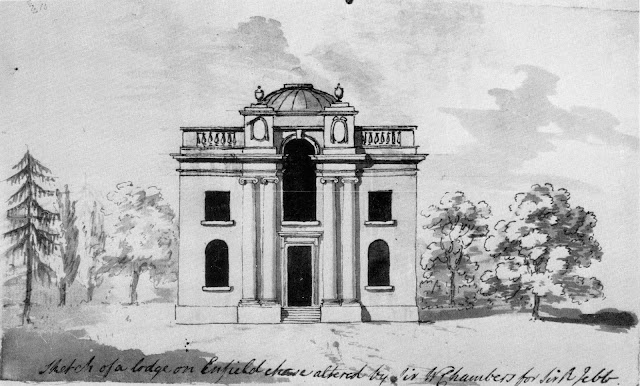 |
Trent Park: view of the villa designed by Sir William Chambers for Sir Richard Jebb by Willey Reveley, painted before 1783.
Image: Sir John Soane Museum Reveley Drawings vol. 31/21. |
Some accounts say that the property incorporated one of the three forest lodges of the former Enfield Chase. This was not the case but either there was some kind of pre-existing structure on the site, around which Jebb's friend Sir William Chambers designed 'a singular loggia in the Italian style', or Jebb started with a greenfield site and turned first to another architect, but abandoned the first house in favour of Chambers' grander scheme. The former seems more likely, but some support for the latter comes from the Gentleman's Magazine in 1787, which described the villa as 'more than once altered' and said it cost 'above £19,000'. Chambers' house, which existed by 1783 when it was drawn by Willey Reveley, was a small south-facing two-storey neo-classical villa, only some 30x40 ft. in size, but overpoweringly architectural: a giant order of coupled Ionic columns framed the entrance doorcase and a tall arched window above that extended into the attic, while a dome crowned the composition. The sale particulars for the sale after Sir Richard Jebb's death mention three 'neat bedrooms', a first-floor music room with a domed ceiling 'richly painted by Novasceilski', a study, and 'a handsome, well-proportioned dining room of oval form'. There wasn't room for everything in the block, and a library and billiard room as well as further bedrooms were placed in outbuildings, kept away from the house, as the architectural impact of the main block was not to be comprised by utilitarian additions. A small lake was formed in the valley north of the house, while a new approach drive with iron gates and twin lodges was laid out to Cockfosters on the western edge of the estate.
Phase II: the development of the house between 1793 and 1831.
Sir Richard Jebb died in 1787 and left instructions that Trent Place should be sold to pay his debts and legacies; despite his investment in the property the sale to the 4th Earl (later 1st Marquess) of Cholmondeley realised just £4,100. The first alterations to the Chambers villa are usually said to have been undertaken for John Wigston, who bought the property from Lord Cholmondeley in 1793 and enlarged the estate to some 500 acres, but when the house was advertised for sale in 1812 the sale notice (The Englishman, 7 June 1812) says the additions were designed by 'Mr Wyatt under the direction of the Earl of Cholmondeley'. On stylistic grounds it seems plausible that the 'Mr Wyatt' in question was Samuel Wyatt, although he is not known to have worked for the Earl elsewhere. Wigston was more certainly responsible for major landscaping works in the 1790s, including the enlargement of the lakes to their present size, but the identity of the designer involved is unknown.
 |
| Trent Park: detail of an engraving of the house from the north in 1808, from Dr Hughson's Description of London. |
The alterations to the house turned it from a villa into a mansion by the addition of wings to the east and west sides, and with the enlargement came a change of name, from Trent Place to Trent Park. A view of the north front in 1808 shows that the wings were of one and a half storeys, with three tall windows on the ground floor and (rather awkwardly) four small attic windows above. Inside, a suite of three lofty new principal rooms was created along the north front, which were said to have been 'superbly decorated at great expense' and to have statuary marble mantlepieces. There were now also fourteen bedrooms, numerous dressing rooms and a breakfast parlour. Further information comes from the 1812 sale notice, which says 'the entrance is by a handsome circular saloon, leading to an elegant suite of lofty apartments, with French windows, statuary marble chimneypieces and oak floors' consisting of a dining room (30x23 ft), a drawing room (32x25 ft) elegantly decorated with Arabesque paintings, and a library (30x23 ft).
In 1816 it was noted that the house had recently been stuccoed by John Cumming, and that he was carrying out 'very considerable improvements in the house and grounds' at that time. When the house was sold followed Cumming's death, the sale notice recorded that he had spent £35,000 on his improvements, which included building new rooms to the south of Chambers' facade, including a hall, dining room and 'gentlemen's room', adding an attic storey, and further improving the grounds. For the latter aspect of the work he engaged the services of a young Lewis Kennedy (1789-1877), whose illustrated proposals for the grounds survive in the collection of the Morton Arboretum near Chicago. Kennedy, who is known to have presented his schemes in a similar way to Humphry Repton, but often bound in blue morocco as opposed to the red favoured by Repton, emphasized the importance of the views from the house to the lake and proposed thinning out the firs that had been thickly planted in the pleasure grounds. He also proposed creating an American garden and laid out a lawn on the south front of the house and a new drive to the west, and some at least of these schemes were carried out.
Phase III: works for the Bevan family, 1837-1908
The estate was sold in 1833 to David Bevan (1774-1846), who according to family legend bought it unintentionally while nodding in his sleep at the auction, where he intended only to bid for some lots of wine! In 1836 he gave the estate, which now included a park of 800 acres and a wider estate of some 3,000 acres, as a wedding present to his eldest son, Robert Cooper Lee Bevan (1809-90), who at once commissioned the building of Christ Church, Cockfosters to the design of H.E. Kendall (his first cousin, once removed). During Bevan's long ownership of the estate the house was altered too, but unfortunately there is limited evidence about what was done when, or by whom. All that can be said is that by 1863 a short tower had been erected at the eastern end of the north front, and a new entrance, with a partially-glazed single-storey porch, formed in the east wall. The single-storey domed saloon with its curved bow frontage at the centre of the north elevation was also raised in height to match the rest of the facade, and given tall arched windows on the first floor. The architect was perhaps H.E. Kendall junior (1805-85), who was the son of the architect of Christ Church, Cockfosters, and thus Robert Bevan's second cousin.
 |
| Trent Park: the north front c.1890. |
 |
| Trent Park: the east front from the south-east c.1890 |
 |
Trent Park: the house and grounds in 1863
from the OS 6" 1st edition map. |
Further large-scale works were carried out in the 1890s for Francis Augustus Bevan (1840-1919), who had obtained a building grant of £10,000 from the Duchy of Lancaster for improvements to the house. He removed the early 19th century stucco from the house, exposing the purple brick of which it had been constructed, created a new basement-level service wing at the west end of the house, and altered the fenestration of the north front, replacing the original sash windows with casements.
 |
| Trent Park: the north front c.1903 (Image: Country Life). |
He made even greater changes to the south front, which in 1890 was a roughly balanced composition but highly irregular in detail. Dominating the composition and holding it together was a full-height curved bow in the centre, with a simple Ionic porch. To the left of this, the house was partly two-storey and partly three-storey. while to the right of it the house was two-storey and had four bays before a broad canted bay. Bevan's rebuilding of the elevation made it more symmetrical and uniformly three-storey. The curved central bow was replaced by a square projecting bay with a large projecting porch. The canted bay at the east end was retained but raised in height, and was balanced by a new square bay at the west end.
 |
| Trent Park: the irregular south front c.1890 |
 |
| Trent Park: the south front as remodelled in the 1890s, photographed c.1908. |
Phase IV: works for the Sassoon family, 1908-39, and the later history.
In 1908 F.A. Bevan gave the freehold of Trent Park to his son, Cosmo, and sold a lease of the house to Sir Edward Sassoon, after whose death in 1912 the estate passed to his son, the immensely rich politician, socialite and collector, Sir Philip Sassoon (1888-1939), 3rd bt., who also possessed a magnificent town house at 25 Park Lane and a country weekend retreat at Port Lympne (Kent). At first, Sassoon's attention was focused on Port Lympne, which was designed for him by Sir Herbert Baker in 1912-14 and enlarged by Philip Tilden after 1919. But in 1923 he was able to acquire the freehold of Trent Park from Cosmo Bevan and became willing to invest immense sums in the transformation of the house into the beau-idéal of a Georgian country house, suitable for entertaining the great and famous at weekend parties which have become legendary. His architect was again Philip Tilden, who refaced the exterior in red brick and stone, much of it purchased from the demolition of William Kent's Devonshire House in Piccadilly (in 1924) and reused here.
 |
| Trent Park: south front in c.2015. |
The south front was again altered and made symmetrical, with the replacement of the canted bay at the east end by a square bay matching that at the west end; the tower and side entrance on the east front were removed and a new regular six bay eastern front was created. A third floor was added to the north front, and all the windows were replaced with regular sash windows, while the central curved bow was taken down and replaced by a square projecting bay, mirrored by similar shallow wings at either end.
 |
| Trent Park: the north and east fronts in recent years. |
 |
| Trent Park: the drawing room in about 1930. |
Inside, the layout of the rooms remained largely unchanged (as it had done since the early 19th century), but they were completely redecorated in early Georgian style, with panelling supplied by Lenygon & Morant from 1925 onwards. A staircase from Devonshire House was imported and reused in place of the existing stair, and in the 1930s Rex Whistler - who also worked at Port Lympne - was asked to add decorative paintings, notably in the gentlemen's room at the east end of the south front. Nor was work confined to the house: Sassoon's friend Norah Lindsay was asked to remodel the garden layout, and a new orangery was built to the designs of Col. Reginald Cooper facing the new east front, as a setting in which lead sculptures of c.1700, acquired from Wrest Park (Beds), could be displayed. Further garden statues from the same source, and from Stowe (Bucks) were placed in the gardens, while in the further reaches of the park, Sassoon installed a tall column, an obelisk and a monument, also from Wrest.
The death of Sir Philip Sassoon in 1939 was symbolic of the end of the inter-war country house parties, and the future of the house was to be very different to its past. During the Second World War it was requisitioned by the Government and used to intern senior captured German and Italian officers who were kept under covert surveillance and whose private conversations provided extremely useful intelligence to the British government. After the war, the house was leased as a teacher training college, and in 1951 the house and immediately adjoining land was compulsorily purchased by Middlesex County Council, thereafter passing through the hands of several successor bodies until 2012, when it was sold by Middlesex University. To meet the needs of the educational institutions which occupied the property for some 70 years, the existing structures were extensively altered and repurposed, and many new buildings were erected in the grounds. In 2015, after a few years of uncertainty, the site was acquired by Berkeley Homes, which has demolished the college and university buildings, and is restoring the house to provide a museum and community facility, with flats on the upper floors, and extensive enabling development in the grounds. The wider estate passed on Sassoon's death to his cousin, Mrs Hannah Gubbay, and was acquired from her by the Greater London Council which opened the estate as Trent Country Park in 1973.
Descent: leased 1777 to Sir Richard Jebb (1729-87), 1st bt., physician; sold 1788 to George James Cholmondeley (1749-1827), 4th Earl and later 1st Marquess of Cholmondeley; sold 1793 to John Wigston (1763-1810) of Edmonton; sold 1810 to Sir Henry Lushington (1775-1863), 2nd bt.; sold 1813 to John Cumming (c.1757-1832), a Russia merchant; sold 1833 to David Bevan (1774-1846), who gave the estate in 1836 to his son, Robert Cooper Lee Bevan (1809-90); to son, Francis Augustus Bevan (1840-1919); sold freehold to Cosmo Bevan (1863-1935) and leasehold to Sir Edward Sassoon (1856-1912), 2nd bt.; to son, Sir Philip Sassoon (1888-1939), 3rd bt., who bought the freehold 1923; to cousin, Mrs Hannah Gubbay (d. 1968) but house was requisitioned for military use, 1939 and leased as teacher training college, 1946; compulsorily purchased by Middlesex County Council, 1951; transferred to London Borough of Enfield, 1965; transferred to Middlesex Polytechnic, 1974; transferred to Middlesex University, 1992; sold 2012 to Malaysian University; sold 2015 to Berkeley Homes (NE Division). The wider estate passed to Greater London Council in 1965 and 1968 and became Trent Country Park in 1973.
Bevan family of Fosbury and Trent Park
 |
| Silvanus Bevan (1661-1725) |
Bevan, Silvanus (1661-1725). Fourth, but second surviving, son of William Bevan (c.1627-1701) of Swansea (Glam.), a Quaker who was imprisoned for his religious beliefs in 1658, and his wife Priscilla, born at Swansea, 9 August 1661. Merchant trading in corn, timber and other goods at Swansea, and a burgess of the town. He also acted as a rent collector for the Duke of Beaufort, who was a large landowner in the district, and in partnership with the duke's agent, Gabriel Powell, he rented a wharf and experimented in copper smelting with the assistance of his son-in-law, James Griffiths, who was one of the originators of copper-smelting in the area. He married, 14 February 1685/6, Jane (1664-1727), daughter of William Phillips, a Swansea Quaker, and had issue:(1) William Bevan (1687-1745), baptised at St Mary, Swansea, 15 February 1686/7; married, 14 July 1709 at Bristol Monthly Meeting, Martha, daughter of Samuel Gibbons of Bristol, and had issue at least one son; buried in Quaker Burial Ground, Bristol, October 1745;
(2) Hester Bevan (1688-1745), baptised at St Thomas, Swansea, 3 December 1688; married James Griffiths (d. 1763), copper smelter, who rented a manor house on the Strand, Swansea, and had issue three sons; buried at St Mary, Swansea, 25 June 1745;
(3) Priscilla Bevan (1690-1781), baptised at St Mary, Swansea, 18 May 1690; married Thomas Inman, died aged 91 without issue on 30 April and was buried at St Mary, Swansea, 6 May 1781;
(4) Silvanus Bevan (1691-1765), born 28 October and baptised at St Mary, Swansea, 6 February 1691/2; moved to London and was apprenticed to Thomas Mayleigh, apothecary in 1708; gaining his freedom in 1715 he established the Plough Court Pharmacy, Lombard St., London, from which the large later firm of Allen & Hanbury derived; he later practised physic at Hackney (Middx), and with his brother Timothy played a considerable part in establishing the first hospital in Philadelphia (USA); elected a Fellow of the Royal Society, 1725 and a member of the Hon. Society of Cymmrodorion, 1762; as a widower in retirement he developed a belated dilettante interest in antiquities, and became a collector of fossils, curios, books, paintings, etc.; an amateur carver in wood and ivory; and a keen gardener; he married 1st, 9 November 1715 at the Friends Meeting House, Gracechurch St., London, Elizabeth (1690-1716), daughter of Daniel Quare (1648-1724), the famous clockmaker, and 2nd, 30 August 1719 at the Quaker Monthly Meeting in the Savoy, London, Martha (1691-1757), daughter of Gilbert Heathcote (1664-1719) of Culthorpe (Derbys), physician to King William III, but had no surviving issue; died at Hackney, 5 June 1765 and was buried at Bunhill Fields; will proved 14 June 1765;
(5) Aquila Bevan (1693-1727), baptised at St Thomas, Swansea, 11 June 1693; tobacconist in Bristol; attended his elder brother's wedding in London, 1715; married, 10 December 1717 at St Mary Redcliffe, Bristol, Sarah (1701-56?), daughter of Francis Roach, and had issue at least one son (who died young); his death aged 34 on 22 June 1727 was recorded in the records of the Southwark and Horselydown (Surrey) Monthly Meeting; will proved in the PCC, 22 July 1727;
(6) Mary Bevan (1698-1784); married at the London & Middlesex Quarterly Meeting at the Bull & Mouth Tavern, London, 20 October 1726, William Padley (1691-1763) of Swansea and Southwark (Surrey), timber merchant and alderman of Swansea, and had issue five sons and three daughters; died 11 December 1784 and was buried in the Quaker Burial Ground at Swansea;
(7) Elizabeth Bevan (1700-67); married James Cornock (b. 1697), and had issue at least one daughter; said to have died in 1767;
(8) Susannah Bevan (1701-84); in middle life moved to Hackney (Middx) to be near her brother and occupied herself with charitable work; died unmarried, 29 February 1784 and was buried at Bunhill Fields;
(9) Rebecca Bevan (c.1704-80), youngest daughter; married, 27 October 1737 at Holy Trinity, Exeter, Robert Phillips of Plymouth, surgeon, and had issue at least one son; died 1 December and was buried in the Quaker Burial Ground, Plymouth, 7 December 1780; will proved 27 January 1781;
(10) Timothy Bevan (1704-86) (q.v.);
(11) Paul Bevan (1706-67); merchant in Swansea; married, 9 June 1754 at Quaker Meeting House, Swansea, Elizabeth Phillips (c.1724-76) and had issue two sons and two daughters; buried in Quaker Burial Ground, Swansea, 16 January 1767; will proved in the PCC, 30 July 1767.
He lived in Swansea (Glam.), and owned property at Penclawdd Llanrhidian, and elsewhere in Wales.
He died 4 December 1725. His widow died 14 November 1727; her will was proved 22 January 1727/8.
Bevan, Timothy (1704-86). Fourth son of Silvanus Bevan (1661-1725) and his wife Jane Phillips, born in Swansea, 7 July 1704. He is said to have trained as an apothecary 'in the country' and moved to London in 1725 to join his brother Silvanus (1691-1765) in the management of the Plough Court Pharmacy. He was made free of the Worshipful Company of Apothecaries, 6 April 1731, and eventually took over the business. He married 1st, 9 October 1735 at the Quaker Quarterly Meeting at the Bull and Mouth Tavern, London, Elizabeth (1714-45), daughter of David Barclay (1682-1769) of Cheapside, London, linen draper, and 2nd, 12 April 1752 at Quaker Monthly Meeting in Norwich, Hannah (1714-84), daughter of John Gurney and widow of Nathaniel Springall, and had issue (with two other sons, both named Silvanus, who died in infancy): (1.1) Priscilla Bevan (1737-72), born 11 December 1737; married, 18 May 1757 at Quaker Quarterly Meeting, Devonshire House, London, as his third wife, Edmund Gurney (1723-96), but had no issue; died 1772 and was buried at Norwich;
(1.2) Silvanus Bevan (1743-1830) (q.v.);
(1.3) Timothy Paul Bevan (1744-73), born 13 November 1744; pharmacist who became a partner in his father's business; married Amelia Moseley (1747-1830) (who m2, 30 September 1774 at St Saviour, Southwark (Surrey), John Perkins (1730-1812), brewer and eventually partner in the Anchor Brewery, and had issue four sons), but had no issue; died 18 April and was buried at Bunhill Fields, 23 April 1773; will proved in the PCC, 28 April 1773;
(2.1) Joseph Gurney Bevan (1753-1814), born 18 February 1753; joined the Plough Court Pharmacy in 1773, became a partner in 1776, and took over the management of the business on his father's retirement; in 1794 he retired from business and moved to Stoke Newington (Middx), after which the business passed into the hands of his friend and assistant, William Allen; he became a writer on Quakerism regarded as the ablest of the apologists for that sect, and published extensively in magazines and pamphlets in the first decade of the 19th century; he married, 27 August 1776, Mary Plumstead (1751-1813), but had no issue; both he and his wife became severely disabled by illness in later life; he died 12 September 1814 and was buried at Bunhill Fields; will proved in the PCC, 22 October 1814.
He lived in Plough Court, Lombard St., London.
He died 12 June and was buried at Bunhill Fields, London, 18 June 1786; his will was proved in the PCC, 30 June 1786. His first wife died at Hackney, 30 August 1745. His second wife died 28 May 1784.
 |
Portrait, believed to be of Silvanus Bevan,
by John Opie (Image: Paul Mellon Colln) |
Bevan, Silvanus (1743-1830). Elder surviving son of Timothy Bevan (1704-86) of Swansea (Glam.) and his wife Elizabeth (1714-45), daughter of David Barclay of Cheapside, London, linen draper, born in Plough Court, Lombard St., London, 3 August 1743. Educated privately by the Quaker Robert Proud (1728-1813). Banker in partnership with his uncle, James Barclay, in a firm known as Barclay, Bevan & Co. and later by other names as additional partners joined the business and retired, but which was the principal progenitor of the modern Barclays Bank. He was also a sleeping partner in the major London brewery firm, Barclay, Perkins & Co., of Anchor Brewery, Southwark, which he helped to finance. He was brought up a Quaker but after his second marriage he was expelled from the Society of Friends for marrying a non-Quaker. His portrait was painted by Johann Zoffany and probably also by John Opie. He married 1st, 4 October 1769 at the Westminster Monthly Meeting of the Society of Friends, Isabella (1752-69), daughter of Edward Wakefield and 2nd, 23 September 1773 at St Giles-in-the-Fields, Holborn (Middx), Louisa (1748-1838), daughter of Henry Kendall, banker, and had issue:(2.1) David Bevan (1774-1846) (q.v.);
(2.2) Henry Bevan (1776-1860), born 4 November and baptised at St Botolph, Bishopsgate, London, 4 December 1776; banker; purchased Cambridge Park (aka Twickenham Meadows), Twickenham, about 1835 and remodelled it to the designs of Lewis Vulliamy; married, 26 April 1802 at St Marylebone (Middx), Harriet (d. 1852), daughter of Simon Droz of London, and had issue two daughters; died 11 September and was buried at Kensal Green Cemetery, 18 September 1860; will proved 15 November 1860 (estate under £400,000); (2.3) Rev. Frederick Stephen Bevan (1779-1859), born 11 October 1779 and baptised at St Edmund King and Martyr, Lombard St., London, 25 February 1780; educated at Lincolns Inn (admitted 1799) and Emmanuel College, Cambridge (matriculated 1799; BA 1803; MA 1807); ordained deacon, 1807 and priest, 1809; stipendiary curate of Easton (Norfk), 1813-21; rector of Carleton Rode (Norfk), 1821-59; rural dean of Depwade, 1842; honorary canon of Norwich Cathedral, 1848-59; married, 17 March 1806 at St George, Hanover Sq., Westminster (Middx), Anne Elizabeth (c.1782-1848), daughter of Sir Robert John Buxton (1753-1839), 1st bt., of Shadwell Court (Norfk), but had no issue; died 26 September 1859; will proved 2 November 1859 (effects under £60,000);
(2.4) Charles Bevan (1781-1832), born 5 March and baptised at St Edmund, King and Martyr, Lombard St., London, 28 March 1781; shareholder in Barclay Perkins & Co., brewers; married, 14 June 1808 at St Marylebone (Middx), Mary Beckford (1789-1854), daughter of James Johnstone (d. 1815), Jamaican plantation owner, and had issue five sons and two daughters; died 13 May and was buried at St Mary, Paddington (Middx), 21 May 1832; will proved in the PCC, 7 June 1832 (estate under £120,000);
(2.5) Rev. George Bevan (1782-1819), born 22 September 1782; educated at Lincoln's Inn (admitted 1805) and Trinity College, Cambridge (matriculated 1809; BA 1813); articled clerk to James Pearson of London, attorney, but evidently did not complete his articles and retrained as a clergyman; ordained deacon, 1813; married, 22 September 1816 at St Mary, Taunton (Som.), Anne (d. 1831), daughter of Andrew Buchanan of Glasgow, and had issue one son and one daughter; died 12 December and was buried at St John, Hampstead (Middx), 20 December 1819;
(2.6) Robert Bevan (1784-1854), of Rougham Rookery (Suffk), born 5 May and baptised at St George, Hanover Sq., Westminster (Middx), 10 June 1784; educated at Trinity College, Cambridge (matriculated 1806; BA 1811); partner in Oakes & Co. of Bury St Edmunds, bankers; married, 10 April 1810 at St Margaret, Kings Lynn (Norfk), Mary Peele (d. 1853), daughter of Rev. William Taylor, rector of Swanton Morley (Norfk), and had issue three sons and six daughters; died 16 January 1854 and was buried at Rougham; will proved in the PCC, 14 March 1854;
(2.7) Richard Bevan (1788-1870), of Highcliff Lodge, Brighton (Sussex), born 22 August and baptised at Swallowfield (Berks), 26 September 1788; educated at Harrow and Trinity College, Cambridge (matriculated 1807; BA 1814); banker; married 1st, 30 August 1823 at Holy Trinity, Clapham (Surrey), Charlotte (d. 1835), daughter of Col. Richard Hunter, and had issue one son and four daughters; married 2nd, 15 July 1836 at Holy Trinity, Clapham, Sarah (d. 1882), daughter of Robert Cuming Dewar of Clapham (Surrey), but had no further issue; died 4 February 1870; will proved 9 March 1870 (effects under £35,000).
He bought Swallowfield Park (Berks) for about £20,000 in 1783 but sold it in 1789 on buying the Riddlesworth Hall (Norfk) estate where he rebuilt the house and laid out the grounds. In 1810 he bought and rebuilt Fosbury House (Wilts) and in 1814 he sold the Riddlesworth estate. He also had a town house at 31 Gloucester Place, London, and a seaside house at 127 Marine Parade, Brighton (Sussex).
He died 25 January 1830 and was buried at St Nicholas, Brighton (Sussex); his will was proved in the PCC, 18 February 1830 (estate under £350,000). His first wife died of a fever after just seven months of marriage, 17 November 1769. His widow died aged 90 on 16 December 1838; her will was proved in the PCC, 16 March 1839.
 |
| David Bevan (1774-1846) |
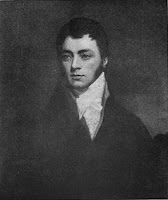
Bevan, David (1774-1846). Eldest son of Silvanus Bevan (1743-1830) and his second wife, Louisa Kendall, born 6 November and baptised at St Botolph, Bishopsgate, 13 December 1774. Educated at Winchester College and joined the family bank in 1791. Banker in London; partner in Barclay, Bevan & Co, but had to withdraw from the business after a stroke in 1826, being succeeded as a partner by his eldest son. He married, 7 May 1798 at St Marylebone (Middx), Favell Bourke (1780-1841), daughter of Robert Cooper Lee (1735-94) of London and Rosehall (Jamaica), and had issue:(1) Louisa Priscilla Bevan (1800-83), born 21 December 1800 and baptised at St George, Bloomsbury, 7 May 1801; a beauty, who retained striking looks into old age; she married, 20 June 1825 at St Marylebone (Middx), Augustus Henry Bosanquet (1792-1877), West India merchant, of Osidge House, Cockfosters (Middx), second son of William Bosanquet (1753-1800) of London, and had issue six sons and four daughters; died 11 April 1883 and was buried at Willesden (Middx), but is also commemorated by a plaque at Cockfosters and a monument at Little Berkhamsted (Herts);
(2) Favell Lee Bevan (1802-78), born 14 July 1802 and baptised at St George, Bloomsbury, 1 June 1803; an evangelical Christian who took responsibility for the education of children on her father's estates and became a popular and influential writer of reading aids and educational and religious works such as The Peep of Day* (1833), More about Jesus (1839), Asia and Australia Described (1849), Reading without tears (1857), and Latin without tears (1877); many of her works are now regarded as openly racist and 'venomous in tone', while her concern to imprint on young minds the eternal consequences of wrongdoing has been described as 'outspokenly sadistic'; as a young woman she was a friend of Cardinal Henry Manning (before his conversion to Rome); she married, 29 April 1841 at Casterton (Westmld.), Rev. Dr. Thomas Mortimer BD (1795-1850) but had no issue, although they adopted a young man, later Rev. Lethbridge Moore, vicar of Sheringham (Norfk); died at West Runton (Norfk), 22 August 1878 and was buried at Upper Sheringham; will proved 29 October 1878 (estate under £25,000);
(3) Frederica Emma Bevan (1803-86), born 24 November 1803 and baptised at St George, Bloomsbury, 29 June 1804; married 1 February 1834 at Holy Trinity, St. Marylebone, Ernest Augustus Edmund Henry Stephenson (1802-55), company director, but had no issue; died 23 September and was buried at Christ Church, Folkestone (Kent), 27 September 1886; will proved 6 November 1886 (estate £4,274);
(4) Robert Cooper Lee Bevan (1809-90) (q.v.);
(5) Richard Lee Bevan (1811-1900), born 15 May and baptised at Walthamstow (Essex), 12 November 1811; educated at Harrow; banker; a partner in Barclay, Bevan & Co.; JP for Northants; leased Brixworth Hall (Northants), 1855-99 and hunted with the Pytchley Hunt, of which he became the oldest member; married, 10 September 1840 at Passenham (Northants), Isabella Judith Maria (1820-85), daughter of Rev. Loraine Loraine-Smith of Enderby Hall (Leics), rector of Passenham, and had issue five sons and four daughters; died 12 February and was buried at Brixworth, 15 February 1900; will proved 10 March 1900 (estate £59,583);
(6) Rev. David Barclay Bevan (1813-98), of Courtlands, Tunbridge Wells (Kent), born 9 March and baptised at Walthamstow, 8 July 1813; educated at Eton, University College, Oxford (matriculated 1831) and Magdalen Hall, Oxford (BA 1836; MA 1838); ordained deacon, 1837 and priest, 1838; rector of Burton Latimer (Northants), 1843-57; vicar of Luton (Beds), 1857-62; vicar of Little Amwell (Herts), 1864-98; married 1st, 27 June 1837 at Casterton (Westmld.), Agnes (1818-55), daughter of Rev. William Carus-Wilson (1791-1859), rector of Whittington (Lancs), and had issue one son and five daughters; married 2nd, 16 April 1857 in the British Embassy at Paris, Catherine Emilia (c.1827-59), daughter of Rev. Mourant Brock, vicar of Christ Church, Clifton (Glos), and had further issue one daughter; married 3rd, 23 October 1860 at Deal (Kent), Rachel O'Brien (1830-63), daughter of Josiah Nisbet, and had further issue one son (who died in infancy) and one daughter; married 4th, 5 July 1866 at All Souls, Langham Place, St Marylebone (Middx), Annis Isabel (1836-81), daughter of John Wood of Thedden Grange (Hants), and had further issue two sons and one daughter; died 31 January 1898; will proved 29 April 1898 (effects £23,919);
(7) Frances Lee Bevan (1819-1903), born 5 April 1819; married, 13 July 1841 at Holy Trinity, St. Marylebone, Vice-Adm. William Robert Morier (1790-1864), son of Isaac Morier (1750-1817) and had issue three sons and two daughters; died 20 March 1903; will proved 11 June 1903 (estate £11,926).
He lived at Hale End, Walthamstow (Essex) from c.1808-22 and then bought Belmont, East Barnet (Middx), where he lived from 1826. He inherited Fosbury House from his father in 1830, but in 1837 he and his son and brothers obtained a private Act of Parliament to sell the Fosbury estate and buy other lands instead, but this does not seem to have happened. He purchased Trent Park (MIddx) in 1833, which he gave to his eldest son as a wedding present in 1836.
He died from injuries sustained in a fire at his home, 24 December 1846 and was buried at Cockfosters; his will was proved in the PCC, 11 January 1847 (estate under £250,000). His wife died 25 August 1841 and was also buried at Cockfosters.
* The Peep of Day remained in print throughout the 19th century; the first edition alone sold more than half a million copies, and it was translated in 37 languages by Religious Tract Society.
.jpg) |
Robert Cooper Lee Bevan
(1809-90) |
Bevan, Robert Cooper Lee (1809-90). Eldest son of David Bevan (1774-1846) and his wife Favell Bourke, daughter of Robert Cooper Lee of London and Rosehall (Jamaica), born 8 February and baptised at Walthamstow (Essex), 15 July 1809. Educated at Harrow and Trinity College, Oxford (matriculated 1826), but was obliged to leave early to take his father's place as a partner in the family bank; he eventually became the senior partner in Barclay, Bevan, Tritton, Ransom, Bouverie & Co. JP for Middlesex. He underwent an evangelical Christian conversion in the 1830s, gave up his favourite sport of hunting on moral grounds, and was said to live a sober, righteous and godly life, in which he was supported by his two wives, the latter of whom eventually joined the Plymouth Brethren. He was one of the founders of the London City and Brighton Town Missions, as well as the founder and builder of Christ Church, Cockfosters (Middx) and Fosbury church (Wilts), and he organised daily prayer meetings in Barclays' head office. He became a freeman of the city of London as a member of the Spectacle-makers Company, 1847. He married 1st, 24 February 1836 at Wimpole (Cambs), Lady Agneta Elizabeth (1811-51), daughter of Vice-Adm. Sir Joseph Sydney Yorke KCB (1768-1831) and sister of Charles Philip Yorke (1799-1873), 4th Earl of Hardwicke, and 2nd, 30 April 1856 at Totteridge (Middx), Emma Frances (1827-1909), daughter of Rt. Rev. Philip Nicholas Shuttleworth, bishop of Chichester 1840-42, and had issue:(1.1) Sydney Yorke Bevan (1838-1901), born 6 October 1838 and baptised at Christ Church, Cockfosters, 21 April 1839; did not inherit his father's banking interests, but was left £3,000 a year for life instead; composer of church music, organist and chorister; lived latterly at Tunbridge Wells (Kent); died unmarried, 22 June 1901, and was buried at Cockfosters; will proved 16 July 1901 (estate £18,125);
(1.2) Francis Augustus Bevan (1840-1919) (q.v.);
(1.3) Lucy Agneta Bevan (1841-45), baptised at Cockfosters, 29 October 1841; died young, 7 September 1845;
(1.4) Alice Lee Bevan (1843-1923), baptised at Cockfosters, 23 April 1843; married, 3 May 1867 at All Saints, Ennismore Gardens, Kensington (Middx), Col. William Butler Gosset RE (1836-1906), eldest son of Sir Ralph Allen Gosset (1809-85), serjeant-at-arms of the House of Commons, 1875-85, and had issue three sons and two daughters; lived latterly at Folkestone (Kent); died 28 January and was buried at Brompton Cemetery (Middx), 1 February 1923; will proved 27 February 1923 (estate £927);
(1.5) Wilfrid Arthur Bevan (1845-1905), born 21 October and baptised at St George, Bloomsbury (Middx), 9 December 1845; educated at Harrow; banker and a director of Barclays Bank; married, 11 May 1869 at St Margaret, Westminster (Middx), Mary Elizabeth (1849-1938), daughter of Frederick Green of London, ship broker, and had issue six daughters; died 1 May and was buried at Brompton Cemetery, 5 May 1905; will proved 3 June 1905 (estate £275,186);
(1.6) Roland Yorke Bevan (1848-1923), born 30 September and baptised at Cockfosters, 29 October 1848; educated at Harrow and Trinity College, Cambridge (matriculated 1866); in about 1873 he undertook a tour across America and then across the Pacific to China and Japan; banker and director of several companies (the Railway Passengers Assurance Co., the Iowa Land Co. and the Commercial Gas Co.); a freemason; married, 7 January 1874 at St Martin-in-the-Fields, Westminster, Hon. Agneta Elizabeth Kinnaird (1850-1940), daughter of Arthur FitzGerald Kinnaird (1814-87), 10th Baron Kinnaird, and had issue two daughters; died at Hyères (France), 19 February 1923; will proved 14 April 1923 (estate £42,230);
(1.7) Edith Agneta Bevan (1850-1929), born 12 February and baptised at Cockfosters, 19 May 1850; married, 9 January 1873 at All Saints, Ennismore Gardens, Knightsbridge (Middx), William Middleton Campbell (1849-1919) of Colgrain (Dumbartons.), son of Colin Campbell, and had issue four sons and one daughter; died 14 April 1929; will proved 9 June 1929 (estate £13,101);
(2.1) Ada Frances Bevan (1857-61), born 15 June 1857; died young, 24 March 1861;
(2.2) Anthony Ashley Bevan (1859-1933), born 19 May 1859; educated at Literary Gymnasium, Lausanne (Switzerland), Strasbourg University (France), where he attended the lectures of Edouard Reuss; and Trinity College, Cambridge (matriculated 1884; BA 1887; Tyrwhitt Hebrew Scholar, 1888; MA 1891); Fellow of Trinity College, Cambridge from 1890; Lord Almoner's Professor of Arabic, Cambridge, 1893-1933; one of the greatest Oriental scholars of his day, he was the author of several academic works and translations, and was elected a Fellow of the British Academy, 1916; he died unmarried while on a solitary visit to Stapleford church (Cambs), 16 October 1933; his will was proved 25 November 1933 (estate £135,242), by which he was a benefactor to his college and several university institutions;
(2.3) Hubert Lee Bevan (1860-1939), born 9 October 1860; educated at Pembroke College, Cambridge (matriculated 1880); married, 18 January 1888 at Brussels (Belgium), Isabella Bessie Eleonora (1865-1942), daughter of Henri Wieniawski, and had issue two daughters; died after a long illness, 29 November and was buried at Brompton Cemetery (Middx), 4 December 1939; will proved 29 March 1940 (estate £5,865);
(2.4) Millicent Ada Bevan (1862-1946), born 5 January and baptised at Cockfosters, 16 July 1862; married, 10 June 1897, at All Saints, Ennismore Gardens, Knightsbridge (Middx), Reginald Hart Dyke (1852-1943), solicitor, son of Sir Percyvall Hart Dyke (1799-1875), 6th bt., and had issue one son; died 7 August 1946; will proved 2 January 1947 (estate £9,535);
(2.5) Gladys Mary Bevan (1864-1947), born 4 December 1864 and baptised at Cockfosters, 4 June 1865; author of Portraits of the Archbishops of Canterbury (1908); disabled by an accident and died unmarried, 15 October 1947; will proved 30 January 1948 (estate £18,085);
(2.6) Gwendolen Bevan (1865-1937), born 11 November 1865 and baptised at Cockfosters, 12 August 1866; married 1st, 4 March 1884 at Cannes (France), Hon. Ion Grant Neville Keith-Falconer (1856-87), third son of Francis Alexander Keith-Falconer (1828-80), 8th Earl of Kintore but had no issue; married 2nd, 15 December 1894 at Simla, Bengal (India), Lt-Col. Frederick Ewart Bradshaw DSO (1865-1958), and had issue two daughters; died 24 October 1937; will proved 13 January 1938 (estate £14,004);
(2.7) Edwyn Robert Bevan (1870-1943), born 15 February and baptised at All Saints, Ennismore Gardens, Knightsbridge, 4 May 1870; educated at Monkton Combe School and New College, Oxford (matriculated 1888; BA 1892; MA 1900; Honorary Fellow); philosopher and historian, who was the author of numerous works in these fields; lecturer in Hellenistic history at Kings College, London; served in First World War in Political Intelligence department of Foreign Office (OBE, 1920); awarded honorary degrees by Universities of Oxford (DLitt, 1923) and St. Andrews (LLD, 1922); married, 25 April 1896 at St Mary Abbotts, Kensington (Middx), Hon. Mary Waldegrave (1871-1935), fifth daughter of Granville Waldegrave (1833-1913), 3rd Baron Radstock, and had issue two daughters; died 18 October and was buried at Buckland (Surrey), 20 October 1943; will proved 13 April 1944 (estate £64,437);
(2.8) Enid Bertha Bevan (1872-1954), born 5 April and baptised at Holy Trinity, Brompton (Middx), 13 May 1872; married, 28 July 1892 at St Matthew, Bayswater (Middx), Harry Filmer Sulivan (1866-1954), of The Hermitage, Melton (Suffk), second son of Rev. Filmer Sulivan, and had issue two daughters; died 13 June 1954; will proved 8 September 1954 (estate £1,257);
(2.9) Nesta Helen Bevan (1876-1960), born 24 August 1876; educated at Westfield College, London; as a young woman she travelled extensively, making two round-the-world tours and visiting particularly India, Burma, Singapore and Japan; after her marriage she became a writer and conspiracy theorist whose views were anti-semitic, anti-German, anti-Bolshevik and pro-Fascist; her absurd claims of secret societies promoting anarchy from the French to the Russian revolutions regrettably had some influence; she was 'a lasting example of the fact that the most extreme and unreal views, even when naïvely expressed, can find a ready response in those political areas that thrive on the myth of a world plot’; she married, 14 May 1904 at St Saviour, Chelsea (Middx), Arthur Templer Webster (1865-1942), Superintendent of Police in India, son of Henry Binney Webster, and had issue two daughters; died 7 May 1960.
He was given the Trent Park estate on his marriage in 1836 and inherited Fosbury Manor from his father in 1846. He also had town houses in London and Brighton, and in later years, a villa at Cannes (France).
He died 22 July 1890; his will was proved 18 August 1890 (estate £953,382). His first wife died 8 July 1851. His widow died at Cannes (France), 15 March 1909; her will was proved 26 May 1909 (estate £17,001).
 |
| Francis Augustus Bevan (1840-1919) |
Bevan, Francis Augustus (1840-1919). Second son of Robert Cooper Lee Bevan (1809-90) and his first wife, Lady Agneta Elizabeth, daughter of Vice-Adm. Sir Joseph Sydney Yorke KCB and sister of Charles Philip Yorke, 4th Earl of Hardwicke, born 17 January and baptised at Christ Church, Cockfosters, 15 March 1840. Educated at Harrow, 1854-56. He was admittted as a partner in the Lombard Street banking house of Barclay, Bevan, Tritton, Ransom, Bouverie & Co. in 1859, and eventually became the senior partner; after the merger of this firm with 19 others to form Barclays Bank Ltd., he became the first chairman, 1896-1916. JP for Middlesex; High Sheriff of Middlesex, 1899; one of HM Lieutenants for the city of London. He was an evangelical Christian and an active supporter of charitable and missionary work, especially in London, and was Chairman of the London City Mission and a Knight of Grace of the Order of St. John. He married 1st, 22 July 1862 at Woburn (Beds), Elizabeth Marianne (1840-63), third daughter of Lt-Col. Lord Charles James Fox Russell (1807-94), MP for Bedfordshire and later Serjeant-at-Arms of the House of Commons; 2nd, 19 April 1866 at St Martin-in-the-Fields, Westminster (Middx), Constance (1841-72), youngest daughter of Rt. Hon. Sir James Weir Hogg (1790-1876), 1st bt., MP for Honiton and Chairman of the East India Company; and 3rd, 1 July 1875 at St Mary, Bryanston Sq., Marylebone (Middx), Maria (1841-1903), daughter of John Trotter (1809-70) of Dyrham Park (Middx), and had issue:(1.1) Cosmo Bevan (1863-1931) (q.v.);
(2.1) Bertrand Yorke Bevan (1867-1948) (q.v.);
(2.2) Rev. Raymond Francis Bevan (1868-1940), born 26 June 1868; educated at Eton and Trinity College, Cambridge (matriculated 1887; BA 1890; MA 1894); ordained deacon, 1892 and priest, 1893; perpetual curate of Whittlebury with Silverstone (Northants), 1897-1903; vicar of Bottisham (Cambs), 1903-07; vicar of St Lawrence, Thanet (Kent), 1907-21; public preacher in diocese of St Albans from 1925; a member of the Alpine Club, 1890-1924; lived latterly at Kingsbury Lodge, St. Albans (Herts); married, 10 January 1893 at Christ Church, Clifton (Glos), Margaret Alda (1867-1949), youngest daughter of Rev. Horace Meyer, vicar of Christ Church, Clifton, and had issue one son and two daughters; died 25 November 1940; will proved 24 February 1941 (estate £28,864);
(2.3) Gerard Lee Bevan (1869-1936), born 9 November 1869; educated at Eton and Trinity College, Cambridge (MA); stockbroker and chairman of the City Equitable Fire Insurance Co., which collapsed spectacularly in 1922 with liabilities of more than £4m, leading him to be charged with fraud; he fled the country but was discovered living in exile under a false name and in disguise in Vienna (Austria) a few months later; when captured he resisted arrest and then attempted suicide but was revived and convicted; he was released from prison in 1927 and subsequently lived in France and Cuba, where he became the manager of a distillery company; after his release he also published a volume of poems; he married 1st, 3 October 1893 at All Saints, Ennismore Gardens, Kensington (Middx) (div. on grounds of his desertion and misconduct, 1923), Sophie (1867-1941), daughter of John Arthur Kenrick (1829-1926), manufacturer, of Berrow Court, Edgbaston, Birmingham, and had issue two daughters; and 2nd, 10 April 1928 in Paris (France), (Jeanne) Marie Loetitia Pertuiset (b. 1884), who had accompanied him when he fled England in 1922; he died in Havana (Cuba), 24 April 1936, and was buried there;
(2.4) Owen Charles Bevan (1870-1950), born 30 October and baptised at Holy Trinity, Brompton (Middx), 26 November 1870; educated at Eton; stockbroker; senior partner in Pember & Boyle, stockbrokers; served in First World War with Royal Artillery (Lt., 1914; Capt., 1917; retired as Maj., 1919; awarded MC); lived at Nutfield (Surrey); married, 12 April 1894 at St George, Hanover Sq., Westminster (Middx), Mary Frances Merelina (1871-1958), eldest daughter of Theodore Bosanquet of West Down House, and had issue one son (from whom descended Sir Timothy Bevan, chairman of Barclays Bank Ltd. in the 1980s) and two daughters; died 28 May 1950; will proved 9 October 1950 (estate £97,193);
(2.5) Ivor Bevan (1872-1941), born 15 April and baptised at Holy Trinity, Brompton, 13 May 1872; educated at Eton; general merchant; married 1st, 14 July 1896 at All Saints, Ennismore Gardens, Kensington (div. 1921), Ethel Jean OBE (1876-1941), daughter of Sir Algernon Charles Plumptre Coote (1847-1920), 12th bt., of Ballyfin (Co. Leix), and 2nd, 30 January 1926 at Tabernacle Presbyterian Church, Philadelphia (USA), Ariana Riddle (1898-1991), daughter of Thomas B. Kennedy of Philadelphia, but had no issue; said to have died December 1941;
(3.1) Leonard Francis Bevan (1876-1901), born 6 April and baptised at Holy Trinity, Brompton (Middx), 11 May 1876; committed suicide, 13 October 1901; will proved 23 November 1901 (estate £1,284);
(3.2) Evelyn Agneta Bevan (1877-1963), born 10 July and baptised at Cockfosters (Middx), 9 September 1877; married 28 April 1903 at Holy Trinity, Brompton (Middx), Philip Ridsdale Warren OBE MICE (1874-1933), civil engineer, only son of Rev. William Warren, vicar of Cockfosters (Middx), but had no issue; as a widow lived at Crondall (Surrey); died 3 February 1963; will proved 18 March 1963 (estate £43,001);
(3.3) Audrey Nona Bevan (1878-1944), born 23 September 1878; author of A history of the Bevan family, (1924); married, 8 October 1901 at Christ Church, Cockfosters, Brig-Gen. Richard Narrien Gamble CB DSO (1860-1937), eldest son of Lt-Gen. Dominic Jacotin Gamble CB (1823-87), but had no issue; died 30 May 1944; will proved 1 August 1944 (estate £15,627);
(3.4) Gytha Constance Bevan (1879-1957), born 19 August 1879; married, 20 October 1903 at Holy Trinity, Brompton, Lionel Offley Micklem (1873-1952), eldest son of Leonard Micklem of Norrysbury, New Barnet, and had issue one son and one daughter; died 14 July and was buried at Holy Trinity, Brompton, 22 July 1957; will proved 13 March 1958 (estate £28,831).
He inherited Fosbury Manor and Trent Park from his father in 1890, and undertook an extensive remodelling of the house at Trent Park in the 1890s. He sold Fosbury c.1902. In 1908 he gave the freehold of Trent Park to his son Cosmo, and sold a lease to Sir Edward Sassoon.
He died at Eastbourne (Sussex), 31 August 1919 and was buried at Christ Church, Cockfosters; his will was proved 17 December 1919 (estate £410,879). His first wife died after childbirth, 8 June 1863, and was buried at Cockfosters. His second wife died 15 October 1872 and was buried at Cockfosters. His third wife died 20 November 1903 and was also buried at Cockfosters; her will was proved 11 January 1904 (estate £2,812).
 |
| Cosmo Bevan (1863-1935) |
Bevan, Cosmo (1863-1935). Only child of Francis Augustus Bevan (1840-1919) and his first wife, Elizabeth Marianne, third daughter of Lord Charles James Fox Russell, born 26 May and baptised at Cockfosters, 28 August 1863. Educated at Eton. Banker; a director of Barclays Bank Ltd from 1905. He married, 5 February 1891 at St Matthew, Bayswater (Middx), Marion Leila (1868-1947), youngest daughter of Rev. John Filmer Sulivan, and had issue:(1) Desmond Russell Bevan (1892-1931), born 27 February and baptised at St Matthew, Bayswater, 29 May 1892; educated at Eton; married, 23 June 1921 at St Margaret, Westminster (Middx), Dorothy Lucy (1893-1962) (who m2, 20 July 1938 at St Ethelburga, Bishopsgate, London, Sq-Ldr. Francis Revel Offord (1896-1968)), elder daughter of Marcus Trevelyan Martin (1842-1908), but had no issue; died 9 July 1931; will proved 2 September 1931 (estate £64,949).
He was given the freehold of Trent Park by his father in 1908, but sold it to the leaseholder, Sir Philip Sassoon, in 1923. He had a town house in London and lived at Widmore Court, Bickley (Kent) from 1898-c.1916 and later at West Farm Place, Cockfosters.
He died 29 October 1935; his will was proved 27 January 1936 (estate £171,676). His widow subsequently lived at West Farm Place with her osteopath, Lionel Atherton, a colourful character with esoteric beliefs, to whose children she bequeathed the bulk of her estate; when she died on 5 August 1947 there were suggestions - subsequently disproved - of foul play, and accusations - eventually rejected by the courts - of undue influence on the preparation of her will.
Bevan, Bertrand Yorke (1867-1948). Eldest son of Francis Augustus Bevan (1840-1919) and his second wife Constance, youngest daughter of Rt. Hon. Sir James Weir Hogg, 1st bt., born 8 January and baptised at St George, Hanover Sq., Westminster (Middx), 7 February 1867. Educated at Harrow, 1880-83. In 1891 he was elected as secretary of the Essex Hunt, but was obliged to step aside on health grounds within a few months. He joined Barclays Bank Ltd in Brighton (Sussex) and became a local director and then a national director, 1926-34. JP for Sussex. He married, 26 September 1889 at Christ Church, Cockfosters (Middx), Georgiana Laura Frederica (1868-1951), second daughter of George Forbes Malcolmson of Norreysbury, East Barnet (Herts), and had issue:
(1) Robert Austen Bevan (1890-1914), born 26 July and baptised at Cockfosters, 14 September 1890; died unmarried, as the result of a hunting accident, 7 February 1914; will proved 7 March 1914 (estate £7,127);
(2) Margarita Constance Bevan (1891-1970), born 4 October and baptised at St Peter, Brighton (Sussex), 15 December 1891; married, 21 January 1926 at St Martin-in-the-Fields, Westminster (Middx), as his second wife, Brig-Gen. Thomas Nairne Scott Moncrieffe Howard CB DSO (1872-1960), son of Col. Thomas Howard, but had no issue; died 7 May 1970; will proved 11 August 1970 (estate £55,465);
(3) Enid Laura Bevan (1894-1974), born 22 January and baptised at Cockfosters, 15 April 1894; died unmarried, 12 May 1974; will proved 11 July 1974 (estate £114,221);
(4) Edith Joyce Bevan (1899-1977), born 1 February and baptised at Patcham (Sussex), 10 March 1899; married, 26 July 1923 at Cuckfield (Sussex) (div. 1945), Lt-Col. Cuthbert Savile Baines DSO (1890-1972) (who m2, 1945, Nancy Joan Eccles (1913-2005)), son of Lt-Col. Cuthbert Johnston Baines of The Lawn, Shirehampton (Glos), and had issue two sons and one daughter; died 22 May 1977; will proved 18 October 1977 (estate £33,001);
(5) Nesta Rosamund Bevan (1911-99), born 17 October and baptised at Cuckfield, 13 December 1911; married 1st, 28 August 1934 at Cuckfield (div. 1950), Gerald Eliot Meysey Bromley-Martin (1906-54), third son of Eliot George Bromley-Martin of Ham Court, Upton-on-Severn (Worcs) and later of Downton House (Radnors.), and had issue one son and two daughters; married 2nd, 31 March 1950 at Saffron Walden (Essex), as his second wife, Lt-Cdr. Graham Foster Cross (1904-97); died 6 March 1999; will proved 3 June 1999.
He lived at Weald Chase, Cuckfield (Sussex) from 1909.
He died 25 April 1948; his will wsa proved 24 July 1948 (estate £73,567). His widow died 3 April 1951; her will was proved 15 June 1951 (estate £9,357).
Principal sources
Burke's Landed Gentry, 1965, pp. 57-62; A.N. Gamble, A history of the Bevan family, 1924; B. Cherry & Sir N. Pevsner, The buildings of England: London 4 - North, 1998, pp. 471-73; Sir N. Pevsner & B. Wilson, The buildings of England: Norfolk - North-West and South, 2nd edn., 1999, p 612; VCH Wiltshire, vol. 16, 1999, pp. 222-26; Giles Quarme Associates, Trent Park: built heritage assessment, 2016; A. Tinniswood, The Long Weekend, 2016, pp. 104-08; W.D. Rubinstein, Who were the rich?, vol. 2: 1830-39, 2018, pp. 120, 166, and vol. 3: 1840-49, 2019, p. 196; J. Orbach, Sir N. Pevsner & B. Cherry, The buildings of England: Wiltshire, 3rd edn., 2021, p. 335; C.J. Hogger & S. Morris, 'Lionel Atherton and the First British Osteopathic Hospital', Studies in the history of Effingham, volume 2, 2023, pp. 88-178;
Location of archives
Barclay, Bevan, Tritton, Ransom, Bouverie & Co., bankers: ledgers, cash books, correspondence, loans list, staff records and partners' personal and business papers, 1661-1932 [Barclays Bank Group Archives A01A]
Bevan, Joseph Gurney (1753-1814): letters, verses and memoirs, 1791-1808 [Religious Society of Friends Library, London]
Additional family and estate papers, formerly on deposit at London Metropolitan Archives, are understood to now be held by current representatives of the family.
Coat of arms
Ermine, a bull passant, between three annulets gules.
Can you help?
- Can anyone provide photographs or portraits of the people whose names appear in bold above, for whom no image is currently shown?
- If anyone can offer further information or corrections to any part of this article I should be most grateful. I am always particularly pleased to hear from current owners or the descendants of families associated with a property who can supply information from their own research or personal knowledge for inclusion.
Revision and acknowledgements
This post was first published 27 July 2025.

%203%20before%201930s%20fire%20(2026_03_04%2016_24_11%20UTC).jpg)
%203a%20as%20rebuilt%20after%201930s%20fire%20(2026_03_04%2016_24_11%20UTC).jpg)


.jpg)
.jpg)


.jpg)

