Showing posts with label American heiresses. Show all posts

Monday, 1 April 2024

(572) Beresford and Horsley-Beresford of Bolam Hall and Sefton Park, Barons Decies

Beresford, Barons Decies 
This fascinating family was a cadet branch of the Beresfords of Curraghmore, Earls of Tyrone and Marquesses of Waterford, who will be the subject of a future post. The genealogy below begins with 
the Most Rev. the Hon. and Rt. Hon. William Beresford (1743-1819), third surviving son of Sir Marcus Beresford (1694-1763), 4th bt. and 1st Earl of Tyrone. He was ordained in about 1764 and became a chaplain to the Lord Lieutenant in 1766.
Bishop's Palace, Dromore, built in 1781
He was made Bishop of Dromore (Co. Down) in 1780, and in the short period he was there, he built a handsome new episcopal house (later known as Bishopscourt), which became redundant in 1842 when the diocese of Dromore was merged with that of Down and Connor. The house was then repurposed as a Jesuit school before being abandoned after the Second World War.

In 1782 Beresford was translated to Kilkenny, as Bishop of Ossory, and he remained there until 1795, when he was promoted to be Archbishop of Tuam (Co. Galway) and Bishop of Ardagh (Co. Longford). Described as 'amiable, kind and loquacious', he was a patron of artists as well as architects. He was also an active politician, who supported the Union of Britain and Ireland and produced a weekly paper, The Patriot, which gave expression to his Pittite views. It was probably on account of his political usefulness that he was raised to the peerage as 1st Baron Decies in December 1812. He was married in 1763 to Elizabeth Fitzgibbon, sister of the 1st Earl of Clare, who was Lord Chancellor of Ireland, 1789-1802, and they had no less than fifteen children in the space of eighteen years. Remarkably, Elizabeth survived this experience (though six of the children did not) and lived another twenty-five years, although she did predecease her husband and did not, in fact, live to see him ennobled.

The archbishop's eldest son, Marcus Beresford (1764-1803), entered the army and rose rapidly to become a Brigadier-General, but died unmarried in his father's lifetime. When the archbishop died, therefore, his peerage passed to his second surviving son, the Rev. John Beresford (1773-1855). He held a range of benefices in Ireland, but was probably largely, if not entirely, non-resident, for in 1810 he married Charlotte Philadelphia (1784-1852), the daughter and sole heir of Robert Horsley (d. 1809) of Bolam Hall (Northbld), and the couple seem to have lived at her family home, although they also maintained an apartment in Paris. In 1816-18 they landscaped the grounds at Bolam to the designs of John Dobson, perhaps partly to provide employment in the recession which succeeded the Napoleonic wars. After his father's death, John had royal licence to adopt the name Horsley-Beresford, which was also used by his sons and grandsons, although subsequent generations dropped the Horsley, perhaps because with sale of Bolam Hall in about 1902 it seemed less important to keep the name alive. John and Charlotte had a more modest family than his father: just one son and three daughters. The younger daughters married well (to the 3rd Earl of Ailesbury and the 4th Duke of Montrose respectively), and the only son, William Robert John Horsley-Beresford (1811-93), 3rd Baron Decies, pursued a brief career in the army before retiring and devoting himself to estate management and country pursuits. He did not marry until he was nearly fifty, but his wife, the daughter of a neighbouring landowner, was thirty-three years his junior and they managed to produce five sons and four daughters between 1861 and 1878. Their careers are set out in the genealogical section below and cannot be rehearsed here, but the adjective 'colourful' might have been invented to describe their lives.

In later years, the 3rd Baron became somewhat eccentric, persisting in dressing in the style fashionable in his youth; he also suffered from increasing ill health, and for the last seven years of his life he lived at an hotel in York rather than at Bolam. His heir was William Marcus de la Poer Horsley-Beresford (1865-1910), 4th Baron Decies, who in 1901 married Maria Willoughby (1862-1939), a prominent cat breeder and fancier. They lived at first in a large suburban villa at Birchington-on-Sea (Kent), but in 1905 they bought Stoke Farm at Stoke Poges (Bucks) and renamed it Sefton Park (the name coming from the Earls of Sefton who had built the house). The couple were childless, and in 1910 he died from heatstroke after spending a very hot day at the races. The peerage and Sefton Park passed to his brother, John Graham Hope de la Poer Horsley-Beresford (1866-1944), 5th Baron Decies, who set about reducing and remodelling the house. The 4th Baron's widow took up nursing during the First World War, rising to be a Commandant in the Red Cross and receiving no less than twelve decorations for her service in France (where she was wounded) and during the Russian Revolution. In a cruel twist of fate, however, in 1920 she lost all her money helping a friend and was bankrupted, and she spent the last two decades of her life running a village shop in Surrey. 

Leixlip Castle (Co. Kildare)
In 1911, the 5th Baron married Helen (1893-1931), the daughter of the American railway magnate, George Jay Gould (1864-1923), who brought exceptional wealth into the marriage. The couple set up home in Paris and enjoyed a lavish lifestyle there. They undertook the remodelling of Sefton Park mentioned above, but they also bought the enchanting Leixlip Castle (Co. Kildare) and made additions there too. The result was that within three years the couple had run through $4m of her inheritance, and her family took steps to safeguard what was left, getting her brother made her trustee and settling only a modest annual allowance on Lord Decies. To live within drastically reduced means, the apartment in Paris was given up, Sefton Park was sold in 1917, Leixlip was rented out after 1922, and a smaller house at Englefield Green (Surrey) became their home. Helen, Lady Decies, died in 1931 and in 1936 the 5th Baron married another American heiress, the socialite and author, Elizabeth Wharton Lehr (1868-1944), but this union does not seem to have been a success and in 1942 Lord Decies filed for divorce, although the case had not been heard before he died at the beginning of 1944. By his first wife, Lord Decies had a son and two daughters. The son, Arthur George Marcus Douglas de la Poer Beresford (1915-92), 6th Baron Decies, served in the Second World War with the RAF Volunteer Reserve.
Kinnitty Castle (Co. Offaly)
In 1946 he sold Leixlip Castle and bought Castle Bernard, otherwise Kinnitty Castle (Co. Offaly), but this too was sold just five years later in 1951. In 1960 the 6th Baron inherited some £680,000 from his American cousin, Howard Gould, and this provided him with greater financial security, and he lived latterly at the Chateau de Bétouzet, Andrien (France)

At his death in 1992, the 6th Baron was succeeded by his only son, Marcus Hugh Tristram de la Poer Beresford (b. 1948), 7th Baron Decies, who was educated in Ireland and became chairman of one of the largest legal practices in Dublin. In 1989 he and his second wife bought Straffan Lodge (Co. Kildare) and raised their family of two sons and two daughters there, but in 2017 the house was sold. It is notable that since Bolam Hall was sold c.1902, circumstances have meant that the family has never settled anywhere for terribly long: Sefton Park, Leixlip Castle, Kinnitty Castle, the Chateau de Bétouzet, and Straffan Lodge have all passed in and out of their ownership in the last hundred and twenty years. One wonders what the future may hold!

Straffan Lodge (Co. Kildare)


Bolam Hall, Northumberland

A square two storey house with two five-bay fronts set at right-angles to each other, built for Robert Horsley (d. 1809). The main entrance front is very plain, with just a central pedimented doorway, plain architraves to the windows, and a shallow cornice supporting the hipped slate roof. The side elevation also has a pedimented doorcase, positioned under the staircase window in the second bay. The other ground floor rooms have tripartite windows which are probably a slightly later insertion. In 1901, when it was advertised to let, the house contained a large entrance hall, dining, drawing and morning rooms and seventeen bedrooms as well as the usual domestic offices. The house was divided into two dwellings c.1980.

Bolam Hall: entrance front and side elevation, 2000. Image: Brian Pearson.

Bolam Hall: extract from Ordnance Survey 6" map showing the layout of the grounds, 1895.
The grounds, including a large and beautiful lake, were laid out in 1816-18 by John Dobson of Newcastle for the Rev. John Beresford, later 2nd Baron Decies. According to Hodgson, he undertook the work 'to give employment to the poor in the scarce, disastrous winters of 1816 and 1817'. The lake and its wooded surroundings have been a country park since about 1980.

Descent: Robert Horsley (d. 1809); to daughter, Charlotte Philadelphia (1784-1852), later wife of Rev. John Beresford (later Horsley-Beresford) (1773-1855), 2nd Baron Decies; to son, William Robert John Horsley-Beresford (1811-93), 3rd Baron Decies; to son, William Marcus de la Poer Horsley-Beresford (1865-1910), 4th Baron Decies, who first let it and then sold it c.1902 to Frank H. Burn; sold c.1912 to Arthur Fenwick (d. 1917); sold to William Boustead Dickenson (fl. 1923); sold c.1929 to Maj. Richard Straker (fl. 1939); sold or leased to Wentworth Henry Canning Beaumont (1890-1956), 2nd Viscount Allendale; sold to Mary Evelyn, Lady Readhead (1882-1953); sold 1956...Anne van Gruisen (fl. 1977); sold 1980 and divided into two residences, while the grounds became a country park.


Sefton Park, Stoke Poges, Buckinghamshire

A farm here was acquired and developed as a ferme ornée by the 2nd Earl of Sefton, for whom Humphry Repton undertook landscaping in 1808; it was known as Stoke Farm throughout the 19th century. The house is apparently essentially of this time, but has been through several phases of alterations which have radically altered its appearance. As first built, the house consisted of a nine-by-four bay block of two storeys, with a veranda along its south (garden) front. The main entrance seems at this time to have been at the west end, where an Ionic porch projected from a single-storey forebuilding which was also decorated with Ionic columns.

Sefton Park: the house from the south-west in 1824, from an engraving in Ackermann's Repository of the Arts.

Sefton Park: another early 19th century view, showing the entrance at the west end of the building.
After 1838, the 3rd Earl of Sefton moved back to Croxteth Park (Lancs) leaving his widowed mother and sisters at Sefton Park, and they occupied the property until the last survivor, Lady Maria Molyneux, died in 1872. The house was then let and perhaps later sold, but its ownership in the late 19th century is uncertain. This is unfortunate because before 1875 the house was radically altered, with the construction of a large, three-storey service wing to the north of the original building. This seems to have involved at least the partial demolition of the forebuilding at the west end of the house, necessitating the construction of a new main entrance on the north side of the house and a subsidiary entrance on the east side.

Sefton Park: the house from the north-east, showing the Victorian service wing and the new entrances on the north and east sides made c.1890.
In 1905 the house was sold to the 4th Baron Decies, who changed its name to Sefton Park, and after he died in 1910 it passed to his brother, John Graham Hope de la Poer Beresford (1866-1944), 5th Baron Decies. He engaged Horace Farquharson to make major changes to the house, replacing the Victorian service wing at right-angles to the main façade with what is now the eastern third of the main front. On the south side, he pulled down the old veranda and built a pair of bow windows at either end of the front, and created a balustraded terrace in front of the elevation. He also remodelled the interiors, creating a series of panelled rooms, with at least one imported 17th century overmantel. 

Sefton Park: drawing room, c.1917

Sefton Park: the north front of the house today

Sefton Park: the remodelled south front, c.1917.
During the Second World War the house was requisitioned for military use and in 1948 it was sold for use as commercial offices. After 1989 there was an extensive redevelopment of the site for Hitachi Data Systems, who have built two large new buildings in the grounds as their European corporate headquarters, and it now forms an 'office campus' occupied by several well-known firms.

Descent: built for William Philip Molyneux (1772-1838), 2nd Earl of Sefton; to son, Charles William Molyneux (1796-1855), 3rd Earl of Sefton; to sister, Lady Maria Molyneux (d. 1872)... let or sold to Walter Barron (fl. 1889)... to John George Bulteel (1856-1920); sold 1905 to William Marcus de la Poer Horsley-Beresford (1865-1910), 4th Baron Decies; to brother, John Graham Hope de la Poer Beresford (1866-1944), 5th Baron Decies; sold 1917 to Sir Bernard Oppenheimer (d. 1922), diamond merchant; sold 1923 to Sir Walter de Freece (husband of Vesta Tilley); sold 1928 to Sir Frederick William Duncan (1859-1929), 2nd bt.; to widow, Helen Julia (1866-1953), Lady Duncan; sold 1948 to Glaxo Ltd; sold 1982 to GEC plc; sold c.1989 to Hitachi Data Systems.

Beresford family, Barons Decies


1st Baron Decies
Beresford, Most Rev. the Hon. and Rt. Hon. William (1743-1819), 1st Baron Decies. 
Sixth, but third surviving son* of 
Sir Marcus Beresford, 4th bt. and 1st Earl of Tyrone and his wife Lady Katherine, from 1767 Baroness La Poer in her own right, daughter and heiress of James Power (d. 1704), 3rd Earl of Tyrone, born 16 April 1743. Educated at Kilkenny College and Trinity College, Dublin (admitted 1759; BA 1763; MA 1766; DD 1780). Prebendary of Rathmichael in St Patrick's Cathedral, Dublin and vicar of Bray (Co. Dublin), 1764-68; rector of Bray, 1765-68, and chaplain to the viceroy, 1766; rector of Termonmaguirke (Co. Tyrone), 1767-80; Rector of Urney (Co. Derry), 1768-80; Bishop of Dromore (Co. Down), 1780-82, where he built a handsome new episcopal residence; Bishop of Ossory (Co. Kilkenny), 1782-95; Archbishop of Tuam (Co. Galway) and Bishop of Ardagh (Co. Longford), 1795-1819. Admitted a freeman of Waterford, 1775. He was a Pittite Tory in politics, and organised a weekly paper, The Patriot. As bishop and archbishop he was a regular attender at the Irish Parliament, and he supported the Union of Great Britain and Ireland. He was sworn of the Privy Council of Ireland, 1794, appointed a Commissioner of the Board of Education, and raised to the peerage as 1st Baron Decies, 22 December 1812. He was 'an amiable, kind and loquacious individual', and a patron of artists including Gilbert Stuart, who painted his portrait. He married, 12 June 1763 at Donnybrook (Co. Dublin), Elizabeth, second daughter of John Fitzgibbon of Mountshannon (Co. Limerick), MP for Newcastle (Co. Wicklow) and sister of John Fitzgibbon (1748-1802), 1st Earl of Clare, Lord Chancellor of Ireland, 1789-1802, and had issue:
(1) Brig-Gen. Marcus Beresford (1764-1803), born 1 June 1764; educated at Westminster and Trinity College, Dublin (matriculated 1780); an officer in the army (Ensign, 1786; Lt., 1787; Capt., 1789; Maj., 1793; Lt-Col., 1794; Col., 1801; brevet Brig-Gen., 1802); Lieutenant-General of the Ordnance, 1800; MP in Irish Parliament for St Canice, 1790-94 and Swords, 1798-1800; died unmarried, 6 January and was buried at St Michael (Barbados), 7 January 1803;
(2) Thomas Beresford (b. c.1765), born about 1765; died young;
(3) Henry Beresford (b. c.1766), born about 1766; died young;
(4) Hon. Catherine Eleanor Beresford (c.1768-1837), born about 1768; married, 1789 (licence 11 November), Rev. William Carew Armstrong (1752-1839) of Mealiffe (Co. Tipperary), prebendary of Kilmoylan, and had issue four sons and three daughters; died at Tramore (Co. Waterford), 6 November 1837;
(5) Elizabeth Beresford (b. c.1769), born about 1769; died young;
(6) Hon. Araminta Anne Beresford (c.1771-1816), born about 1771; married, 26 May 1794, Very Rev. Arthur John Preston DD (1761-1844), rector of Loughcrew (Co. Meath), 1784-98, canon of Kildare Cathedral, 1793-1808; Dean of Kildare, 1808-09 and Dean of Limerick, 1809-44 (who m2, 1819, Isabella (d. 1859), daughter of Rev. Dr. John Shepherd and had further issue one daughter), son of Rev. Nathaniel Preston, vicar of Loughcrew, and had issue two sons; died 26 September 1816;
(7) Hon. Harriet Beresford (c.1772-1834), born about 1772; married, 1796 at St Peter, Dublin (licence 26 January), Col. Thomas Bermingham Daly Henry Sewell (1774-1852) (who unsuccessfully claimed the barony of Athenry in 1800), son of Thomas Bailey Heath Sewell (1746-1803), and had issue two sons (one of whom died in infancy) and four daughters; died 11 June 1834;
(8) Rev. John Beresford (later Horsley-Beresford) (1773-1855), 2nd Baron Decies (q.v.);
(9) Hon. Frances Beresford (c.1775-1864), born about 1775; married, 1797 (licence 14 January), as his third wife, Col. Thomas Burrowes (b. c.1742) of Dangan Castle (Co. Meath), and had issue one son and one daughter; died 7 October 1864;
(10) Rev. the Hon. George de la Poer Beresford (1776-1842), born 21 May 1776; educated at Emmanuel College, Cambridge and Trinity College, Dublin (admitted 1791; LLB and LLD 1797; MA 1809); ordained deacon, 1797 and priest, 1798; Rector of Killererin, 1798-99, prebendary of Faldown, 1798-1816 and of Iniscarra, 1799-1826; vicar choral of Cork, 1816-26, vicar of Fenagh, 1816-42 and Provost of Tuam, 1816-42; married, 21 May 1798 at St George, Dublin, Susan, third daughter of Hamilton Gorges (1739-1802) of Kilbrew (Co. Meath), and had issue five sons and two daughters; died 10 August 1842;
(11) William Beresford (b. c.1777), born about 1777; died young;
(12) Henry Beresford (b. c.1778), born about 1778; died young;
(13) William Beresford (b. c.1779), born about 1779; died young;
(14) Rev. the Hon. William Beresford (1780-1830), born 20 November 1780; educated at Trinity College, Dublin (admitted 1798; MA 1809); ordained priest, 1802; rector and vicar of Kilvine, Ballinrobe, Crossboyne, Kilcolman and Mayo, c.1803-08; rector and vicar of Headford, c.1808-16; prebendary of Laccagh, 1808-30 and of Tullaghorton (diocese of Lismore), 1809-30; vicar choral and vicar of Tuam, 1812-30; admitted a freeman of Waterford, 1802; married, 19 July 1804 by special licence at her father's house in Portman Sq., Westminster, Lady Anna (1774-1836), second daughter of Charles Bennet (1743-1822), 4th Earl of Tankerville, and had issue one son and one daughter; died 27 June 1830;
(15) Hon. Louisa Beresford (c.1782-1851), born about 1782; married 1st, 16 April 1806, by special licence at 46 Upper Seymour St., Portman Sq., in the parish of St Marylebone (Middx), the immensely rich merchant and interior designer, Thomas Hope (1769-1831) of Deepdene (Surrey), and had issue four sons and one daughter; married 2nd, 29 November 1832, Gen. William Carr Beresford (1768-1854), 1st Viscount Beresford of Beresford and Marquis of Campo Maior, illegitimate son of George Beresford, 2nd Earl of Tyrone; died 21 July 1851.
He lived in the episcopal and archepiscopal residences attached to his bishoprics, and also maintained a town house in London.
He died at Tuam Palace, 6 September 1819, and was buried at Clonagam (Co. Waterford). His will was proved in Dublin in 1819; he is said to have left goods to the value of £250,000. His wife died 24 August 1807.
* The Dictionary of Irish Biography calls him an illegitimate son, but does not cite an authority for this, and it may be a confusion with his nephew of the same name, who was an illegitimate son of the 2nd Earl of Tyrone (vide supra).

Beresford (later Horsley-Beresford), Rev. John (1773-1855), 2nd Baron Decies. Fourth, but eldest surviving, son of Most Rev. the Hon. and Rt. Hon. William Beresford (1743-1819), 1st Baron Decies, Archbishop of Tuam, and his wife Elizabeth, second daughter of John Fitzgibbon (and sister of 1st Earl of Clare), born 20 January 1773. Educated at Trinity College, Dublin (admitted 1789), Emmanuel College, Cambridge (matriculated 1791; BA 1795; MA 1809), Lincolns Inn (admitted 1795) and Kings Inns, Dublin (called to Irish bar, 1797). Ordained deacon and priest, 1803. Rector and vicar of Burrishoole, Kilmina and Achill, 1803-09; rector of Gowna and Granard, 1805-11; rector of Aherne and Ballymore, 1806-55; prebendary of Kilrossanty in diocese of Lismore, 1812-55, but was probably largely, if not entirely, non-resident. He took the additional name Horsley in 1819 after succeeding his father as 2nd Baron Decies. He married, 26 July 1810, Charlotte Philadelphia (1784-1852), only surviving child and heiress of Robert Horsley (1749-1809) of Bolam Hall (Northbld), and had issue:
(1) William Robert John Horsley-Beresford (1811-93), 3rd Baron Decies (q.v.);
(2) Hon. Georgina Catherine Horsley-Beresford (1812-66?), born 21 August 1812 and baptised at Bolam, 24 August 1812 and again at St Marylebone, 4 June 1813; married 1st, 7 August 1831 at Bolam (div. 1843), William Watson (c.1811-67) of North Seaton (Northbld) (who m2, 29 November 1843 at St George-in-the-East, London, Julia Charlotte (c.1813-87), daughter of Robert Johnson, merchant), son of William Watson (d. 1830), and had issue at least two sons; married 2nd, 25 September 1845  at St Clement Danes, London, Henry Edward Brown, solicitor, son of Richard Brown; possibly the 'Catherine Brown' buried at St George, Hanover Sq., Westminster (Middx), 12 January 1866;
(3) Hon. Louisa Elizabeth Horsley-Beresford (1814-91), born 6 April and baptised at Bolam, 21 August 1814; married, 25 November 1834 at Great Bedwyn (Wilts), Ernest Augustus Charles Brudenell-Bruce (1811-86), 3rd Marquess of Ailesbury, of Tottenham House (Wilts), MP for Marlborough 1832-78, and had issue five sons and two daughters; died at Biarritz (France), 14 October, and was buried at Great Bedwyn, 22 October 1891; will proved 22 January 1892 (effects £43,122);
(4) Hon. Caroline Agnes Horsley-Beresford (1818-94); after her second marriage she operated as a successful racehorse owner and trainer under the soubriquet 'Mr Manton'; she married 1st, 15 October 1836, James Graham (1799-1874), 4th Duke of Montrose, of Buchanan Castle (Stirlings), MP for Cambridge, 1825-32 and Lord Lieutenant of Stirlingshire, 1843-74, and had issue three sons and three daughters; married 2nd, 22 January 1876 at Holy Trinity, Chelsea (Middx), William Stuart Stirling-Crawfurd (1819-83) of Milton (Lanarks) and Cannes (France); married 3rd, 26 July 1888, Marcus Henry Milner DSO MVO (1864-1939), racehorse trainer and comptroller to the Earls of Derby; after her second marriage she lived at Sefton Lodge, Newmarket (Suffk); she died in London, 16 November 1894.
He inherited Bolam Hall (Northbld) in right of his wife on his marriage in 1810. He also maintained an apartment in Paris (France).
He died in London, 1 March 1855; his will was proved in the PCC, 30 May 1855. His wife died at Ryde (IoW), 9 March 1852.

Horsley-Beresford, William Robert John (1811-93), 3rd Baron Decies. Only son of Rev. John Beresford (later Horsley-Beresford) (1773-1855), 2nd Baron Decies, and his wife Charlotte Philadelphia, only daughter and heiress of Robert Horsley of Bolam Hall (Northbld), born 24 June 1811 and baptised at Bolam, 17 March 1812. Educated at the Royal Military College, Sandhurst. An officer in the 10th Hussars (Cornet, 1827; Lt., 1829; Capt., 1833) and the Grenadier Guards (Lt. & Capt., 1834; retired 1837). He succeeded his father as 3rd Baron Decies, 1 March 1855. He took no part in public affairs, but devoted himself to the management and improvement of his estate, which he made one of the most productive in Northumberland. As a young man he was a keen participant in hunting and a follower of other sports, particularly wrestling. In later years he became somewhat eccentric, particularly in the matter of dress, where he adhered to the fashions of his youth. He married, 31 July 1860 at Bolam, Catherine Anne (1844-1941), second daughter of Cdr. William Dent Dent RN (1796-1872) of Shortflatt Tower (Northbld), and had issue:
(1) Hon. Caroline Catherine Horsley-Beresford (1861-1929), born 11 October 1861 and baptised at Bolam, 3 January 1862; a great traveller, she was said 'to have visited almost every country in the course of an exceptionally active life'; she married, 14 July 1886 at St Peter, Eaton Sq., Westminster (Middx), as his second wife, Col. George Alexander Eason Wilkinson CBE DSO (1860-1941) of Middlethorpe Hall, York and Dringhouses Manor (Yorks), inspector of racecourses for the Jockey Club and manager of York Racecourse, son of Dr. Matthew Eason Wilkinson of Middlethorpe Hall, but had no issue; died at Bath (Som.), 9 February 1929; will proved 28 August 1929 (estate £3,768);
(2) Hon. Louisa Beresford (1863-66), born 20 March 1863; died young, 5 December 1866;
(3) William Marcus de la Poer Horsley-Beresford (1865-1910), 4th Baron Decies (q.v.);
(4) John Graham Hope de la Poer Horsley-Beresford (1866-1944), 5th Baron Decies (q.v.);
(5) Hon. Seton Robert de la Poer Horsley-Beresford (1868-1926), born 25 July 1868; educated at Eton and Magdalene College, Cambridge (matriculated 1887); he was briefly an officer in the army reserves (2nd Lt., 1888; Lt., 1890; retired 1894) and later a war correspondent during the Boer War; bankrupted in 1901 and after going to America for his elder brother's wedding he stayed there for a decade, joining Archer H. Morgan of New York in 1914 and organising the supply of 25,000 American horses for the war effort in France; he later became a director of two shipping associations and developed a co-operative shipping plan between North and South America; he returned to England in 1919 but seems to have been a compulsive gambler (he published The future at Monte Carlo (1923) advocating a system for 'beating the bank') and he was bankrupted again in 1925; an all-round sportsman, he played ice hockey for the All England team, was an amateur boxer, won the World trap-shooting championship four years running, 1901-04, and played first class cricket for Middlesex and the MCC, 1909-10; he married 1st, 20 November 1899 at Chelsea Register Office (div. 1908 on the grounds of his adultery and cruelty) Delia Dorothy (c.1874-1966?), (who m2, 1909, Sir Charles Philip Huntington (1888-1928), 3rd bt., and m3, 1928 Sir Edward Lingard Lucas (1860-1936), 3rd bt. and was bankrupted 1936), daughter of Daniel John O'Sullivan of The Grange, Killarney (Co. Kerry); married 2nd, 28 June 1915 at St Lawrence Jewry, London, Joan Rosemary (1890-1971), ice-skating champion (who m2, 28 February 1929, Col. Ralph Patterson Cobbold (later Cobbold-Sawle) DSO (1869-1965)), daughter of Rear-Adm. Sir Charles John Graves-Sawle (1851-1932), 4th bt. of Penrice House, St Austell (Cornw.); died 28 May 1928, and was buried in the Cimetière Communal de Ste. Marguerite at Nice (France)
(6) Hon. Catherine Elizabeth Ellen Horsley-Beresford (1870-1948), born 9 May and baptised at Windermere (Westmld.), 13 June 1870; married, 16 September 1902 at St Michael-le-Belfry, York, Lt-Col. Edward James Machell Lumb (1863-1962) of Northcroft House, Englefield Green (Surrey), son of James Lumb of Homeward, Hensingham (Cumbld.), but had no issue; died at Monte Carlo (Monaco), 11 March 1948; will proved 7 July 1948 (estate £7,457);
(7) Hon. Charlotte Ernestine de la Poer Horsley-Beresford (1871-1923), born 3 September 1871; married, 8 October 1892 at St Peter, Eaton Sq., Westminster (sep. 1902 after he unsuccessfully brought divorce proceedings on the grounds of her adultery, which she denied), Maj. Cameron Barclay (1866-1954) of The Orchard, York, fourth son of Henry Ford Barclay of Markham (Essex), and had issue one daughter; died at Royat-les-Bains, Auvergne (France), 28 September 1923 and was buried at Stoke Poges (Bucks); will proved 29 October 1923 (estate £3,375);
(8) Hon. Henry William Walter Horsley-Beresford  (1876-1924), born 22 April 1876; an officer in the army (2nd Lt., 1895; Lt. 1897; retired 1906; returned to colours as Capt., 1915; retired 1919), seconded to the British South African Police, 1897-1900; moved to the USA with his wife in 1909 and had minor roles in films; married*, 6 October 1904 at St James, Piccadilly, Westminster (Middx), as her third husband, the stage and film actress 'Kitty Gordon' (1878-1974), who was born Constance Millie, daughter of Col. Joel Blades and was the widow of Maxwell James (d. c.1902) and Michael Levenston (d. 1904), theatre manager, (she m4, 1932 (licence 15 Sept.) in New York, Ralph Ranlet (b. 1874), an American stockbroker); they had no issue, but her daughter, Cynthia Vera (1901-45) by Maxwell James took the name Beresford, and herself became a film actress; he died at Garche, Seine-et-Oise (France), 28 January 1924; administration of goods granted 27 March 1925 (estate £3,612);
(9) Hon. William Arthur de la Poer Horsley-Beresford (1878-1949), born 9 August 1878; an officer in Strathcona's Horse in the Boer War and in the army (2nd Lt., 1918) during the First World War; proprietor of the Frensham Ponds Hotel, 1941-44; lived latterly at Wokingham (Berks); married 1st, 17 June 1901 at St Stephen, Buffalo, New York (USA) (div. 1919), Florence (1882-1969), daughter of Dr. Gardner L. Miller of Providence, Rhode Island (USA), and had issue three sons and two daughters; married 2nd, 22 July 1919 in London (div. 1928), Laura (1899-1958) (who m2, 8 October 1932 (div. 1946), Reginald Robert Coventry (1901-61) and m3, 2 December 1950, John Hamilton Hamilton (1901-79)), daughter of Capt. St. John Halford Coventry (1866-1920), and had further issue one son and one daughter; married 3rd, 18 August 1933 in London (div. 1940), Georgina Leonora (1879-1969), only daughter of Richard Frederick Hendrick Mosselmans and formerly wife of Capt. Henry Barnard, Lord Sholto George Douglas (1872-1942), His Imperial Highness Prince Mehmed Burhameddin (1885-1949) of Turkey and Count Fernand de Bertier de Sauvigny; married 4th, 1941, Ida Kaye Kauffman, and had further issue one son and one daughter; died 11 July and was buried at Henley Road Cemetery, Reading, 14 July 1949; will proved 20 October 1949 (estate £9,686).
He inherited Bolam Hall from his father in 1855, but for the last seven years of his life lived at the North-Eastern Hotel, York. After the First World War, his widow converted her home at Sunningdale (Berks) into an hotel as a money-making venture; she lived latterly at White Lodge Hotel, Blindley Heath (Surrey).
He died at the North-Eastern Hotel, York, 3 July 1893, and was buried at Bolam; his will was proved 28 August 1893 (estate £40,717). His widow died aged 96 on 27 February 1941 and was buried at Stoke Poges; her will was proved 22 December 1941 (estate £11,877).
* Henry Horsley-Beresford first obtained a licence to marry Kitty Gordon on 2 March 1903, when she was the widow of Maxwell James, but the marriage did not proceed and she married Michael Levenston instead. After his death, four months later, she returned to Henry and the marriage proceeded. Kitty filed for divorce in 1910 on the grounds of his adultery, but failed to complete the paperwork and the case was struck off by the courts in 1912.

4th Baron Decies
Horsley-Beresford, William Marcus de la Poer (1865-1910), 4th Baron Decies. 
Eldest son of William Robert John Horsley-Beresford (1811-93), 3rd Baron Decies, and his wife 
Catherine Anne, second daughter of Cdr. William Dent Dent RN of Shortflatt Tower (Northbld), born 12 January and baptised at Bolam, 4 March 1865. Educated at Eton and Christ Church, Oxford (matriculated 1885). He succeeded his father as 4th Baron Decies, 3 July 1893. JP and DL (from 1890) for Northumberland and the Cinque Ports. He married, 12 March 1901 at St Michael, Chester Sq., Westminster (Middx), Maria Gertrude (1862-1939), a prominent cat lover and breeder, younger daughter of Sir John Pollard Willoughby (1798-1866), 4th bt., but had no issue.
He inherited Bolam Hall from his father in 1893, but had let it by 1899 and evidently sold it c.1902. He lived at a suburban villa (Beresford Lodge) at Birchington-on-Sea (Kent) until he bought Sefton Park, Stoke Poges (Bucks) in 1905.
He died, apparently of heatstoke, after a day at the races, 30 July 1910 and was buried at Stoke Poges; his will was proved 20 October 1910 (estate £97,484). His widow took up a nursing career (rising to be a Red Cross volunteer Commandant) during the First World War (wounded and won twelve decorations) and Russian Revolution; in 1920 she is said to have lost all her money helping a friend, was bankrupted, and was reduced to running a village shop and tearoom near East Grinstead (Sussex) for the rest of her life; she died 4 April 1939.

5th Baron Decies
Horsley-Beresford, John Graham Hope de la Poer (1866-1944), 5th Baron Decies. 
Second 
son of William Robert John Horsley-Beresford (1811-93), 3rd Baron Decies, and his wife Catherine Anne, second daughter of Cdr. William Dent Dent RN of Shortflatt Tower (Northbld), born 5 December 1866. Educated at Eton. An officer in the army reserves (2nd Lt., 1887; Col.), 1886-1910, who served in South Africa and Somaliland; Colonel of the Southern Irish Horse, 1911-16 and was awarded the DSO, 1904. He succeeded his brother as 5th Baron Decies, 30 July 1910, and was a representative Irish peer, 1912-44. Chief Press Censor for Ireland, 1916-19. Director of the Income Taxpayers Society, c.1920-44. He married 1st, 7 February 1911 at St Bartholomew, New York, Helen Vivien (1893-1931), daughter of George Jay Gould of New York (USA), a railway magnate of great wealth*, and 2nd, 25 May 1936 in Paris (France), Elizabeth Wharton** (1868-1944), daughter of Joseph Wilhelm Drexel of Philadelphia (USA), banker, and widow of John Vinton Dahlgren (1868-99), lawyer, and Henry Symes Lehr (1869-1929), socialite, and had issue:
(1.1) Hon. Eileen Vivien de la Poer Beresford (1912-75), born 17 August 1912; married, 21 April 1931 at St George, Hanover Sq., Westminster (Middx), Maj. Robert Alfred O'Brien MVO KStJ (1902-82), and had issue one son and two daughters; died 10 May 1975 and was buried at Englefield Green (Surrey); will proved 9 July 1975 (estate £98,596);
(1.2) Hon. Catherine Moya de la Poer Beresford (1913-67), born 21 September 1913; married 1st, 16 April 1936 at Brompton Oratory (sep. by 1943; div. 1946), Hon. Patrick Herbert Bellew (1905-84), artist and cartoonist (who m2, Helen Carol (fl. 2003), daughter of Walter Clinton Louchheim (1870-1957) of New York (USA)), and had issue one son; married 2nd, 19 December 1946 at Reno, Nevada (USA), Dr Max Wilhelm Johannsen (1909-65) of New York, and had further issue two sons and one daughter; died at Palm Beach, Florida (USA), 26 May 1967; administration of her goods (with will annexed) was granted 27 February 1968 (effects in England, £2,733);
(1.3) Arthur George Marcus Douglas de la Poer Beresford (1915-92), 6th Baron Decies (q.v.).
He inherited Sefton Park, Stoke Poges (Bucks) from his brother in 1911 and remodelled it. He bought Leixlip Castle (Co. Kildare) and enlarged it, but after 1922 he let it, and it was sold after his death. He lived latterly at Parkside House, Englefield Green (Surrey).
He died 31 January 1944 and was buried at Stoke Poges (Bucks); his will was proved 6 July 1944 (estate £25,948). His first wife died 3 February 1931 and was buried at Stoke Poges. His second wife died 13 June 1944.
* Newspaper reports at the time of the marriage mentioned that the wedding gifts included jewellery valued at $1m. It is said that some years later, Lady Decies' brother was made her trustee as her husband had spent some $4m of her fortune in less than three years.
** After the death of her second husband she wrote two books giving an insider's view of the American 'gilded age': "King Lehr" and the Gilded Age (1935) and Turn of the World (1937). The former gives an intimate picture of her unconsummated marriage to a gay man. Lord Decies filed for divorce in 1942, but his petition was contested and the matter remained unresolved when he died.

Beresford, Arthur George Marcus Douglas de la Poer (1915-92), 6th Baron Decies. Only son of John Graham Hope de la Poer Beresford (1866-1944), 5th Baron Decies, and his first wife, Vivien, daughter of George Jay Gould of New York (USA), born 24 April 1915. He served with the RAF Volunteer Reserve (Flying Offr) in the Second World War, and was awarded the American DFC. He married 1st, 21 October 1937, Ann Christina Margo (d. 1945), daughter of Sidney Walter Trevor of Camperdown, Victoria (Australia), and 2nd, 12 September 1945, Diana Mary (1916-2004), daughter of Wing Cdr. George Turner-Cain of Marsh House, Wells (Norfk) and widow of Maj. David W.A. Galsworthy, and had issue:
(2.1) Marcus Hugh Tristram de la Poer Beresford (b. 1948), 7th Baron Decies (q.v.);
(2.2) Hon. Sarah Ann Vivien de la Poer Beresford (b. 1949), born 23 June 1949; married 1st, 1975 (div. 1982), Jeorg B. Schnapka, son of Dr Hubert Schnapka of Bochum (Germany), and had issue one son; married 2nd, 1992, Andrew McMeekan;
(2.3) Hon. Clare Antoinette Gabrielle de la Poer Beresford (b. 1956), born 31 December 1956; married 1st, 1986 (div. 1995) Jorge Koechlin, son of Jose Edmondo Koechlin of Lima (Peru), and had issue one son; married 2nd, 2005, Peter Polster (b. 1962).
In 1946 he bought Kinnitty Castle (Co. Offaly) but sold it to the Irish government in 1951. He lived latterly at Chateau de Bétouzet, Andrien (France). In 1960 he inherited about 4% of the £17m estate of his cousin, Howard Gould.
He died 7 November 1992; his will was proved 16 June 1994 (estate in England & Wales, £75,155). His first wife died in St. Lucia (West Indies), 28 March 1945. His widow died 14 March 2004; her will was proved 23 March 2005.

Beresford, Marcus Hugh Tristram de la Poer (b. 1948), 7th Baron Decies. Only son of Arthur George Marcus Douglas de la Poer Beresford (1915-92), 6th Baron Decies, and his second wife, Diana, daughter of Wing Cdr. George Turner-Cain of Marsh House, Wells (Norfk) and widow of Maj. David W.A. Galsworthy, born 5 August 1948. Educated at St Columba's College and Trinity College, Dublin (BA 1971; MLitt 1975), and qualified as a solicitor. Partner in A. & L. Goodbody, solicitors, 1977-2010 (latterly Chairman). He succeeded his father as 7th Baron Decies, 1992. In retirement he pursued historical interests relating to members of his family, and published several books and articles, including Marshal William Carr Beresford: The ablest man I have yet seen with the army (2019) and (with K. Krenz) From Napoleon to the Nazis: The Mysterious Story of Marshal Beresford’s Silver (2023). A trustee of the Alfred Beit Foundation, 1999-2014 (Chairman, 2008-14), the Apollo Foundation, and the Irish Architectural Archive, as well as Alexandra College, Dublin, Hewetson's School, Millicent (Co. Kildare), and St Columba's College, Dublin. He married 1st, 11 April 1970 (div. 1974), Sarah Jane (b. 1947), only daughter of Col. Basil Leslie Gunnell of Gun House, New Romney (Kent), and 2nd, Jul-Sept 1981, Edel Jeanette (b. 1957), daughter of Vincent Ambrose Hendron (1901-77) of Dublin, and had issue:
(2.1) Hon. Louisa Katherine de la Poer Beresford (b. 1984), born 23 October 1984;
(2.2) Hon. Robert Marcus Duncan de la Poer Beresford (b. 1988), born 14 July 1988; heir apparent to the peerage; married, 2019, Susannah, daughter of James Hill of Dunganstown (Co.Wicklow), and has issue two sons;
(2.3) Hon. David George Morley Hugh de la Poer Beresford (b. 1991), born 4 May 1991;
(2.4) Hon. Jessica Laragh de la Poer Beresford (b. 1996), born 16 November 1996.
From 1989 he lived at Straffan Lodge (Co. Kildare) which he sold in 2017.
Now living. His first wife is now living. His second wife is now living.

Principal sources

Burke's Peerage and Baronetage, 2003, pp. 1061-63, 4084-92; Sir N. Pevsner, I. Richmond et al, The buildings of England: Northumberland, 2nd edn., 1992, pp. 196-97; Sir N. Pevsner & E. Williamson, The buildings of England: Buckinghamshire, 2nd edn., 1994, p. 658; 

Location of archives

Beresford of Bolam Hall, Barons Decies: deeds and estate papers, 18th-20th cents. [Northumberland Archives]

Coat of arms

Beresford, Barons Decies: Quarterly, 1st and 4th, argent semée of cross crosslets fitchée three fleurs-de-lis within a bordure engrailed all sable (for Beresford); 2nd and 3rd, argent a chief indented sable (de la Poer); a mullet argent for difference.

Can you help?

  • Does anyone have fuller information about the ownership history of Bolam Hall in the 20th century or of Sefton Park in the late 19th century?
  • Can anyone provide photographs or portraits of the people whose names appear in bold above, for whom no image is currently shown?
  • If anyone can offer further information or corrections to any part of this article I should be most grateful. I am always particularly pleased to hear from current owners or the descendants of families associated with a property who can supply information from their own research or personal knowledge for inclusion.

Revision and acknowledgements

This post was first published 1 April 2024 and updated 12 April 2024.

Saturday, 17 March 2018

(324) Baillie of Polkemmet and Leeds Castle, baronets

Baillie of Polkemmet, baronets
The Baillie family of Polkemmet are said to trace their descent through the Baillies of Jervistown and of Carphin from the Baillies of Lamington, but they emerge into history only with the purchase of the Polkemmet estate in West Lothian at the beginning of the 17th century. For the best part of two centuries they remained an obscure and minor gentry family, but Thomas Baillie (1708-85), who was a Writer to the Signet (solicitor) and his son William Baillie (c.1737-1816), who was trained as an advocate and who was made a judge of the Court of Session in 1795 as Lord Polkemmet, raised the status of the family somewhat. It is said that it was intended to make William Baillie a baronet, but that he died before effect could be given to this intention, and that the honour was therefore conferred on his son, Sir William Baillie (1782-1854), 1st bt., instead. There are several similar recorded cases, and it would not be particularly remarkable except that the dates are puzzling. Lord Polkemmet stood down from judicial office in 1811 and that would be the logical time for him to have been honoured. He lived until 1816, so there was plenty of time to confer a baronetcy on him. But if at the time of his death there was an unrealised intention, why was the baronetcy not actually conferred on his son until 1823? The son had spent twenty years as a junior army officer in India, and there seems to be nothing in his career to justify such an honour, so it probably was belated recognition of his father - but the timing remains puzzling.

Either the accumulated proceeds of his father's long career in the law or else the opportunities that India provided for personal enrichment allowed Sir William Baillie to greatly enlarge and remodel Polkemmet House in the 1820s or 1830s. He had a very large family of thirteen children and some physical expansion of the house was probably necessary to accommodate them. The heir to Polkemmet was the eldest son, Sir William Baillie (1816-90), 2nd bt., who married but had no issue. He left Polkemmet to his widow, but the baronetcy passed to his nephew, Sir George Baillie (1856-96), 3rd bt., who was a farmer in Australia. When he died unmarried of typhoid, the title passed to his brother, Sir Robert Alexander Baillie (1858-1907), who had been brought up in Australia but came back to England to study at Oxford and later joined the Imperial Yeomanry. When the 2nd baronet's widow died in 1910, Polkemmet passed to Sir Gawaine George Stuart Baillie (1893-1914), who had inherited the baronetcy from his father as a teenager in 1907. Sadly, Sir Gawaine was one of the many gallant young subalterns who met an early death in the first weeks of the First World War, and the title and estate passed to his younger brother, Sir Adrian Baillie (1898-1947), 6th bt. Coal mining had begun on the Polkemmet estate in 1913, and the mine became productive from 1921, significantly increasing the wealth of the family. After service in the First World War, Sir Adrian joined the diplomatic corps in 1921, but he resigned in 1928 in order to stand as a Unionist candidate for West Lothian in the 1929 General Election. He was not successful on that occasion, but fared better in 1931, in which year he married. His bride was Olive Cecilia (1899-1974), the daughter of Almeric Hugh Paget (from 1918, Lord Queenborough) and through her mother, Pauline Payne Paget (née Whitney), one of the heirs of William Collins Whitney (1841-1904), an American politician and financier, and of Col. Oliver Hazard Payne, one of the founders of Standard Oil. Shortly before her death in 1916, Pauline Paget had settled £4,000,000 on her two daughters. Olive Cecilia, the elder daughter, had already been divorced twice when she married Sir Adrian Baillie, and with her second husband she had in 1926 bought Leeds Castle in Kent and invested a substantial part of her settlement in its restoration and modernisation. Leeds Castle became the Baillies' home, and the process of restoration and redecoration continued throughout the 1930s. Lady Baillie made Leeds Castle a place of lavish hospitality, where politicians, the aristocracy of Europe, wealthy Americans and film stars were frequently entertained. During the Second World War, Lady Baillie did her best to continue entertaining, although the main building of the castle was used as a war hospital. When she died in 1974, Lady Baillie left Leeds Castle to a charitable foundation charged with its preservation for public benefit. The castle has been open to the public since 1976, but much of its atmosphere of luxury and influence survives.

Sir Adrian and Lady Baillie had one child, but their marriage also ended in divorce in 1944. When Sir Adrian died of pneumonia in the harsh winter of 1947, the baronetcy and the Polkemmet estate passed to their son, Sir Gawaine George Hope Baillie (1934-2003). The Polkemmet Colliery was nationalised in 1948, and Polkemmet House was leased to the Trefoil Trust and later to the Scottish National Police College. During the 1950s, the Polkemmet estate was sold to the National Coal Board, and after the Police College gave up its lease on the house in 1960, the Coal Board pulled down the mansion. In 1959, Sir Gawaine set up an engineering business in Burgess Hill (Sussex), which he continued to run until his death. He had many other interests, however, and during the 1960s he was a successful amateur racing driver. Once his mother had decided to leave Leeds Castle to a charitable trust and it was clear that he would not inherit it (though he did inherit the wider Leeds estate), he decided to buy a new property nearer to his business in Sussex. He settled on Freechase at Warninglid, a rambling late 19th century house with fine views across the Weald to the south Downs. His intention seems always to have been to rebuild the house, and after obtaining plans for a neo-Georgian house from Claud Phillimore, he settled on building a Modernist house, which was built on the old site in 1975-77, to the designs of Tom Hancock and Tony Swannell. True country houses in a pure Modernist style are remarkably rare, perhaps because their is an innate contradiction between the relaxed and rather messy opulence of country house life and the Modernist aversion to decoration and ornament. Freechase has, however, been accounted one of the more successful examples of the genre, and it is at least spatially interesting. It is now the home of Sir Gawaine's son, Sir Adrian Louis Baillie (b. 1973), the 8th baronet, and his family.


Polkemmet House, West Lothian


At the core of Polkemmet House (West Lothian) was an early 17th century house built for Thomas Baillie (d. 1645) or for his father, also Thomas Baillie, who acquired the estate in about 1600. The estate descended through seven generatons to William Baillie (d. 1816), who was admitted an advocate in 1758 and later became a Lord of Session (Law Lord) as Lord Polkemmet. He was succeeded by his son, Sir William Baillie (1782-1854), who was made a baronet in 1823. About that time, the house at Polkemmet was enlarged and remodelled in the castellated style associated with David Hamilton, although there seems to be no evidence that he was personally involved here. By 1854, the footprint of the house seems to have been very much as it remained in the 20th century, and it may well be that Sir William Baillie was responsible for a second phase of alterations before his death, as the house later had a visual complexity that seems unlikely for the 1820s. There were also some fancy decorative touches, including a pair of onion-dome capped turrets on the entrance front and a a tower with a concave-sided pyramidal roof, which feel later 19th century. 


Polkemmet House: entrance front and side elevation, early 20th century.

The house was enlarged again in 1912 by Dick Peddie and Forbes Smith for the trustees of Sir Gawaine Baillie, 5th bt, who was killed in the first year of the First World War. His mother made Polkemmet available as a hospital, but returned to the house after the war. Her second son, Sir Adrian Baillie (1898-1947), who succeeded as 6th bt., entered politics and became MP for West Lothian, 1931-35 and later for Tonbridge, 1937-45. He lived principally in London, but used Polkemmet occasionally (the Duke and Duchess of Kent were entertained here on one occasion, while staying at Holyroodhouse). After the voters of West Lothian declined to re-elect Sir Adrian as their MP in 1935, however, the family made less and less use of the house. 
Polkemmet House: the entrance front from an old postcard.
Polkemmet House: staircase hall.
At the outbreak of the Second World War Polkemmet was made available to the County Council, which established an experimental residential school for physically disabled children, run by the Trefoil Trust, in the house. This continued until 1951, when the school moved to more suitable premises elsewhere and was replaced as tenant by the Scottish Police College. In 1960 the college moved to Tullieallan Castle, and the house was left empty. The estate had by then been sold to the National Coal Board, which demolished the house in the 1960s. The grounds and outbuildings were, however, preserved, and in 1971 opened as a country park and golf course. Coal mining, which ceased in 1985, has left much of the former estate as an industrial wasteland.

Descent: sold c.1600 to Thomas Baillie (fl. 1600); to son, Thomas Baillie (d. 1645); to son, Thomas Baillie (d. 1660); to son, Thomas Baillie (c.1646-1704); to son, Thomas Baillie (1678-1758); to son, Thomas Baillie (1708-85); to son, William Baillie (c.1737-1816), Lord Polkemmet; to son, Sir William Baillie (1782-1854), 1st bt.; to son, Sir William Baillie (1816-90), 2nd bt.; to widow, Mary, Lady Baillie (d. 1910) and then to his great-nephew, Sir Gawaine George Stuart Baillie (1893-1914), 5th bt.; to brother, Sir Adrian William Maxwell Baillie (1898-1947), 6th bt.; to son, Sir Gawaine George Hope Baillie (1934-2003), 7th bt., who sold in 1950s to National Coal Board; demolished after 1960.


Leeds Castle, Kent


The romantic moated setting of the house has ensured that since it opened to the public in 1976, Leeds Castle has become one of the most popular heritage attractions in England, with around half a million visitors a year. But the same qualities have been attracting visitors and owners for centuries, and ensured that the castle has been almost continuously occupied since medieval times. The manor of Leeds was in the hands of the de Crevecoeur family by about 1120, and they had a motte and bailey castle here, corresponding to the Gloriette and the main island. The 'stagnum' or moat is first mentioned in 1272 and was created by damming a marshy bottom which is fed by the river Len. The castle came into royal possession in about 1278, and was a favourite place of King Edward I, who made it part of the estate he settled on Queen Eleanor (d. 1290), though he continued to invest in its development throughout the 1280s and 1290s. For more than two centuries, it continued to form part of the dower of successive queens, the last being Catherine of Aragon, for whom it was extensively updated in 1518-22.

Leeds Castle in the early 18th century, showing the new block built by Sir Richard Smythe in its original form.

In 1552 the castle was granted by the Crown to Sir Anthony St. Leger (d. 1559) of Ulcombe (Kent), whose grandfather had been constable of the castle in the later 15th century. His descendants sold it to Sir Richard Smythe in the early 17th century, and it was apparently he who first built a modern house within the site of the castle. This is recorded in an 18th century oil painting as a two-storey, seven-by-three bay battlemented block with typical 17th century cross-windows.  Sir Richard Smythe sold Leeds Castle in 1632 to Sir Thomas Colepeper, who settled it on his son, Sir Cheney Colepeper, whose Parliamentarian allegiance ensured that the castle was not slighted during the Civil War, although it was used as both an arsenal and a prison. 

When the 6th Baron Fairfax emigrated to America in 1745 to live on his vast American estate, he gave Leeds castle to his younger brother, Robert Fairfax (1707-93), who at the end of his life succeeded as 7th Baron.  18th century views of the castle show that he remodelled the main building in a Gothick form, with quatrefoils set in the upper parts of the wall over pointed windows. Nothing is known of the interiors of this time.


Leeds Castle in the late 18th century, showing the Gothick fenestration applied to the Smythe range by that time.
In 1821 the estate devolved upon Fiennes Wykeham-Martin, who at once began to rebuild the post-medieval house (which he linked by a two-storey stone bridge to the Gloriette) and to add turrets and battlements to the Gloriette and the Maiden's Tower. The proportions of his new Main Building were very much those of its predecessor, but it was apparently a complete rebuilding, not a remodelling. 


Leeds Castle: the new main building erected in 1822-25. Image: Nicholas Kingsley. Some rights reserved.
The work was undertaken in 1822-25 to the designs of William Baskett of Camberwell, who produced a characteristically naive piece of early 19th century medievalism: a symmetrical rectangular two-storey block with battlements, octagonal angle-turrets, generous Tudor-style windows, and a large central tower pulling the composition together. By the time the new range and associated works had been completed, the castle had outwardly assumed very much its current form.


Leeds Castle: the castle from the south-west in 1869. The outward appearance is much the same today.

Leeds Castle: ground plan in 1869.

Nothing coherent seems to survive of the original internal decoration, although the original internal layout is known from a plan of 1869.

After Lady Baillie bought the castle in 1926, she set about transforming the interior of the castle into a comfortable modern residence, with the assistance of Owen Little as architect and first Armand Albert Rateau (in 1927-29) and later Stephane Boudin (in 1936-39) as interior designers. Under Rateau, Lady Baillie seems to have stuck to an essentially medievalising style, but in the later work, undertaken after her marriage and to the designs of Boudin, she moved to a more fashionable neo-Georgian manner, executed with considerable flair and no expense spared.


Leeds Castle: staircase by A.A. Rateau, c.1927-29.
Image: Nicholas Kingsley. Some rights reserved.
From the Rateau period there remain the heavily moulded Jacobean style ceiling of the so-called Heraldry Room at the centre of the main building. In the 19th century this was known as the Great Hall, and the ceiling may be a cast of a genuine 17th century one, although the source has not been traced. There are also three neo-medieval rooms of c.1927 on the ground floor of the Gloriette, fitted up with some genuine French late medieval work. The internal courtyard of the Gloriette has stone walls and Tudor windows, except at the south end, where timber framing in a late medieval French style was introduced c.1927, together with a winding staircase lined with linenfold panelling. Lady Baillie's private apartments on the first floor were decorated by Boudin. The Yellow drawing room is in a mid C18 Palladian style, with some French touches. The Thorpe Hall room next door is the complete panelled Artisan Mannerist interior of the Great Parlour from Thorpe Hall (Hunts), built in 1654-56 by Peter Mills. On the other side of the staircase landing are the Library of 1938-39, copied from an engraved design by Daniel Marot, and the elegant panelled dining room, which is painted a pale blue.


Leeds Castle: Yellow Drawing Room, decorated by Boudin, c.1936-39. Image: Nicholas Kingsley. Some rights reserved.


Leeds Castle: the Thorpe Hall room. Image: K. Hoffmann.
On Lady Baillie's death in 1974, Leeds Castle was handed over to a Trust charged with its preservation for public benefit. It has been open to the public since 1976, and it also hosts grand weddings and conferences; it has been used several times for high profile political conferences, including some of the discussions leading to the Middle East Camp David Accords and the talks between the parties in Northern Ireland that led to the Good Friday Agreement. The estate surrounding the castle continues to belong to the Baillie family.

Descent: Crown granted 1552 to Sir Anthony St. Leger (d. 1559);to son, Sir Warham St. Leger (d. 1597); to Anthony St. Leger (d. 1602); to Sir Warham St. Leger, who sold 1618 to his kinsman Sir Richard Smythe (d. 1628); to Sir John Smythe (d. 1632), whose heirs sold 1632 to Sir Thomas Culpeper of Hollingbourne, who gave it to his son, Sir Cheney Culpeper (d. 1663), whose executors sold to his cousin, Thomas Colepeper (1635-89), 2nd Baron Culpeper; to widow, Margaret, Lady Culpeper (d. 1710); to daughter, Catherine (d. 1719), widow of Thomas Fairfax (1657-1710), 5th Baron Fairfax; to son, Thomas Fairfax (1692-1782), 6th Baron Fairfax, who gave the castle in 1745 to his brother, Robert Fairfax (1707-93), 7th Baron Fairfax, when he emigrated to America, where he owned some 5,000,000 acres in Virginia; to nephew, Rev. Dr. Denny Martin Fairfax (d. 1800); to brother, Gen. Philip Martin (d. 1821); to kinsman, Fiennes Wykeham-Martin (d. 1840); to son, Charles Wykeham-Martin MP (d. 1870); to son, Philip Wykeham-Martin MP (d. 1878); to widow, Elizabeth (d. 1893); to Cornwallis Philip Wykeham-Martin (d. 1924); to Fairfax Wykeham-Martin, who sold 1926 to Hon. Olive (1899-1974), wife of Arthur Wilson Filmer (div. 1931) and later wife of Sir Adrian Baillie (1898-1947), 6th bt. (div. 1944); she bequeathed the castle to the Leeds Castle Foundation and the estate to her son, Sir Gawaine Baillie (1934-2003), 7th bt.


Freechase, Warninglid, Sussex


Freechase, Warninglid: the house in c.1905, from an early postcard.

A rambling red brick and tile-hung house in a free Old English style, which was built c.1885-88 as the replacement for an earlier small rectangular cottage.  The architect has not been identified, but the clients were Capt. Frederick Charteris (who died in 1887 while it was under construction) and his wife, Lady Louisa Charteris, whose sister lived in the adjoining property, Lydhurst.  The gardens were developed by George Berney Allen after he bought the house in about 1898, and continued to be enhanced by Charles Nix, who came here in 1938 after downsizing from Tilgate House, and by his son, Lt-Col. Christopher Nix.


Freechase, Warninglid: the new house designed by Tom Hancock and Tony Swannell, built in 1975-77. Image: Elara Fritzenwalden.

In 1970 the estate was bought by Sir Gawaine Baillie, 7th bt., who needed a new family home to replace Leeds Castle, which his mother placed in the care of a charitable trust. He probably always intended to rebuild the house, and initially approached Claud Phillimore, who produced designs for a neo-Georgian building. 
Freechase, Warninglid: the drawing room of the new
house built in 1975. Image: Architectural Review.
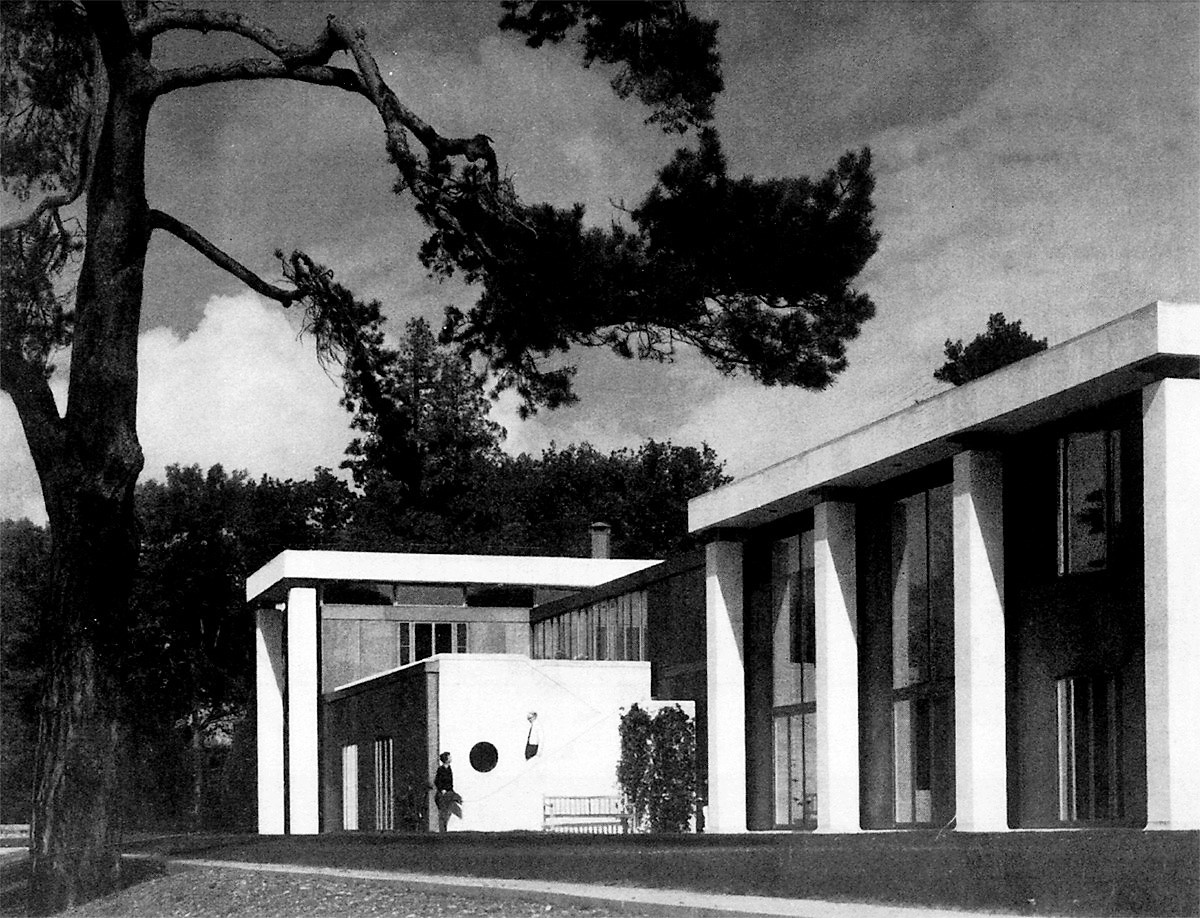
Sir Gawaine then changed his mind, and decided to build a Modernist house, for which the designs were supplied by Tom Hancock in association with Tony Swannell. It was built in 1975-77 on the site of the Victorian house, overlooking the fine views to the south, and was described soon afterwards (by John Martin Robinson in 1984) as 'perhaps the finest post-war country house in the Modern style', although that was (and remains) a field offering limited competition. Despite the use of expensive materials, the exterior is hardly more prepossessing than a secondary school of the 1960s. The low and spreading design derives from pre-war Modern Movement exemplars, but there are nods to a more contemporary Brutalism in the flat roof and square piers clad in Portland stone, supporting a Portland stone fascia. The external wall surfaces are clad in aluminium panels and large windows of tinted glass. The house is essentially L-shaped, with the kitchen and offices in one wing and guest and family rooms in the other, and a triangular centre in the angle between the two, which contains a two-storey drawing room with a rather Space Age elliptical staircase at one end. This has a genuinely interesting form, and the internal finishes, including joinery and plasterwork, are of an unusually high standard, but there is nothing to make the interior opulent: nothing to replace the colour, richness, decoration and allusion rejected by Modernism. The sterility of the house was to some extent offset by historic furniture and by Sir Gawaine's extensive collection of early Meissen porcelain, but these were sold after his death. Further photographs and plans of the house can be seen here.

Descent: built c.1885-88 for Capt. Frederick Charteris (1837-87); to widow, Lady Louisa Charteris (1836-1930); sold c.1898 to George Berney Allen (1862-1917); to brother, Charles T. Allen, who let to Sir Reginald Tuck; sold 1938 to Charles George Ashburton Nix (1873-1956); to son, Lt-Col. Christopher Nix; sold 1970 to Sir Gawaine Baillie (1934-2003), 7th bt.; to son, Sir Adrian Baillie (b. 1973), 8th bt.


Baillie family of Polkemmet, baronets


Baillie, Thomas (fl. 1600). He married, c.1600, Elizabeth Polwarth of Cathlaw, and had issue:
(1) Thomas Baillie (d. 1645) (q.v.);
(2) James Baillie; married, 1642, Christian Hamilton of Airdrie;
(3) Elizabeth Baillie; married, 1637, Robert Hamilton (d. 1661), son of William Hamilton of Boghead, and had issue one son and one daughter;
(4) Katherine Baillie; married, 1653, John Sommerville.
He purchased the Polkemmet estate.
His date of death is unknown. His wife's date of death is unknown.

Baillie, Thomas (d. 1645). Elder son of Thomas Baillie (fl. 1600) of Polkemmet and his wife Elizabeth Polwarth of Cathlaw, born about 1603. He fought for the Royalist cause under the Marquis of Montrose at the Battle of Kilsyth. He married, 1625, Alison, daughter of Sir James Muirhead, and had issue:
(1) Thomas Baillie (d. 1660) (q.v.);
(2) Margaret Baillie; married, 30 April 1654 at Hamilton (Lanarks), Robert Flemyng of Ravens Craig (Lanarks) and had issue.
He inherited Polkemmet from his father.
He was killed at the Battle of Kilsyth in 1645. His wife's date of death is unknown.

Baillie, Thomas (d. 1660). Only son of Thomas Baillie (d. 1645) of Polkemmet and his wife Alison, daughter of Sir James Muirhead, born about 1626. He married, 1644, Margaret, daughter of William Baillie of Carphin, and had issue:
(1) Thomas Baillie (c.1646-1704) (q.v.);
(2) John Baillie; said to have been educated at Oxford; a cornet of cavalry;
(3) Jean Baillie (d. 1722); married, 6 November 1692 at Bothwell, as his second wife, Archibald Nisbet (c.1631-95) of Carphin, and had issue one son; buried 25 February 1722.
He inherited Polkemmet from his father in 1645.
He died in 1660. His wife's date of death is unknown.

Baillie, Thomas (c.1646-1704). Elder son of Thomas Baillie (d. 1660) of Polkemmet and his wife Margaret, daughter of William Baillie of Carphin, born about 1646. He married, 1667, Ann, daughter of Thomas Inglis of Murdiston, and had issue:
(1) Thomas Baillie (1678-1758) (q.v.);
(2) John Baillie; died without issue;
(3) William Baillie; an officer in the guards (Capt.); died unmarried;
(4) Robert Baillie; died unmarried;
(5) Gavin Baillie (d. 1759?); magistrate of Leith (Midlothian), 1722-23; married 1st, 1721, Katharine Gray; married 2nd, 18 June 1724 at Edinburgh, Margaret, daughter of Andrew Aitken of Edinburgh, merchant, and had issue one son and one daughter; possibly the person of this name buried at Bothwell (Lanarks), 16 April 1759;
(6) Bethia Baillie; married, 5 March 1703 at Livingston, Rev. John Smith of Livingstone; died without issue;
(7) Margaret Baillie; died unmarried.
He inherited Polkemmet from his father in 1660.
He died in 1704. His wife's date of death is unknown.

Baillie, Thomas (1678-1758). Eldest son of Thomas Baillie (d. 1704) and his wife Ann, daughter of Thomas Inglis of Murdiston, born 1678. He married, 1706, Ann Cockburne of Borthwick, and had issue:
(1) Thomas Baillie (1708-85) (q.v.);
(2) William Baillie (b. 1710), baptised at Livingston, 7 February 1710; died young;
(3) Ann Baillie; died unmarried;
(4) John Baillie (1713-36), born 3 March 1713; migrated to Georgia (USA), where he had a grant of 400 acres of land, 1734; died there, 1736;
(5) Patrick Baillie (b. 1714), baptised 22 June 1714; surgeon; lost at sea;
(6) Bethia Baillie (b. 1717), baptised at Livingston, 5 March 1717; died young;
(7) William Baillie (b. 1718), baptised 22 September 1718 at Livingston;
(8) Isabel Baillie; married, 22 December 1735, Robert Livingston (1706-59) of Badlornie (alias West Quarter) and had issue;
(9) Catherine Baillie (1720-1800), baptised at Livingston, 22 August 1720; married, 2 June 1751, Andrew Wardrop (1694-1774) of Forbeau Hill, and had issue one son; died 25 October 1800;
(10) Jean Baillie (b. 1721), baptised at Livingston, 2 October 1721; died unmarried;
(11) Bethia Baillie (b. 1723), baptised at Livingston, 4 February 1723; died unmarried.
He inherited Polkemmet from his father in 1704 and also property from his mother's family.
He died in 1758. His wife's date of death is unknown.

Baillie, Thomas (1708-85). Eldest son of Thomas Baillie (1678-1758) of Polkemmet and his wife Ann Cockburne of Borthwick, baptised at Livingston, 22 April 1708. Apprenticed to Robert Hepburne WS; admitted a Writer to the Signet, 1732. He married, 1731, Isabel (d. 1777), daughter of Rev. Alexander Walker, minister of Kirkurd, and had issue:
(1) Ann Baillie (d. 1733); died in infancy, 12 November 1733;
(2) Thomas Baillie (1733-41), born 2 March 1733; died young, 1741;
(3) Christine Baillie (d. 1736); died young, 23 September 1736;
(4) William Baillie (c.1737-1816), Lord Polkemmet (q.v.);
(5) Mary Baillie (d. 1769); married, 23 June 1763, as his first wife, Stair Agnew (1734-1809), Virginia merchant and later 6th bt. of Lochnaw, and had issue two sons and three daughters; died 9 April 1769;
(6) Henrietta Baillie (d. 1742); died young, 11 July 1742;
(7) Robert Baillie (1741-1826), born 21 June 1741; died unmarried, July 1826;
(8) Thomas Baillie (1743-72), born 4 August 1743; an officer in the Royal Navy (Lt., 1766); died at sea, 14 August 1772;
(9) Isabell Baillie (d. 1757); died young, 24 July 1757.
He inherited Polkemmet from his father in 1758.
He died at Polkemmet, 3 February 1785. His wife died at Polkemmet, 13 August 1777.

William Baillie, Lord Polkemmet
Baillie, William (c.1737-1816), Lord Polkemmet. Second, but eldest surviving, son of Thomas Baillie (1708-85) of Polkemmet, born about 1737. He was admitted to the College of Advocates, 1758, and practiced as an advocate. Sheriff-Depute for West Lothian for over 20 years. In 1795 he was made a judge of the Court of Session by the title of Lord Polkemmet (resigned 1811). He was much liked by his fellow Scottish lawyers for his good humour and use of Scottish dialect. Never one of the great legal minds of the age, he relied upon a fund of common sense in his judicial decisions. It was intended to make him a baronet but he died before this was done, and a baronetcy was accordingly conferred on his son some years later. Physically, he was noted for the exceptional length of his fingers. He married 1st, 3 December 1768 at Edinburgh, Margaret (b. 1751), daughter of Sir James Colquhoun, 1st bt., of Luss (Dunbartons), and 2nd, 15 April 1803, Janet (c.1756-1833), daughter of George Sinclair of Ulbster, and had issue:
(1.1) Thomas Baillie (b. 1770), born 20 February and baptised at Edinburgh, 25 February 1770; probably died young;
(1.2) Mary Baillie; married, 21 September 1800, at Polkemmet House, James Johnston (d. 1841) of Straiton (Midlothian), and had issue;
(1.3) Helen Baillie (d. 1826); died unmarried, 10 May 1826;
(1.4) Isabella Baillie (d. 1844); died unmarried, 28 November 1844 and was buried at Greyfriars Cemetery, Edinburgh;
(1.5) James Baillie (b. 1781), born 18 June 1781 and baptised at Edinburgh, 14 July 1787; an officer in the HEICS; died unmarried in the lifetime of his father;
(1.6) Sir William Baillie (1782-1854), 1st bt. (q.v.);
(1.7) Janet Baillie (c.1783-1817); married, 25 August 1804 at Polkemmet House, Dugald John Campbell (1783-1827) of Skerrington (Ayrs.), and had issue one daughter; died of 'nervous fever', 25 June 1817 and was buried at Ayr (Ayrs.);
(1.8) Eliza Hope Baillie (1784-1855), born 23 March and baptised at Edinburgh, 6 April 1784; married James Campbell of Dunmore; died 5 October 1855;
(1.9) Robert Baillie (1790-1806); a midshipman in the Royal Navy; died unmarried on HMS Atlas in the West Indies, 19 November 1806;
(1.10) Penuel Jane Baillie (c.1792-1856); married, 24 April 1817, Farquhard Campbell (1760-1829) of Ormsary House, South Knapdale (Argylls), and had issue two sons; died 29 November 1866.
He inherited Polkemmet from his father in 1784.
He died 14 March 1816. His first wife's date of death is unknown. His widow died 19 January 1833.

Baillie, Sir William (1782-1854), 1st bt. Eldest surviving son of William Baillie (d. 1816), Lord Polkemmet, and his first wife, Margaret, daughter of Sir James Colquhoun, 4th bt., of Luss (Dunbartons), born 25 July 1782 and baptised at Edinburgh, 14 July 1787. An officer in the Bengal Army (Cadet, 1798; arrived in India, 1799; Cornet, 1800; Lt, 1805; retired, 1818). He was created a baronet, 14 November 1823, an honour which it had been intended to confer on his father. He married, 25 April 1815, Mary Lyon (1793-1872), daughter of James Dennistoun of Colgrain (Dunbartons.) and co-heir of her mother, Margaret, daughter of Robert Dreghorn of Blochairn, and had issue:
(1) Sir William Baillie (1816-90), 2nd bt. (q.v.);
(2) James Dennistoun Baillie (1817-76), born 21 June and baptised at Barony (Lanarks), 28 June 1817; emigrated to Australia with his younger brother in 1838 or 1840 and took up farming at Carngham, but became insolvent in the 'great crash' of 1841-42; sold Carngham in 1843 and bought a farm later known as Polkemmet near Horsham, Victoria, which he farmed until 1858, when he returned to Scotland; civil servant; lived at Manuel House, nr. Linlithgow; died 1 May 1876; will confirmed 14 May 1877 (effects £21,246);
(3) Robert Baillie (1818-83), born 6 October and baptised at Barony (Lanarks), 20 November 1818; educated at Royal Military College; an officer in the 77th regiment (Ensign, 1837; Lt. 1841; retired 1845); lived at Manuel House, nr. Linlithgow; died at Royal Edinburgh Asylum, 12 May 1883; administration of goods confirmed, 14 September 1883 and 25 April 1884 (total effects £2,113);
(4) Margaret Dreghorn Baillie (1821-70), born 7 January and baptised at Barony, 19 February 1821; died unmarried, 26 August 1870;
(5) Margaret Colquhoun Baillie (1822-68), born 3 March and baptised at Barony, 10 April 1822; died unmarried, 12 October 1868 and was buried at Whitburn;
(6) Thomas Baillie (1823-89) (q.v.);
(7) John Hope Baillie (1825-37), born 3 March 1825; died young and was buried at Boulogne (France), 18 February 1837;
(8) Janet Sinclair Baillie (1826-83), born 1 August 1826; lived at Manuel House, Linlithgow; died unmarried, 12 March 1883; will confirmed 12 June 1883 (effects £13,558);
(9) Alexander Hope Baillie (1827-83), born 14/15 October 1827; married, 30 April 1878, Edith Caroline (c.1842-1928), second daughter of Fairfax Fearnley of Sutton (Notts), but had no issue; died 19 September 1883; will confirmed in Edinburgh, 25 March 1884 (effects £15,110) and sealed in London, 23 April 1884;
(10) Mary Isabella Baillie (1829-64), born 7 March 1829; married, 29 September 1848 at Linlithgow, as his second wife, Alexander Baron Seton (1806-84) of Preston (W. Lothian) and had issue five sons and three daughters; died in childbirth, 14 January 1864;
(11) Elizabeth Penuel Jane Baillie (1830-87), born 10 July 1830; married, 31 August 1854 at Muree, Bengal (India), Dr. Samuel Reeve Tucker (1824-57) MD HEICS, and had issue one son; died at Glen Eira City, Victoria (Australia), 14 June 1887 and was buried at St Kilda Cemetery, Melbourne;
(12) Helen Jane Baillie (1831-1902), born 1 December 1831; died unmarried at Mentone (France), 7 May 1902; will confirmed in Stirling, 31 July 1902 (estate £11,974) and sealed in London, 7 August 1902;
(13) George Augustus Frederick Baillie (1833-82), born 31 July 1833; an officer in the East Lothian artillery militia (Capt.); lived latterly at Clifton, Bristol; married, 16 February 1871, Mary Gertrude (1841-1922), fourth daughter of Benjamin Peyton Sadler RN, and had issue one son and three daughters; died 7 April 1882; will confirmed in Scotland, 24 August 1882 (effects £523).
He inherited Polkemmet from his father in 1816 and radically remodelled it.
He died at Perth (Scotland), 28 January 1854. His widow died 17 December 1872.


Baillie, Sir William (1816-90), 2nd bt. Eldest son of Sir William Baillie (1782-1854), 1st bt., and his wife Mary Lyon, daughter of James Dennistoun of Colgrain, born 2 February 1816. Educated at Eton and Christ Church, Oxford (BA 1836). JP and DL for West Lothian; Conservative MP for West Lothian, 1844-47; Convenor of West Lothian for 27 years. An officer in the Midlothian Yeomanry Cavalry (Capt.); Hon. Col. of 1st Brigade of Scottish Division, Royal Artillery. He succeeded his father as 2nd baronet, 28 January 1854. He married, 14 April 1846, Mary (d. 1910), eldest daughter of Stair Hathorn Stewart of Physgill (Wigtowns.), but had no issue.
He inherited Polkemmet from his father in 1854. After his death it passed to trustees for his widow, and then to his great-nephew, Sir Gawaine Baillie.
He died 21 July 1890 and was buried at Whitburn; his will was proved in Scotland and sealed in London, 4 June 1891. His widow died 7 June 1910.

Thomas Baillie (1823-89)
Baillie, Thomas (1823-89). Fourth son of Sir William Baillie (1782-1854), 1st bt., and his wife Mary Lyon, daughter of James Dennistoun of Colgrain, born 21 June 1823. He emigrated to Australia with his brother James in 1838 or 1840, returned to Scotland in 1857, but went back to Australia in 1863. A trustee and member of session of the Scots Presbyterian Church in Melbourne; and a Trustee of the Presbyterian Ladies' College there. He married, 27 December 1849, Elizabeth Simpson (1826-1900), daughter of James Ballingall of Australia, and had issue:
(1) William James Baillie (b. & d. 1851), born 16 January 1851; died in infancy, 21 January 1851 and was buried in the Old Cemetery, West Melbourne;
(2) Mary Dennistoun Baillie (1853-99), born 1853; married, 5 August 1874, Lt-Col. Thomas Caradoc Rose Price CB (1841-1911) and had issue three sons and one daughter; died 22 March 1899;
(3) Sir George Baillie (1856-96), 3rd bt., born 20 October 1856; educated at Scotch College, Melbourne and Gonville & Caius College, Cambridge (BA 1881); pastoralist in Victoria; JP for Victoria and New South Wales (Australia); succeeded his uncle as 3rd baronet, 21 July 1890; died unmarried of typhoid fever, 2 April 1896 and was buried at St Kilda Cemetery, Melbourne;
(4) Sir Robert Alexander Baillie (1859-1907), 4th bt. (q.v.);
(5) William Baillie (1861-1928), born 25 April 1861; married, 1892, Mary (d. 1946), daughter of Rev. Walter Fellowes, vicar of St John, Toorak, Melbourne (Australia) and had issue three daughters; died 24 April 1928;
(6) Elizabeth Janet Baillie OBE (1864-1935), born 22 August 1864; awarded OBE 1918; married, 25 March 1885, Brig-Gen. the Hon. William Edwin Cavendish MVO (1862-1931) of The Farm House, Holkham (Norfk), son of William George Cavendish, 2nd Baron Chesham, and had issue one son and one daughter; died 2 May 1935; her will proved 19 June 1935 and certified at Edinburgh, 3 July 1935 (estate £27,211).
He lived at Toorak, Melbourne, Victoria (Australia).
He died at Queenscliff, Victoria (Australia), 7 January 1889, and was buried at St Kilda Cemetery, Melbourne. His widow died 21 May 1900 and was also buried at St Kilda Cemetery.

Baillie, Sir Robert Alexander (1859-1907), 4th bt. Second surviving son of Thomas Baillie (1823-89) and his wife Elizabeth, daughter of James Gallingall of Australia, born 24 August 1859. Educated at Scotch College, Melbourne (Australia) and Brasenose College, Oxford (matriculated 1879; BA 1882). An officer in the Australian squadron of the King's Colonials Imperial Yeomanry (Capt., 1901; Maj., 1903). He succeeded his elder brother as 4th baronet, 2 April 1896. He married, 13 July 1887 at the Scots Church, Melbourne (Australia), Isabel (d. 1945), daughter of David Elliot Wilkie of Ratho Byres (Midlothian), and had issue:
(1) A daughter (b. & d. 1891); died in infancy, 18 December 1891;
(2) Sir Gawaine George Stuart Baillie (1893-1914), 5th bt.(q.v.);
(3) A son (b. & d. 1895); died in infancy, 27 November 1895; 
(4) Sir Adrian William Maxwell Baillie (1898-1947), 6th bt. (q.v.).
He spent most of his life in Australia, but was living at Colchester (Essex), where his regiment was garrisoned, at the time of his death.
He died 16 October 1907. His widow died 1 February 1945; her will was proved in Scotland and sealed in London, 15 August 1947.

Sir Gawaine Baillie, 5th bt.
Baillie, Sir Gawaine George Stuart (1893-1914), 5th bt. Elder son of Sir Robert Alexander Baillie (1859-1907), 4th bt., and his wife Isabel, daughter of David Elliot Wilkie of Ratho Byres (Midlothian), born at Melbourne (Australia), 29 May 1893. Educated at Eton. He succeeded his father as 5th bt., 16 October 1907. An officer in 2nd Dragoon Guards (Scots Greys) (2nd Lt., 1912). He was unmarried and without issue.
He inherited Polkemmet on the death of the 2nd baronet's widow in 1910. After his death, his mother established Polkemmet as a Red Cross Hospital in his memory.
He was killed in action at Rebais (France), 7 September 1914; his body was cremated and the ashes buried in the Baillie Mausoleum in the grounds of Polkemmet, and later reinterred in the churchyard at Whitburn.


Sir Adrian Baillie, 6th bt.
Baillie, Sir Adrian William Maxwell (1898-1947), 6th bt. Second son of Sir Robert Alexander Baillie (1859-1907), 4th bt., and his wife Isabel, daughter of David Elliot Wilkie of Ratho Byres (Midlothian), born 5 May 1898. Educated at Eton and Royal Military College, Sandhurst. He succeeded his elder brother as 6th baronet, 7 September 1914. He was an officer in the 2nd Dragoon Guards (Scots Greys) during the First World War (2nd Lt., 1917; Lt., 1919; resigned 1919). JP and DL for West Lothian. An officer in the Diplomatic Service, 1921-28 (2nd Secretary). Unionist MP for West Lothian (which he also contested in 1929 and 1935), 1931-35 and Conservative MP for Tonbridge, 1937-45. He married, 4 November 1931 at Holy Trinity, Brompton (Middx) (div. 1944), the Hon. Olive Cecilia (1899-1974), daughter of Almeric Hugh Paget, 1st Baron Queenborough and formerly wife of Hon. Charles John Frederic Winn (1896-1968) and Arthur Thomas Filmer Wilson-Filmer (1895-1968), and had issue:
(1) Sir Gawaine George Hope Baillie (1934-2003), 7th bt. (q.v.).
His wife purchased Leeds Castle (Kent) in 1926 and after his marriage he lived there until his marriage broke down. He inherited the Polkemmet estate from his brother in 1914 and came of age in 1919; he let the house from 1939 and the estate was sold after his death to the National Coal Board. He also bought Howden House, Livingstone in 1931 but sold it to the Ministry of Agriculture in 1946.
He died of pneumonia, 8 January 1947; his will was proved in Scotland and sealed in London, 9 April 1947. His ex-wife died 9 September 1974.

Sir Gawaine Baillie, 7th bt.
Baillie, Sir Gawaine George Hope (1934-2003), 7th bt. Only child of Sir Adrian William Maxwell Baillie (1898-1947), 6th bt., and his wife, the Hon. Olive, daughter of Almeric Hugh Paget, 1st Baron Queenborough and formerly wife of Arthur Wilson Filmer, born 8 March 1934. During the Second World War he was evacuated to stay with cousins on Long Island, New York (USA). Educated at Eton and Cambridge. He succeeded his father as 7th bt., 8 January 1947. In 1959 he set up HPC Engineering at Burgess Hill (Sussex), a company making parts for the automotive, aerospace, computer, defence, medical and machine tool industries, and he remained Chairman and Managing Director for the rest of his life. In the late 1950s and 1960s he was an amateur motor racing driver, and achieved considerable success in races around the world. He was a Governor of the Star & Garter Homes for Disabled Servicemen. He and his wife collected early Meissen porcelain models of birds and animals, building on a collection formed by his mother; he also secretly amassed a remarkably complete collection of mint British Empire stamps; these collections were sold after his death. He married, 28 December 1966, Lucille Margot (1934-2012), only daughter of Senator Louis Philippe Beaubien of Montreal (Canada) and formerly wife of Peter Melvill-Gardner, and had issue:
(1) Liza Katharine Baillie (b. 1969), born 8 April 1969; married, Apr-Jun 1994, Ian Curtis (b. 1968) of Abbot's Leigh Place (Sussex), accountant and company director, and had issue two sons and two daughters; now living;
(2) Sir Adrian Louis Baillie (b. 1973), 8th bt. (q.v.).
He inherited the Leeds Castle estate from his mother in 1974, but not the castle itself, which was vested in the Leeds Castle Foundation. In 1971 he built Freechase, a new, Modern Movement house, on his property at Warninglid (Sussex).
He died 21 December 2003; his will was proved 19 April 2004. His widow died 9 March 2012.

Baillie, Sir Adrian Louis (b. 1973), 8th bt. Only son of Sir Gawaine George Hope Baillie (1934-2003), 7th bt., and his wife Lucille Margot, only daughter of Senator Louis Philippe Beaubien of Montreal (Canada) and formerly wife of Peter Melvill-Gardner, born 26 March 1973. Educated at Eton, Manchester Univ. (BA), City Univ. (Dip. Law), the Inns of Court School of Law, London Business School (MBA), and Middle Temple (called to bar, 1999). Investment manager; Director of the Hepatitis C Trust. He succeeded his father as 8th baronet, 2003. He married, 6 September 2006 in Ohio (USA), Amber Rose (b. 1980), daughter of Ms. Sheri Laine of Del Mar, California (USA), and had issue:
(1) Sebastian Gawaine Baillie (b. 2011), born 18 April 2011;
(2) Eloise Laine Baillie (b. 2013).
He inherited Freechase, Warninglid and the Leeds Castle estate from his father in 2003.
Now living.


Sources


Burke's Peerage and Baronetage, 1924, pp. 182-83; Burke's Peerage and Baronetage, 2003, pp. 221; Debrett's Peerage & Baronetage, 2015, p. B38; J. Cornforth, 'Boudin at Leeds Castle', Country Life, 14 April 1983, pp. 925-28 and 21 April 1983, pp. 1018-21; J.M. Robinson, The latest country houses, 1984, pp. 2, 152-54, 209; M. Miers, 'Leeds Castle: the inside story', Country Life, 8 May 2003, pp. 106-11; J. Harris, Moving rooms: the trade in architectural salvage, 2007, pp. 75-76; J. Newman, The buildings of England: Kent - West Kent and the Weald, 4th edn., 2012, pp. 355-58; Leeds Castle guidebooks, 1989, 2009.


Location of archives


Baillie family of Polkemmet, baronets: estate and family papers, 1672-1773 [National Records of Scotland, GD170/3556-3712]


Coat of arms


Azure, nine mullets (three, three, two and one) or within a bordure counter-nebuly argent and sable.


Can you help?


Here are a few notes about information and images which would help to improve the account above. If you can help with any of these or with other additions or corrections, please use the contact form in the sidebar to get in touch.

  • Can anyone provide any internal photographs of the original Freechase, or identify the architect of the house?
  • Can anyone add to the rather inadequate genealogical information for the earlier generations of this family?
  • Can anyone explain the reason for, and the timing of, the conferral of the baronetcy on Sir William Baillie in 1823?


Revision and acknowledgements


This post was first published 17 March 2018.