 |
| Bankes of Winstanley |
When James Bankes died in 1617, his property passed to his eldest son, William Bankes (1593-1666), who had been educated at Grays Inn to equip him with the sort of legal knowledge useful in estate management (his younger brother, who entered the same inn at the same time, was called to the bar, and became a barrister in London). William is a shadowy figure by comparison with his father, but by dint of staying carefully out of politics, he seems to have managed to remain neutral during the English Civil War, and to have preserved his estate without impairment. His son, William Bankes (1631-76), by contrast, entered public life at the Restoration and was clearly sympathetic to the Court faction. He had a powerful sponsor in the form of Charles Stanley (d. 1672), 8th Earl of Derby, who found him a seat in Parliament and persuaded a reluctant King Charles II that he was of sufficient standing to become a Deputy Lieutenant. But it would seem that his religious sympathies were more radical than his political views, as he employed a deprived minister as tutor to his children: it may be that a similar ambivalence had motivated his father's neutrality.
William was succeeded by his son William Bankes (1658-90), whose public career was along much the same lines as his father's, but was cut short when he died aged 32. He was married but had no children, so the Winstanley estate passed to his younger brother, Thomas Bankes (1659-1728), who had a large family (many of whom died in infancy) but no public career. Thomas was succeeded by his eldest surviving son, Robert Bankes (1699-1748), who went to Cambridge and evidently had scientific interests, as he later became a Fellow of the Royal Society, but who again died unmarried. He was followed by his younger brother, William Bankes (1709-75), about whom even less can be said, although it seems likely that he began the exploitation of the coal reserves on the estate for more than purely local consumption. His only surviving son, William Bankes (1751-1800), undertook the first recorded remodelling of Winstanley Hall in about 1780, but again had no children, and with him the continuous male line descent of the estate came to an end. He bequeathed his property to his first cousin, the Rev. Thomas Holme (1732-1803), who lived at Holland House, Upholland, and when he died soon afterwards the estate came to his eldest surviving son, Meyrick Holme (1768-1827), who took the name Bankes in 1804. Meyrick had a career as an officer in the Royal Navy, but retired some time in the 1790s as a lieutenant; he then served as a militia officer before inheriting Winstanley, and going on to become High Sheriff and a Deputy Lieutenant. He continued the process of developing coal working on the estate, and the profits of this enabled him to enlarge and remodel Winstanley Hall in 1818-19. It was, however, his son, another Meyrick Bankes (1811-81), who finally put coal mining on the estate onto a fully commercial basis, establishing coal depots in Liverpool and Manchester from which his coal was distributed directly to customers, and hugely increasing the scale of production.
In the 19th century, the profits of coal mining made the Bankes family a great deal richer than they had been before. In the 1830s, Meyrick Bankes, who took little part in public life and was 'of a retiring disposition', bought several large and contiguous properties in north-west Ross-shire to form the Letterewe estate, which was used as a late summer and autumn retreat for shooting and deer stalking. Over time, a series of large houses were built on this estate for members of his family. The earliest may have been Gruinard House, a curiously English neo-Tudor house which may have been built soon after Bankes purchased the property in 1835; Letterewe itself was rebuilt in about 1858; while Drumchork House at Aultbea was under construction for his eldest son in 1881-82; and was unfinished when first the father and then the son died within a few months of each other.
In later life, Meyrick Bankes became increasingly eccentric, and he left separate wills respecting his English and Scottish property which were extremely complex, highly manipulative of his children, and provided lucrative work for lawyers for years afterwards. One of his principal objectives seems to have been to separate the ownership of Winstanley and Letterewe, and this he achieved. What he did not foresee was that both his legitimate sons would die without issue within a year of his will being proved. The effect of the wills was therefore that his eldest daughter, Eleanor (1837-1907), inherited the Winstanley estate, while his second daughter, Maria Ann (1839-1904) received Letterewe. Eleanor was married to William John Murray (1835-84), who owned a small estate of his own in Ross-shire but who was already confined in an Edinburgh asylum by the time his wife came into Winstanley. After he died, Eleanor joined forces with her second son to buy Balconie Castle (Ross-shire), which took the place of Letterewe as a base for Scottish holidays from 1890 onwards and remained in the family until the Second World War. Maria Ann had married Lt-Gen W.C. Robertson Macdonald of Kinlochmoidart, but divorced him in 1881 and married a Frenchman of modest physical stature, Paul Liot, who took the name Bankes and threw himself rather improbably into Highland life, where he became known as the 'pocket French laird'. Maria sold Letterewe after his death in 1901.
Winstanley Hall and Balconie Castle passed on Eleanor's death in 1907 to her second but eldest surviving son, George Hildyard Bankes (1867-1949), who was the last person to fully occupy either house. During his lifetime, many of the coal mines which had sustained the prosperity of the estate in the 19th century were closed, and after the Second World War (when both Winstanley and Balconie were requisitioned for military use) he also sold Balconie to a local timber merchant who had no use for the house and let it rot until it became dangerous and had to be demolished. His estate was still comfortably over £400,000 when he died, however, so it is hard to see why his daughter, Joyce (1904-74), who wrote articles and a book about the history of the Winstanley estate and was clearly interested in the place, was apparently unable to afford to live in the house, even after paying the swingeing death duties of the time. In the 1950s, she and her husband, Ralph Vincent Bankes (who was no relation, but a member of the Bankes family of Soughton Hall in Flintshire), carved a family flat out of the house and more or less abandoned the rest of the building. By the 1980s the house was unoccupied and it has remained so ever since, sliding ever more rapidly into dereliction and ruin. The estate remains in the hands of the family, but the house and a small amount of surrounding land was sold in 2000 to a housing development company which first applied for permission to demolish the house and redevelop the site and then submitted a scheme for restoration that involved so much enabling development that it was rejected by Wigan Council. The house is now partly roofless and almost beyond economic repair, and one hopes a creative restoration solution - perhaps involving sale to a building preservation trust - can be found before a catastrophic collapse takes place.
Winstanley Hall, Wigan, Lancashire
There was probably a manor house of the eponymous Winstanley family here from the 13th century, for there is a moated site in the park which is likely to have been the location of a high status dwelling. However the present Winstanley Hall is essentially an Elizabethan stone house built for James Bankes (1542-1617) soon after he bought the estate in 1596. The main front faces east, and has a half-H plan with two projecting wings either side of a recessed centre, with square projections in the re-entrant angles, originally forming the entrance porch and hall bay. It is one of three houses in the Wigan area built in this form, the other two being Birchley Hall (1594) and Bispham Hall (c.1600-10).
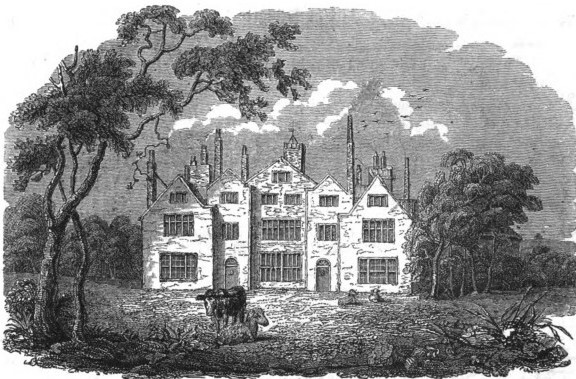 |
| Winstanley Hall: an engraving of the house in 1817, showing it before the removal of the gables. |
The centre, wings, and the projections in between were originally all gabled, but the gables were taken down and replaced by a plain parapet in the early 19th century. The house was traditionally planned, with a great hall in the centre, a great chamber above, the porch leading into a screens passage at the lower end (to the right), and a bay window lighting the dais at the upper end. The original elevation may not have been entirely symmetrical but it had evidently become so by the 19th century, when the window lighting the dais end of the hall had evidently become a second porch.
 |
| Winstanley Hall: the south front built by Lewis Wyatt in 1818-19, from an old postcard. |
Winstanley was extensively remodelled by Lewis Wyatt in 1818-19 for Meyrick Bankes (1768-1827). He created a new south front, clustered around a four storey central tower, which is quite convincingly in the same style as the original work, and is united with it by the continuous parapet. His new range must, however, incorporate earlier additions, for at the south-west corner is a canted bay of 1780, designed by L. Robinson but with an extra storey added by Wyatt. The west range is gabled and irregular, but some of it seems to date from the 1780 period. There were further extensions at the north end of the house (helpfully with datestones of 1843 and 1889), but again they incorporate some earlier work. The interior is, or perhaps more accurately was until recent dereliction, largely of the Lewis Wyatt period. The staircase hall has an elegant neo-classical ceiling rose and a delicate wrought iron balustrade, and what may have originally been a drawing room but was later used as a study retains a neo-classical chimneypiece and simple frieze.
To the north-east of the house stands a large stable yard, loosely enclosed by four free-standing ranges of different, mostly 19th century dates. In the centre of the yard is a big Neptune fountain of c.1830 by William Spence, with rearing horses executed in stone. The once secluded park was probably given its present form by Lewis Wyatt, who built the lodge and gatepiers on Pemberton Road in c.1818, and perhaps also the former walled garden. During the Second World War, Winstanley Hall was requisitioned for military use, and open-cast coal mining was begun in the park in 1942. The hall survived military occupation, although there was some vandalism, but the coal mining in the park caused subsidence which affected part of the house, even though coal was not taken from directly under the building. In the 1960s, the construction of the M6 motorway cut the park in two. However, the landscape of the park was reinstated after mining finished (and the Bankes family carried out some subsequent tree planting), and the motorway is sunk in a cutting, so the setting was not fatally compromised by these developments.
 |
| Winstanley Hall: the current state of the building after a partial collapse of the roof. |
As far as I have been able to establish, in the 1950s the family created a flat within the house which they continued to use, while largely abandoning the rest of the building. The house remained thus partly occupied until 1984, but has since been wholly abandoned and allowed to decay. The property was sold to a developer in 2000 who applied for permission to demolish the house, which was refused after Save Britain's Heritage intervened and offered financial and professional support for a scheme involving the restoration of the buildings. SAVE has also drawn up a proposed scheme of reuse, but although the developer has submitted a number of planning applications, none have yet been approved, apparently because the level of enabling development required by the developer is unacceptable to the Council. This has led to an impasse in which the only change is that the house accelerates towards disaster, and the cost of restoration rapidly increases. Some stabilisation work was undertaken on the courtyard buildings in 2015, with financial support from the English Heritage, but the condition of the house is now very poor: it has suffered from dry rot and extensive water ingress and, as a result, the roof and ceilings have partially collapsed. At the time of writing, it can still be saved, but time is running out fast and it is very much to be hoped that a scheme satisfactory to all parties can be agreed soon.
Descent: sold 1596 to James Bankes (1542-1617); to son, William Bankes (1593-1666); to son, William Bankes (1631-76); to son, William Bankes (1658-90); to brother, Thomas Bankes (1659-1728); to son, Robert Bankes (1699-1748); to brother, William Bankes (1709-75); to son, William Bankes (1751-1800); to cousin, Rev. Thomas Holme (1733-1803); to son, Meyrick Holme (later Bankes) (1768-1827); to son, Meyrick Bankes (1811-81); to daughter, Eleanor Starkie Letterewe (1837-1907), wife of William John Murray (later Bankes) (1835-84); to son, George Hildyard Bankes (1867-1949); to daughter, Joyce Helena Murray (1904-74), wife of Capt. Edward William Jervis Bankes RN (1904-84) ....sold 2000 (with 10 acres) to Dorbcrest Homes. Much of the surrounding estate still belongs to the Bankes family.
Letterewe House, Ross & Cromarty
 |
| Letterewe House: the house as it exists today |
The house began as a minor laird's house on the estate of the Mackenzies of Gairloch, described as 'a good seat' in 1813, and reputedly having 16th or 17th century origins. The house can still only be reached by boat across Loch Maree or on foot, and the large estate (81,000 acres in 1996) is one of the most remote parts of the British Isles. Successive remodellings, including a major one in 1858 for Meyrick Bankes (1811-81) and another after 1976 for Paul Fentener van Vlissingen, have turned the house into a pretty white-harled baronial shooting lodge with bartisans on the corners, tall dormers breaking into the roof, and a pyramidal-roofed tower with a cupola on top. The house is now available for short-term rental on a self-catering basis.
Descent: Hector Mackenzie sold 1835 to Meyrick Bankes (1811-81); to daughter, Maria Ann (1839-1904), wife of Lt-Gen. W.C. Robertson Macdonald and later of Paul Liot (later Bankes) (d. 1901); sold 1901 to Lawrence Dundas (1844-1929), 3rd Earl and later 1st Marquess of Zetland, who gave it c.1922 to his son, Lawrence John Lumley Dundas (1876-1961), 2nd Marquess of Zetland; sold to Col. Bill Whitbread (1900-94), who sold 1977 to Paul Fentener van Vlissingen (1941-2006); to daughters Alicia and Tannetta Fentener van Vlissingen.
Balconie Castle, Evanton, Ross & Cromarty
An early 19th century castellated house, built on the site of a medieval tower house, and said to have incorporated part of its fabric. It was constructed for Alexander Fraser, who managed one of Evan Baillie's estates in Grenada and married his daughter; he purchased the estate in 1806 and later founded the adjoining village of Evanton. His house was a six-bay, three-storey block with a central tower and a service wing to one side. It was essentially a rather plain building with sash windows, but was given a touch of Gothick fantasy by a crenellated parapet all round, which was repeated on the top of the tower. |
| Balconie Castle: the house in the early 20th century, from an old postcard. |
The house was altered internally and extended by Andrew Maitland & Sons for George H. Bankes in 1891-92, shortly after he and his mother jointly purchased the property, and was subsequently used as a holiday home and a base for shooting and fishing in the summer months. During the Second World War the house was requisitioned by the Army and troops were billeted there. After the War, George Bankes sold the estate to A.J.M. Munro, a timber-merchant from Alness, who allowed the house to remain empty. It gradually became derelict and a target for vandalism, and by 1968 it was deemed unsafe and was blown up. The stables and some outbuildings survived and were later converted into a private house.
Descent: built c.1806 for Alexander Fraser (1759-1837); sold 1838 to Hugh Munro of Teaninich; given to illegitimate daughter, Catherine (d. 1877), later wife of [forename unknown] Reid; to cousin, Mary Mackenzie, who sold 1890 to George Hildyard Bankes (1867-1949) and his mother, Eleanor Starkie Letterewe Bankes (1837-1907); he sold 1948 to A.J.M. Munro, who demolished the house in 1968.
Bankes family of Winstanley Hall
Bankes, James (1542-1617). Reputedly the son of William Bankes of Wigan, born 1542. Citizen, goldsmith and moneylender of London, in partnership with John Ballett until 1576; retired between 1590 and 1592; by industry and sharp practice he built a substantial fortune, which from 1576 onwards he increasingly salted away in the purchase of land, especially land with mineral resources in the form of coal. He was litigious, and the rector of Wigan noted that he was "of great wealth and riches, and by means thereof grown to be a very proud and insolent man". He married 1st, 6 June 1575 at St Vedast, Foster Lane, London, Elizabeth, daughter of his partner John Ballett, and 2nd, c.1590, Susan (d. 1627/8), daughter of William Sherrington of London, haberdasher, and had issue:
(1.1) A son, who died young;
(2.1) John Bankes (d. 1592); died in infancy and was buried at Wigan, 13 August 1592;
(2.2) William Bankes (1593-1666) (q.v.);
(2.3) Thomas Bankes (1595-1651), baptised at Wigan, 21 December 1595; educated at Grays Inn (admitted 1613); barrister-at-law in London; married, 1626, Elizabeth, daughter of William Bispham and widow of Edward Cotton of Cotton Hall (Cheshire); died 1651;
(2.4) Margaret Bankes (b. c.1600); married, 1625, George Hyde of Urmston (Lancs);
(2.5) Ralph Bankes (b. c.1600), born about 1600; living in 1617;
(2.6) James Bankes (1603-61), baptised at Wigan, 12 October 1603; buried at Wigan, 22 August 1661.
He purchased the manor of Winstanley in 1596 and built Winstanley Hall soon afterwards. His second wife inherited substantial property, including Wardley Hall, from her family before 1601, when she sold it to other members of her family.
He died 4 August 1617 and was buried at Wigan the following day; his will was proved at Chester, 29 October 1617 (effects £336). His first wife died before 1590. His widow died in 1627/8 and was buried at Wigan.
Bankes, William (1593-1666). Eldest surviving son of James Bankes (1542-1617) and his second wife Susan, daughter of William Sherrington of London, merchant, baptised at Wigan, 30 December 1593. Educated at Grays Inn (admitted 1613). He maintained a stance of neutrality throughout the Civil War and successfully preserved his property intact. He married 1st, 1613, Elizabeth, daughter of Sir Thomas Ireland, kt., of Bewsey Hall (Lancs) and 2nd, 20 May 1624 at Chastleton (Oxon), Sara (1590?-1668), daughter of Walter Jones of Chastleton House, and had issue:
(1.1) James Bankes (1614-59), baptised at Wigan, 15 May 1614; educated at Grays Inn (admitted 1634); died in the lifetime of his father and was buried at Wigan, 12? February 1658/9;
(1.2) Thomas Bankes (1615-57?), baptised at Wigan, 15 August 1615; died in the lifetime of his father, and was perhaps the man of this name buried at Wigan, 30 April 1657;
(1.3) William Bankes (b. & d. 1619), baptised at Wigan, 15 June 1619; died in infancy and was buried at Wigan, 29 June 1619;
(2.1) William Bankes (1630-76) (q.v.).
He inherited Winstanley Hall from his father in 1617.
He was buried at Wigan, 13 October 1666. His first wife was buried at Wigan, 2 April 1621. His widow was buried at Wigan, 25 June 1668.
Bankes, William (1630-76). Only recorded son of William Bankes (1593-1666) and his second wife, Sara, daughter of Walter Jones of Chastleton (Oxon), baptised at Wigan, 19 August 1630. MP for Newton, 1660 and Liverpool, 1675-76; JP for Lancashire, 1665-66, 1670-76; DL for Lancashire, 1660-62, 1663?-76; Vice-Admiral of Lancashire and Cheshire, 1673-76; Commissioner for Assessment, 1660-74; joint Farmer of the Excise for Lancashire, 1665-74; Freeman of Liverpool by 1670. He was a client of the Earls of Derby, who promoted his career and persuaded King Charles II to accept him as a Deputy Lieutenant. As an MP, he was a supporter of the Court, but in the early 1660s, he employed the deprived Presbyterian minister, Adam Martindale, as tutor to his children. He married, 23 October 1656, Frances (d. 1693?), daughter of Peter Legh of Bruche (Lancs), and granddaughter of Sir Peter Legh of Lyme Park, and had issue:
(1) William Bankes (1658-90) (q.v.);
(2) Thomas Bankes (1659-1728) (q.v.);
(3) Rev. James Bankes (1660-1742), born 1660; educated at St Paul's School, London, and Trinity College, Cambridge (matriculated 1679; BA 1682/3; MA 1686); Tutor and Librarian of Trinity College, Cambridge, 1691-1706; rector of Lilley (Herts), 1706-09; rector of Bury (Lancs), 1710-43 and vicar of Heywood (Lancs), 1729-42; died unmarried and was buried at Wigan*, 21 May 1743;
(4) Sarah Maria Bankes (1663-1748); died without issue;
(5) Frances Bankes (b. 1665), baptised at Wigan, 23 May 1665; died young before 1670;
(6) Legh Bankes (1666-1705), baptised at Wigan, 30 August 1666; educated at Grays Inn, London (admitted 1685); married, 19 August 1703 at Ashton-in-Makerfield (Lancs), Alice, widow of Thomas Launder of Newhall, Ashton; buried at Wigan, 5 October 1703;
(7) Charles Bankes (1667-71), baptised at Wigan, 20 February 1667/8; died young and was buried at Wigan, 8 August 1671;
(8) Anne Bankes (1669-72), baptised at Wigan, 28 October 1669; died young and was buried at Wigan, 18 June 1672;
(9) Frances Bankes (1670-1745), baptised at Wigan, 22 February 1670; married, Edward Morgan (b. 1669) of Golden Grove (Flints.) and had issue including Catherine (who married Robert Bankes (1699-1748) (q.v.)); died 1744/5;
(10) Piers Bankes (b. & d. 1673), baptised at Wigan, 6 February 1672/3; died in infancy and was buried at Wigan, 5 April 1673;
(11) Elizabeth Bankes (b. 1675), baptised at Wigan, 31 August 1675; married, 1711, her cousin Richard Legh (1679-1740), Captain of Horse, third son of Richard Legh of Lyme Park, but died without issue.
He inherited Winstanley Hall from his father in 1666.
He died 6 July 1676 and was buried at Chastleton (Oxon); his will was proved in the PCC, 9 November 1676. His widow is said to have died in 1693.
* According to an entry in the Bury parish register.
Bankes, William (1658-90). Eldest son of William Bankes (1630-76) and his wife Frances, daughter of Peter Legh of Bruche (Lancs), born 24 August 1658. Educated at Christ Church, Oxford (matriculated 1676) and Grays Inn (admitted 1676). MP for Wigan, 1679, 1688-89 on the interest of the Earl of Derby. JP for Lancashire, 1683-88, 1689-90 and DL for Lancashire, 1689-90. Bailiff of Liverpool, 1685-88. He married, 31 March 1687 at Wigan, his cousin Lettice (1663-1719), daughter of Richard Legh of Lyme Park (Cheshire), but had no issue.
He inherited Winstanley Hall from his father in 1676 and came of age in 1679.
He died 10 January 1689/90 and was buried at Wigan. His widow married 2nd, 1700, Thomas Fleetwood, and died in 1719.
Bankes, Thomas (1659-1729). Second son of William Bankes (1630


