Showing posts with label Industrial fortunes. Show all posts

Saturday, 1 April 2023

(541) Morrison-Bell of Highgreen Manor and Otterburn Hall, baronets

Morrison-Bell baronets
This family is said to have been settled in Weardale (Co. Durham) for several hundred years, but their rise to the landed gentry began with William Bell (1779-1856), who was a successful coal fitter and later colliery proprietor, based at Bishopwearmouth (now Sunderland) in the early 19th century. He married the daughter of a naval officer, and his two surviving sons were brought up as gentlemen, with the elder being sent to Cambridge and both of them serving in the army, although both of them became partners in the family businesses of coal and lead mining. The elder son, Charles William Bell (1833-1914), had a short army career but soon after his father's death took over the management of the family businesses. By the 1870s he had evidently put in managers to undertake the day-to-day running of his companies, and was able to move away from the north-east and live in a succession of homes in the south of England. The frequent moves between properties suggests a rather restless spirit, but they do all seem all to have been rented and his moves may have simply been the result of fixed-term tenancies ending. In the 1880s he purchased a remote moorland farm called Highgreen near Tarset (Northumberland), and replaced the farmhouse with a country house, the round towers of which give it something of the character of a French château. This house, extended in 1894, remains the family seat today, but in 1896 he also bought Otterburn Hall, not far away, which he altered in 1905, and he had a house at Poole (Dorset) which seems to have been a summer holiday place, as well as a town house in London. All this property was a reflection of burgeoning wealth, and in 1905 (apparently as a result of a legacy from his mother's family) he obtained a licence to add his mother's maiden name (Morrison) to his patronymic, and a few weeks' later he was raised to a baronetcy. Sir Charles Morrison-Bell, 1st bt., as he became, left an estate worth nearly half a million pounds when he died in 1914, and even his bachelor younger brother, who died in 1900, left nearly a quarter of a million. Such were the profits of coal and lead mining in the late 19th century.

Sir Charles and his wife had four sons and two daughters, who all lived to adulthood and married. The eldest son, and principal heir, was Sir Claude Morrison-Bell (1867-1943), 2nd bt., who, after a short career in the army, became deputy chairman of the family businesses after his father's death, although he does not seem to have been actively engaged in their management. He sold Otterburn Hall in 1922, after his mother's death, and although he retained Highgreen he seems to have lived chiefly in the south of England, at Balcombe Tower, Poole (Dorset) and from 1936 at Glendon, Corfe Mullen (Dorset). His younger brothers all sought careers in the army and later in politics, with Sir Arthur Clive Morrison-Bell (1871-1956), 1st bt., being MP for Honiton, 1910-31 and climbing the junior ranks of the ministerial ladder in the early 1920s, while Lt-Col Ernest Fitzroy Morrison-Bell (1871-1960) was MP for Ashburton, 1908-10, 1910-18, and Eustace Widdrington Morrison-Bell (1874-1947) was a member of the London County Council.

Sir Claude Morrison-Bell left one son and three daughters at his death in 1943, and while Highgreen descended to his son, Sir Charles Reginald Francis Morrison-Bell (1915-67), 3rd bt., his home at Glendon (which had been requisitioned for military use during the Second World War) was left to his daughter Veronica (1911-2001) and her Austrian-American husband, Maj. John Jerome Stonborough. Sadly, Sir Charles died when his two sons were young, and Highgreen was let during the minority of his successor, Sir William Hollin Dayrell Morrison-Bell (b. 1956), 4th bt., who took over the management of the estate in 1977. He became a qualified solicitor and lived chiefly in London until he retired, since when he has invested in the development of Highgreen Manor as a centre for artistic endeavours of various kinds, while part of the building has become a holiday let.

Highgreen Manor, Tarset, Northumberland

A stone house of relatively modest size that gives the impression of being much larger than it is because of an agglomeration of cottages and outbuildings set around an informal courtyard at the rear. It was built on the site of an earlier farmhouse, parts of which may be incorporated in the outbuildings, and one source says there was a medieval pele tower on the site, although the evidence for this is unclear. 

Highgreen Manor: the site in 1896, from the OS 25" map
Highgreen Manor: the site in 1862 from the OS 6" map


The present house was built in about 1885 and extended to the right in 1894 by William James Ancell (1853-1913), who may also have been the original architect, for Sir Charles Morrison-Bell (1833-1914), 1st bt. The earlier part consists of a three-bay two-storey centre, with a central gabled porch and paired sash windows to each bay, with stepped and castellated gables set over each bay. To either side of this are corner towers rising half a storey higher than the centre, with tall conical roofs, which give it a chateau air. 

Highgreen Manor: the principal front, with the addition of 1894 on the right. Image: Oliver Dixon. Some rights reserved.
The addition of 1894 is L-shaped, and stands on slightly higher ground than the earlier building, so that its one and a half storeys are the same height as the original block. The recessed section has five small casement windows in raised moulded surrounds on the upper floor and a garden door below. The projecting section to the right has a first-floor canted oriel window carried on a moulded corbel with shield dated 1894, and flanking the window two carved panels in foliage frames, with the family crest, and a bell rebus. Above the oriel there is a gable flanked by chimneys with a pronounced batter. Inside, there is a stone fireplace with another depiction of the family arms on the overmantel, set in an aedicule with pilasters and a modillion cornice. The house is now the home of the family's Highgreen Arts organisation, which runs residential art, yoga and writing courses at the house.

Descent: built for Sir Charles William Bell (later Morrison-Bell) (1833-1914), 1st bt.; to son, Sir Claude William Hedley Bell (later Morrison-Bell) (1867-1943), 2nd bt.; to son, Sir Charles Reginald Francis Morrison-Bell (1915-67), 3rd bt. ; to son, Sir William Hollin Dayrell Morrison-Bell (b. 1956), 4th bt.

Otterburn Hall, Northumberland

An earlier house of the same name, which belonged to the Hall family in the early 18th century and later to the Ellisons, was described in 1782 as 'an elegant and modern-built... mansion house... pleasantly and desirably situated... near the Conflux of the Rivers Reed and Otterburn'. It was probably on or close to the site of the present Otterburn Tower, and had either disappeared or been renamed by 1863. 

The present Otterburn Hall is a neo-Elizabethan building of brick with stone dressings, built on a greenfield site for Lord James Murray in 1868: the land is said to have been given to him in recompense for the death of his ancestor, the 2nd Earl of Douglas, at the battle of Otterburn in 1388, but I have been unable to find the source of this story or to identify the benefactor with an uneasy conscience. In 1882 it was to let and was described as containing a library, drawing, dining, and other reception rooms, ten principal bed rooms, two dressing rooms, as well as service accommodation. The east front was altered in 1905 for Sir Charles Morrison-Bell by Henry Thomas Wright of Newcastle, who worked in the original style but with rather more freedom than the unidentified first architect. The alterations of this time, which included the addition of the porch, can be distinguished by their use of a rather bright orange brick, which contrasts with the soft red of the earlier work. 

Otterburn Hall: the sadly neglected east front today. 
The east facing entrance front is of two storeys, with a taller projecting cross-wing on the right. The large two-storey porch has a pointed-arched doorway flanked by diagonal buttresses with offsets. Above the doorway is a carved wreath enclosing the Bell family's crest of a falcon with wings furled, and above that is a four-light mullioned window lighting the porch room, and a cornice decorated with grotesque carvings, Tudor roses, and gargoyles at the angles. The rest of the elevation is irregularly fenestrated with large mullioned-and-transomed windows, and there is a (probably later) extruded single-storey bay window in the angle with the cross-wing. 

Otterburn Hall: the south front from an early 20th century postcard.
Round the corner to the south is a more regular five-bay elevation dating from the 1870 period, with a central two-storey canted bay window and broad projecting end bays. This side is crenellated, but the very plain parapet on the east front has lost the finials which survive only on the gable end on the cross-wing. In 1929 the building was reduced to a shell, with a complete loss of the original interiors, by a fire started by an electrical fault during its conversion to a hotel and 'hydro'. The interior was reconstructed and a new billiard room was added, and the hotel finally opened in 1931. 

The house was requisitioned for wartime use as a military hospital and sold in 1948 for conversion to a Christian educational centre. It was acquired by the YMCA in 1980 and later became an hotel and wedding venue. This business closed suddenly in 2012 and the house has been empty and decaying ever since, despite having changed hands several times; there are now new plans for it to reopen as an hotel.

Descent: built 1868 for Lord James Murray; sold 1896 to Sir Charles William Bell (later Morrison-Bell) (1833-1914), 1st bt.; to widow, Dame Louisa Maria Morrison-Bell (d. 1920) for life; sold after her death, 1922, to a Newcastle syndicate, which sold 1925 to a Scottish hotel syndicate, which converted it into an hotel; requisitioned for military use during Second World War; sold 1947 to Border Conference Estate Ltd., a Christian educational body; sold c.1980 to YMCA; sold 2002 to Angel Group, which closed the hotel in 2012 and sold 2015; sold 2021.

Bell (later Morrison-Bell) family of Highgreen Manor and Otterburn Hall, baronets


Bell, William (1779-1856). Second son of William Bell (1744-1818) of Anfield House, Lanchester (Co. Durham) and his wife Jane (d. 1823), daughter of John Kirsopp of Conside, Meadowsley (Co. Durham), born 11 April 1779. Coal fitter and owner in County Durham; senior partner of William Bell & Partners and partner in the Belmont Coal Co. In the 1840s he became an active railway promoter. JP for County Durham and Vice-Admiral of County Durham. Paymaster of the Royal Yacht, Victoria and Albert, 1843-56. He married, 20 May 1828, Mary Wilhelmina (1793-1850), second daughter of John Morrison RN of Stamfordham (Northbld) and Alston (Cumbld), and had issue:
(1) Sir Charles William Bell (later Morrison-Bell) (1833-1914), 1st bt.;
(2) William Morrison Bell (1834-1900), born 1 July and baptised at Bishopwearmouth (Co. Durham), 30 July 1834; an officer in the 3rd Light Dragoons (Cornet, 1854; Lt., 1857; Capt., 1858; Maj., 1864; retired, 1869); a partner with his brother in the family colliery and lead mining business, though he was probably never an active partner; after leaving the army he made a trip round the world with friends in 1869-70, documented in his handwritten diaries and in his two-volume book, Other Countries (1872); lived at Birchington (Kent) and Bonchurch (IoW); died unmarried at Bonchurch, 6 April 1900, and was buried there, where he is commemorated by a wall plaque; will proved 15 May 1900 (estate £236,317);
(3) James Hampson Bell (b. & d. 1836), baptised at Bishopwearmouth (Co. Durham), 26 August 1836; died in infancy, 1836.
He lived at Field House, Bishopwearmouth in the 1830s and then rented Ford Hall near Sunderland (Co. Durham) from about 1839 to 1849, leaving after the freehold of the property was sold at auction in 1848.
He died in Newcastle, 16 December 1856. His wife died at Edinburgh 'after a long and tedious illness', 26 May 1850 and was buried in the Dean Cemetery there, where she and her husband are commemorated by a monument.

Bell (later Morrison-Bell), Sir Charles William (1833-1914), 1st bt. Eldest son of William Bell (1779-1856) and his wife Mary Wilhelmina, second daughter of John Morrison RN of Stamfordham (Northbld) and Alston (Cumbld), born 18 March and baptised at Bishopwearmouth (Co. Durham), 19 April 1833. Educated at St. John's College, Cambridge (matriculated 1854). An officer in Durham Artillery Militia (2nd Lt., 1853; Lt. 1854), and then in the army (Cornet, 1855; Lt., 1856; retired, 1860) and later in the Lancashire Hussars Yeomanry Cavalry (Cornet, 1860), and the Durham Rifle Volunteers (Maj., 1864). JP for County Durham, Northumberland (from 1892), Sussex and Wiltshire and DL for County Durham. He was an important coal owner in County Durham, and a Fellow of the Geological Society. He took the additional surname Morrison for himself and his descendants (on inheriting property from his mother's family) by royal licence, 15 October 1905, and was created a baronet, 18 December 1905. He married, 1 September 1863 at Moseley (Worcs), Louisa Maria (1844-1920), second daughter of William Henry Dawes of Moseley Hall and The Hall, Kenilworth (Warks), and had issue:
(1) Sir Claude William Hedley Bell (later Morrison-Bell) (1867-1943), 2nd bt. (q.v.);
(2) Evelyn Beatrice Bell (later Morrison-Bell) (1869-1927), born 18 October 1869; married, 10 December 1924 at St Margaret, Westminster, Henry Dixon, son of John Dixon, barrister-at-law; died without issue, 24 July 1927; will proved 15 December 1927 (estate £228,949);
(3) twin, Sir Arthur Clive Bell (later Morrison-Bell) (1871-1956), 1st bt., of Harpford House (Devon), born 19 April 1871; educated at Eton and RMA Sandhurst; an officer in the Scots Guards (2nd Lt., 1890; Maj., 1908; retired 1908 but returned to colours 1914 and retired 1918) who served in the Boer War and First World War (prisoner of war, 1915-18); Conservative MP for Honiton (Devon), 1910-31; Parliamentary Private Secretary to First Lord of the Admiralty, 1920-23, to the Lord Privy Seal, 1923, and to the Chancellor of the Exchequer, 1924-26; noted for his use of cartographic visualisations of political issues, such as the Tariff Walls Map; created a baronet, 18 July 1923; married, 21 November 1912 at St Margaret, Westminster, Hon. Lilah Katherine Julia (1888-1981), daughter of Mervyn Wingfield (1836-1904), 7th Viscount Powerscourt, and had issue three daughters; died 16 April 1956, when his baronetcy became extinct; his will was proved 8 August 1956 (estate £46,708);
(4) twin, Ernest Fitzroy Bell (later Morrison-Bell) (1871-1960), born 19 April 1871; educated at Eton; an officer in the 9th Lancers (2nd Lt., 1891; Lt., 1894; Capt., 1901; Maj., 1914; Lt-Col., 1917; retired 1919), who served in the Boer War (mentioned in despatches) and First World War; appointed OBE, 1919; JP and DL for Gloucestershire; MP for Ashburton (Devon), 1908-10, 1910-18; married, 12 November 1902 at St Paul, Knightsbridge (Middx), Maud Evelyn (1871-1960), daughter of Lt-Col. Frank Henry of Elmestree House, Tetbury (Glos), and had issue four daughters; lived latterly at The Close, Long St., Tetbury; died 20 October 1960; will proved 30 January 1961 (estate £74,707);
(5) Muriel Blanche Gwendoline Bell (1872-1919), born 30 June and baptised at Winterslow (Wilts), 2 August 1872; one of the founders of the Christian Scientist Church, Sevenoaks; married, 10 May 1899 at St Paul, Knightsbridge (Middx), Col. John Middleton Rogers DSO (1864-1945) of Riverhill House, Sevenoaks (Kent) (who m2, 1921, Hilda Rudd Stevenson (1871-1945)), and had issue three sons and two daughters; died 25 December 1919 and was buried at Sevenoaks; will proved 30 March 1920 (estate £77,753).
(6) Eustace Widdrington Bell (later Morrison-Bell) (1874-1947), born 10 February and baptised at Winterslow, 18 March 1874; an officer in the Rifle Brigade (2nd Lt., 1894; Lt., 1897; Capt., 1900; retired 1907) who served on the NW Frontier in India, and the Boer War; from 1908 in the 2nd County of London Yeomanry (Capt., 1908; Maj. by 1914; Lt-Col. by 1919), and served in the First World War; member of London County Council for West Marylebone district, 1914-22?; polo player and yachtsman; married, 4 August 1914 at Holy Trinity, Brompton (Middx), Hon. Harriet Margaret (1891-1975), sixth and youngest daughter of Charles Henry Rolle Hepburn-Stuart-Forbes-Trefusis (1834-1904), 20th Baron Clinton, and had issue one son and two daughters; lived latterly on the Isle of Wight; died 13 December 1947; will proved 1 April 1948 (estate £226,800).
He lived at Lorbottle House (Northbld) and later Newbus Grange near Darlington (Co. Durham) in the 1860s, at Roche Court, Winterslow (Wilts) in the 1870s, and at Yewhurst, East Grinstead in the 1880s. He built Highgreen Manor about 1885 and extended it ten years later; and bought Otterburn Hall in 1896 and enlarged it in 1905. He also owned a house called Manor Heath in Manor Road, Bournemouth.
He died 21 October 1914; his will was proved 18 March 1915 (estate £495,849). His widow died 15 December 1920; her will was proved 1921 (estate £186,300).

Bell (later Morrison-Bell), Sir Claude William Hedley (1867-1943), 2nd bt. Eldest son of Sir Charles William Bell (later Morrison-Bell) (1833-1914), 1st bt., and his wife Louisa Maria, second daughter of William Henry Dawes of The Hall, Kenilworth (Warks), born 5 May 1867. Educated at Eton. An officer in the 93rd Foot (2nd Lt., 1888; Lt., 1892; Capt., 1898; retired 1902; returned to colours 1915), who served on the North-West Frontier in India, 1897-98 and in the First World War. JP for County Durham (from 1902). In March 1903 he was cited as co-respondent in the divorce of Maj. Philip Cecil Harcourt Gordon and admitted adultery with Mrs Gordon. He took the additional surname Morrison from 1905 and succeeded his father as 2nd baronet, 21 October 1914. Deputy Chairman of Wearmouth Coal Co. Ltd. and South Moor Colliery Co. Ltd. He married, 11 November 1903 at Christ Church, Down St., Westminster (Middx), Frances Isabel (1881-1966), daughter of Lt-Col. Charles Atkinson Logan of Kennedy House, St. Andrews (Fife), and had issue:
(1) Kathleen Frances Morrison-Bell (1906-2001), born 12 December 1906; an officer in the Women's Royal Army Corps (Maj.) in Second World War; County Councillor for Northumberland, 1952-57, 1974-80 (County Alderman, 1957-74); JP for Northumberland from 1957; died unmarried aged 94 on 10 March 2001; will proved 3 September 2001;
(2) Daphne Frances Morrison-Bell (1908-83), born 24 April 1908; married, 12 May 1950, as his second wife, Brig. Brian Mortimer Archibald CBE DSO (1906-93), eldest son of Dr Thomas Dickson Archibald (1876-1951) of Toronto (Canada), and had issue one daughter; died 19 March 1983; will proved 23 June 1983 (estate £146,257);
(3) Veronica Frances Morrison-Bell (1911-2001), born 27 February 1911; married, 17 July 1942 at Brockville, Ontario (Canada), Maj. John Jerome Stonborough (1912-2002)*, an intelligence officer in the Canadian army, younger son of Jerome Stonborough of New York (USA), and had issue two sons and one daughter; inherited Glendon from her parents and divided her time between England and Austria; died 28 January 2001;
(4) Sir Charles Reginald Francis Morrison-Bell (1915-67), 3rd bt. (q.v.).
He inherited Highgreen Manor and Otterburn Hall from his father in 1914, but sold the latter in 1922. In the early 1920s he was living at Balcombe Tower, Poole (Dorset), and in 1936 he bought Glendon, Corfe Mullen (Dorset), which was requisitioned in the Second World War to house US army officers.
He died 22 November 1943 and was buried at Otterburn, where he and his wife are commemorated by a headstone; his will was proved 1 May 1944 (estate £350,437). His widow died 12 March 1966 and was also buried at Otterburn; her will was proved 24 May 1966 (estate £42,243).
* His parents were American and Austrian, his mother, Margarethe, being the sister of the philosopher Ludwig Wittgenstein and the pianist Paul Wittgenstein.

Morrison-Bell, Sir Charles Reginald Francis (1915-67), 3rd bt. Only son of Sir Claude William Hedley Bell (later Morrison-Bell) (1867-1943), and his wife Frances Isabel, daughter of Lt-Col. Charles Atkinson Logan, born 26 June 1915. Educated at Eton and Trinity College, Cambridge. Described as a retired hotelier in 1939, he served as an officer in the 12th Lancers (Capt.) in the Second World War (wounded). High Sheriff of Northumberland, 1955-56. He married, 18 June 1955, Prudence Caroline (1936-2020), only daughter of Lt-Col. Wyndham Dayrell Davies (1901-70), and had issue:
(1) Sir William Hollin Dayrell Morrison-Bell (b. 1956), 4th bt. (q.v.);
(2) Julian Francis Tarret Morrison-Bell (b. 1959), born 14 February 1959; photographer, apprenticed to Gordon Bishop, and later farmer on the Highgreen estate; DL for Northumberland, 2021; director of Kielder Water and Forest Park Development Trust, 2000-22; Chairman of Northumberland National Park Development Committee, 2022-date; married 1st, 28 November 1984 (div.), Penelope Josephine (b. 1953), of Chipchase Castle (Northbld) (who m3, 1991, Paul Laszlo Torday (1946-2013), businessman and novelist), daughter of Lt-Col. Richard Ian Griffith Taylor DSO MC (d. 1984), of Chipchase Castle, and formerly wife of Robert John Elkington (b. 1949), and had issue one son; he married 2nd, 11 July 1991, Karenina A., daughter of Nigel O'Flaherty of Dublin, and had further issue one son and one daughter; now living.
He inherited Highgreen Manor from his father in 1943.
He died 23 December 1967 and was buried at Otterburn (Northbld); his will was proved 27 February 1968 (estate £196,985). His widow married 2nd, 19 September 1969 (div. 1979), Peter Gillbanks; after her divorce she reverted to her first married name; she died 20 March 2020.

Morrison-Bell, Sir William Hollin Dayrell (b. 1956), 4th bt. Elder son of Sir Charles Reginald Francis Morrison-Bell (1915-67), 3rd bt., and his wife Prudence Caroline (fl. 2003), only daughter of Lt-Col. Wyndham Dayrell Davies, born 21 June 1956. He succeeded his father as 4th baronet, 22 December 1967. Educated at Eton, St Edmund Hall, Oxford (BA 1978) and Kings College, London (LLM, 1996). Qualified solicitor; in-house solicitor for Air Products plc and associated companies, 1992-2017; landowner and farmer; now involved with several arts-related initiatives including Highgreen Arts and Bloodaxe Books, 2020-date; an amateur artist; Chairman of ManKind Project, 2009-14. He married, 6 October 1984, Cynthia Helene Marie MA (b. 1959), director and curator of Art Circuit Touring Exhibitions, 1996-date, younger daughter of Teddy White of Kensington (Middx) and Switzerland, and had issue:
(1) Thomas Charles Edward Morrison-Bell (b. 1985), born 13 February 1985; educated at Westminster School, Trinity College, Dublin (matriculated 2004; BA 2008) and University College, Dublin (MSc 2012); public affairs manager; heir apparent to the baronetcy;
(2) Emily Prudence Collette Morrison-Bell (b. 1996), born 12 December 1996.
He inherited Highgreen Manor from his father in 1967 and came of age in 1974. The house was leased to Balfour Beatty during the construction of Kielder Water reservoir.
Now living. His wife is now living.

Principal sources

Burke's Peerage and Baronetage, 2003, pp. 2783-84; Sir N. Pevsner, I. Richmond et al., The buildings of England: Northumberland, 2nd edn, 1992, pp. 287, 537;

Location of archives

No significant accumulation of family papers appears to be in a public repository and the family may retain records at Highgreen or elsewhere; some family papers have surfaced at auction in recent years, including the travel diaries of William Morrison Bell (1834-1900).
Morrison-Bell, Sir Arthur Clive (1871-1956), 1st bt.: diaries, autobiography and press cuttings, 1903-56 [Parliamentary Archives, MOR]

Coat of arms

Quarterly, 1st and 4th, sable on a fess ermine between three bells argent a falcon close between two crescents of the field; 2nd and 3rd, argent on a fess azure between three moors' heads couped at the neck proper, the turbans vert doubled argent, three roses or.

Can you help?

  • Does anyone know the source of the story that the site of Otterburn Hall was gifted to Lord James Murray by way of reparation for the death of his ancestor five hundred years earlier?
  • Can anyone provide portraits of the people whose names appear in bold above, for whom no image is currently shown?
  • If anyone can offer further information or corrections to any part of this article I should be most grateful. I am always particularly pleased to hear from current owners or the descendants of families associated with a property who can supply information from their own research or personal knowledge for inclusion.

Revision and acknowledgements

This post was first published 1 April 2023.

Saturday, 11 March 2023

(538) Bell of Rounton Grange, baronets

Bell of Rounton Grange, baronets 
The story of this family can be traced back to Isaac Bell (c.1753-1830), yeoman, of Wreay (Cumberland), who was a neighbour, relation by marriage, and perhaps a tenant of the colourful Losh family of Woodside, Wreay, of whom Jenny Uglow has written a splendid account in The Pinecone. The Loshes were an upwardly mobile family, for whom their place in 18th century society as minor gentry became a springboard, enabling them to raise the capital to enter the developing industrial world of Tyneside, and where they led, the Bells followed. Isaac Bell's eldest son, Thomas Bell (1784-1845), with whom the genealogy below begins, moved to Newcastle in 1808 to work for Losh & Co., engineers and chemical manufacturers, later becoming a partner as the firm evolved into Losh, Wilson & Bell; and later still Thomas' brother John also joined the firm as his clerk. Both the Loshes and the Bells maintained their links with Cumberland, and for a generation or more must frequently have traversed the high and often dangerous road across the Pennines from Carlisle to the Tyne Valley. In 1815, Thomas married Catherine Lowthian in Carlisle, but he made his home in Newcastle so that he could attend daily at the firm's factories in Newcastle and nearby Walker and Jarrow. The couple had nine children, most of whom survived to adulthood, and the three eldest sons, Isaac Lowthian Bell (1816-1904), Thomas Bell (1817-94) and John Bell (1818-88) all followed their father into industrial careers. In 1844 they formed Bell Bros. & Co., which built an integrated iron and steel business, involved in coal and iron ore mining, the railways transporting these raw materials to their factories, the smelting process, and the manufacture of rails and sheet steel for use across the British Empire. The eldest of the brothers, Lowthian Bell (as he was always known), who had attended universities in Edinburgh and Paris and obtained early practical manufacturing experience in Denmark, Germany and Marseilles, became a leading metallurgical chemist and was a pioneer in the production of aluminium as well as introducing important innovations in steel production. He was the linchpin of Bell Bros & Co., and comes across from his life story and in photographs as a typical Victorian pater familias figure. He built a fortune over his long life, leaving an estate of over three quarters of a million pounds at his death in 1904, and building two large houses: Washington Hall (Co. Durham) in 1854-57 and 1864-66, and Rounton Grange in 1873-76. In 1898 he gave Washington Hall away for charitable purposes, and purchased the Arncliffe Hall estate adjoining Rounton Grange, which included the ruins of Mount Grace Priory and the house built there in the 17th century, which he restored and extended. 
His younger brother Thomas lived at Usworth Hall (Co. Durham) until he withdrew from the firm and retired to Switzerland, perhaps for health reasons. The third brother, John, also left a substantial estate when he died in 1888, and also built a country house - Rushpool Hall (1863-64) - but he was not as rich as his elder brother, lived a far less conventional life, and seems to have had interests beyond the factory gates, including painting. In 1868 he and his wife acquired a Moorish palace in Algiers where he spent time every year, and where his wife and eldest daughter seem to have lived most of the time after his death.

Lowthian Bell's career was crowned with accolades: Fellowship of the Royal Society; the Legion d'honneur; being a judge at the Paris Exhibition of 1878; and, in 1885, a baronetcy. His sons, Hugh (1844-1931) and Charles (1855-1906), followed him into Bell Bros & Co., and Hugh in particular seems to have been almost as dedicated to business as his father. In 1868-70 he built himself a house near the coast, Red Barns, to the design of Philip Webb, who had carried out the alterations to Washington Hall a few years earlier. He encouraged his father to rebuild Rounton Grange to Webb's design in the 1870s, and when he inherited the estate in 1904 he brought in Webb's former assistant, George Jack, to make some alterations to the house, while his daughter, the Arabist and explorer Gertrude Bell (1868-1926), made improvements to the gardens. Sir Hugh Bell succeeded his father as chairman of Bell Bros., and his position as a Teesside industrialist and as a major landowner in Yorkshire brought him the Lord Lieutenancy of the North Riding, which he held from 1906 until his death in 1931. Economic conditions in the steel industry did not enable him to sustain the healthy financial position which his father had bequeathed to him, and when he died his wealth was barely a third of what he had inherited. This financial decline was reflected in some retrenchment after the First World War, with Red Barns sold in 1920 and Rounton Grange being used only for a few weeks a year and the family living chiefly at Mount Grace House, while Arncliffe Hall was occupied by other members of the family. 

Sir Maurice Bell (1871-1944), 3rd bt., who inherited in 1931, was a director of Bell Bros. and of its successor, Dorman Long, but devoted his energy to the territorial army and the hunting field rather than the boardroom. He struggled to pay the death duties on his father's estate during the depression, and gave up Rounton Grange altogether, so that for a decade before the Second World War it remained unoccupied. He was unmarried and so at his death the baronetcy and estates passed to his nephew, Sir Hugh Francis Bell (1923-70), 4th bt., who served with the Royal Navy Volunteer Reserve, 1942-46. For his generation, faced with neglected houses, an absence of servants, and punitive death duties, there seemed no chance of a return to the pre-war country house world. Places like Rounton Grange, abandoned for a decade before the war and damaged by wartime neglect, seemed like pointless white elephants, merely draining resources from the estate. After trying unsuccessfully to sell the house or to give it to the National Trust, Sir Hugh pulled down Rounton Grange but retained the estate, and made his home at Arncliffe Hall, which was much smaller and had been extensively renovated after a fire in 1912. Mount Grace was given to the state in lieu of death duties, and subsequently handed over to The National Trust. Sir Hugh died at the young age of 46, and Arncliffe Hall passed to his ten-year-old son, Sir John Lowthian Bell (b. 1960), 5th bt., who remains the owner. He later demolished the 19th century service wing and restored the remainder of the building.

Washington New Hall, Co. Durham

Washington New Hall: the south front in the early 20th century, after Philip Webb's alterations.
The house was designed and built for Isaac Lowthian Bell (1816-1904) in 1854-57 by the Newcastle architect, Alfred Burkin Higham (1821-62) and built in red brick in the 'Jacobethan' style. In 1864, Bell decided to enlarge the house, and Higham being dead he turned to Philip Webb, who may have been recommended to him by mutual friends in the pre-Raphaelite circle (of which he was a patron) or by Ruskin, who had stayed at Washington in 1863. In a first campaign of work, Webb increased the size of the conservatory on the east side of the house, and added a lean-to Turkish bath suite (now demolished), study and first-floor bedroom at the north-east corner of the building.
Washington New Hall: the new entrance created by Webb
In 1866, Webb was invited to make further enlargements at the south-west corner of the house, and created a new entrance hall, dining room, two further bedrooms and a top-floor flat which was perhaps intended for the owner's eldest son and his bride. He also replaced the spire with which Higham had terminated his low tower with a new upper storey of more domestic appearance, with plain bricks used creatively to form decorative patterns. His work at Washington is important because it marks a shift in his output from the Victorian Gothic towards the Domestic Revival, although there are still traditional features, such as the pointed arch of his new porch. The tall casement windows recur in his later work for the family at Red Barns and Rounton Grange, and also at a house in Kensington (Middx) which Webb designed for George Howard, a relation by marriage of the Bells. In 1891 Bell gave the house to a local charity as a children's home. In 1912 it passed to Dr Barnado's, and the interior was remodelled by C.S. Errington soon afterwards, although some original features remain. The house was sold to the National Coal Board in 1948 but later became a residential school, a care home (for which large additions were built to the east and south-east), and has now been converted to apartments.

Washington New Hall: a bird's eye view of the house after its conversion to apartments.

Rushpool Hall, Skelton, Saltburn-by-the-Sea (Yorks NR)

A richly-decorated Victorian Gothic house built of rock-faced local ironstone with generous sandstone ashlar dressings in 1863-64 for John Bell (1818-88) and apparently designed by Cuthbert Brodrick of Leeds, who referred to himself as the architect when he sought tenders in 1863. The house is asymmetrical but mainly of two storeys, with a three-storey porch tower crowned by a Rhenish helm roof and a circular turret at one corner with a witch's cap roof. The garden front has a projecting two storey bay next to the circular turret and a row of dormer windows in the attic.

Rushpool Hall: the ruins of the house after the fire of 1904, from an old postcard.

Rushpool Hall: the entrance front today.
The house was seriously damaged by fire in 1904 and restored in 1906 by T.M. Bottomley of Middlesborough, who remodelled the internal layout. It became derelict between the First and Second World Wars, but was later returned to use as a school and hotel, and has recently been extensively restored as a wedding venue.

Descent: built 1863-64 for John Bell (c.1818-88); to widow, Margaret Elizabeth Bell (1842-1910); burnt 1904; sold to Sir Joseph Walton (1849-1923) and restored 1906; abandoned after his death and became derelict, but restored after the war for use as a school and hotel; it is now a hotel and wedding venue.

Red Barns, Redcar, Yorkshire (NR)

A substantial but unpretentious house, really a suburban villa, built for Thomas Hugh Bell (1844-1931) in 1868-70 by Philip Webb, who had recently enlarged his father's house at Washington Hall. Bell and his first wife lived first in the top-floor flat at Washington Hall, and the move to a separate establishment close to the coast was driven at least partly by his wife's poor health. His wife died in 1871 after giving birth to their second child, but Bell married again and produced further children. Webb was recalled several times, first to built a new stable block in 1875; then in 1881-82 to add a schoolroom wing and additional bedrooms, and to make a new servants' hall; and finally in 1897 to enlarge the drawing room bay window.

Red Barns, Redcar: the garden front of the house as first built. Image: Gertrude Bell Archive, Newcastle University
Red Barns, Redcar: the garden front after the addition of the schoolroom wing and other alterations.
Image: Gertrude Bell Archive, Newcastle University
The original house was built of red brick, with red clay pantile roofs, on a two acre site between the railway and a new road, and was built right by the road. It is an unassuming, almost puritanical, building, which reflected the taste of the owner rather than his status, and which has few decorative elements to give away its true date. It was constructed on a simple rectangular plan, with bay windows on the dining and drawing rooms, but the simplicity of the layout is masked outside by the asymmetry and varied heights of different parts of the building. The later additions were built of the same materials as the main building, but add further variety and movement to the design. Inside, the dining and drawing rooms, the study and the main bedrooms were decorated with William Morris & Co. wallpapers and curtains. A hand-knotted carpet with an ivory background was designed by Morris and made at Hammersmith for the drawing room; this is now at Mount Grace Priory (see below).

In the 20th century, the house became the headmaster's house for Sir William Turnor's School, Redcar, while the stables were demolished and replaced, and the service quarters adapted, to provide accommodation for the school's boarding pupils. The family rooms survived much as they were built until the 1980s, when many of Webb's internal fittings were removed by the then owner. The house later became a private hotel and then a pub, before being coming derelict by 2016, when it appeared on the Victorian Society's Buildings at Risk Register. Fortunately new owners came forward who undertook an extensive restoration and now operate the house as a bed and breakfast establishment alongside some private accommodation.

Red Barns, Redcar: the house as restored in 2018-21. Image: Historic England.
Descent: built 1868-70 for Sir Thomas Hugh Bell (1844-1931), 2nd bt.; sold 1920 to Sir William Turner's School, Redcar; sold c.1970 for conversion as a public house and B&B;... sold 2018 to Mr & Mrs J. Dale, who restored it.

Rounton Grange, Yorkshire (NR)

Sir Isaac Lowthian Bell (1816-1904), 1st bt., bought the East Rounton estate in 1865 and at first contemplated only a minor addition to the existing farmhouse to provide improved service accommodation, at a cost of about £800. In 1871 his architect, Philip Webb produced a scheme of this kind, but also a proposal for the replacement of the entire house, and by October that year Bell had been persuaded by his son and his architect to go for the larger scheme. The first design was for a house inspired by the pele houses of the north east, with a tower-like element and a lower 'barmkin' wing of domestic offices. The vertical profile this implied had the practical advantage of allowing views over the surrounding trees to the hills. The final scheme, for which the architect produced detailed plans in October 1872, adapted this concept by incorporating elements from the quadrangular castles of the north-east such as Langley Castle and Bolton Castle, although Webb stopped short of any overtly historical references such as battlements or corbelling, and dispensed with an internal courtyard. 

Rounton Grange: an early photograph of the house from the south-east, showing the 'ambulatory' in its original form.
The house was built of the warm honey-coloured stone from the local quarry by direct labour under a clerk of works in 1873-76, and together with a new coach house and farm buildings, the Home Farm, and a terrace of cottages for the farm manager and labourers cost a substantial £32,880. Webb's final design was for a solid, five-storey tower with four-storey pyramid-roofed corner turrets or pavilions, to which were attached two-storey service ranges surrounding a kitchen courtyard on the north side of the tower. Six tall chimneystacks rising from the roof of the tower gave it further vertical emphasis. Laurence Weaver, in writing an article for Country Life about Rounton Grange in 1915 (which was, in effect, an obituary for Philip Webb, who died that year), said of the house that 'its keynote is to be sought rather in its sincerity and grasp of essentials than in beauty achieved'. He also criticised the decision to rebuild on the site of the original farmhouse rather than on a larger site available nearby where 'the air of gauntness, inappropriate to a country house, would have been avoided'. This is slightly to miss the point that Webb's puritanical streak responded to the stripped, functional forms he derived from the castle idiom.

Rounton Grange: the dining room in 1915. Image: Country Life.
Inside, the main reception rooms, which in Webb's original scheme had been on the first floor, were moved to the ground floor, pushing the billiard room and Lowthian Bell's study into the service wing. To cater for Bell's interest in plants, a tile-roofed ambulatory with continuous glazing ran from the bay window of the dining room along the east front, through the garden porch in the base of the clock tower, along the east wall of the service range, where it had a glass roof and a brick arcade, to a range of glasshouses set at right-angles to the north end of the house, with a palm house at its centre. The main rooms were furnished and decorated almost entirely with Morris & Co. fabrics and wallpapers, and aimed at comfort rather than grandeur or luxury. The ceilings of the drawing and dining rooms were painted by Morris himself, and the drawing room had a deep frieze based on Chaucer's poem, Romaunt of the Rose, with figures by Burne-Jones, decorative details by Morris, and fauna by Webb. Lady Bell and her daughter spent eight years embroidering two panels of the Beauties and Miseries of Love, which faced each other across the room, while between them was a third panel of The Pilgrim in the Garden of Idleness. The walls were hung with 19th century pictures, including Millais' 'The Romans leaving Britain', portraits by Watts and Richmond, and landscapes and watercolours by Boyce, Hunt and de Wint. The two-storey living hall had a gallery with an oak balustrade set above a deeply-coved oak-boarded cornice, and oak wainscoting, much of which was reused from Newcastle Cathedral. The principal staircase went only to the first floor; access to the upper floors was by a series of secondary staircases.

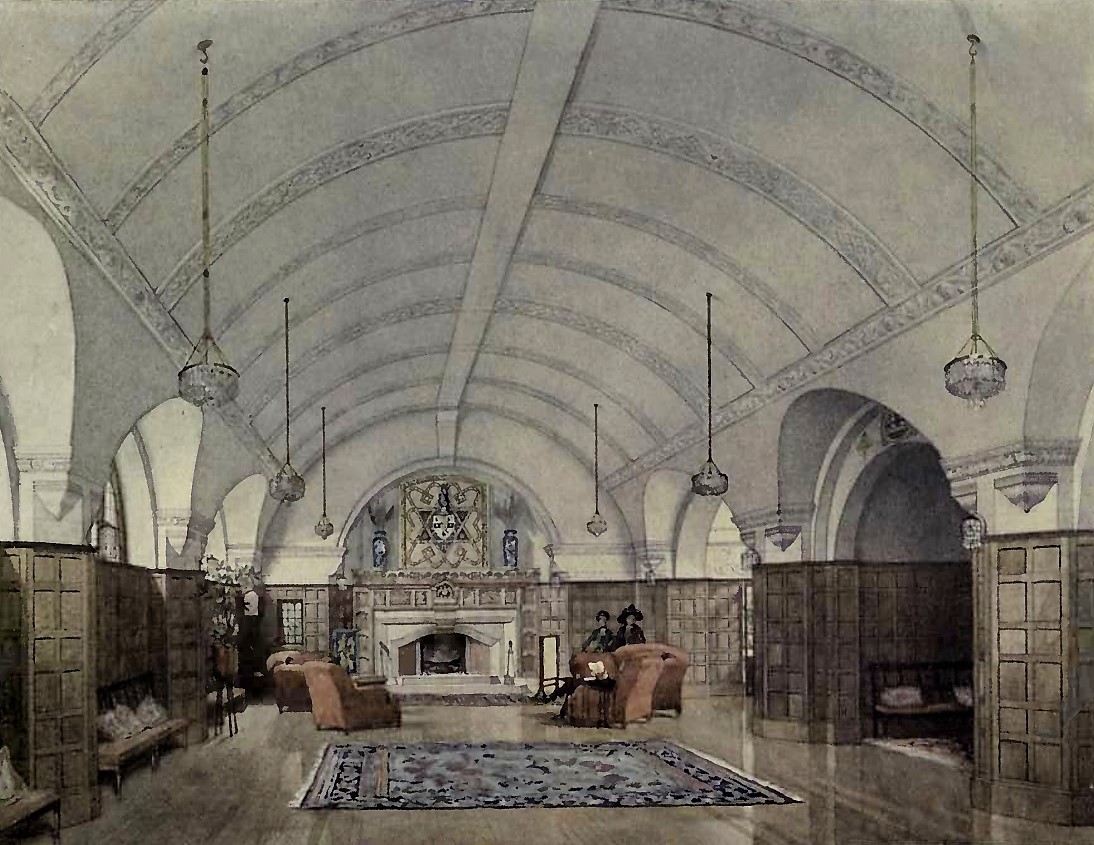
Rounton Grange: George Jack's scheme for the Common Room, published in Academy Architecture, 1910.
Alterations were made to the house in 1896, when Webb created a dining room for the upper servants in the western archway to the kitchen court, and in 1905-06 (for Sir Hugh Bell) when his former assistant, George Jack, added a long, spacious gallery which led to a bright, airy, quintessentially Edwardian 'Common Room' panelled in light oak, a stark contrast to the darker panelling of the original house. These additions marked the heyday of the house. The combination of the death duties on Sir Lowthian Bell's estate with a downturn in heavy industry meant that such a large house became too expensive for the family to live in. In the 1920s they moved to nearby Mount Grace Manor for most of the year, and from 1931, when they incurred further death duties on the death of Sir Hugh Bell, the house was shut up. It was requisitioned during the Second World War and used to house evacuees and later Italian prisoners of war, and the usual decay resulting from lack of maintenance set in. A further round of death duties on the death of Sir Maurice Bell in 1944 effectively sealed the fate of the house. Unable to afford the repairs or to live there the family unsuccessfully attempted to sell the house or to pass it to the National Trust, which was unable to accept it as the family could not provide the necessary endowment. Some of the outbuildings were taken down from 1951 and the house itself was dismantled in 1953-54. The family retained the estate but moved into Arncliffe Hall.

Descent: built for Sir Lowthian Bell (1816-1904), 1st bt.; to son, Sir Thomas Hugh Bell (1844-1931), 2nd bt.; to son, Sir Maurice Hugh Lowthian Bell (1871-1944), 3rd bt.; to half-nephew, Sir Hugh Francis Bell (1923-70), 4th bt., who demolished it in 1953-54.

Arncliffe Hall, Ingleby Arncliffe, Yorkshire (NR)

An important early house by John Carr of York with wonderful Rococo plasterwork, dated 1753 and built for Thomas Mauleverer  whose family had owned it since the 16th century.
Arncliffe Hall: the 17th century house from a sketch by Samuel Buck, 1718.
Either William Mauleverer (d. 1618), or his son Col. James Maulverer (d. 1664) must have been responsible for the first recorded house on the site, a three-bay early 17th century gabled building with an off-centre doorway, which was sketched by Samuel Buck in 1718. James, who was a colonel in the Parliamentary army, died a prisoner for debt in York Castle in 1664, and the estate was heavily mortgaged in the late 17th century. Timothy Mauleverer, who inherited in 1703, recouped the family fortunes by marrying an heiress, and his son Thomas (d. 1785), who married another (Miss Wilberfoss), was in a position to rebuild the old house. 

Arncliffe Hall: the entrance front after the fire in 1912, showing the service wing later pulled down, from a postcard.

Arncliffe Hall: the garden front in 1920. Image: Country Life.
His new house is of two-and-a-half storeys above a fairly high basement, with a tall ground floor and emphatic quoins. The garden front has a three-bay pediment and an elegant Palladian perron, but the entrance front is unrelieved. except for a pediment over the doorway, The house is one of Carr's earliest and the plan is surprisingly unsophisticated, owing more to the smaller manor houses common in Yorkshire since the 1680s than to Palladian models. The rather old-fashioned layout is, however, more than made up for by the wonderful Rococo plasterwork and chimneypieces in the drawing room, dining room and staircase hall. 

Arncliffe Hall: staircase ceiling in 1979.
Image: Nicholas Kingsley. Some rights reserved.
Arncliffe Hall: detail of saloon ceiling in 1979.
Image: Nicholas Kingsley. Some rights reserved.


The drawing room has a centre with a large figure of Venus and with Cupid flying; the staircase hall has a figure of Plenty hovering over Cleveland (represented by Rosebery Topping), and by a cow and cottage. Both figural panels are surrounded by the most light-hearted Rococo scrollwork. The plasterwork is patently of the York School and comparisons of details can be made with other Carr houses (eg Fairfax House, York or Lytham Hall (Lancs)). The plasterer at Lytham was Giuseppe Cortese, and the stucco at Arncliffe may also be by him. There are also very good chimneypieces in the house, the finest in the dining room. The staircase itself is 20th century, but the hall has four excellent doorcases. On the first floor is a lobby out of the staircase hall and a through-corridor from east to west, only partially preserved. 

Arncliffe Hall: the house today
Thomas Mauleverer outlived all his sons, and his five daughters became his co-heirs, but the estate was reunited in the next generation by his grandson, William Gowan (d. 1857), who assumed the name of Mauleverer. He was responsible for the addition of an east service wing to the house, which echoed the plain external form of the original house. The house and estate was sold in 1898 to Sir Isaac Lowthian Bell, 1st bt., but was badly damaged in a fire in 1912. In the subsequent restoration by Ambrose Poynter, the original pyramidal roof was replaced by one with a flat top and the staircase had to be replaced. After Sir John Bell inherited in 1970 the 19th century service wing was demolished and the remainder of the building restored. In the grounds are handsome stables, also by Carr and contemporary with the house, a summerhouse and two canals.

Descent: Sir Edmund Mauleverer (d. 1571); to son, William Mauleverer (d. 1618); to son, Col. James Mauleverer (d. 1664); gave estate in 1651 to son, Timothy Mauleverer; to son, Timothy Mauleverer (d. 1703); to son, Timothy Mauleverer; to son, Thomas Mauleverer (d. 1785); to daughters as co-heirs; estate reunited by grandson, William Gowan (later Mauleverer) (d. 1857); to daughters as co-heirs, of whom Georgina Helen, wife of Douglas Brown, bought out the others; to son, William Brown, who sold 1898 to Sir Lowthian Bell (1816-1904), 1st bt.; to son, Sir Thomas Hugh Bell (1844-1931), 2nd bt.; to son, Sir Maurice Hugh Lowthian Bell (1871-1944), 3rd bt.; to half-nephew, Sir Hugh Francis Bell (1923-70), 4th bt.; to son, Sir John Lowthian Bell (b. 1960), 5th bt.

Mount Grace Manor, Yorkshire (NR)

Mount Grace Priory is the best preserved of the seven medieval Carthusian houses in England. It was founded in 1398 and was one of the last monastic houses in Yorkshire to be dissolved, in December 1539. After the dissolution the buildings were allowed to gradually slide into dereliction, until in 1654, Thomas Lascelles (d. 1697) converted part of the west range that had been the guest house of the priory into a house, adding a porch and inserting mullioned and transomed windows.

Mount Grace Manor: the house built in the 17th century before restoration. Image: Victoria County History
By the late 19th century the condition of the priory buildings was giving the antiquarian community cause for concern, and, on hearing that the site might be for sale, the Society for the Protection of Ancient Buildings wrote to Sir Isaac Lowthian Bell in 1886 as a sympathetic local landowner, asking whether 'an association of gentlemen of the neighbourhood, making the request from patriotic motives, would be able to obtain the ruins’ and place them under the protection of a public body. Sir Isaac went to see the owner, Douglas Brown QC, who although sympathetic felt he was not in a position to help. However, his nephew and heir, William Brown, who inherited in 1892, was an antiquary, and he brought in the archaeologist Sir William St. John Hope to excavate the site, and in 1898 sold the entire Arncliffe Hall estate, including Mount Grace, to Bell, who set about repairing and conserving the monastic ruins and restoring and enlarging the 17th century house as another family home. He at first attempted to prise Philip Webb out of retirement to work on the project, but Webb politely declined, and he turned instead to Alfred Powell, a SPAB protégé, to repair the monastic ruins. Powell began work, but had to abandoned the project and take a sea voyage when he developed pleurisy, and between 1901 and 1905 the work continued under Ambrose Poynter, who soon attracted criticism for his handling of the ruins (Webb thought he was "not up to the craft"), and his reconstruction of one of the monk's cells.

Mount Grace Manor: the house today. Image: English Heritage.
Poynter had been brought in first for the proposed restoration and extension of the 17th century house as a family home for the Bells. The building was then described as being ‘in a bad state of decay and was hardly more than a farmhouse, inhabited by a caretaker whose cows grazed in the inner courtyard of the priory’. Poynter repaired the structure, exposing ancient features such as the inglenook fireplace in the old kitchen (now the shop), and added a projecting wing containing a library at the rear. At the front, he opened an additional window on the first floor, which is dated but otherwise indistinguishable from the original 17th century windows. Inside, the rooms Poynter refitted have a modest Arts & Crafts character, with modern tiled fireplaces inserted into 17th century surrounds, while in the hall, the walls were lined with salvaged old panelling. The drawing room now houses the Morris carpet from Red Barns.

When work on the house was complete, Mount Grace became a weekend retreat, used for entertaining and shooting parties, but from the 1920s onwards it increasingly replaced Rounton Grange as the family’s main residence. Archaeological work on the ruins continued at intervals, and in 1927, the priory became the stage for the three day Pageant of Mount Grace, written and organised by Sir Hugh Bell’s second wife, the author and playwright Florence Bell, which told the story of the monastery in words, action, dance and music, with the participants in medieval costume. It was directed by Edith Craig (the daughter of the actress Ellen Terry), and was captured on film. 

The continuing financial decline of the Bells made the future of Mount Grace problematic. Sir Hugh Bell, 4th baronet, moved to Arncliffe Hall after the Second World War, and there was a rumour that Mount Grace might again be a Carthusian monastery. In 1950, he explored placing the site in the guardianship of the Ministry of Works, which expressed interest but wanted to separate the house from the ruins by a high fence and demolish the wing added in 1901 and even that built in 1654. Fortunately this was avoided when Sir Hugh brokered a deal by which Mount Grace was accepted in lieu of death duties and allocated to the National Trust. Today, the site is administered by English Heritage, who although the lineal successors of the Ministry of Works no longer harbour a barbarous desire to demolish the house and did indeed restore it about ten years ago.

Bell family of Rounton Grange, baronets


Bell, Thomas (1784-1845). Son of Isaac Bell (c.1753-1830) of Low Hurst, Wreay (Cumbld.) and his wife Grace Slack (d. 1828), baptised at Wreay, 5 March 1784*. His father's farm at Wreay adjoined the Losh family estate, and in 1808 he joined Losh & Co. of Newcastle-on-Tyne, a firm of engineers who were branching out into the manufacture of alkali and iron at Jarrow (Co. Durham). In due course, he became a partner in the firm (then Losh, Wilson & Bell). Alderman of Newcastle-on-Tyne. He married, 30 March 1815 at St Cuthbert, Carlisle (Cumbld), Catherine (c.1786-1875), daughter of Isaac Lowthian of Newbiggin (Cumbld), and had issue including:
(1) Sir (Isaac) Lowthian Bell (1816-1904), 1st bt. (q.v.);
(2) Thomas Bell (1817-94), baptised at St Andrew, Newcastle-on-Tyne, 3 September 1817; partner in Bell Bros. & Co. from 1850 until he retired and moved to Switzerland; married, 8 September 1842 at St Mary, Gateshead (Co. Durham), Frances Jane (1821-1900), daughter of Joshua Johnson of Redheugh (Co. Durham), and had issue six sons and four daughters; died in Switzerland, 21 November 1894; administration of goods granted to his widow, 15 January 1895 (estate £933);
(3) John Bell (1818-88) [for whom see below, under Bell of Rushpool Hall];
(4) Mary Grace Bell (1820-98), baptised at St Andrew, Newcastle-on-Tyne, 9 August 1820; married, 11 May 1858, as his second wife, George Routledge (1812-88), publisher, son of Robert Routledge, and had issue one son and one daughter; died 16 August 1898; will proved 14 October 1898 (estate £23,147);
(5) Catherine Bell (1822-1905), baptised at St Andrew, Newcastle-on-Tyne, 14 January 1822; married, 18 June 1857 at St Nicholas, Newcastle-on-Tyne, William Henry Porter (1816-1905), and had issue six daughters; died 16 November 1905; will proved 28 December 1905 (estate £1,094);
(6) Sarah Bell (1823-1911), baptised at St Andrew, Newcastle-on-Tyne, 5 August 1823; married, 18 May 1843 at St Andrew, Newcastle-on-Tyne, Robert Twentyman Lightfoot (1815-1908), surgeon, and had issue three sons and three daughters; died 31 March and was buried at Jesmond Old Cemetery, Newcastle-on-Tyne, 4 April 1911; will proved 24 May 1911 (estate £44,554);
(7) William Bell (1825-26), born about August 1825; baptised at St Andrew, Newcastle-on-Tyne, 12 March 1826; died in infancy, 14 June 1826;
(8) Henry Bell (1828-89), baptised at St Andrew, Newcastle-on-Tyne, 3 October 1828; married, 20 December 1853 at St Andrew, Newcastle-on-Tyne, Frances Laura (1828-82), daughter of William Richardson, and had issue one son and one daughter; died at Lucerne (Switzerland), 15 August 1889; will proved 7 September 1889 (estate £12,783);
(9) Hugh Bell (b. 1830), baptised at Newcastle-on-Tyne, 2 March 1830; perhaps died in infancy.
He lived at Picton Place, Newcastle-on-Tyne.
He died 20 April 1845 and was buried at Jesmond Old Cemetery, Newcastle-on-Tyne. His widow died 11 September 1875; her will was proved 23 March 1876 (effects under £9,000).
* Not 1774 as in many online genealogies.

Sir Isaac Lowthian Bell (1816-1904), 1st bt. 
Bell, Sir (Isaac) Lowthian (1816-1904), 1st bt.
Eldest son of Thomas Bell (1784-1845) and his wife Katherine, daughter of Isaac Lowthian of Newbiggin (Cumbld), born 15 February and baptised at St Andrew, Newcastle-on-Tyne, 20 June 1816. Educated at John Bruce's Academy, Newcastle-on-Tyne, Edinburgh University and the Sorbonne, Paris. After joining his father's business (Losh, Wilson & Bell) in 1836, he 
became one of the leading metallurgical chemists, writing classic works on the smelting and manufacturing of iron and steel. In 1852 he founded the Washington Chemical Co. in partnership with his father-in-law, and retired from Losh & Wilson. In 1844, with his brothers John and Tom, Lowthian also formed Bell Bros & Co., which became an iron and steel empire supplying a third of the metal used in the UK and exporting extensively to projects across the British Empire; it became a limited company in 1873. By a focus on vertical integration, Bell Brothers came to own the whole process of steel production from the mining of ores and coal, through transport by railway, to the production facilities, and employed 47,000 men; the company also owned a chemical plant which became the first to manufacture aluminium. To transport his iron and coal he built the Cleveland Railway, and after this was sold to the North-Eastern Railway Co., he became a director there (Deputy Chairman, 1895-1904). He was the author of many scientific and promotional publications for the iron and steel industry, and became a collector of contemporary art. Mayor of Newcastle-on-Tyne, 1854, 1862; JP and DL for Co. Durham, Newcastle-on-Tyne, and the North Riding of Yorkshire; High Sheriff of Co. Durham, 1884; Liberal MP for Hartlepool, 1875-80. He became a Member of the Institution of Mechanical Engineers, 1858; was made a Fellow of the Royal Society, 1875; and was awarded several honorary degrees. He was a juror at the Paris Exhibition of 1878 and was made an Officer of the Legion d'honneur. He was created a baronet, 21 July 1885. He married, 20 July 1842 at Newcastle-on-Tyne, Margaret (1820-86), daughter of Hugh Lee Pattinson FRS, a metallurgical chemist, of Scots House (Co. Durham), and had issue:
(1) Sir Thomas Hugh Bell (1844-1931), 2nd bt. (q.v.);
(2) Margaret Florence Bell (1847-1930), baptised at Longbenton (Northbld), 12 October 1847; married, 10 August 1871 at Washington (Co. Durham), Walter Johnson (1842-1915), a lieutenant in the Royal Scots Greys but later an iron merchant and a director of Bell Bros & Co., ironmasters, only son of Rev. Walter Rankin Johnson (1787-1844) of West Wycombe (Bucks), and had issue two sons and four daughters; died 27 March 1930; will proved 15 November 1930 (estate £17,464);
(3) Mary Katherine Bell (1848-1929), baptised at Longbenton, 1 January 1849; married, 5 February 1873 at Washington Hall, Rt. Hon. Edward Lyulph Stanley (1839-1925), MP for Oldham, 1880-85 and from 1903, 4th Baron Stanley of Alderley, 4th Baron Sheffield and 3rd Baron Eddisbury, and had issue three sons and five daughters; died 4 January 1929 and was buried at Nether Alderley (Ches.); will proved 13 March 1929 (estate £53,754);
(4) Ada Phoebe Bell (1850-1900), born 26 May and baptised 21 September 1850; married, 17 October 1876 at Hutton Rudby (Yorks NR), Lt-Col. Arthur Fitzpatrick Godman (1842-1930) of Smeaton Manor (Yorks NR), son of Joseph Godman of Park Hatch (Surrey), and had issue two sons; died 28 January 1900 and was buried at Great Smeaton (Yorks NR);
(5) Charles Lowthian Bell (1855-1906), born 24 March 1855; educated at Wellington College and Ecole des Mines, Paris; a partner in Bell Bros & Co., ironmasters; JP for North Riding of Yorkshire and Middlesborough; Mayor of Middlesborough, 1892; an officer in 1st North Riding Volunteer Artillery (Lt. Col. commanding); lived at Ashgate, Linthorpe (Yorks NR); married, 21 April 1885 at Hayton (Cumbld), his cousin, Helen (1860-1915), daughter of William Henry Porter of Heads Nook (Cumbld), but had no issue; died of pneumonia, 8 February 1906 and was buried at Acklam (Yorks NR); will proved 19 April 1906 (estate £182,864);
(6) Ellen Maud Bell (b. & d. 1860), born 7 June 1860; died in infancy.
He built and later enlarged Washington Hall (Co. Durham) in the 1850s and 1860s, and bought the East Rounton estate (Yorks NR) in 1865 from John Wailes, on which he built Rounton Grange to the designs of Philip Webb in 1872-76. He bought the Arncliffe Hall estate (including Mount Grace Priory) in 1900.
He died 20 December and was buried at East Rounton, 23 December 1904; his will was proved 30 January 1905 (estate £768,676). His wife died 18 November 1886 and was buried at East Rounton.

Sir Hugh Bell, 2nd bt. 
Bell, Sir (Thomas) Hugh (1844-1931), 2nd bt.
Elder son of Sir (Isaac) Lowthian Bell (1816-1904), 1st bt. and his wife Margaret, daughter of Hugh Lee Pattinson of Scots House (Co. Durham), born at Walker-on-Tyne, 10 February 1844. Educated at Merchiston Castle School, Edinburgh; and in Paris and Göttingen. Ironmaster and coal owner; Chairman of Bell Bros. & Co., Dorman Long & Co., Pearson and Dorman Long & Co., and Horden Collieries Ltd; director of North-Eastern Railway Co. and Yorkshire Insurance Co. JP and DL for Co. Durham and JP for North Riding of Yorkshire and Middlesborough; High Sheriff of Co. Durham, 1895; Mayor of Middlesborough, 1874, 1883 and 1911; Lord Lieutenant of the North Riding of Yorkshire, 1906-31; Alderman of the North Riding County Council. President of the Iron and Steel Institute, 1907-10; member of the Senate of Durham University; awarded honorary degrees by Durham University (DCL 1909), Leeds University (LLD, 1910), Oxford University (DCL, 1929) and Sheffield University (DCL, 1930); Fellow of the Society of Antiquaries of London. He twice stood for Parliament as a Liberal but was unsuccessful on both occasions, possibly because he deliberately chose 'unwinnable' seats. He succeeded his father as 2nd baronet, 20 December 1904. He was an enthusiastic traveller, and visited Australia in 1925. He married 1st, 23 April 1867 at Rothesay (Buteshire), Mary (1843-71), daughter of John Shield of Newcastle-on-Tyne and Ashburn, Isle of Bute, and 2nd, 10 August 1876 at Holy Trinity, Sloane Street, Chelsea (Middx), Dame Florence Eveleen Eleanor DBE JP (1851-1930), novelist and playwright, daughter of Sir Joseph Oliffe MD (1808-69), physician to the British Embassy in Paris, and had issue:
(1.1) Gertrude Margaret Lowthian Bell (1868-1926), born at Washington Hall, 14 July 1868; an intellectually and athletically gifted child who was encouraged to study unlike many girls of her age and class; educated at Queen's College, Harley St., London and Lady Margaret Hall, Oxford (admitted 1886; 1st class honours in history, 1888), followed by extensive travels in eastern Europe, 1888-89; Persia, 1892; western Europe, 1893-95, and world tours with her brother Maurice, 1897-98 and half-brother Hugo, 1902-03; she spent the summers of 1899-1904 mountaineering in the Alps, climbing Mont Blanc and the Matterhorn; and from 1900 began exploring the Middle East, visiting Jerusalem, Syria, Turkey, and what later became Iraq as an explorer, archaelogist, author and Arabic scholar; during First World War she worked first for the Red Cross and in 1915 joined the Arab Bureau, being seconded to the Mesopotamian Expeditionary Force as an Assistant Political Officer and subsequently acting as Oriental Secretary to the British High Commissioner for Iraq, 1920-26; her political views and support for Arab self-determination gradually becoming extremely influential; she was elected a Fellow of the Royal Geographical Society in 1913 and appointed CBE, 1917; in the intervals between her travels she laid out the gardens of Rounton Grange and became a leading figure in the Women's National Anti-Suffrage League; at the end of her life she raised funds for the establishment of the National Museum in Baghdad (Iraq); she had become an aetheist in religion by 1902; she was unmarried, having twice been disappointed in love, and suffered from depression at the end of her life; she died in Baghdad from an overdose of sleeping tablets, 12 July 1926, and was buried in the British Cemetery there the same day; will proved 15 December 1926 (estate £25,604);
(1.2) Sir Maurice Hugh Lowthian Bell (1871-1944), 3rd bt. (q.v.);
(2.1) Rev. Hugh Lowthian (k/a Hugo) Bell (1878-1926) (q.v.);
(2.2) Florence Elsa Bell (1880-1971), born 9 March 1880; married, 8 July 1907 at East Rounton, Adm. Sir Herbert William Richmond KCB (1871-1946), naval historian and Master of Downing College, Cambridge, 1934-46, second son of Sir William Blake Richmond KCB RA, artist, and had issue one son and four daughters; died aged 91 on 3 May 1971 and was buried at East Rounton; will proved 7 September 1971 (estate £19,881);
(2.3) Mary Katharine (k/a Molly) Bell (1881-1966), born 12 October 1881; educated at Queen's College, Harley St., London; political hostess and charity worker; one of the founders of the Council for the Protection of Rural England; a supporter of women's suffrage (unlike her half-sister); appointed OBE, 1963; a Unitarian in religion; married, 6 January 1904 at Holy Trinity, Sloane St., Chelsea, Sir Charles Philips Trevelyan (1870-1958), 3rd bt., of Wallington Hall (Northbld), Liberal and later Labour MP, President of Board of Education, 1929-31, eldest son of Rt. Hon. Sir George Otto Trevelyan, 2nd bt., and had issue three sons and four daughters; died 8 October 1966; will proved 18 April 1967 (estate £30,423).
He lived at Red Barns, Redcar (Yorks NR), which was built for him by Philip Webb in 1868-70, until he inherited Rounton Grange and Arncliffe Hall from his father in 1904. He restored and remodelled Arncliffe Hall after a fire in 1912. From the 1920s he lived chiefly at Mount Grace Manor, the former guest house of Mount Grace Priory, which he had restored and remodelled.
He died 29 June 1931 and was buried at East Rounton; his will was proved 29 September 1931 (estate £264,909) and 3 February 1953 (estate in settled land £16,000). His first wife died 19 April and was buried at West Rounton, 22 April 1871. His second wife died 16 May and was buried at East Rounton, 19 May 1930; her will was proved 3 October 1930 (estate £1,680).

Bell, Sir Maurice Hugh Lowthian (1871-1944), 3rd bt. Only son of Sir (Thomas) Hugh Bell (1844-1931), 2nd bt. and his first wife, Maria, daughter of John Shield of Asburn (Isle of Bute), born 29 March 1871. Educated at Eton and Royal Military College, Sandhurst. An officer in the Territorial Army (2nd Lt., 1891; Capt., 1901; Lt-Col. of 4th Battn, Yorkshire Regiment, 1913-17, 1920-23; Hon. Col., 1927), who served in the Boer War and First World War (mentioned in despatches twice); appointed CMG, 1916. JP (from 1896) and DL (from 1895) for North Riding of Yorkshire; High Sheriff of Co. Durham, 1921-22. A director of Bell Bros & Co., and after they merged with Dorman Long & Co., of the latter firm. He succeeded his father as 3rd baronet, 29 June 1931. He was supporter of the Hurworth Hunt and an enthusiastic participant in shooting and fishing. He was unmarried and without issue.
He inherited Rounton Grange, Mount Grace House and Arncliffe Hall from his father in 1931.
He died 17 November 1944 and was cremated at Newcastle; his ashes were interred at East Rounton, 21 November 1944. His will was proved 6 September 1945 (estate £206,838).

Bell, Rev. Hugh Lowthian (k/a Hugo) (1878-1926). Only son of Sir (Thomas) Hugh Bell (1844-1931), 2nd bt. and his second wife, Dame Florence Eveleen Eleanor DBE JP, daughter of Sir Joseph Oliffe MD, born at Redcar, 21 October 1878. Educated at Trinity College, Oxford (matriculated c.1898; BA 1901; MA 1904) and Cuddesdon Theological College. Ordained deacon, 1908 and priest, 1912. Curate at Guiseley, 1908-12; domestic chaplain to Bishop Furse, Bishop of Pretoria, in South Africa, 1912-20; thereafter a licenced preacher in the diocese of Bradford. He married, 24 November 1921 at Kirkby Malhamdale (Yorks), Frances Helena (1895-1988), only daughter of John William Morkill JP DL of Newfield Hall, Bell Busk (Yorks) and had issue:
(1) Sir Hugh Francis Bell (1923-70), 4th bt. (q.v.);
(2) John Lowthian Bell (1925-44), born in Johannesburg, 17 June 1925; served as an Ordinary Seaman in Royal Navy Volunteer Reserve in Second World War and was killed in action on HMS Warwick, 20 February 1944; buried at St Merryn (Cornw).
He contracted typhoid fever on the voyage home after visiting South Africa in 1925, and died in London, 2 February 1926; administration of his goods was granted to his widow, 9 April 1926 (estate £73,685). His widow died 2 February 1988 and was buried at Ingleby Arncliffe; her will was proved 19 April 1988 (estate £195,403).

Bell, Sir Hugh Francis (1923-70), 4th bt. Elder son of Rev. Hugh Lowthian Bell (1878-1926) and his wife Frances Helena, only daughter of John William Morkill JP DL of Newfield Hall, Bell Busk (Yorks), born in Johannesburg, 7 December 1923. Educated at Bryanston School. An officer in the Royal Naval Volunteer Reserve, 1942-46. He succeeded his half-uncle as 4th baronet, 17 November 1944. He married 1st, 17 October 1947 (div. 1959), Mary Helen (d. 2000), daughter of Archibald Mathieson of London NW11; and 2nd, 11 August 1959, Mary JP MD BCh DObst RCOG, second daughter of George Howson MC of The Hyde, Hambleden (Bucks), and had issue:
(2.1) Sir John Lowthian Bell (b. 1960), 5th bt. (q.v.);
(2.2) David Hugh Bell (b. 1961), born 8 October 1961;
(2.3) Andrew Mark Howson Bell (b. 1963), born 6 August 1963; commissioning editor for Arts programmes with BBC; a director of the Showroom Gallery Ltd., London NW8; married, 1993, Baindu A. Bright;
(2.4) Thomas Hugh Bell (b. 1965), born 16 January 1965; married, 1999, Penelope Jane Aird, younger daughter of Reginald Whittome of Gerrards Cross (Bucks) and had issue one son.
He inherited Rounton Grange and Arncliffe Hall from his half-uncle in 1944, but demolished Rounton in 1953-54. He lived subsequently at Arncliffe Hall.
He died 6 August 1970. His first wife died in February 2000. His widow married 2nd, Prof. Dominick Stuart Graham MC (d. 2013), and died in 2000.

Bell, Sir John Lowthian (b. 1960), 5th bt. Eldest son of Sir Hugh Francis Bell (1923-70) and his second wife, Mary JP MB BCh DObst RCOG, second daughter of George Howson MC of The Hyde, Hambleden (Bucks), born 14 June 1960. He succeeded his father as 5th baronet, 6 August 1970. Educated at Trinity College, Glenalmond and Royal Agricultural College, Cirencester. Farmer and landowner. He married, 22 June 1985, Venetia Mary Frances (b. 1962), second daughter of John Ambrose Perry (1927-2000) of Llanstefan, Taunton (Som.), and had issue:
(1) John Hugh (k/a Jack) Bell (b. 1988), born 29 July 1988; heir apparent to baronetcy; married, 29 June 2019 at Ingleby Arncliffe, Laura, younger daughter of John Charrington of Sydney (Australia);
(2) Sophia Amelia Bridget Bell (b. 1990), born 10 April 1990.
He inherited Arncliffe Hall from his father in 1970.
Now living. His wife is now living.

Bell of Rushpool Hall, Saltburn-by-the-Sea


Bell, John (1818-88). Third son of Thomas Bell (1784-1845) and his wife Katherine, daughter of Isaac Lowthian of Newbiggin (Cumbld), baptised at St Andrew, Newcastle-on-Tyne, 31 October 1818. A partner in Bell Bros & Co. He married, 23 August 1865 at Christ Church, Lancaster Gate, London, his illegitimate daughter's companion, Margaret Elizabeth (1842-1910), daughter of John Robinson of Silcoates, Wakefield (Yorks WR), and had issue:
(1) Evelyn Frances Bell (1866-1953), born at Skelton, 25 September 1866; married 1st, 12 May 1891 (div. 1908) at the English church, Algiers, John Edward Courtenay Bodley (1853-1925), barrister, author and private secretary to Sir Charles Dilke, son of Edward Fisher Bodley (1815-81) of Dane Bank House, Congleton (Ches.), pottery manufacturer, and had two sons and one daughter; married 2nd, 1910, Herbert Leavitt Hunt (1877-1960) of New York (USA); died at Villa Gaintzuriena, Guéthary, Basse-Pyrénées (France), 31 October 1953, and was buried at Guéthary;
(2) Lillian Margaret Bell (1875-1963), born 16 September 1875; a talented amateur artist; married, 17 August 1898 at Skelton, Maj. Clive Macdonald Dixon (1870-1914), son of Sir Raylton Dixon, kt., shipbuilder, and had issue three sons and three daughters; died 12 June 1963 and was buried at Kirby-in-Cleveland (Yorks NR); will proved 1 August 1963 (estate £33,882);
(3) Sybil Maud Bell (1883-1957), born 30 August 1883; married 1st, 28 July 1904 (div. 1914 on the grounds of her adultery), Henry John Pack-Beresford (b. c.1872) of Kellestown House (Co. Carlow), son of Capt. Denis William Pack-Beresford, and had issue two sons; married 2nd, 30 November 1914, Air Chief Marshal Sir Charles Stuart-Burnett KCB CB DSO (1882-1945) of Barra Castle, Old Meldrum (Aberdeens.), and had issue four daughters, the eldest of whom was born prior to the marriage; died at Dalmally (Argylls), 8 February 1957, and was buried at Kilmalieu Burial Ground, Inveraray (Argylls); will proved 10 April 1957 (estate £28,142). 
Prior to this marriage, he had a relationship with Margaret Ann (b. c.1825), daughter of George Cowan of Newcastle-upon-Tyne, grocer, who was sometimes described as his wife, although they did not live together and he was officially unmarried at the time of the 1851 census*, and they had issue:
(X1) Amelia Serena (k/a Amy) Bell (1845-73), baptised at St Oswald, Durham, 24 January 1845; married, 23 August 1865 at St George, Hanover Sq., Westminster (Middx), Col. Hugh Stewart Cochrane VC (1829-84), but had no surviving issue; died at Cork (Co. Cork), 7 January 1873; will proved 16 October 1873 (estate under £4,000);
(X2) John Charles Bell (1853-93), baptised at Ripon Cathedral (Yorks WR), 13 December 1853; an officer in 2nd West Yorkshire Militia (Sub-Lt., 1875; Lt. 1876; retired 1879) and reputedly also in the Turkish Army; lived at Langbaurgh Hall, Great Ayton (Yorks); married, 8 November 1884 (but sep. shortly before his death) at St James Piccadilly, Westminster, Ethel (1858-1939) (who m2, 1897 'by declaration' and again in 1900 before a London registrar (div. 1908), as his second wife, Arthur John Clark Kennedy (1857-1926) of Eustace Lodge, Fylingdales (Yorks NR)), daughter of Nicholas Frank Dobrée, of Beverley (Yorks ER) and Beau Séjour (Guernsey), merchant, and had issue two sons and two daughters; committed suicide, 23 February 1893; will proved 10 June 1893 (effects under £42,000);
(X3) Margaret Louisa Bell (b. & d. 1856), baptised at Holy Trinity, Ripon, 10 January 1856; died in infancy and was buried at Sharow Chapel, Ripon, 14 January 1856;
(X4) Clara Ann Bell (1857-1939), born 22 June and baptised at Sharow Chapel, Ripon, 6 August 1857; married, 6 August 1879 at All Saints, Skelton, Capt. William Loftus Wigram (1852-97), son of Rt. Rev. Joseph Cotton Wigram (1798-1867), Bishop of Rochester, but had no issue; died 17 November 1939; will proved 10 January 1940 (estate £33,519);
(X5) William Henry Bell (b. & d. 1858), baptised at Holy Trinity, Ripon, 18 February 1858; died in infancy and was buried at Sharow Chapel, Ripon, 22 February 1858.
He lived at Rushpool Hall, Skelton, Saltburn-by-the-Sea (Yorks NR) which he built in 1863-64, and at Mustapha Rais, Algiers, which he purchased in 1868 and remodelled. His widow lived in Algiers in the 1890s when Rushpool Hall was let, but had returned to the house before it burned down in 1904. It was sold soon afterwards.
He died in Algiers, 21 January 1888, and was buried in the Anglican church there; will proved 11 May 1888 (estate £187,312). His first wife or partner probably died between 1861 and 1865. His widow died 23 April 1910; her will was proved (estate £13,348).
* However, he described himself as married in the 1861 census and as a widower at the time of this recorded marriage, so it is possible that a marriage took place after 1851, but I have been unable to trace it.

Principal sources

Burke's Peerage and Baronetage, 2003, p. 331; L. Weaver, 'Rounton Grange, Yorkshire', Country Life, 26 June 1915; S. Kirk, Philip Webb: pioneer of Arts & Crafts architecture, 2005, pp. 118-25, 180-81, 215-17; J. Uglow, The Pinecone, 2012, pp. 12, 93, 96; G. Stamp, 'The saving of Mount Grace Priory', Country Life, 1 October 2017; M. Roberts, Sir N. Pevsner & E. Williamson, The buildings of England: County Durham, 3rd edn, 2021, pp. 762-63; Yorkshire Gardens Trust report on Rounton Grange, 2018;


Location of archives

Bell family of Rounton Grange, baronets: deeds, estate and family papers, c.1400-20th cent. [North Yorkshire Record Office ZFK]

Coat of arms

Argent, on a fesse between three hawk's lures azure, as many hawk's bells of the first.

Can you help?

  • Can anyone provide additional photographs of the interior of Rounton Grange, or other early images of the houses discussed here?
  • Can anyone explain why Thomas Bell (1817-94) was comparatively impoverished at the time of his death?
  • Can anyone provide portraits of the people whose names appear in bold above, for whom no image is currently shown?
  • If anyone can offer further information or corrections to any part of this article I should be most grateful. I am always particularly pleased to hear from current owners or the descendants of families associated with a property who can supply information from their own research or personal knowledge for inclusion.

Revision and acknowledgements

This post was first published 11 March 2023 and updated 14 March 2023. I am grateful to Murray Franklin for corrections.