 |
| Benyon of Englefield |
The Benyon family were established as merchants in London throughout the 17th century. Daniel Benyon (d. 1690) was master of the tallow chandlers' company in 1689-90, and his son, Daniel Benyon (1664-1708), with whom the genealogy below begins, perhaps continued his father's business. By the time of his death in 1708 he was living at Blackheath (Kent), and in less than two years he was followed to the grave by his daughter and his widow, all three of them being buried at Lee (Kent). This left only his young son, Richard Benyon (1698-1774), orphaned at the age of eleven, for whom responsibility evidently fell on Col. John Perry, probably a neighbour or friend of his father. In what seems at first sight an uncommonly callous and risky action, Perry sent the boy out to India, but it is not known what arrangements were made for him there, or indeed for his care during the journey. On arrival, he was taken into the household of Osmond de Beauvoir, who in due course arranged for his employment by the East India Company as a writer and later as a colonial administrator. He evidently showed some aptitude for the work, for at the age of just twenty he was appointed to the Council of Fort St. George (later Madras and now Chennai), and served in that role until 1725, when he made a first return to England, bringing with him his first wife. Richard had evidently already begun to make money in India, for in 1728 he bought the manor of Coptfold at Margaretting. He probably intended to make this his principal residence at the time, for he constructed a family vault in Margaretting church where he and several members of his family were later buried, but in about 1732 he returned to India, rejoining the Council at Fort St George and in 1735 heing appointed President or Governor of the Fort. Employment as an official of the East India Company offered many opportunities for private enrichment, which varied from straightforward commercial side-hustles to outright bribery, corruption and extortion. In the relatively lawless world of the Indian sub-continent, Benyon's hands seem to have been cleaner than most, but he still returned to England at the end of his Governorship in 1744 with a fortune estimated at £75,000. Once settled in England he bought further property in Essex, including the Gidea Hall estate in 1745, the Newbury estate in Ilford in 1747, and the North Ockendon Hall estate in 1758. He also married again, this time to Mary Wrighte (1714-77), who was the niece of the Osmond de Beauvoir who had taken him into his household in India thirty years earlier and also the widow of Powlett Wrighte of Englefield House, in which she held a life interest.
Richard and Mary Benyon made a town house in Grosvenor Square, London, their principal residence (although they do seem to have spent time at both Gidea Hall and Englefield), and there they raised their son, Richard Benyon II (1746-96) as well as Mary's son by her first marriage, Powlett Wrighte (1739-79). Once they reached adulthood, Powlett took possession of Englefield House and Richard junior made his home at Gidea Hall, and both men were responsible for alterations. Powlett died without issue in 1779 and the Englefield estate passed to his uncle, Nathan Wrighte (1717-89) for life, with remainder to Richard Benyon II, whose eldest son, Richard Benyon III (later Benyon de Beauvoir), was about to come of age. Probably recognising that Englefield, with its 11,000 acre estate, was a significantly grander property than Gidea Hall, Richard Benyon II installed his son at Englefield and left instructions in his will that Gidea Hall should be sold for the benefit of his younger children, although the other Essex property was retained for several further generations.
Richard Benyon III was married in 1797 to Elizabeth, the daughter of Sir Francis Sykes, another Indian nabob, whose seat at Basildon Park (Berks) lay fairly close to Englefield. Although the couple seem to have been happily married until Elizabeth's death in 1822, the fact that they had no children to inherit their Berkshire and Essex property did not deter Richard from remodelling Englefield House to the designs of Thomas Hopper. Richard had adopted the additional names Powlett Wrighte before Benyon in 1814, and in 1822 he changed his name again to Benyon de Beauvoir, on inheriting the Hackney (Middx) estate of his elderly great-great-uncle, the Rev. Peter de Beauvoir, rector of Downham (Essex). Shortly before his death, de Beauvoir had leased his entire estate at Hackney to William Rhodes (the grandfather of Cecil Rhodes, the explorer), a speculative builder who had plans for developing the area as an up-market residential district. Richard Benyon de Beauvoir quickly realised that the lease, which gave him a paltry £1,200 a year, divided the returns from developing the estate unfairly, and he asked the courts to set it aside on the grounds that his great-great-uncle had not understood what he was agreeing to. The case was hotly contested and went all the way to the House of Lords, but final judgement was given in his favour in 1834. Having recovered possession, he implemented a new plan, developing the area as middle-class housing, the rents from which quickly made him an extremely wealthy man. When he died in 1854, the press speculated wildly about his net worth, estimating it at £7,500,000. That figure was vastly overstated, but the estate income in the 1880s suggests that the capital value might have been as much as £2.5 million. His wealth was not derived wholly from the Hackney estate, for in 1824, before development began, he was in a position to purchase the Culford Hall estate (Suffk) from the estate of Lord Cornwallis for £230,000, perhaps financed partly by borrowing. In 1839 he settled this property on his nephew, the Rev. Edward Richard Benyon (1802-83), who is said to have been born at Lausanne (Switzerland) in 1802 but who first appears on the public record when he went to Cambridge in 1820.
When he died in 1854, Richard Benyon de Beauvoir left Englefield House, the Hackney estate and his remaining Essex property to a genuine nephew, Richard Fellowes (1811-97), who was the second surviving son of Benyon de Beauvoir's sister Emma and her husband, William Henry Fellowes (1769-1837). He was the middle one of three brothers, collectively known as 'the lucky Fellowes', who all acquired country houses as a result of inheritances. Richard, who was a barrister, took the name Benyon at his uncle's request and settled at Englefield House, which he again remodelled in the late 1850s to the design of a little-known Scottish architect, Richard Armstrong. Richard Benyon served as chairman of the Berkshire Quarter Sessions for twenty years, and was noted as a philanthropist, said to have built more churches on and around his estates than any other man in modern times, although he kept his donations quiet, 'having a dread of his benevolent actions becoming known'.  |
| Kingston Maurward House |
He and his wife had three daughters, but no son to succeed him, so at his death in 1897 the estates again passed to a nephew, this time his brother James' son, James Herbert Fellowes (1849-1935). James had also inherited Kingston Maurward House (Dorset) from his father, but he sold this in 1906. He took the name Benyon in 1897 and was Lord Lieutenant of Berkshire from 1901 until his death, when he was succeeded by his only son, Sir Henry Benyon (1884-1959), 1st bt, who was raised to a baronetcy in 1958. Sir Henry sold the remaining Essex estates to clear the death duties payable on his father's estates, but was able to retain the Englefield House and Hackney properties, although due to wartime restrictions during after the Second World War his properties deteriorated in both condition and value. He served as Lord Lieutenant, 1945-59, like his father, and was briefly Chairman of Berkshire County Council.
Sir Henry and his wife had no children, so at his death his estates passed to his second cousin, Vice-Admiral Richard Benyon Shelley (1892-1968), the younger son of Col. Sir John Shelley (1848-1931), 9th bt. and his wife Marion Emma Benyon, daughter of Richard Fellowes (later Benyon) (1811-97). Admiral Shelley took the name Benyon, but passed the estate straight on to his eldest son, Sir William Richard Shelley (later Benyon) (1930-2014), kt., who as Bill Benyon was a long-serving MP for Buckingham and later Milton Keynes, 1970-92, and who was knighted in 1994 after retiring from the Commons. Sir Bill effected a remarkable transformation in the fortunes of his estates, carefully restoring Englefield House and encouraging and supporting the 'gentrification' of his Hackney property, with a resulting growth in the rental income it provides. He handed the estates over to his elder son, the Rt. Hon. Richard Henry Ronald Benyon (b. 1960) in about 2010. Mr. Benyon also pursued a political career, serving as MP for Newbury, 2005-19, and being made a life peer as Baron Benyon in 2021. He has continued the process of developing and diversifying his estates with vigour, and has ensured the succession, with five sons by his two marriages. The Hackney property is now managed on his behalf by his younger brother, Edward Benyon (b. 1962).
Gidea Hall, Hare Street, Romford, Essex
The house is first referred to in 1250. Sir Thomas Cooke obtained the king’s licence to create a park, and to rebuild and crenellate Gidea Hall in 1466, but 'falling under the displeasure of the Court, to the great injury of his fortune, he completed only the front'. His great-grandson, Sir Anthony Cooke (d. 1576), tutor to King Edward VI, who lived in exile during the reign of Queen Mary, completed it before 1568, when he entertained Elizabeth I here. The building was moated, and consisted of four ranges round a courtyard, with an open colonnade on one side, as is shown by a survey plan in John Thorpe's late 16th century 'Book of Drawings' at the Soane Museum. In the 17th century Gidea Hall was the second largest house in the liberty of Havering-atte-Bower, after the king’s house at Havering, being taxed on 35 hearths in 1670, and Marie de Medici, mother of Queen Henrietta Maria, stayed there in 1638, as a result of which a woodcut depicting the house was published in a French account of her visit.
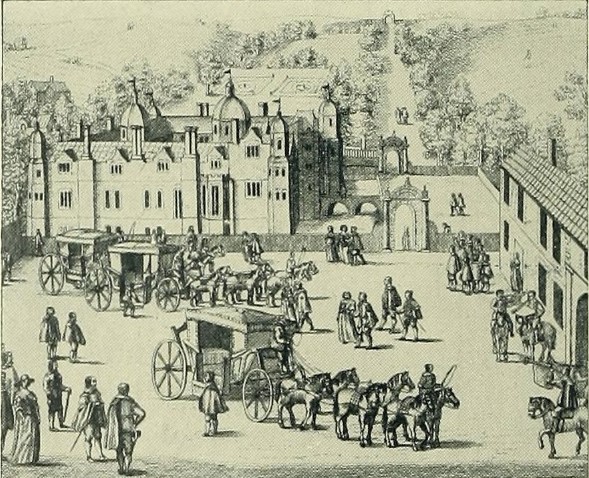 |
Gidea Hall: the house at the time of Marie de Medici's visit in 1638.
|
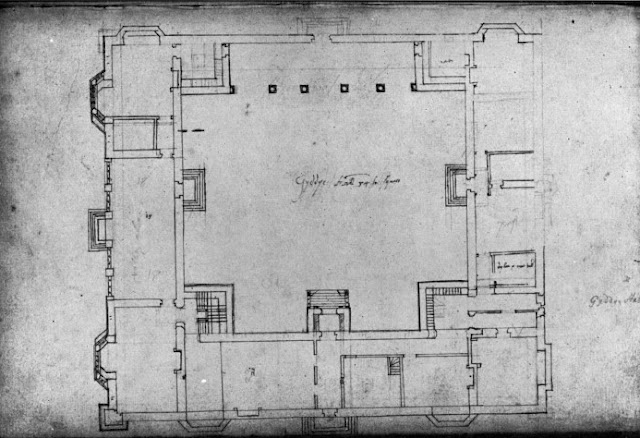 |
| Gidea Park: ground floor plan from John Thorpe's 'Book of Drawings' [Sir John Soane Museum vol. 101, T.164] |
The fortuitous survival of both a plan and a view of the house suggests that Thorpe's plan may have silently incorporated improvements of his own invention to increase the symmetry of the design; for example, he shows two canted bay windows and a doorway on the elevation nearest the viewpoint of the drawing, which the latter shows as having only one canted bay; and the external angles of the building had domed octagonal towers at the corners, barely suggested by Thorpe. In the courtyard, two large domed staircase towers stood in the internal angles at either end of the hall range. These distinctive features allow the drawing to be correctly oriented to the plan, and make it clear that the hall range was that nearest the viewpoint, with the private apartments in the range to the left of this, the main entrance being by the bridge across the moat into the right-hand range, and the colonnade facing onto the courtyard lying on the fourth side. The hall was approached from the courtyard by a flight of steps up to a porch leading into the screens passage. The rooms on the service side of the screens passage appear to be very faintly labelled in pencil as 'Wynt' and 'Kit'; i.e. Winter Parlour and Kitchen.
The house and estate were sold soon after 1710 to Sir John Eyles, who pulled down the Tudor house and built a new one. However, some 16th century stabling west of the Georgian house survived until 1922 and if the stables in question are those shown on the right of the 17th century view - which the shape of the building on 19th century Ordnance Survey maps suggests may well be the case - then the Tudor house stood on almost exactly the same site as its successor, meaning that the 17th century view was taken from the north of the site, and that the archway on the horizon at the top of the drawing marked the access to the estate from the Roman road through Hare Street to the south. The drawing shows the land rising to that gateway, which which accords with the local topography, although it rather overstates the extent of the rise, which is only about ten feet.
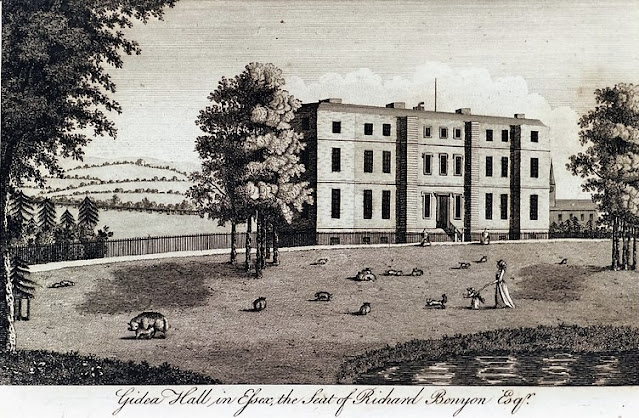 |
| Gidea Hall: engraving of the Georgian house in 1771. |
Sir John Eyles was a London financier, who served as Lord Mayor of London in 1726-27 and was Whig MP for Chippenham 1715-27 and for London, 1727-34. From 1715-25 he was one of the commissioners to oversee estates forfeited to the Crown following the Jacobite rebellion, and he also served two terms as a director of the East India Company, 1710-14 and 1717-21, before being brought into the South Sea Company as deputy governor to sort out its finances following the collapse of the 'South Sea Bubble'. His new Georgian house was a plain but massive nine by seven bay, three-storey block, said to have been dated 1718, but unfortunately his architect is not recorded. The long fronts to north and south had three bay projecting centres, framed by French quoins, and also projecting end bays. The two main storeys were of even height and separated by quite a deep cornice from a full attic storey. 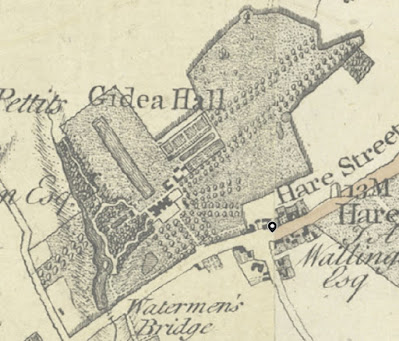 |
| Gidea Hall: the estate as depicted on Chapman & Andre's map of 1777 |
The end elevations may originally have had recessed centres, effectively creating pavilions at the angles (as is shown on Chapman & André's map of 1777), but they later acquired broad curved bows. When the house was first built, the service accommodation seems to have been in the basement, to which light was given by an area around the house, bridged by the steps to the doors in the centre of the facade. Nothing is recorded, and little can be deduced, about the original internal arrangement of the building, but its scale means that it must always have had a top-lit central staircase.
In 1745 the estate was sold to Richard Benyon, governor of Madras, who is said to have enlarged the park in 1766, and work does seem to have taken place in the grounds at this time. The early 18th century house was set in a formal garden with a long canal to the north (Spoon Pond) and avenues converging on the house. Chapman & André's map, surveyed in 1773-74, shows that the remnants of this landscape survived but had been softened by the addition of an informal pond (now Black's Canal) to the west flanked by a wilderness with a sinuous path. The landscape architect Richard Woods was a tenant of the Benyons on their property at North Ockendon (Essex), and he was probably responsible for these works, although his name appears in the accounts only in connection with designs for a new ice house (for Richard Benyon junior) in 1776. The pond broadened at its southern end where it met the main road, making a new bridge necessary, and this was designed by James Wyatt. It survives, though it has been widened to the south, and is of three brick arches.
 |
| Gidea Hall: an early 20th century photograph of the house showing the curved bows on the end elevations, perhaps added by James Wyatt c.1788. |
By 1788, Wyatt had also designed a temple for a cold bath, and he may well have been responsible for the addition of the broad curved bows on the end elevations of the house and for alterations to the interior decoration: the one photograph of the drawing room which is known shows a late 18th century ceiling much in his style. A pedimented orangery and a stable court with a clock tower and cupola would also seem to have been late 18th century; they survived in 1911 but were demolished soon afterwards. Another landscape gardener, the great Humphry Repton, was also a tenant of the Benyons, having his polite cottage on the main road in Hare Street. In 1794 he published an engraving showing Gidea Hall and its grounds, but there is no evidence that he was employed to make any improvements.
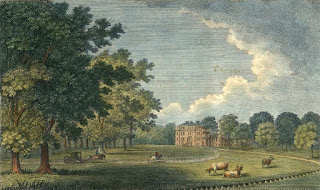 |
| Gidea Hall: view of the estate by Humphry Repton, 1795 |
 |
| Gidea Hall: the orangery c.1911. |
Richard Benyon left instructions in his will that Gidea Hall was to be sold, and the house was tenanted for a few years before a purchaser was found in 1802. In the 18th and early 19th centuries, wealth from London flowed into the surrounding countryside and led to the building of many villas for gentlemen, as well as the improvement of old farmhouses as smart seats. In the later 19th and early 20th century this first wave of suburban development was succeeded by rapid urban expansion which removed the seclusion and peace of places like Romford and made parks and gardens into valuable development land.  |
| Gidea Hall: plan of the 1911 cottage exhibition in the garden suburb |
In 1883 the Gidea Hall estate was sold to the Lands Allotment Co. for development, and although the group of which this firm was part went bust in 1893 before anything had been done apart from the sale of some outlying areas, it remained earmarked for development. In 1897 the residue was bought by Sir Herbert Raphael, 1st bt., of Havering Court, who gave the lake and some land for a public park and from 1910 set about developing the remainder as a garden suburb. He had the novel idea of inviting one hundred architects and urban planners to design and build houses for the estate at their own expense, which were then opened to the public as an exhibition to showcase the buildings to prospective buyers, and also entered into a competition for the best design. He succeeded in securing 159 entries, including some from many of the leading architects in the Arts & Crafts and Art Nouveau styles, and a second competition was run on similar lines in 1934 for houses in the Art Deco style.
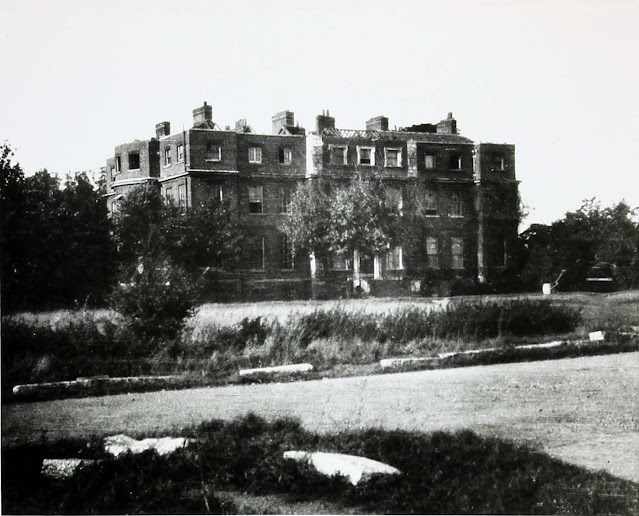 |
| Gidea Hall: the house derelict, partially unroofed, and awaiting demolition, 1929. |
The Georgian house became a club house for a while, but by 1929 it was derelict and had been partially unroofed. In 1930 it was bought by a demolition contractor who pulled it down and sold the materials, although as he made a loss of £600 he was bankrupted in 1932. The Spoon Pool was filled in in the early 20th century and the site is now occupied by tennis courts. The immediate site of the house seems not to have been built on, and would offer excellent scope for future archaeological investigation.
Descent: Robert of Havering; sold to William Baldwin (fl. 1376), saddler of London; sold by 1412 to Robert Chichele of London, merchant, brother of Archbishop Henry Chichele... Robert and Christine Saltmarsh, who sold 1452 to Sir Thomas Cooke (d. 1478), draper and lord mayor of London in 1462; to son, Phillip Cooke (1454-97); to son, Sir John Cooke (1473-1536), kt.; to son, Sir Anthony Cooke (1505-76), kt., tutor to King Edward VI and father-in-law of Lord Burghley; to son, Richard Cooke (d. 1579); to son, Anthony Cooke (d. 1604); to son, Edward Cooke (1581-1625); to son, Charles Cooke (d. 1629); to sister Ann (d. 1652), wife of Sir Edward Sydenham, who sold 1658 to Richard Emes, cooper of London; sold 1664 to John Burch (d. 1668), a West India planter; to widow, Margaret (d. 1685), for life, with remainder to his sister Rebecca Hothersall; to sons, Thomas and Burch Hothersall; to Thomas Hothersall (d. 1710); sold after his death to Benjamin Haskins Stiles and John Hunter, agents for Sir John Eyles (1683-1745), 2nd bt., who rebuilt the house; to son, Sir Francis Haskins Eyles-Stiles (d. 1762), 3rd bt., who sold 1745 to Richard Benyon (1698-1774), governor of Fort St. George (Madras, India); to son, Richard Benyon (1746-96); to son, Richard Benyon (later Benyon de Beauvoir) (1769-1854); sold 1802 to Alexander Black (d. 1835); to widow, Alice (d. 1871); to daughters, Anne, wife of William Neave and Adelaide, wife of Alfred Douglas Hamilton, who sold 1883 to the Lands Allotment Co., a member of Jabez Balfour’s Liberator group, which collapsed 1893; sold 1897 to Sir Herbert Henry Raphael (1859-1924), 1st bt., who gave part of the grounds for a public park and developed the rest as a garden suburb.
Englefield House, Berkshire
The estate belonged from at least the mid 12th century to the eponymous Englefield family. We know almost nothing about the manor house they had here, except that in the 19th century workmen undertaking repairs claimed to have found the date 1558 inscribed on a timber in the long gallery. Work at this date would have been undertaken for Sir Francis Englefield (d. 1592), a Catholic lawyer who was Master of the Court of Wards and Liveries under Queen Mary I, and who fled to Spain soon after Queen Elizabeth I's accession, being outlawed in 1564. His possessions were seized by the Crown and his complaints to the privy council falling on deaf ears, in 1576 he transferred his rights in all his property to a Protestant nephew, retaining the right to reclaim his property on presenting the nephew with a gold ring. In 1585, Sir Francis was attainted for treason and his possessions were formally forfeited to the Crown, but only after four years of litigation and a special Act of Parliament did the authorities succeed in getting a clear title to the lands, and even so the Protestant branch of the family was able to recover a house in the village and a small part of the land, which their descendants held for another 200 years.
Queen Elizabeth granted the estate in 1589 to her 'favourite', Robert Devereux, 2nd Earl of Essex, but its descent over the next forty years was unusually complex. By 1599 it had come to the Queen's venerable counsellor, Lord Norris of Rycote (Oxon), who settled it on his third son, Sir Edward Norris. According to the latter's secretary, Dudley Carleton, in 1600 Sir Edward was 'making a parke about this house... having a purpose to enlarge his house the halfe as much as it is according to old Englefields building but after a new project". This letter seems to confirm that Sir Francis Englefield had been responsible for the earlier building, and makes it very likely that it was Norris who built the new main block which still forms the core of the present house. The Queen dined at Englefield on her way to Basing House (Hants) in September 1601, but if work had not started in 1600 it seems unlikely that the new building could have been completed by then, although it is probable that it was largely finished before Norris died suddenly in 1603.
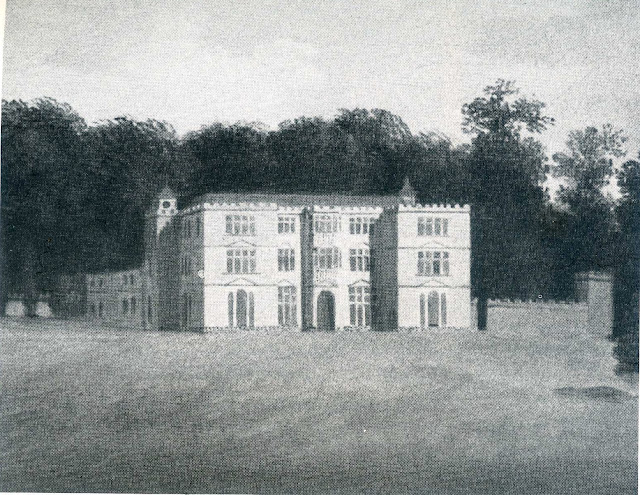 |
Englefield House: the earliest depiction of the house seems to be this view, from the background of Paulet Wrighte's portrait of c.1775,
showing it after his alterations, though the form of the house of c.1600 remains clear. |
Although there are no known illustrations of the house before it was altered in the 18th century, the earliest views make clear that the new building was of three storeys, with an E-plan layout consisting of a central three-storey porch and shallow projecting wings at either end. Thus far, the house was traditional in arrangement, but the walls terminate in a castellated parapet, not gabled attics, suggesting an awareness of and sympathy with the late Elizabethan and Jacobean fashion for neo-medieval decoration, as at Longford Castle, Bolsover Castle and Wadham College, Oxford. The shallow pediments set over mullioned and transomed windows are reminiscent of those found on many houses in East Anglia at this time (e.g. Roos Hall), as is the flushwork decoration between the floors on the porch and bay windows. Such flushwork is also known in Wiltshire, however, and it seems more likely that the master mason responsible for the remodelling came from this more local source rather than from further afield. The pairs of shell-headed niches on the return walls of the two end bays are a motif which can be found in works of the 1590s by William Arnold (Montacute House and Cranborne Lodge), and since Arnold was also responsible for the design of Wadham College, with its crenellated parapets, he may tentatively be suggested as a possible designer. Sadly, nothing is known of the original interiors, which were completely remodelled later.
The estate was acquired in 1635 by John Paulet, 5th Marquess of Winchester and his wife, Lady Honora de Burgh. Their principal seat was Basing House (Hants) which was famously beseiged and destroyed in the Civil War. After the Restoration, they made no attempt to rebuild Basing, but settled at Englefield. In 1712, the estate descended to the Marquess' granddaughter and her husband, the Rev. Nathan Wrighte, who were probably responsible for the creation of the forecourt and formal gardens shown on an estate map of 1762, and for alterations to the house of which some traces remain. These include three fine carved Corinthian doorcases in the present entrance hall, which are believed to have been moved from the original entrance hall when it was converted into a library in 1855, and perhaps some elements of the ceiling in the library, including the slightly recessed rectangular section in the centre with delicate sprays of acanthus, and six medallions of birds, although the ceiling was otherwise altered in the 19th century.
During the mid 18th century, Englefield saw the long minorities of Paulet Wright, who inherited in 1729, came of age in 1737 and died aged 24 in 1741, and of his son, also Paulet Wright, who was born in 1739 and came of age in 1760. It was the latter who eventually initiated further changes to the house. It is unclear when he gained effective control of the property, but it is unlikely that he had to wait until his mother's life interest expired at her death in 1776. It would seem that his alterations took place in the 1770s, and had probably been completed when his portrait was painted standing in front of the remodelled house. This was almost certainly before his marriage in 1777, as the portrait shows him standing alone. An account of 1792 in Robertson's Topographical Survey of the Great Road from London to Bath and Bristol says that he 'reduced and modernised' the house, and an undated plan of the house suggests that he intended to build a new corridor and staircase behind the Jacobean house, with a cupola-capped tower at either end of it, and ranges of new service accommodation set around a courtyard at the rear.
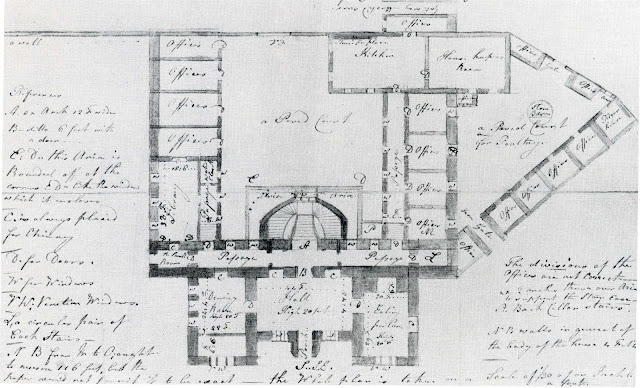 |
| Englefield House: plan of proposed alterations, c.1775. The works as completed seem to have been broadly in line with this scheme. |
Broadly, this intention seems to have been carried out, for the wide corridor behind the main rooms on the south front still exists today, and the staircase is in the position (but not the Imperial form) the plan depicts. The cupola-capped towers at either end of the corridor were constructed at this time (though altered since), and major elements of the decoration of the dining room, drawing room and study look right for the 1770s. Paulet Wrighte died in 1779, and his executors' accounts show that he left unpaid bills for new furniture from Ince & Mayhew, as well as a bill of 10 guineas from 'Mr Woods, surveyor' (no doubt Richard Woods, the landscape architect, who had worked for his half-brother at Gidea Park), and who was presumably consulted about landscape improvements. His alterations were evidently financed by raising money secured on the estate and his uncle, Nathan Wrighte, who inherited in 1779, was obliged to let the house as he could not afford to live in it.
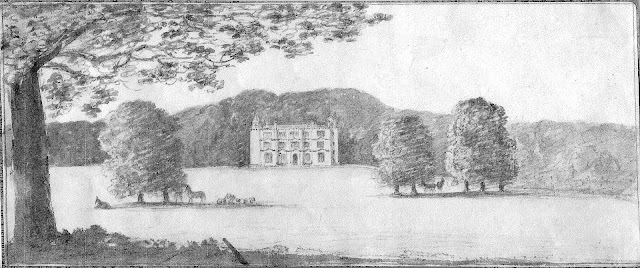 |
| Englefield House: a pencil sketch of the house c.1800. |
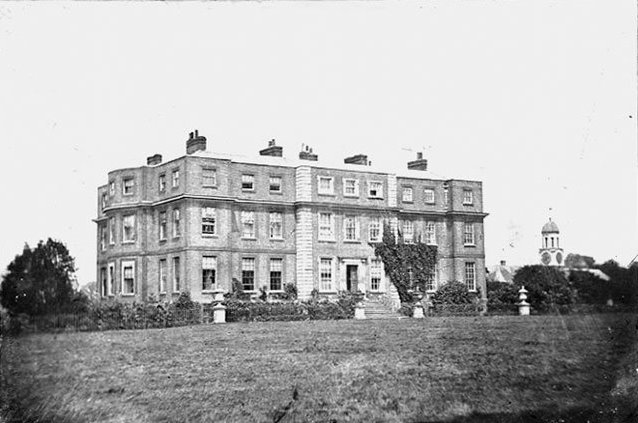
In 1796 the estate came into the possession of Richard Benyon (1770-1854), who married Elizabeth Sykes, a Berkshire neighbour from Basildon Park, in 1797 and made his home at Englefield. Sir John Soane was employed at both Benyon's town house in London, in 1805, and at Englefield in 1806, but the entries in his cost book suggest he was only making repairs or minor alterations to both properties. These may have included the removal of cupolas from the towers, the replacement of the Venetian windows on the south front with large mullioned and transomed windows, and the opening up of a new entrance on the east side of the house. More extensive improvements did not take place until the 1820s, by which time Richard Benyon's income had been augmented by his inheritance of the de Beauvoir estate in Hackney (Middx) and he had changed his name to Benyon de Beauvoir. In about 1823 he brought in Thomas Hopper (whose work he may have encountered at nearby Purley Hall), who added the bay windows to the south fronts and side elevations of the drawing room and dining room. Those on the south front copy exactly the proportions and decoration of the Jacobean porch bay, while those on the side elevations are broader; together, they strongly reinforce the Elizabethan character of the house. He also added a series of rather curious small square turrets with finials to the skyline of the house, some of which concealed chimneys. Inside the house, the ceilings of the dining room and library (formerly the entrance hall) were given their current form. Work seems to have been completed by 1829, and to mark the remodelling, Benyon de Beauvoir commissioned a painting of the house from John Constable which now hangs in the house. It was also photographed early in the 1840s by W.H. Fox-Talbot, the photographic pioneer, in one of the earliest country house photographs.
 |
| Englefield House: photograph by W.H. Fox-Talbot, c.1840-45, showing the house as altered by Thomas Hopper in the 1820s. |
Richard Benyon de Beauvoir died in 1854 and was succeeded by his sister's second son, Richard Fellowes (1811-97), who took the name Benyon and at once put in hand further changes to the house. The works were undertaken in c.1856-57 to the designs of Richard Armstrong (1799-1876), a Scottish architect who seems to have trained in the office of William Burn, acted as clerk of works to Edward Blore at Haveringland Hall, and also altered Haveringland for Benyon's elder brother at the same time as he was working here. His alterations to Englefield were extensive, but stylistically conservative and surprisingly sympathetic to the earlier fabric. The south front was entirely refaced and the porch at its centre was converted into a bay window, but the flushwork decoration of the porch and the 17th century shell-headed niches were faithfully reproduced in the new work. The crenellated parapet was replaced all round the house by a much showier fretwork balustrade that breaks forward over the bay windows with inset panels of coats of arms.
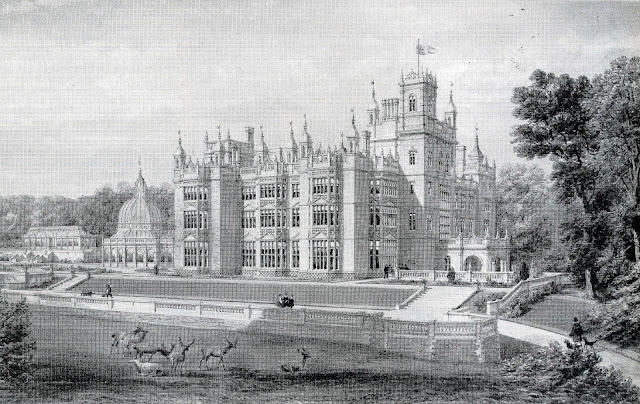 |
| Englefield House: view of the house as remodelled by Richard Armstrong in the 1850s, exhibited in 1873. The domed winter garden was never built. |
Inside, the former entrance hall was converted into a large new library, and the 18th century Corinthian doorcases no doubt formerly in this room were moved to a new two-storey hall on the east side of the house, where a new main entrance was created. The present staircase dates from the 1850s, and the corridors which run through the house from east to west on the ground and first floors were also redecorated at this time. The most significant change was the rebuilding of the east tower which was made wider and higher than before, so that it became the dominant feature of the house from any angle, and creates the sort of picturesque asymmetry so favoured by Blore and his contemporaries. Armstrong probably also laid out the formal gardens west of the house in the style of W.A. Nesfield, and in 1862 created the neo-Jacobean gate screen at the end of the main approach drive on the A340. In 1860-61, the interiors of the house were extensively redecorated by J.G. Crace, though few traces of his work have survived today.
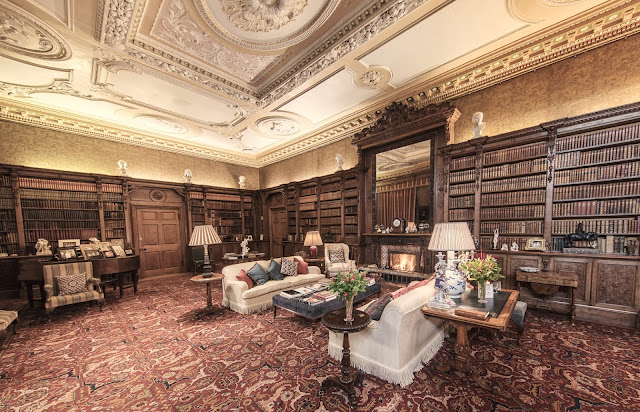 |
| Englefield House: the library created from the former entrance hall in the 1850s. |
On 12 August 1886 a fire broke out in the laundry in the east wing of the house and did considerable damage, although it was happily prevented from spreading to the main block. The one interior of note that was damaged was the long gallery on the upper floor of the east range, where workmen had earlier found a timber dated 1558. The long gallery was quickly repaired, apparently under the direction of Richard Anderson junior, who continued his father's practice after his retirement in 1875, and was given a coved ceiling with skylights. It was probably Anderson junior who made the fine drawing of the house exhibited at the Royal Academy in 1873, which shows a large domed winter garden to the west of the house which was never built.
In 1897, on the death of Richard Benyon without issue, the estate passed to his nephew, James Herbert Fellowes, who again took the name Benyon. By this date, the richly coloured and patterned decoration by Crace had fallen out of favour, and in 1907 he brought in Gillow & Co. to redecorate the house in a more neutral, loosely dixhuitième style. Further redecoration took place in 1937 for Sir Henry Benyon (1884-1959), 1st bt., under the supervision of Jacksons, the interior decorators.
Descent: Sir Francis Englefield (d. 1592), attainted 1585 and forfeited to Crown, which granted 1589 to trustees for Robert Devereux (1567-1601), 2nd Earl of Essex; sold 1597 to Henry Norris (c.1530-1601), 1st Baron Norris de Rycote; who gave it 1599 to his third son, Sir Edward Norris (d. 1603); to widow, Elizabeth, later wife of Sir Thomas Erskine (1566-1639), 1st Viscount Fentoun and 1st Earl of Kellie, who sold 1622 to his creditors, Sir Peter Vanlore and William Rolfe, who sold 1623 to Erskine's stepdaughter's husband, Sir John Davis (d. 1626), kt.; to daughter, Lucy, wife of Ferdinand Hastings (1609-56), Baron Hastings and later 6th Earl of Huntingdon, who sold? 1635 to John Paulet (c.1598-1675), 5th Marquess of Winchester, whose lands were sequestered and sold 1649 to Sir Thomas Jervoise (1587-1654), but were restored to him at the Restoration in 1660; to younger son, Lord Francis Paulet (c.1646-96); to son, Francis Paulet (1686-1712); to sister, Anne Paulet (1685-1729), wife of Rev. Nathan Wrighte (d. 1721); to son, Powlet Wrighte (1716-41); to widow, Mary (d. 1777), later wife of Richard Benyon (1698-1774) for life and then to her son, Powlet Wright (1739-79); to uncle, Nathan Wrighte (1717-89) for life and then to half-brother, Richard Benyon (1746-96); to son, Richard Benyon (later Powlet Wrighte and then Benyon de Beauvoir) (1769-1854); to nephew, Richard Fellowes (later Benyon) (1811-97); to nephew, James Herbert Fellowes (later Benyon) (1849-1935); to son, Sir Henry Fellowes (later Benyon) (1884-1959), 1st bt.; to second cousin, Adm. Richard Shelley (d. 1967); to son, Sir William Richard Shelley (later Benyon) (1930-2014), kt.; to son, Richard Henry Ronald Benyon (b. 1960), Baron Benyon. From 1781-89 the house was let to Lady Clive, the widow of Clive of India.
Benyon family of Gidea Hall and Englefield House
Benyon, Daniel (1664-1708). Son of Daniel Benyon (c.1628-90) of Crooked Lane, London, tallow chandler, Master of the Tallow Chandlers Company, 1689-90, and his wife Mary, baptised at St Nicholas Acons, London, 12 August 1664. He married 23 April 1691 at St Anne & St Agnes, London, Elizabeth Moore, and had issue*:
(1) Richard Benyon (1698-1774) (q.v.);
(2) Elizabeth Benyon (d. 1709); died young and was buried at Lee (Kent), 29 July 1709.
He lived in London and later at Blackheath (Kent).
He was very probably the 'Daniel Bynian' buried at Lee (Kent), 27 May 1708, whose widow was buried at Lee, 19 October 1709.
* Bernard Benyon, who died in India in 1715, and who is sometimes said to be an elder son of Daniel, describes himself in his will as the cousin of Richard Benyon (1698-1774).
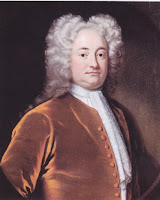 |
| Richard Benyon (1698-1774) |
Benyon, Richard (1698-1774). Only recorded son of Daniel Benyon (1664-1708) and his wife Mary, born 26 November 1698. On the death of his mother he was orphaned and his guardian, Col. John Perry, sent him out to India, where he joined the household of Osmond de Beauvoir (whose niece he would eventually marry as his third wife). As soon as he was old enough he joined the East India Company as a writer, and was appointed a member of the Council of Fort St George (Madras), 1718-25, resigning on returning to England in the latter year. He subsequently went out to India again, and was re-elected to the Council in 1732, becoming President of Madras, 1735-44. He is regarded as one of the best and least oppressive early Presidents of Madras, who oversaw the rapid development of the city and the repulsion of two Maratha invasions. He returned to England at the end of his Presidency with a modest fortune of some £75,000. He married 1st, 17 October 1724 in Madras, Mary, daughter of Edward Fleetwood; 2nd, 14 October 1738, Frances (d. 1742), daughter of Richard Horden and widow of Sandys Davis; and 3rd, 18 July 1745, Mary (1714-77), daughter of Frances Tyssen of Hackney and widow of Paulet Wrighte (1716-41) of Englefield (Berks), and had issue:(1.1) Elizabeth Benyon (b. & d. 1727), born 7 May and baptised at St Martin-in-the-Fields, Westminster (Middx), 7 June 1727; died in infancy and was buried at St Martin-in-the-Fields, 8 June 1727;
(1.2) Lucy Benyon (b. & d. 1729), baptised at St George the Martyr, Bloomsbury (Middx), 14 February 1728/9; died in infancy and was buried at Margaretting, 17 May 1729;
(2.1) Frances Benyon (b. & d. 1741), born 24 January 1741; died in infancy and was buried in Madras, 25 January 1742;
(3.1) Richard Benyon (1746-96) (q.v.).
He bought the manor of Coptfold Hall at Margaretting (Essex) in 1728, while on a visit back to England. He bought Gidea Park in 1745 after retiring from the East India Co.; Great Newbury House, Ilford in 1747; and the North Ockendon Hall estate (Essex) in 1758. His third wife had a life interest in Englefield House. They also had a town house in Grosvenor Square, which seems to have been their principal residence.
He died 22 September and was buried at Margaretting, where he built a family vault, 4 October 1774; his will was proved in the PCC, 11 October 1774. His first wife died between 1733 and 1738. His second wife died in childbirth, 21 October 1742. His third wife died 18 September 1777 and was buried at Englefield; her will was proved in the PCC, 8 October 1777.
Benyon, Richard (1746-96). Only child of Richard Benyon (1698-1774) and his third wife, Mary, daughter of Frances Tyssen of Hackney and widow of Paulet Wrighte (d. 1740/1) of Englefield (Berks), baptised at St George, Bloomsbury (Middx), 26 June 1746. Educated at Eton. A 'well-meaning and honest man', he was a supporter of Lord Fitzwilliam, his friend and Eton contemporary, and sat as MP for Peterborough, 1774-96, in the Fitzwilliam interest. He married, 3 September 1767 at Breamore (Hants), Hannah (1747-1828), eldest daughter of Sir Edward Hulse, 2nd bt., of Breamore House, and had issue:
(1) Richard Benyon (b. & d. 1769), baptised at Romford, 23 February 1769; died in infancy and was buried at Romford, 3 March 1769;
(2) Richard Benyon (later Powlet Wrighte Benyon and then Benyon de Beauvoir) (1770-1854) (q.v.);
(3) Hannah Elizabeth Benyon (1771-1852), born 1 June and baptised at St George, Hanover Sq., Westminster, 2 June 1771; married, 30 March 1813 at St George, Hanover Sq., Westminster, Vice-Adm. Edward Fellowes (1772-1841) of Little Gidding (Hunts), son of William Fellowes (d. 1804) of Mortimer Lodge, Stratfield Mortimer (Berks), but had no issue; died 5 October and was buried at Stratfield Mortimer, 13 October 1852;
(4) Maria Benyon (1772-1852), born 8 April and baptised at St George, Hanover Sq., Westminster, 6 May 1772; married, 15 May 1797 by special licence, as his second wife, George Brodrick (1754-1836), 4th Viscount Midleton, of Peper Harow House (Surrey), MP for Whitchurch, 1774-96 and Lord Lieutenant of Surrey, 1814-30, and had issue one son and five daughters; died 14 January 1852; will proved in the PCC, 3 May 1852;
(5) Charlotte Benyon (1774-1854), born 13 January and baptised at St George, Hanover Sq., Westminster, 10 February 1774; married, 11 June 1799 at St George, Hanover Sq., Westminster, Joseph Berens (1773-1853) of Kevington House, St Mary Cray (Kent) and Lincoln's Inn, barrister-at-law, and had issue five sons and one daughter; died 1 July 1854 and was buried at Orpington (Kent); will proved in the PCC, 8 September 1854;
(6) Louisa Benyon (b. 1775), born 30 August and baptised at St George, Hanover Sq., Westminster, 25 September 1775; probably died young;
(7) Harriet Benyon (1777-98), born 19 February and baptised at St George, Hanover Sq., Westminster, 17 March 1777; died unmarried and was buried at Margaretting (Essex), 27 February 1798;
(8) Edward Henry Benyon (1779-1806) (q.v.);
(9) Emma Benyon (1780-1862) (q.v.);
(10) Frances Benyon (1781-1866), born 6 October and baptised at St George, Hanover Sq., Westminster, 2 November 1781; died unmarried in London, 3 February 1866; will proved 16 March 1866 (effects under £120,000);
(11) William Benyon (1786-97?), born 6 February and baptised at St George, Hanover Sq., Westminster the same day; probably died young and was the person of this name buried at Margaretting, 6 December 1797;
(12) Charles Benyon (1789-1810), born 5 April and baptised at St George, Hanover Sq., Westminster, 28 June 1789; an officer in the Royal Navy (Lt.); killed in action while attempting to board an enemy vessel of the island of Elba, 11 September 1810.
He inherited Gidea Park from his father in 1774 and Englefield House from his kinsman, Nathan Wrighte, in 1789.
He died at Bath (Som.), 22 August and was buried at Margaretting (Essex), 30 August 1796, where he is commemorated by a monument; his will was proved in the PCC, 14 September 1796. His widow died 27 April 1828, and was buried at Margaretting, where she is commemorated by a monument; her will was proved 9 June 1828.
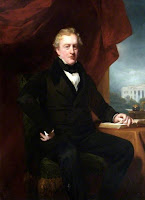 |
Richard Benyon de Beauvoir (1770-1854)
Image: The Royal Berkshire NHS Foundation Trust |
Benyon (later Powlett Wrighte Benyon and then Benyon de Beauvoir), Richard (1770-1854). Eldest surviving son of Richard Benyon (1746-96) and his wife Hannah, eldest daughter of Sir Edward Hulse, 2nd bt., of Breamore (Hants), born 28 April and baptised at St George, Hanover Sq., Westminster (Middx), 28 May 1770. Educated at Charterhouse and St. John's College, Cambridge (matriculated 1788; BA 1792; MA 1795). JP and DL for Berkshire. Independent MP for Pontefract, 1802-06 and for Wallingford, 1806-12; he retired from the House in 1812 and declined an invitation to stand for Reading in 1816. High Sheriff of Berkshire, 1816-17; High Steward of Wallingford, 1828-44. He assumed the surnames Powlett Wrighte in addition to Benyon in 1814, and in 1822 substituted the name Benyon de Beauvoir on inheriting the Hackney estate. In 1839 he made a major benefaction of £5,000 towards the foundation of the Royal Berkshire Hospital. He became blind in his old age. He married, 27 September 1797 at St George, Hanover Sq., Westminster, Elizabeth (1775-1822), only daughter of Sir Francis Sykes (1732-1804), 1st bt., of Basildon Park (Berks), but had no legitimate issue. He inherited Gidea Park, a lease of the manor of Havering-atte-Bower, property at North and South Ockendon (Essex) and the Englefield House estate from his father in 1796, but sold Gidea Park in 1802 and the lease of Havering-atte-Bower in 1819. He inherited the Hackney (Middx) estate of the Rev. Peter de Beauvoir (who had conducted his marriage and was his great-great-uncle), rector of Downham (Essex) in 1822 and, after a lengthy legal dispute with the tenant of the estate, developed it for middle-class housing. In 1824 he purchased the 11,000 acre Culford Hall estate (Suffk) for £230,000, but he gave this property to his nephew, the Rev. Edward Richard Benyon (1802-83) in 1839. At his death, he bequeathed Englefield House and the Hackney estate to another nephew, Richard Fellowes (later Benyon) (1811-97). He died 22 March 1854 and was buried at Englefield, where he is commemorated by an elaborate monument; his will was proved in the PCC, 1 June 1854 (effects under £300,000, although press reports after his death claimed his real and personal estate was worth as much as £7,500,000; the real figure may have been around £2,500,000). His wife died 29 October 1822 and was buried at Lower Basildon (Berks), where she is commemorated by a monument.
Benyon, Edward Henry (1779-1806). Third son of Richard Benyon (1746-96) and his wife Hannah, eldest daughter of Sir Edward Hulse, 2nd bt., of Breamore (Hants), born 9 April and baptised at St George, Hanover Sq., Westminster (Middx), 2 June 1779. He had an illegitimate son by his mistress, Dorothy Elizabeth Hanske:
(X1) Rev. Edward Richard Benyon (1802-83), said to have been born in Lausanne (Switzerland), 1 November, and baptised 14 December 1802, but later naturalised as a British subject; educated at St John's College, Cambridge (matriculated 1820; BA 1824; MA 1827); ordained deacon, June 1826 and priest, December 1826; rector of Downham and North Ockendon (Essex), 1827-39, and of Culford (Suffk), 1839-83 and Elveden (Suffk), 1841-45; given the Culford Hall estate by his 'uncle', 1839; married, 5 October 1830 at Eyton (Herefs), Jane (c.1806-76), daughter of Edward Evans of Eyton Hall, but had no issue; died suddenly, 7 July 1883, and was buried at Culford; will proved 14 January 1884 (effects £50,167).
He lived at Newbury Hall, Barking (Essex), but c.1801 he left England to live at Belle Vue near Lausanne in Switzerland.
He died unmarried at Nîmes (France), 25 January 1806; his will was proved in the PCC, 8 November 1806 and provided for his son to live with his mother until the age of six and then be moved to school at Sorez (France) before being brought to England to finish his education under the care of his uncle and godfather, Richard Benyon (1770-1854). The combination of the will and codicils was open to interpretation and resulted in a Chancery case in 1807.
Benyon, Emma (1780-1862). Sixth daughter of Richard Benyon (1746-96) and his wife Hannah, eldest daughter of Sir Edward Hulse, 2nd bt., of Breamore (Hants), born 4 July and baptised at St George, Hanover Sq, Westminster (Middx), 25 July 1780. She married, 23 July 1805 at St George, Hanover Sq., Westminster, William Henry Fellowes (1769-1837) of Ramsey Abbey (Hunts), MP for Huntingdon, 1796-1807 and Huntingdonshire, 1807-30, and had issue:
(1) William Henry Fellowes (1806-36), born 11 July and baptised at St Marylebone, 11 August 1806; educated at Christ Church, Oxford (matriculated 1824; BA 1828); appointed a conservator of the Bedford Level Corporation, 1830; DL for Huntingdonshire, 1834; died unmarried, 17 March, and was buried at St Michael, Paternoster Royal, London, 22 March 1836;
(2) Emma Fellowes (1808-87); a keen amateur meteorologist, who collected rainfall data for over fifty years; married, 9 August 1842, Rev. Henry William Townshend (later Powlett) (1797-1866), 3rd Baron Bayning of Honingham Hall (Norfk), younger son of Charles Townshend, 1st Baron Bayning, and had issue one son (who predeceased his father); died 10 November 1887; will proved 24 December 1887 (effects £50,570);
(3) Edward Fellowes (1809-87), 1st Baron de Ramsey, born 14 April and baptised at St Marylebone, 8 May 1809; MP for Huntingdonshire, 1837-80; raised to the peerage as 1st Baron de Ramsey, 8 July 1887; inherited Ramsey Abbey from his father and remodelled it to the designs of Edwrd Blore, whom he subsequently employed to rebuild Haveringland Hall (Norfk); married 22 July 1845 at St James, Piccadilly, Westminster, Hon. Mary Julia (1825-1901), daughter of George John Milles (1794-1874), 4th Baron Sondes, and had issue two sons and two daughters; died 9 August 1887;
(4) Richard Fellowes (later Benyon) (1811-97) (q.v.);
(5) James Fellowes (1813-89) (q.v.).
Her husband inherited Ramsey Abbey, which he employed Sir John Soane to alter, and Haveringland Hall (Norfk). After his death she moved to Felthorpe Hall (Norfk).
She died at Felthorpe Hall, 27 January 1862; her will was proved 9 April 1862 (effects under £25,000). Her husband died 23 August 1837 and was buried at Ramsey (Hunts); his will was proved in the PCC, 6 December 1837.
 |
| Richard Benyon (1811-97) |
Fellowes (later Benyon), Richard (1811-97). Third, but second surviving, son of William Henry Fellowes MP (1769-1837) of Ramsey Abbey (Hunts) and his wife Emma, second daughter of Richard Benyon (1746-96), born 17 November and baptised at Haveringland (Norfk), 9 December 1811. Educated at Charterhouse and St. John's College, Cambridge (matriculated 1829; BA 1833; MA 1836), and Lincolns Inn (admitted 1833; called 1837). Barrister-at-law. JP (Chairman of Quarter Sessions, 1864-84) and DL for Berkshire; High Sheriff of Berkshire, 1857-58; MP for Berkshire, 1860-76; an Alderman of Berkshire County Council, 1888-91. He assumed the name of Benyon in lieu of Fellowes by royal licence, 10 January 1855, in compliance with the wishes of his uncle. It was noted at the time of his death that he had probably built more churches than any other man in modern times, but he kept his philanthropy quiet, having 'a dread of his benevolent actions becoming known'. His charity extended to the support of many schools on and around his estate in Berkshire, the National Society, and missionary work overseas. He married, 25 April 1858, Elizabeth Mary (1833-1909), second daughter of Robert Clutterbuck of Watford House (Herts), and had issue:(1) Marion Emma Benyon (1860-1948) (q.v.);
(2) Edith Gertrude Benyon (1862-1953). born 15 January and baptised at St Mark, North Audley St., Westminster (Middx), 18 February 1862; married, 27 September 1894 at St Mark, North Audley St. Westminster, Alfred Ernest Hoare OBE (1861-1930) of Hendon (Middx), son of Francis Hoare of Cromer (Norfk), banker, and had issue two sons and one daughter; died 9 April 1953; will proved 26 June 1953 (estate £2,895);
(3) Julia Benyon (1863-1905), born 19 November and baptised at St Mark, North Audley St., Westminster, 19 December 1863; married, 9 February 1888 (sep.), Sir Anthony Henry Wingfield (1857-1952), kt., of Ampthill House (Beds), Chairman of Bedfordshire Quarter Sessions and owner of a private zoo, eldest son of George John Wingfield (1822-60), and had issue two sons; after leaving her husband she lived with her mother; she died 17 September and was buried at Englefield, 22 September 1905.
He inherited Englefield House, the Hackney estate and the remaining Essex property from his uncle, Richard Benyon de Beauvoir, in 1854. At his death his estates passed to his nephew, James Herbert Fellowes (later Benyon).
He died 26 July 1897 and was buried at Englefield; his will was proved 4 November 1897 (effects £722,809). His widow died 23 October 1909 and was buried at Englefield; her will was proved 10 December 1909 (estate £261,372).
Fellowes, James (1813-89). Fourth, but third surviving, son of William Henry Fellowes MP (1769-1837) of Ramsey Abbey (Hunts) and his wife Emma, second daughter of Richard Benyon (1746-96), born 31 July 1813. He was admitted to Christ's College, Cambridge in 1830 but did not reside, having already joined the Royal Navy in 1826 (Lt., 1838; retired 1841). DL and JP for Dorset; High Sheriff of Dorset, 1859. A staunch Conservative in politics, he was 'a man of some peculiarities', according to his obituarist. He married, 19 July 1847 at All Souls, Langham Place, Marylebone (Middx), Gertrude Charlotte (1826-1906), daughter of Nathaniel Micklethwait of Taverham Hall (Norfk), and had issue:
(1) James Herbert Fellowes (later Benyon) (1849-1935) (q.v.);
(2) Emily Gertrude Fellowes (1851-82), born 19 February and baptised at St Mary, Bryanston Sq., Westminster (Middx), 15 April 1851; married, 30 April 1872 at St George, Hanover Sq., Westminster, Sir Henry Cosmo Orme Bonsor (1848-1929), 1st bt. (who m2, 3 March 1886, Mabel Grace Brand), of Kingswood Warren (Surrey), brewer and company director, MP for Wimbledon, 1885-1900, son of Joseph Bonsor, and had issue three sons and two daughters; died 18 July and was buried at Tandridge (Surrey), 22 July 1882; administration of goods granted 7 March 1883 (effects £337);
(3) Georgiana Charlotte Fellowes (1859-1936), born 17 April and baptised at St Marylebone (Middx), 20 May 1859; married, 14 January 1892 at St Marylebone, Francis William Preston (1851-98), barrister-at-law, son of Thomas Edward Preston (1816-90), and had issue one daughter; lived latterly at Westbrook House, Upwey (Dorset); died 31 October 1936; will proved 31 December 1936 (estate £75,452).
He purchased Kingston Maurward House (Dorset) in 1853.
He died 4 July 1889; his will was proved 9 August 1889 (effects £264,881). His widow died 25 April 1906 and was buried at Stinsford (Dorset); her will was proved 31 May 1906 (estate £74,348).
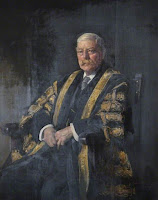 |
James Herbert Benyon (1849-1935)
by Oswald Birley.
Image: Reading University Art Collection |
Fellowes (later Benyon), James Herbert (1849-1935). Only son of James Fellowes (1813-89) and his wife Gertrude Charlotte, daughter of Nathaniel Micklethwait of Taverham Hall (Norfk), born 30 October 1849. Educated at Eton, Magdalene College, Cambridge (matriculated 1868; BA 1873; MA 1876; Hon. Fellow, 1928) and the Inner Temple (admitted 1872; called 1875). JP and DL for Dorset; High Sheriff of Dorset, 1892-93. He assumed the name of Benyon in lieu of Fellowes by royal licence, 1897, on inheriting the Englefield estate. Lord Lieutenant of Berkshire, 1901-35; President of Berkshire Territorial Forces Association, 1908-35; a member of Berkshire County Council (Alderman from 1898; Chairman, 1916-26, and chairman of its education committee from its formation in 1903); President of University College, Reading, and first Chancellor of Reading University (to which he was a generous benefactor), 1926-35; a Governor of Abingdon School, 1902-34 (Chairman, 1903-27). He was also a keen agriculturist. He married, 29 July 1875 at Uffculme (Devon), Edith Isabel GBE (1857-1919), youngest daughter of Sir John Walrond (1818-89), 1st bt., of Bradfield House, Uffculme, and had issue:(1) Gertrude Fellowes (1876-1953), born 29 August and baptised at St Peter, Eaton Square, Westminster (Middx), 27 September 1876; married, 1 January 1897 at Stratfield Mortimer (Berks), Rev. Francis Edward Rooke (later Trelawny) (1862-1937) of Coldrennick (Cornw.), and had issue one son and one daughter; died 8 November 1953 and was buried at Menheniot (Cornw.); will proved 9 January 1954 (estate £14,034);
(2) Edith Marion Fellowes (later Benyon) (1880-1942), born 19 January and baptised at Holy Trinity, Brompton (Middx), 21 January 1880; died unmarried, 9 November 1942 and was buried at Englefield; administration of goods granted 19 February 1943 (estate £25,089);
(3) Sir Henry Arthur Fellowes (later Benyon) (1884-1959), 1st bt. (q.v.);
(4) Winifred Fellowes (later Benyon) (1893-1970), born 28 March and was baptised at St Saviour, Chelsea (Middx), 1 April 1893; died unmarried, 19 December 1970; will proved 18 February 1971 (estate £55,807).
He inherited Kingston Maurward from his father in 1889, and Englefield House, the Hackney estate and the remaining Essex property from his uncle, Richard Fellowes (later Benyon) in 1897. He sold Kingston Maurward in 1906.
He died 14 February 1935 and was buried at Englefield; his will was proved 28 June 1935 (estate £1,586,968). His wife died 25 March 1919; administration of her goods was granted 14 June 1919 (estate £2,572).
Fellowes (later Benyon), Sir Henry Arthur (1884-1959), 1st bt. Only son of James Herbert Fellowes (later Benyon) (1849-1935) and his wife Edith Isabel GBE, daughter of Sir John Walrond, 1st bt., born 9 December 1884 and baptised at Holy Trinity, Brompton (Middx), 6 January 1885. Educated at Eton and Trinity Hall, Cambridge. An officer in the Berkshire Yeomanry (2nd Lt., 1910; Lt., 1917; Capt., 1917; retired 1921). JP for Berkshire; High Sheriff of Berkshire, 1925; Lord Lieutenant of Berkshire, 1945-59. Member of Berkshire County Council, 1922-49 (Vice-Chairman, 1938; Chairman, 1948-49) and County Alderman, 1935-49; Chairman of Berkshire Agriculture Executive Committee, 1944-57 and Deputy President of Royal Agricultural Society, 1954. Appointed CBE, 1946 and created a baronet, 1958. He married, 10 March 1915 at Holy Trinity, Sloane St., Chelsea (Middx), Violet Eveline (1887-1964), second daughter of Sir Cuthbert Edgar Peek, 2nd bt., of Wimbledon House (Surrey) and Rousdon (Devon), but had no issue.
He inherited Englefield House, the Hackney estate and the remaining Essex property from his father in 1935, but sold the Essex estates to pay the death duties. During his ownership, wartime neglect and other issues led to Englefield becoming rather dilapidated.
He died 15 June 1959; his will was proved 2 July 1959 (estate £997,587). His widow died 3 February 1964; her will was proved 23 March 1964 (estate £168,972).
Benyon, Marion Emma (1860-1948). Eldest daughter of Richard Fellowes (later Benyon) (1811-97) and his wife, Elizabeth Mary, second daughter of Robert Clutterbuck of Watford House (Herts), born 14 February and baptised at St Mark, North Audley St., Westminster (Middx), 22 February 1860. She married, 29 June 1882 at St Mark, North Audley St., Col. Sir John Shelley (1848-1931), 9th bt., of Shobrooke Park (Devon), son of Rev. Sir Frederick Shelley (1809-69), 8th bt., and had issue:
(1) Elizabeth Marion Shelley (1883-1949), born 14 June and baptised at St Mark, North Audley St., 21 July 1883; married, 29 April 1911, Kenneth Loder Cromwell Prescott (1875-1922) of Arborfield Court (Berks), banker and company director, and had issue one daughter; died 19 November 1949; will proved 10 February 1950 (estate £27,094);
(2) Sir John Frederick Shelley (1884-1976), 10th bt., born 14 October and baptised at St Mark, North Audley St., 19 November 1884; educated at Winchester and Trinity College, Cambridge; JP and DL for Devon; married 1st, 17 April 1912 at Exeter Cathedral, Nora Coleridge (1886-1953), daughter of Francis James Coleridge Boles (1854-1934), and had issue two sons and three daughters; married 2nd, 28 October 1953, Marianne (1885-1974), daughter of Maj. Wolstan Francis (1855-1945) and widow of Capt. John Theodore Martin Mee (d. 1950) of Hempsted (Norfk), poultry farmer; died 8 March 1976 and was buried at Shobrooke (Devon); will proved 7 May 1976 (estate £151,414);
(3) Constance Mary Shelley (1890-1971), born 5 May and baptised at St Mark, North Audley St., 3 June 1890; married, 14 April 1921 at Shobrooke (Devon), Noel Arthur Godolphin Quicke (1888-1943), son of Ernest Henry Godolphin Quicke of Newton House, Newton St Cyres (Devon), and had issue two sons and one daughter, died 1 November 1971 and was buried at Newton St. Cyres (Devon); will proved 10 January 1972 (estate £12,313);
(4) Vice-Adm. Richard Benyon Shelley (1892-1968) (q.v.);
(5) Mary Shelley (1895-98), born 16 September and baptised at St Mark, North Audley St., 19 October 1895; died young and was buried at St John the Baptist, Margate (Kent), 20 May 1898.
She and her husband lived at Shobrooke Park (Devon). As a widow she moved to Newton House, Newton St. Cyres (Devon).
She died 30 March 1948; will proved 7 June 1948 (estate £27,529). Her husband died 29 March 1931; his will was proved 19 June 1931 (estate £97,756).
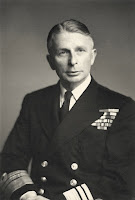,%20V-Adm%20Richard%201892-1968.jpg) |
Vice-Adm. Richard Shelley
(later Benyon). Image: NPG |
Shelley (later Benyon), Vice-Adm. Richard Benyon (1892-1968). Second son of Sir John Shelley (1848-1931),9th bt., and his wife Marion Emma, eldest daughter of Richard Fellowes (later Benyon) (1811-97), born 18 January and baptised at St Mark, North Audley St., Westminster (Middx), 20 February 1892. An officer in the Royal Navy (Lt., 1914; Lt-Cdr, 1922; Cdr., 1927; Capt., 1934; Rear-Adm., 1944; retired as Vice-Adm., 1948), who served in the First and Second World Wars. He was naval attaché to Germany, Denmark and the Netherlands at the outbreak of the Second World War, and Captain of the Mediterranean Fleet, 1940-42; appointed CBE, 1942 and CB, 1946. He took the name Benyon in lieu of Shelley by deed poll, 1964 and by royal licence, 1967. High Sheriff of Berkshire, 1958; Vice-Lord Lieutenant of Berkshire, 1961-68. He married, 16 April 1929, Eve Alice (1900-95), daughter of the Right Reverend Lord (Rupert Ernest) William Gascoyne-Cecil, Bishop of Exeter, and had issue:(1) Sir William Richard Shelley (later Benyon) (1930-2014), kt. (q.v.);
(2) James Edward Shelley (1932-2017), of Ramsdell (Hants), born 18 June 1932; educated at Eton and University College, Oxford (MA 1961); secretary to the Church Commissioners; appointed CBE, 1990; married, 16 June 1956 at Fulmer (Bucks), Judith (b. c.1934), only daughter of George Grubb of Gerrards Cross (Bucks), and had issue two sons and two daughters; died 18 January 2017; will proved 16 June 2017;
(3) Andrew Thomas Rupert Shelley (1933-2018), born 18 November 1933; educated at Eton and Royal Military Academy, Sandhurst; an officer in the army (2nd Lt., 1954; Lt., 1956; Capt., 1960; Maj., 1967; retired 1988); married, 11 December 1971, Joanna Margaret (1938-2006), only daughter of Adm. Sir Randolph Stewart Gresham Nicholson CB DSO DFC (1892-1975), kt., of The Toll House, Bucks Green (Sussex) and had issue one son and one daughter; died 3 April 2018; will proved 3 September 2018;
(4) David Robert Shelley (1937-2018), born 2 April 1937; educated at Eton and University College, Oxford (BA 1961); married, 30 August 1971, Elizabeth Rhoda (b. 1938), younger daughter of Gilbert Graham Balfour of Upper Hardres (Kent), and had issue two sons; died 31 December 2018; will proved 1 December 2019.
He lived at The Pickeridge, Fulmer (Bucks) until he inherited the Englefield House and Hackney estates from his kinsman, Sir Henry Fellowes (later Benyon), 1st bt., in 1959. He did not, however, occupy Englefield House but handed the estate over to his eldest son and lived latterly at The Lambdens, Beenham (Berks).
He died 13 June 1968 and was buried at Englefield; his will was proved 21 August and 31 October 1968 (estate £118,863). His widow died aged 95 on 4 March 1995; her will was proved 15 August 1995 (estate £116,456).
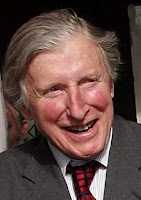 |
| Sir Bill Benyon (1930-2014) |
Shelley (later Benyon), Sir William Richard (k/a Bill) (1930-2014), kt. Eldest son of Vice-Adm. Richard Benyon Shelley (later Benyon) (1892-1968), and his wife Eve Alice daughter of the Right Reverend Lord (Rupert Ernest) William Gascoyne-Cecil, Bishop of Exeter, born 17 January 1930. Educated at Royal Naval College, Dartmouth. He joined the Royal Navy in 1943 (Sub-Lt., 1951; Lt., 1951; retired 1956). With Courtaulds Ltd., 1956-64. MP for Buckingham, 1970-83, and for Milton Keynes, 1983-92; PPS to Minister of Housing. 1972-74; Opposition Whip, 1974-77. JP for Berkshire, 1962-77; County Councillor for Berkshire, 1964-74; Vice Lord Lieutenant of Berkshire, 1994-2005 (DL 1970-94). Chairman of Peabody Trust, 1993-98 and Ernest Cook Trust, 1993-2004. He married, 24 August 1957, Elizabeth Ann (b. 1932), daughter of Vice-Adm. Ronald Hamilton Curzon Hallifax (1885-1943) of Shedfield (Hants), and had issue:(1) Catherine Rose Ingrid Benyon (b. 1958), of Mayridge Fm, Englefield, born 15 November 1958; married, 22 September 1984, Peter David Ian Haig (b. 1954), son of Maj. Andrew Haig of Southernwood House, Hingham (Norfk), and had issue one son and two daughters;
(2) Richard Henry Ronald Benyon (b. 1960), Baron Benyon (q.v.);
(3) Edward Benyon (b. 1962), born 23 May 1962; manages the Hackney estate on behalf of his brother; married, 17 June 1989 (div.), Karen Elizabeth (k/a Katy) (b. 1969) (who m2, 2004, Oliver Christian Davis (b. 1966) of Fifehead St Quintin (Dorset), vetinary surgeon), younger daughter of Robin Crofts of Nethercote House, Flecknoe (Warks), and had issue one son and one daughter;
(4) Mary Elizabeth Benyon (b. 1965), born 4 July 1965; High Sheriff of Berkshire, 2020; a director of the Ernest Cook and Ufton Court Educational Trusts; married, 9 June 1990, Capt. Thomas Richard Phineas Riall (b. 1960), company director, son of Maj. Patrick Riall of Knockbawn (Co. Wicklow), and had issue two sons and one daughter;
(5) Susannah Eve Benyon (b. 1969), born 17 May 1969; bookbinder and paper conservator; married, 18 May 1996, George Neville McBain (1960-2020), and had issue three sons and one daughter.
His father handed over the Englefield House and Hackney estates to him on inheriting them.
He died 2 May 2014; his will was proved 16 July 2015. His widow was living in 2022.
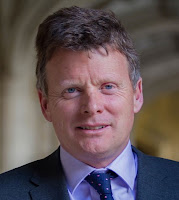 |
| Lord Benyon |
Benyon, Rt. Hon. Richard Henry Ronald (b. 1960), Baron Benyon. Elder son of Sir William Richard Shelley (later Benyon) (1930-2014), kt., and his wife Elizabeth Halifax, born 21 October 1960. Educated at Bradfield College, Royal Agricultural College, Cirencester and Royal Military Academy, Sandhurst. An officer in the army (2nd Lt., 1981; Lt., 1983; retired 1984). Land agent, 1987-90. He stood for parliament unsuccessfully in 1993 and 1997, but was Conservative MP for Newbury, 2005-19; appointed to Privy Council, 2016; created a life peer, 29 January 2021; Parliamentary Under-Secretary, Department for Environment, Food & Rural Affairs, 2010-13 and 2021-22; Minister of State for Biosecurity, Marine and Rural Affairs in DEFRA, 2022-24. Lord Chamberlain of the Royal Household, 2024-date. Member of Newbury District Council, 1991-98? He married 1st, 8 October 1988 (div. 2003), Emma (b. 1963), daughter of Capt. Anthony Henry Heber Villiers (1921-2004) of Woodchester (Glos), and 2nd, 24 May 2004, Zoe Lavinia Beatrice (b. 1970), daughter of (Francis) Alastair Lavie Robinson (b. 1937) of Ousden (Suffk), and had issue:(1.1) Hon. Henry Charles William Benyon (b. 1990), born 12 July 1990; director of Englefield Estate Trust since 2021; married, 2021, Sarah, daughter of Philip Proctor of Skelton (Yorks), and has issue one son;
(1.2) Hon. Thomas Anthony Edward Benyon (b. 1992), born 6 June 1992; married, September 2022, Roseanna (b. 1992), elder daughter of Henry Vane Eden of Cromlix, Dunblane (Perths.);
(1.3) Hon. Frederick Richard Benyon (b. 1994), born 14 March 1994; educated at Royal Military Academy, Sandhurst; an officer in the army (2nd Lt., 2018; Lt., 2019, Capt., 2021) and an accomplished polo player;
(2.1) Hon. Louis Benyon (b. 2005), born 19 November 2005;
(2.2) Hon. Jimmy Benyon (b. 2007), born 10 May 2007.
His father handed over Englefield House and the de Beauvoir estate in Hackney to him c.2010.
Principal sources
Burke's Landed Gentry, 1952, p. 162; P. de la Serre, Histoire de L'Entrée de la Reine Mère dans la Grand Bretagne (1775), pl. ii; VCH Essex, vol. 7, 1978, pp. 64-72, 110-17;.G. Jackson-Stops, 'Englefield House, Berkshire' in Country Life, 26 February and 5-12 March 1981; S. Daniels, Humphrey Repton, 1999, pp. 59-60; F. Cowell, Richard Woods (1715-93): master of the pleasure garden, 2009, pp. 194-95; G. Tyack, S. Bradley & Sir N. Pevsner, The buildings of England: Berkshire, 2nd edn., 2010, pp. 293-94; K. Smith, 'Englefield House: processes, practices and the making of a Company house' in M. Finn & K. Smith (eds.), The East India Company at Home, 1757-1857, 2017, pp. 191-204;
Location of archives
Benyon of Englefield House: deeds, estate and family papers, 13th-20th cents. [Royal Berkshire Archives D/EBy, D/EZ 173]; Essex deeds and papers, 15th-20th cents. [Essex Record Office, D/DBe; A10365]; Hackney deeds and estate papers, 1550-1950 [London Metropolitan Archives, E/BVR]; Hackney deeds and rent accounts, c.1727-1826 [The National Archives, C108/283]
Coat of arms
Benyon of Englefield: Vair, sable and or, on a chief wavy of the second, an Eastern crown between two mullets gules.
Can you help?
- Can anyone provide photographs or portraits of the people whose names appear in bold above, for whom no image is currently shown?
- If anyone can offer further information or corrections to any part of this article I should be most grateful. I am always particularly pleased to hear from current owners or the descendants of families associated with a property who can supply information from their own research or personal knowledge for inclusion.
Revision and acknowledgements
This post was first published 13 February 2024 and updated 14-15, 25 February, 1 August, 21 October and 14 November 2024. I am most grateful to Shane Coulson and Sharon Lewison for additional information and corrections.


,%20V-Adm%20Richard%201892-1968.jpg)

