Showing posts with label Northamptonshire. Show all posts

Monday, 30 September 2024

(584) Bernard of Abington and Brampton, baronets

Bernard of Abington and Brampton, baronets 
This family traces its descent from the Bernard or Barnard family of Isleham in Cambridgeshire. Robert Bernard (fl. 1384) of Clare (Suffk) married Elizabeth, the daughter of Sir Nicholas Lylling (d. 1419), kt., of Abington (Northants) and through his marriage acquired property in Northamptonshire, of which he was High Sheriff in 1384-85. His wife evidently died before her father, for in 1416 Sir Nicholas made her second son, Thomas Bernard (d. 1464), with whom the genealogy below begins, his ultimate heir (the eldest son, John Bernard, being heir to his father's property in Cambridgeshire). The bequest was, however, conditional on the extinction of the life interest of Sir Nicholas's widow. She may have been a second, much younger, wife, for she lived until about 1451, and only then did Thomas come into possession of his estate at Abington. Since Thomas lived, and was buried, at Clare, it may be that he never moved to Northamptonshire, and simply handed the estate on to his son John Bernard (d. 1485), who had made an advantageous marriage to Margaret, the daughter of Henry le Scrope, 4th Lord Scrope of Bolton. When John died in 1485 he left Margaret a life interest in the estate, which she retained until her death in 1496. She was then succeeded by their son, John Bernard (c.1469-1508), and it was probably soon afterwards that he commissioned the building of a new manor house, of which the great hall still survives, albeit in a much altered form.

The Abington estate descended to John's elder son, John Bernard (c.1490-1550), and then to his eldest son, Francis Bernard (c.1526-1602), with whom the genealogy of the family is at last on rather firmer ground. Francis and his wife had a large family, of fourteen children, all but two of whom survived to adulthood. The eldest son, John Bernard, died in his father's lifetime in about 1586, so Abington passed to his second son, Baldwin Bernard (c.1554-1610). He married twice, producing three daughters by his first marriage and two sons and a daughter by his second. After his death, his widow Eleanor (d. 1634) married again, to Sir Edmund Hampden (c.1575-1627), kt., who in 1626 was one of the 70 people imprisoned without trial for refusing to pay the 'forced loan' demanded by King Charles I to finance his war against Spain. The opposition to the the 'forced loan' was one of the early instances of civil disobedience in the power struggle between the king and parliament that was ultimately resolved by the Civil War. Baldwin Bernard's elder son, Sir John Bernard (1604-74), kt., had just come of age at the time of the 'forced loan' dispute, and his political views were no doubt shaped by his stepfather's experience. At the outbreak of the Civil War he certainly supported the Parliamentary side, and he was actively involved as a local sequestration commissioner, although he is not known to have taken up arms. The execution of King Charles I in 1649 was evidently a step too far for his conscience, however, and he largely withdrew from public life during the Commonwealth years, when he was described as 'inclinable to royalism'. After the Restoration, he was knighted in 1661 and became a justice of the peace, and in 1664 he sought to represent the borough of Northampton in parliament, but was unseated on appeal. Sir John was twice married. By his first wife, who died in 1642, he had four sons and four daughters, but all the sons died in infancy, leaving him with no male heir. The turmoil of the Civil War then supervened, and when he married again, in 1649, it was to a widow, Elizabeth Nash (1608-70), who was the granddaughter of William Shakespeare. She gave him no further children, and in 1669 he sold the Abington estate to William Thursby. 

The third son of Francis Bernard (c.1526-1602) was Francis Bernard (c.1558-1630?). He evidently inherited property at Kingsthorpe (Northants) from his father, and settled there. He remains a somewhat shadowy figure, but it is known that he married twice and produced four sons by his second wife. The eldest of these, Sir Robert Bernard (1601-66), 1st bt., was educated at the Middle Temple and became a barrister, and later a serjeant-at-law and a judge. He made his home at Huntingdon, in the Parliamentarian heartland, and was MP for the town in the Short Parliament of 1640, but did not stand again at the second election of that year. His career suggests he was acceptable to both the Parliamentarians and the Royalists - something that few achieved successfully - and he was knighted at the Restoration and raised to a baronetcy two years later. When he died in 1666, he chose to be buried at Abington, then still in the possession of his cousin, but his eldest son, who succeeded him as Sir John Bernard (1630-79), 2nd bt., established a new seat by the purchase in 1653 of Brampton Park, just outside Huntingdon, and the building there of a new house, about which almost nothing is known.

Sir John married twice, having eight children by his first wife, the survivors of whom were all minors when he died in 1679. His widow was left to bring up her stepchildren, and did not marry again until 1688, when they were all grown up. The eldest son, Sir Robert Bernard (1663-1703), 3rd bt., was MP for Huntingdonshire in 1689-90 and High Sheriff of Cambridgeshire and Huntingdonshire in 1691-92. In the latter year he married the daughter of a London mercer, but he died comparatively young, leaving a small family. His widow went on to marry the 1st Lord Trevor and have three more sons, but Brampton passed to his only son, Sir John Bernard (1699-1766), 4th bt. Sir John was the only one of the five baronets in this family not to stand for Parliament, and he seems to have played little part in public affairs. Through his marriage to Mary St John (d. 1793) he acquired estates in Essex as well as Northamptonshire, although there does not seem to have been a significant seat at any of his properties there. Sir John and his wife had nine children, many of whom died young: only his eldest son, Sir Robert Bernard (1739-89), 5th bt., and his eldest daughter, Mary Bernard (1738-93) survived to maturity. Sir Robert was regarded as a wealthy man, and had a keen interest in politics, where his views moved progressively to the radical left. For a time he was an associate of John Wilkes, whose influence secured his election as MP for Westminster, 1770-74, but his career was twice derailed by falling out with his political friends, and his career was eventually cut short by increasingly painful attacks of gout. He was unmarried and at his death the family baronetcy became extinct. His estates passed to his sister's son, Brig-Gen. Robert Bernard Sparrow (d. 1805), whose career will be considered in a future post on that family.

Abington Park (later Abbey), Northamptonshire

Abington has long been swallowed by the suburban expansion of Northampton, and the house (originally Abington Park but known as Abington Abbey since the mid 19th century) has been a museum since 1897. It is a courtyard house with south and east fronts of the 1670s and 1730s, and north and west ranges which were rebuilt in the 19th century as service accommodation.

Abington Abbey: watercolour of the house in the early 19th century by George Clarke (1790-1868). Image: Northampton Central Library.
Between the south range and the central courtyard, however, there remains an open hall built for John Bernard (c.1469-1508), who inherited the estate on the death of his mother in 1496. The timbers of the roof have been dated to this period, and his arms appear on reset panelling from the room. The hall has lost its screens passage, but the blocked door from the screens into the courtyard is still apparent. Also of the early 16th century is a wing beyond the dais end of the hall which now forms the southern part of the west range, and which contained a ground-floor parlour with a chamber above. The Oak Room at the west end of the 17th century south front has panelling of c.1500 from several sources, including some fine linenfold and a frieze depicting the labours of the months, which was gathered together and reset here in the 19th century.

Abington Abbey: the interior of the great hall, looking west and showing
 the fireplace inserted in the 1730s. Image: Historic England BB82/2382.


Abington Abbey: phased ground plan of the house before 1900.
Image: Crown Copyright.
The early 16th century hall house remained in the Bernard family until 1669, when Sir John Bernard sold it for £13,750 to William Thursby (c.1630-1701), a London lawyer and court official. He settled at Abington and was responsible for modernising the house and enlarging the park. In altering the house, he aimed to create the increasing number of private apartments required by contemporary living. The open hall was obsolete and blocked the circulation round the house at first floor level. About 1670, he therefore built a new block in front of the hall, making the south range a double pile, and providing the grand new rooms he required. The new south front which resulted is a long low composition, with a platband, windows with segmental heads and keystones, and slight projections in the centre and at the ends, which were apparently originally gabled. The central projection has its original doorcase with flanking pilasters, but the upper storey was rebuilt in 1743. Inside, a passage led from the front door to the old hall, which became a central circulation space. Next to the passage but not accessible from it a grand new staircase was provided, which was rather old-fashioned, with turned balusters and finials to the newels.

Abington Abbey: the south front of c.1670, as altered in 1743.

Abington Abbey: the east front, built in 1738.
In 1736 the house passed to William Thursby's niece Mary, wife of John Harvey (c.1711-64), who changed his name to Thursby and came to live here. He too remodelled and enlarged the house, building what now forms the east range (dated 1738) and going on to alter and refenestrate the south range (dated 1743). The design of his work has been attributed on stylistic grounds to Francis Smith of Warwick (who died in 1738) and his son William. This is very plausible, as  Thursby had a portrait of Francis Smith and paid for it to be engraved. His new east front incorporates (as its left-hand four bays) the end of the 17th century south range. The central three bays of the front break forward under a steep pediment. The central doorcase has Doric pilasters carrying a segmental pediment, and the flanking windows have triangular pediments. All the other windows on the south and east sides have rectangular moulded and eared stone architraves with sills supported on corbels. On the south front the original gables were removed and a moulded cornice and parapet was added. The new east wing provided further apartments on the first floor but it is not clear what functions were assigned to which rooms on the ground floor. As part of all these works, the original dais in the hall was removed and the present marble floor was laid.

A generation later, the lobby between the front entrance and the great hall was decorated in the Gothick style, with a plaster vault springing from clustered columns, while the doorway into the hall was set in a screen with similar columns and ogee arches. These Gothick additions are attributed to the Hiorne brothers and dated to c.1760-70.

Abington Abbey: the Oak Room, an interior created in the late 19th century with panelling gathered from around the house and new work.
In 1798 the house passed to John Harvey Thursby (1768-1838), who refitted or altered several rooms before 1803. The main rooms at the east end of the south wing were redecorated as a suite of two drawing rooms, with new chimneypieces, and were connected by a wide opening, while a new staircase was made east of the hall. The east range was replanned as a service block either at this time or a little later. Towards the end of his life, J.H. Thursby was evidently in financial difficulties, for he raised mortgages on the estate and from 1836 let it to a tenant. After his death in 1838, the estate was sold to Lewis Loyd of Overstone (Northants) and leased to Dr. Thomas Prichard as a private lunatic asylum, and the north and west ranges were rebuilt. The house was also renamed Abington Abbey at this time. In 1897 Loyd's granddaughter, Lady Wantage, presented the house and its park to the town of Northampton. The house became a museum and the grounds a public park. The essence of the park still survives, although a busy road now runs through the middle of it. The north part contains a tower, once dated 1678, which housed a dovecote above a well from which water was pumped for the needs of the house by a mechanism designed by Samuel Warren of Weston Favell, who had a reputation for hydraulic inventions.

Descent: Sir Nicholas Lylling (d. 1419); to grandson, Thomas Bernard (d. 1464); to son, John Bernard (d. 1485); to widow, Margaret (d. 1496); to son, John Bernard (c.1469-1508); to son, John Bernard (c.1490-1550); to son, Francis Bernard (c.1526-1602); to son, Baldwin Bernard (c.1554-1610); to son, Sir John Bernard (1604-74), kt., who sold 1669 to William Thursby (c.1630-1701); to nephew, Richard Thursby (1666-1736); to first cousin once removed, John Harvey (later Thursby) (1709-64); to son, John Harvey Thursby (1734-98); to son, John Harvey Thursby (1768-1838); to son, John Harvey Thursby (1793-1860), who sold 1841 to Lewis Loyd (1767-1858), banker; to son, Samuel Jones Loyd (1796-1883), 1st Baron Overstone; to daughter, Harriet Sarah (d. 1920), wife of Robert James Lindsay (later Loyd-Lindsay) (1832-1901), 1st Baron Wantage, who donated the house and park to the borough of Northampton in 1898.

Brampton Park, Huntingdonshire

Brampton Park, which covers about 100 acres south-west of the village of Brampton, can be traced back to the 12th century, when it was a royal hunting ground. The house may have originated as a lodge in the park, but in 1328 was said to be ruinous. An Elizabethan house seems to have been built here, probably by the Throckmortons, which is described as a fair brick house, but nothing more is known of its appearance, for it was incorporated in a house probably built by Sir John Bernard, who purchased the property in 1653. 

The mid 17th-century house, of which I have traced no visual record, was in turn remodelled by Lady Olivia Sparrow who came into possession after her husband died in 1805. In 1806-07 she brought in John Nash, who built service accommodation and made alterations to the house itself, and the gabled and castellated gault brick west end of the present house is presumably his work; one room in the service wing has a shallow saucer dome on squinches which could be his work. Later on, in 1823-25, Lady Olivia employed Thomas Stedman Whitwell (1784-1840) to rebuild the principal block of the house, and J.B. Papworth to carry out internal decoration in the library and dining room. Thomas Hopper also claimed to have worked at Brampton in the late 1820s, although it is not clear what was done to his designs, as a plan of 1824 appears to show the same footprint for the house as it occupied later. The house that resulted from these works was recorded in a number of late 19th century engravings and photographs. Its most striking feature was a large domed conservatory on the south front, flanked by two four-storey towers, while the east front had extensively glazed three-storey projecting bays either side of a centre with a canted central bay on the ground floor. The entrance front on the north side was plainer, but had a single-storey porch with an elaborate achievement of arms over the archway. It may be that on this side, elements of the earlier house were retained and incorporated. Papworth also produced a picturesque design for the grounds, which was probably not followed, although the surviving thatched lodge is in his style. 

Brampton Park: north front before the fire of 1907. Image: Huntingdonshire Archives

Brampton Park: engraving of the south and east fronts of the house in 1852.
Sadly, the main block of the house was gutted in a disastrous fire on 24 January 1907, which is said to have started in a box room at the west end of the main block and spread east, initially through the roof space, although within two hours it had largely gutted the main block. The fire happened at a time of light winds and its rapid spread was put down to the largely timber construction of the internal walls.

Brampton Park: the ruins of the south front after the fire and the collapse of the conservatory, 1907. Image: Huntingdonshire Archives

Brampton Park: east front after the fire, 1907. Image: Huntingdonshire Archives
After the fire, the damaged part of the building was pulled down and replaced by a smaller new house in red brick. Although clashing in colour with the older part of the house, this emulates the style of the Nash wing, which was again restored and remodelled. The rebuilding was commissioned by Viscount Mandeville, but the architect seems not to be recorded. 

Brampton Park: the house in 2018 before its recent conversion to apartments. Image: Derelict Places/Rubex
The house passed into the hands of the Royal Air Force during the Second World War, and remained in military use, latterly as the officers' mess for a camp which sprawled across the park, until 2012. A further fire in the early 1980s led to a programme of repairs and remodelling that included significant extensions to the south and west of the house, and the addition of a new porch on the north side of the house. The building was restored and the modern extensions removed after 2019, when it was converted to multiple occupation. Extensive suburban housing has been constructed in the former park since 2015.

Descent: William Foster (d. 1508); to son, John Foster (d. 1526); to son, Gerard Foster (b. c.1524), who sold 1545 to John Newton, who sold 1550 to Simon Throckmorton MP (d. 1585); to son, Robert; to brother Simon Throckmorton (d. 1613); to brother Joseph Throckmorton, who sold 1613 to Sir Thomas Hetley (d. 1637), kt., serjeant-at-law; to son, Francis Hetley (d. 1638); to brother, William Hetley, who sold 1653 to Sir John Bernard (1630-79), 2nd bt.; to son, Sir Robert Bernard (1663-1703), 3rd bt.; to son, Sir John Bernard (1699-1766), 4th bt.; to son, Sir Robert Bernard (1739-89), 5th bt.; to nephew, Brig-Gen. Robert Bernard Sparrow (d. 1805); to widow, Lady Olivia Sparrow (d. 1863); to grandson, William Drogo Montagu (1823-90), 7th Duke of Manchester; to son, George Victor Drogo Montagu (1853-92), 8th Duke of Manchester; to son, William Angus Drogo Montagu (1877-1947), 9th Duke of Manchester. The house was leased to Benjamin Beasley as an institution for the cure of stammering, 1889-1907. He was in the process of giving up his lease at the time of the fire, but though he was uninjured in the blaze he died a fortnight later. The house was used to house German prisoners of war in the First World War. In the Second World War it was first used as an evacuation home for mothers and babies from the East End of London and later taken over by the RAF, which acquired the freehold. It remained in use for military purposes until 2013, when it was closed and redeveloped for large-scale housing.

Bernard family of Abington Abbey, baronets


Bernard, Thomas (d. 1464). Second son of Robert Bernard (fl. 1384) of Isleham (Cambs) and his wife Elizabeth, daughter of Sir Nicholas Lylling (d. 1418) of Abington (Northants). Escheator of Rutland and Northamptonshire, 1415. He married Margaret, daughter of John Mantell, and had issue:
(1) John Bernard (d. 1485) (q.v.);
(2) Rev. Thomas Bernard (fl. 1449), vicar of Pattishall (Northants).
He lived at Clare (Suffk), and evidently acquired the manor of Abington on the death of his mother c.1451, but there is no evidence that he lived there.
He died in 1464. His widow married 2nd, William Newenham (c.1435-1504) of Thenford (Northants) and was living in 1467.

Bernard, John (d. 1485). Elder son of Thomas Bernard (d. 1464) and his wife Margaret, daughter of John Mantell. He married Margaret (or Mary), daughter of Henry Scrope, 4th Lord Scrope of Bolton and widow of William Plessington and Hugh Stafford, and had issue:
(1) John Bernard (c.1469-1508) (q.v.);
(2) Francis Bernard;
(3) Rev. Eustace Bernard*; a secular priest at Filgrave (Bucks), Thenford (Northants), Tarporley (Ches) and Maidford (Northants);
(4) Thomas Bernard, of Gloucestershire;
(5) Rev. Robert Bernard (fl. 1510); said to be rector of Cotterstock (Northants) in 1510.
He lived at Reading (Berks) and inherited the manor of Abington from his father in 1464. At his death it passed to his widow for life.
He died in October 1485. His widow is said to have died in 1496.
* Probably not the man who was an Augustinian canon at Ravenstone Priory (Bucks) (prior, 1473-85), who would have been at least a generation older.

Bernard, John (c.1469-1508). Eldest son of John Bernard (d. 1485) and his wife Margaret, daughter of Henry Scrope, 4th Lord Bolton and widow of William Plessington and Hugh Stafford, born about 1469. He married Margaret, daughter of Roger Wake* of Blisworth (Northants), and had issue:
(1) John Bernard (c.1490-1550) (q.v.);
(2) Richard Bernard, of Earl's Barton (Northants); married Anne [surname unknown] (who m2, John Mulsoe).
He inherited Abington from his mother in 1496 and built a new manor house.
He died 24 August 1508, and an inquisition post mortem was held at Northampton Castle, 31 March 1509. His wife's date of death is unknown.
* She is generally said to be the daughter and heiress of John Daundelyon, but the particulars given in John Bernard's inquisition post mortem are as above.

Bernard, John (c.1490-1550). Elder son of John Bernard (c.1469-1508) and his wife Margaret, daughter of Roger Wake of Blisworth (Northants), born about 1490 as he was aged 18 at the time of his father's death. He married, 16 January 1507/8 at Earls Barton (Northants), when his bride was probably still a child, Cicely (d. 1557), daughter of John Muscott of Earls Barton, and had issue:
(1) Francis Bernard (c.1526-1602) (q.v.);
(2) John Bernard; married Mary, daughter of John Haslewood, and had issue one son;
(3) Elizabeth Bernard; married 1st, John Covert, and 2nd, William Dixon;
(4) Mary Bernard; married George Purley of Lincs;
(5) Dorothy Bernard, a nun at Delapré Abbey (Northants);
(6) Bridget Bernard; married John Dixon.
He inherited the Abington estate from his father in 1508.
He died 4 February 1549/50 and was commemorated by a memorial brass (now lost) at Abington; an inquisition post mortem was held at Northampton, 3 Edward VI. His widow died 21 September 1557 and was commemorated by a brass (also now lost) at Abington.

Bernard, Francis (c.1526-1602). Elder son of John Bernard (c.1490-1550) and his wife Cicely, daughter of John Muscot of Earls Barton, born about 1526, based on his age at his father's death. He married Alice (d. 1612?), daughter of John Haslewood of Maidwell (Northants), and had issue, with two further daughters who died in infancy:
(1) John Bernard (d. c.1586); married Dorothy (who m2, Richard Neale of Rugby (Warks), daughter of Francis Cave (c.1502-83) of Baggrave (Leics), but died without issue in the lifetime of his father, c.1585/6;
(2) Baldwin Bernard (c.1554-1610) (q.v.);
(3) Francis Bernard (c.1558-1630?) (q.v.);
(4) Thomas Bernard (c.1560-1628) of Reading, born before 1564; ancestor of the Bernards of Nether Winchendon (Bucks); married Sarah [surname unknown] (d. 1640) and had issue two sons and three daughters, baptised at Reading*; buried at St Mary, Reading, 14 December 1628;
(5) Richard Bernard (c.1562-1613), of Turvey (Beds) and Great Doddington (Northants), born before 1564; married 1st, Alice (c.1543-1606), daughter of John Chibnell of Astwood (Bucks) and widow of William Adam of Turvey (Beds), but had no issue; married 2nd, Elizabeth (d. 1622), daughter of Anthony Woolhouse of Glasswell (Derbys) and widow of [forename unknown] Morley, and had issue two sons and one daughter; buried at Great Doddington (Northants), 24 April 1613; will proved in the PCC, 16 June 1613;
(6) Katherine Bernard, born before 1564; married Ambrose Agard (d. 1612) (who m2, Anne [surname unknown], and had issue one daughter) of Broughton (Northants) and later of Forrock House, Chipping (Lancs), and had issue at least one son and two daughters; death not traced;
(7) Anne Bernard (d. 1629), born before 1564; married 1st, John Doyley (d. 1593) of Merton (Oxon), son of Robert Doyley (d. 1577) of Merton, and had issue four daughters; married 2nd, 11 December 1600 at St Margaret, Westminster (Middx), Sir James Harington (c.1555-1614), kt. and 1st bt., of Ridlington (Rut.) and married 3rd, c.1615, Sir Henry Poole (1564-1632), kt., of  Kemble (Glos) and Oaksey (Wilts); died 1629 and was buried at Merton;
(8) Magdalen Bernard, born before 1564; married Thomas Danvers of Banbury (Oxon), son of George Danvers;
(9) Elizabeth Bernard, born before 1564; married 1st, Thomas Harrison (1568?-1625) of Gobion's Manor, Northampton, second son of Robert Harrison (d. 1598?) of Stow (Northants), and had issue at least five sons and three daughters; married 2nd, Henry Favell of Coventry;
(10) Jane Bernard (c.1560-1619), born before 1564; married, as his second wife, Richard Saltonstall (d. 1619) of Chipping Warden (Northants) and Groves, South Ockendon (Essex), son and heir of Sir Richard Saltonstall, Lord Mayor of London, and had issue at least three sons and one daughter; died 1619; will proved in the PCC, 4 June 1619;
(11) Dorothy Bernard, born before 1564; married Thomas Charnock of Wellingborough (Northants);
(12) Prudence Bernard (fl. 1619), probably born about 1566; married Richard Winhall of Warks; living in 1619 when she was mentioned in the will of her sister Jane.
He inherited the Abington Park estate from his father in 1550.
He died 21 October 1602. His widow was living in 1610 and is said to have died in 1612.
* The mother's name is unfortunately not given in the parish register.

Bernard, Baldwin (c.1554-1610). Second, but eldest surviving, son of Francis Bernard (c.1526-1602) and his wife Alice, daughter of John Haslewood of Maidwell (Northants), born about 1554. He married 1st, 11 November 1587 at St Clement Danes, Westminster (Middx), Alice, daughter of Thomas Stafford of Tattenhoe (Bucks), and 2nd, 20 July 1603 at Tanworth-in-Arden (Warks)*, Eleanor (d. 1634), daughter and co-heir of John Fulwood of Ford Hall (Warks), and had issue:
(1.1) Elizabeth Bernard (fl. 1610); living in 1610; probably died unmarried;
(1.2) Anne Bernard (fl. 1610); probably died unmarried;
(1.3) Dorothy Bernard (fl. 1610); probably died unmarried;
(2.1) Sir John Bernard (1604-74), kt. (q.v.);
(2.2) William Bernard (b. c.1608) of Ecton (Northants), born about 1608; married, 11 November 1658 in Northampton, Mary, perhaps the daughter of Francis Lane of Abington, but had no issue; probably died before his brother as he is not mentioned in his will;
(2.3) Catherine Bernard, probably died unmarried.
He inherited the Abington Park estate from his father in 1602.
He died 7 September and was buried at Abington, 11 September 1610, where he is commemorated by a monument erected by his elder son in 1634; his will was proved at Northampton, 1610. His first wife died before 1603. His widow married 2nd, c.1615, Sir Edmund Hampden (d. 1627), son of Griffith Hampden of Great Hampden (Bucks), and had further issue four sons and two daughters; she died 27 June 1634, and was buried with her second husband at Abington; her will was proved in the PCC, 18 December 1634.
*Where he appears in the register as 'Baldwin Barneyard'!

Bernard, Sir John (1604-74), kt. Elder son of Baldwin Bernard (c.1554-1610) and his second wife, Eleanor, daughter and co-heir of John Fulwood of Ford Hall, born 23 August 1604. After his father's death he was made a ward of the Crown. Educated at King's College, Cambridge (matriculated 1621) and Grays Inn (admitted 1624). He stood unsuccessfully for parliament in Northampton in 1640 and supported the Parliamentary side during the Civil War, being a local sequestration commissioner in 1643, but after the execution of the king he became increasingly 'inclinable to royalism' and he went out of political life during the Protectorate, returning to public office after the Restoration. He was knighted 24 September 1661 and elected MP for Northampton, 1664, but unseated on appeal; JP for Northamptonshire, 1661-74. He married 1st, Elizabeth (c.1602-42), daughter of Clement Edmondes (1568-1622) of Preston Deanery (Northants) and 2nd, 5 June 1649 at Billesley (Warks), Elizabeth (1608-70), daughter and heir of Dr. John Hall of New Place, Stratford-on-Avon (Warks)* and widow of Thomas Nash (1593-1647) of Welcombe (Warks), and had issue:
(1.1) Elizabeth Bernard (c.1630-66), born before 1631, when she was mentioned in her grandmother's will; 'a person of extraordinary charity and piety', a memoir of whose life was written by her husband; she married, 18 February 1657/8 at Abington, Henry Gilbert (fl. 1662) of Locko (Derbys), and had issue five sons and one daughter; buried at Spondon (Derbys), 16 January 1665/6, where she is commemorated by a monument;
(1.2) Mary Bernard (fl. 1671); married, 7 July 1657 at Abington, Thomas Higgs (d. 1671) of Colesbourne (Glos), second son of Thomas Higgs (d. 1649) of Colesbourne, and had issue at least one child; living in 1671;
(1.3) Eleanor Bernard (b. c.1635), born about 1635; married, 8 September 1659 at Abington, Samuel Cotton (b. c.1632; fl. 1684) of Hinwick Hall (Beds) and later of Dadlington (Leics), High Sheriff of Leicestershire, and had issue at least six children;
(1.4) John Bernard (d. 1645), eldest son; died young and was buried at Abington, 18 January 1644/5;
(1.5) William Bernard (d. 1637); died young and was buried at Abington, 30 March 1637;
(1.6) Charles Bernard (1638-39), baptised at Abington, 8 February 1637/8; died in infancy and was buried at Abington, 5 June 1639;
(1.7) Charles Bernard (1640-51); baptised at Abington, 7 May 1640; died young and was buried at Abington, 25 May 1651;
(1.8) Catherine Bernard (b. & d. 1642), baptised at Abington, 9 March 1641/2; died in infancy and was buried at Abington, 13 March 1641/2.
He inherited the Abington Park estate from his father in 1610, enlarged and modernised the house, but sold it in 1669.
He was buried at Abington, 5 March 1673/4. His first wife was buried at Abington, 30 March 1642. His second wife was buried at Abington, 17 February 1669/70, where she is commemorated by a monument.
* And therefore granddaughter of the poet and playwright, William Shakespeare (1564-1616).

---

Bernard, Francis (c.1558-1630?). Third son of Francis Bernard (c.1530-1602) and his wife Alice, daughter of John Haslewood of Maidwell (Northants), born about 1558. He is said to have married 1st, [name unknown], widow of William Mercer of Oxford, and 2nd, c.1596, Mary, eldest daughter of Anthony Woolhouse of Glasswell (Derbys) and had issue:
(1.1) Francis Bernard; died in the lifetime of his father;
(1.2) Ann Bernard; married Robert Welling of Riscom (Suffk);
(2.1) Sir Robert Bernard (1601-66), 1st bt. (q.v.);
(2.2) John Bernard;
(2.3) James Bernard;
(2.4) William Bernard.
He lived at Kingsthorpe (Northants).
He is said to have died 21 November 1630. His first wife's date of death is unknown. His second wife's date of death is unknown.

Bernard, Sir Robert (1601-66), 1st bt. Eldest son of Francis Bernard (c.1558-1630?) and his second wife Mary, daughter of Anthony Woolhouse of Glasswell (Derbys), born at Kingsthorpe, 1601. Said to have been educated at Queen's College, Oxford (but does not appear in the Alumni Oxoniensis) and the Middle Temple (admitted 1615; called 1621; bencher 1647). Barrister-at-law; Recorder of Huntingdon 1640-63, Counsel for the University of Cambridge, 1646; Serjeant-at-law, 1648 and 1660; Steward and Judge of the Court of the Isle of Ely, 1649. MP for Huntingdon, 1640. He was knighted in 1660 and raised to a baronetcy, 1 July 1662. He married 1st, 13 April 1625 at Huntingdon, Elizabeth, daughter of Sir John Tolcarne* (1569-1627), kt., of Ashen Hall (Essex), and 2nd, Elizabeth (c.1601-62), elder daughter of Sir James Altham of Oxhey and widow of Sir Francis Astley (d. 1638) and Robert Digby (c.1599-1642), 1st Baron Digby of Geashill, and had issue, perhaps among others:
(1.1) Lucy Bernard (1626-69), baptised at Huntingdon, 19 January 1625/6; married, 14 January 1641, Sir Nicholas Pedley (1615-85), kt. (who m2, 10 June 1674, Anne, daughter of Richard Dorrington of Stow (Hunts) and widow of Lawrence Torkington (1622-73) of Great Stukeley (Hunts)), of Abbotsley (Hunts), serjeant-at-law and MP for Huntingdon or Huntingdonshire, 1656-60, 1673-79, and had issue eight sons and seven daughters; died 12 May 1669;
(1.2) Mary Bernard (b. c.1628), born about 1628; married, before 1647, Lawrence Torkington (1622-73) (who m2, Anne, daughter of Richard Dorrington of Stow (Hunts)), of Great Stukeley (Hunts);
(1.3) Sir John Bernard (1630-79), 2nd bt. (q.v.);
(1.4) William Bernard (c.1634-98?), born about 1634; said to have been an officer in the Commonwealth army (Col.) and later grocer in London**; a friend of Samuel Pepys; married, 1680, Jane (c.1648-c.1700), daughter of Henry Ireton and widow of Richard Lloyd (d. by 1680); probably the man of this name who was buried at St Giles-in-the-Fields, Holborn (Middx), 2 December 1698 and administration of whose goods was granted to his widow Jane in the PCC, 12 December 1698.
He lived in Huntingdon by 1625, but also maintained chambers in London.
He died at Serjeant's Inn, 18 April 1666, and was buried in the north aisle at Abington, where he is commemorated by a monument. His first wife's date of death is unknown. His second wife died 3 January 1662/3, and was buried at St Paul, Covent Garden, Westminster (Middx), 7 January 1662/3.
* This surname is also spelled Tollakerne, Tallakern, Tolkern, Talkerne etc.
** He was certainly a grocer, but his reputed military career is more doubtful.

Bernard, Sir John (1630-79), 2nd bt. Elder son of Sir Robert Bernard (1601-66), 1st bt. and his first wife Elizabeth, daughter of Sir John Tolcarne, born November 1630. Educated at Christ's College, Cambridge (matriculated 1645) and the Middle Temple (admitted 1645; called 1649). Barrister-at-law. MP for Huntingdon, 1654-55, 1656-58, 1659, 1660; JP for Huntingdonshire, 1660-70, 1673-79; a commissioner for sewers in Lincolnshire, 1660; a conservator of the Bedford Level, 1669-75. Knighted c.1662 and succeeded his father as 2nd baronet, 18 April 1666. He married 1st, 26 February 1655/6 at Enfield (Middx), Elizabeth (d. 1667), daughter of Sir Oliver St John, 2nd bt., of Bletsoe (Beds), Lord Chief Justice of Common Pleas, and 2nd, 1670 (licence 30 August), Grace (1643-1721?), daughter of Sir Richard Shuckburgh (1596-1656), kt., of Shuckburgh Hall (Warks), and had issue:
(1.1) Elizabeth Bernard (d. 1679); died unmarried and was buried at Brampton, 8 April 1679;
(1.2) Anne Bernard (1659-89), baptised at Brampton, 11 October 1659; died unmarried and was buried at Brampton, 5 March 1689;
(1.3) Mary Bernard (1660-1704), born 28/29 November and baptised at Brampton, 4 December 1660; married, 1682 (licence 9 October), as his second wife, Thomas Browne (1640-1713) of Arlesey (Beds), MP for Bedfordshire, 1690-95, and had issue two sons and five daughters; buried at Arlesey, 14 November 1704;
(1.4) Lucy Bernard (1662-1716), baptised at Brampton, 21 February 1661/2; died unmarried and was buried at Brampton, 1 November 1716;
(1.5) Sir Robert Bernard (1663-1703), 3rd bt. (q.v.);
(1.6) Joanna Bernard (1665-1740?), baptised at Brampton, 11 April 1665; married, 4 January 1700/1 at St George's Chapel, Windsor, Ven. Richard Bentley (1662-1742), archdeacon of Ely and Master of Trinity College, Cambridge, and had issue one son and two daughters; said to have died in 1740;
(1.7) Frances Bernard (b. 1666), baptised at Brampton, 4 August 1666; living in 1679 but died young;
(1.8) Grace Bernard (1667-84), baptised at Brampton, 27 August 1667; died young and was buried at Brampton, 10 December 1684.
He purchased the Brampton Park estate (Hunts) in 1653.
He died 25 June and was buried 26 June 1679 at Brampton, where he is commemorated by a monument; his will was proved 11 January 1679/80. His first wife was buried at Brampton, 5 September 1667. His widow married 2nd, 20 September 1688 at St Benet, Paul's Wharf, London, as his third wife, Thomas Mariett (1631-91) of Whitchurch (Warks) and Alscot Park, Preston-on-Stour (then Glos, now Warks), MP for Warwickshire in 1681, and is said to have died in 1721.

Bernard, Sir Robert (1663-1703), 3rd bt. Only son of Sir John Bernard (1630-79), 2nd bt., and his first wife, Elizabeth, daughter of Sir Oliver St John, Lord Chief Justice of Common Pleas, baptised at Brampton, 15 December 1663. JP and DL for Hunts, 1688-1703; High Sheriff of Cambridgeshire and Huntingdonshire, 1688 (but did not act) and 1691-92. Whig MP for Huntingdonshire, 1689-90. He married, 26 May 1692 at St Margaret, Westminster (Middx), Anne (c.1670-1746), daughter of Robert Weldon of London, mercer, and had issue:
(1) Anne Bernard (1693-1765), born before August 1693; died unmarried, 6 November 1765; will proved in the PCC, 27 November 1765;
(2) Mary Bernard (1696-1785), baptised at Brampton, 7 September 1696; died unmarried, 11 March 1785; will proved in the PCC, 26 March 1785; 
(3) Sir John Bernard (1699-1766), 4th bt. (q.v.);
(4) Elizabeth Bernard (d. 1703); born in or before 1702; buried at Brampton, 21 July 1703.
He inherited the Brampton Park estate from his father in 1679 and came of age in 1684.
He is said to have died 26 July and was buried at Brampton, 5 August 1703; his will was proved in the PCC, 16 August 1703. His widow married 2nd, 25 September 1704 at Brampton, as his second wife, the Rt. Hon. Thomas Trevor (1658-1730), 1st Baron Trevor, of Bromham (Beds), Lord Privy Seal, 1726-30 and Lord President of the Council, 1730, and had further issue three sons; she died 5 December and was buried at Bromham, 13 December 1746; her will was proved in 1746.

Bernard, Sir John (1699-1766), 4th bt. Only son of Sir Robert Bernard (1663-1703), 3rd bt., and his wife Anne, daughter of Robert Weldon of London, baptised at Brampton, 23 February 1698/9. He succeeded his father as 4th baronet, 26 July 1703. He married, 22 December 1735 at St Stephen Walbrook, London, Mary (d. 1793), youngest daughter of Sir Francis St. John (c.1680-1756), 1st bt., of Longthorpe (Northants), and had issue*:
(1) Mary Bernard (1738-93), born 26 January 1738/9; married 8 July 1771 at St Marylebone (Middx), Robert Sparrow (1741-1822) of Worlingham Hall (Suffk), and had issue one son and one daughter; died 9 February 1793;
(2) Sir Robert Bernard (1739-89), 5th bt. (q.v.);
(3) Ann Bernard (1740-44), born 17 July and baptised at St Margaret, Westminster (Middx), 28 July 1740; died young and was buried at Brampton, 12 July 1744;
(4) Francis Bernard (1741-57), born and baptised at St Margaret, Westminster, 30 October 1741; said to have died at school in Bishop's Stortford (Herts), and been buried 6 July 1757;
(5) Elizabeth Bernard (c.1743-50), buried at Brampton, 3 March 1749/50;
(6) Richard Bernard (b. & d. 1747), baptised at Brampton, 20 October 1747; died in infancy and was buried at Brampton, 22 October 1747;
(7) Richard Bernard (b. & d. 1749), baptised at Brampton, 5 July 1749; died in infancy and was buried at Brampton, 10 July 1749;
(8) Frances Bernard (1750-70), born 9 August and baptised at St Margaret, Westminster, 29 August 1750; mentioned in her father's will in 1757; died unmarried and was buried at St John, Peterborough, 16 June 1770;
(9) William Bernard (c.1751-66?); mentioned in his maternal grandfather's will in 1755, his father's will of 1757, and his aunt Anne's will of 1765; said to have died at Thorpe Hall (Hunts), 8 February 1766.
He inherited Brampton Park from his father in 1703 and came of age about 1720. His father in law settled the manors of Leigh Hall and Hadleigh as well as lands at Paggleham, Barling and Shopland (all Essex) on him, and bequeathed his estates in Co. Armagh to trustees for his son William.
He died 15 December and was buried at St John, Peterborough (Hunts), 21 December 1766; his will was proved in the PCC, 30 December 1766. His widow died 'at a great age', 21 September 1793, and her will was proved in October 1793.
* Some online sources plausibly mention other children who died young, but I have been unable to find any evidence to support their existence.

Bernard, Sir Robert (1739-89), 5th bt. Eldest son of Sir John Bernard (1699-1766), 4th bt., and his wife Mary, youngest daughter of Sir Francis St. John, 1st bt., of Longthorpe (Northants), born 17 June and baptised at St Martin-in-the-Fields, Westminster, 2 July 1739. Educated at Westminster and Christ Church, Oxford (matriculated 1758). He succeeded his father as 5th baronet, 15 December 1766 and undertook a tour in Spain in 1771 with Col. Barre. Recorder of Bedford, 1771-89. He was initially elected to Parliament on the Duke of Manchester's influence as MP for Huntingdonshire, 1765-68, but quarrelled with his patron in 1766 and became a radical Whig. In 1769 he helped to found the Bill of Rights Society, and was with the help of John Wilkes elected as MP for Westminster, 1770-74, but in 1771 he voted for the the dissolution of the Bill of Rights Society and joined the rival Constitutional Society and broke with Wilkes. On this account he was deselected by the Westminster radicals and made no further attempt to sit in Parliament, although he had a personal interest at Bedford; his obituary suggests he was obliged to abandon politics by 'violent attacks of gout'. He was unmarried and without issue.
He inherited Brampton Park from his father in 1766. At his death, he left his property, valued at £14,000 a year, to his sister's son, Robert Bernard Sparrow.
He died 2 January 1789, when the baronetcy became extinct, and was buried at Brampton, 7 January 1789; his will was proved in the PCC, 21 January 1789.

Principal sources

Burke's Extinct and Dormant Baronetcies, 2nd ed., 1841, p. 59; J. Bridges, History & Antiquities of Northamptonshire, 1791, vol. 1, p. 400-05; S. Napier-Higgins, The Bernards of Abington and Nether Winchendon: a family history, 1903 (2 vols); VCH Hunts, vol. 3, 1936, pp. 12-20; VCH Northamptonshire, vol. 4, 1937, pp. 65-69; J. Heward & R. Taylor, The country houses of Northamptonshire, 1996, pp. 47-51; B. Bailey, Sir N. Pevsner & B. Cherry, The buildings of England: Northamptonshire, 3rd edn., 2013, pp. 471-72; C. O'Brien & Sir N. Pevsner, The buildings of England: Bedfordshire, Huntingdonshire and Peterborough, 2nd edn., 2014, pp. 427-28; Brampton Park Heritage Assessment, 2015; History of Parliament biographies of Sir John Bernard, kt. and of 1st, 2nd, 3rd and 5th baronets;

Location of archives

Bernard and Sparrow families of Brampton: deeds, estate and family papers, 17th-19th cents. [Huntingdonshire Archives, DDM]

Coat of arms

Bernard of Abington and Huntingdon: argent, a bear rampant sable muzzled or.

Can you help?

  • Can anyone provide photographs or portraits of the people whose names appear in bold above, for whom no image is currently shown?
  • If anyone can offer further information or corrections to any part of this article I should be most grateful. I am always particularly pleased to hear from current owners or the descendants of families associated with a property who can supply information from their own research or personal knowledge for inclusion.

Revision and acknowledgements

This post was first published 30 September 2024 and was updated 1-4 October 2024.

Sunday, 25 June 2023

(548) Bellville of Tedstone Court, Papillon Hall and Fermyn Woods Hall

According to Burke's Landed Gentry, the first English forebear of this family was John Bellville, a French émigré who came to England at the time of the French Revolution and was the father of John Benjafield Bellville (c.1793-1847), with whom the genealogy below begins. The only certain reference to the first John which I have been able to trace, however, occurs in the apprenticeship indenture of his son in 1807, where the father is described as 'John Bellville of Codford St. Peter' (Wilts). There seems to be no evidence that the first John had any long association with Codford, however, and I have been unable to trace either his burial or his son's baptism (he is said to have been born in Bath). Although the story of John's origin as a French émigré seems perfectly plausible, it bears a slightly suspicious similarity to that of the well-known astronomer, John Henry Bellville (1795-1856), who was baptised at St Pancras (Middx) but was apparently the child of French refugees who settled at Westbury (Wilts) - less than ten miles from Codford - and came under the patronage of Lady Pulteney of Bath. This might be a coincidence, or the two families might be connected, but it also possible that the mercantile Bellvilles quietly copied the background of their namesake when they grew rich and wanted to suggest an obscure but potentially romantic lineage.

John Benjafield Bellville (c.1793-1847) was apprenticed to Matthias Archibald Robinson (1775-1838) as a needlemaker, but in 1823 the two men established the firm of Robinson & Bellville to manufacture patent barley and groats drinks - the ancestor of the modern-day Robinson's Lemon Barley Water. With the death of Robinson in 1838 and J.B. Bellville in 1847, the business was carried on by John's son, William John Bellville (1830-91), who in 1862 merged the business with Thomas Keen & Son, mustard manufacturers. By 1876 he was the sole proprietor of the merged firm of Keen, Robinson & Bellville, and he died an extremely wealthy man, leaving property valued at over £600,000. William left four sons but they had been educated as gentlemen and not for business, and he bequeathed the goodwill of the company to his widow, who sold it to J. & J. Colman of Norwich, a rival mustard manufacturer, in 1903. A connection was maintained with the business as Frank Ashton Bellville (1870-1937), became a director of Colmans at that time.

The four sons of William John Bellville all acquired country houses. Henry Archibald Bellville (1866-1930) bought Tedstone Court (Herefordshire) in 1908, while the other three all bought seats in the prime foxhunting country of the East Midlands, where they could indulge their shared passion for hunting. William's widow bought Papillon Hall (Leics) for Frank Ashton Bellville (1870-1937) in 1901, and he then employed Sir Edwin Lutyens to greatly enlarge and remodel it from 1903. William John Bellville (1868-1937) bought Kibworth Hall (Leics) in 1918 and George Ernest Bellville (1879-1967) acquired Fermyn Woods Hall (Northants) in 1922.

Kibworth Hall: the early 19th century house acquired by William John Belville in 1918 and sold by his nephew in about 1942, from an old postcard.
The sale of the family business in 1903 took place just at the moment when changes in social legislation and taxation were beginning to make it impossible to transmit inherited wealth from one generation to the next in an unimpaired fashion. As the 20th century developed, it was increasingly essential for a country house and the lifestyle associated with it to be actively supported by earned income and for inherited wealth to be husbanded with care and good fortune if it was not to be seriously depleted by capital and other taxes. The legacies left by William John Bellville were big enough to support the next generation without too many cares, but some of the successors of Henry, William, Frank and George Bellville were less fortunate. Miles Aubrey Bellville (1909-80), an Olympic sailor and wartime officer in the Royal Marines, inherited Tedstone Court in 1930. He was able to remain there throughout his life, but his son, Richard John Bellville (1945-2000) sold it in 1996. William John Bellville (1868-1937) had no surviving children, and left Kibworth Hall to his nephew, Anthony Seymour Bellville (1902-70), who sold it and moved to a smaller house on the Isle of Wight. Because Anthony received this inheritance, Frank Ashton Bellville left Papillon Hall to his younger son, Rupert Bellville (1904-62), who tried to sell it almost at once and eventually pulled down the house in 1950 before finally finding a buyer for the estate. He also inherited £105,000 from his father, but in less than twenty years had spent it and been declared bankrupt. George Ernest Bellville (1879-1967) lived for thirty years longer than any of his brothers, but had no sons to inherit Fermyn Woods, which he bequeathed to his divorced elder daughter, Dodo Maxwell (1919-2002). She reduced the size of the house soon afterwards and lived in the surviving part until her death, by which time it was in very poor condition. It was sold after her death to a local architect who was able to finance a thorough restoration thanks to being one of the heirs to a construction industry fortune. In less than a hundred years, therefore, the family have acquired and sold four significant country houses.

Tedstone Court, Tedstone Delamere, Herefordshire

A large and essentially U-shaped building, given its present form by Richard Wight after he inherited the estate in 1805, with the main fronts looking east and south towards the parish church and the wooded valley of the Sapey Brook.  Between the house and the church stood a long-deserted medieval village, and the present house seems to stand on the site of, and perhaps to incorporate elements of, the earlier manor house, which was the seat of the Wyshams from the 14th to the 17th centuries. 

Tedstone Court: the south and east fronts. Image: John Burrows/Historic England IOE01/07479/25
The south and east fronts are rendered and of two-and-a-half storeys, and have sash windows with stone architraves, but the fenestration is irregular, which is strong evidence that Wight remodelled rather than rebuilt the earlier house. The east front has a central Doric porch, mostly tripartite windows, and a two-storey canted bay at the northern end. 

Tedstone Court: west front in 2022.
On the west side the house is partly of brick, and has a three-bay centre under a big pedimental gable. In the 20th century, this part of the house became a separate dwelling (known as Gracefields), but by 2023 the two properties had been reintegrated as one dwelling.

Descent: Robert Mason (d. 1684); to son; to son, Robert Mason (d. 1738)... James Moore (d. 1805) of Shelsley Beauchamp (Worcs); to Richard Wight (c.1780-1821); to widow, Mary Maria (d. 1838), later the wife of Thomas Philip Paine Wight (d. 1834) of Collington (Herefs); to son by her first marriage, James Lane Wight (c.1818-85); to son, Edgar Wight (1845-1918); sold 1908 to Henry Archibald Bellville (1866-1930); to son, Maj. Miles Aubrey Bellville (1909-80); to son, Richard John Bellville (b. 1945); sold 1997 to Stennard Harrison, who divided the property between himself and his daughter, who sold Gracefields in 2013; main house sold 2015 and Gracefields sold 2022 to Andrew and Louise Jones.

Papillon Hall, Lubenham, Leicestershire

The original house on the site of Papillon Hall, which stood on a hillock near the western boundary of Lubenham parish, was built by David Papillon (1581-1659), a French Huguenot architect and military engineer who had prospered as a property speculator in the London area and who later also made designs for Lamport Hall (Northants). He bought the site in 1627 but it was not a manor house and was never associated with a large estate. No doubt under the influence of his military experience, Papillon built an extraordinary octagonal moated two storey house of stone, with a cross-shaped slated roof that had tall gables on the axes. The walls were treated in a remarkable manner, with broad bands in the stonework by which a few courses were alternately raised and recessed to create a primitive and Brobdingnagian rustication. The house was surrounded by a rectangular moated enclosure approached through a single central gatehouse, which is shown on a rather stark drawing that seems to be the only record of its first appearance.

Papillon Hall: a mid 18th century view of the house with its encircling moat and gatehouse.
Image: Record Office for Leicestershire, Leicester and Rutland DE2221/59.
In the years after 1780 the house was altered by George Bosworth, who installed the arched sash windows shown in later records of the building, entirely altered the ground floor layout, and added a service wing at the north-west corner. He probably also altered the surrounding landscaping, for there is no trace in later records of the encircling moat.

Papillon Hall: engraving of 1798 showing the house as altered for George Bosworth in the 1780s.

Papillon Hall: this photograph seems to be the only one showing the house before Lutyens' alterations.
In 1901 Mrs. Emma Bellville of Stoughton Grange bought the house for her son, Capt. Frank Ashton Bellville (1870-1937), who was heir to the Keen's Mustard fortune (hence the phrase, "as keen as mustard"), but who 'did little else but hunt'. He brought in Sir Edwin Lutyens in 1903 to extend the house. Since visiting Norman Shaw's Chesters (Northbld) a few years earlier, Lutyens had always wanted the chance to design a butterfly-plan house as he thought he could improve on the essays of his Arts & Crafts contemporaries. The fact that the existing house was a flattened octagon and had been built for a Papillon (which means butterfly in French) gave him the perfect opportunity. The plan was based on Chesters, which Lutyens much admired, but for the elevations he abandoned the Baroque of Chesters for a more cottagey style, influenced particularly by E.S. Prior's house, The Barn at Exmouth (1893-97), a choice which sits rather oddly with the very formal and rather mannered planning.

Papillon Hall: ground floor plan as remodelled by Lutyens.

Papillon Hall: the south front with the lily pond in 1912. Image: Country Life.
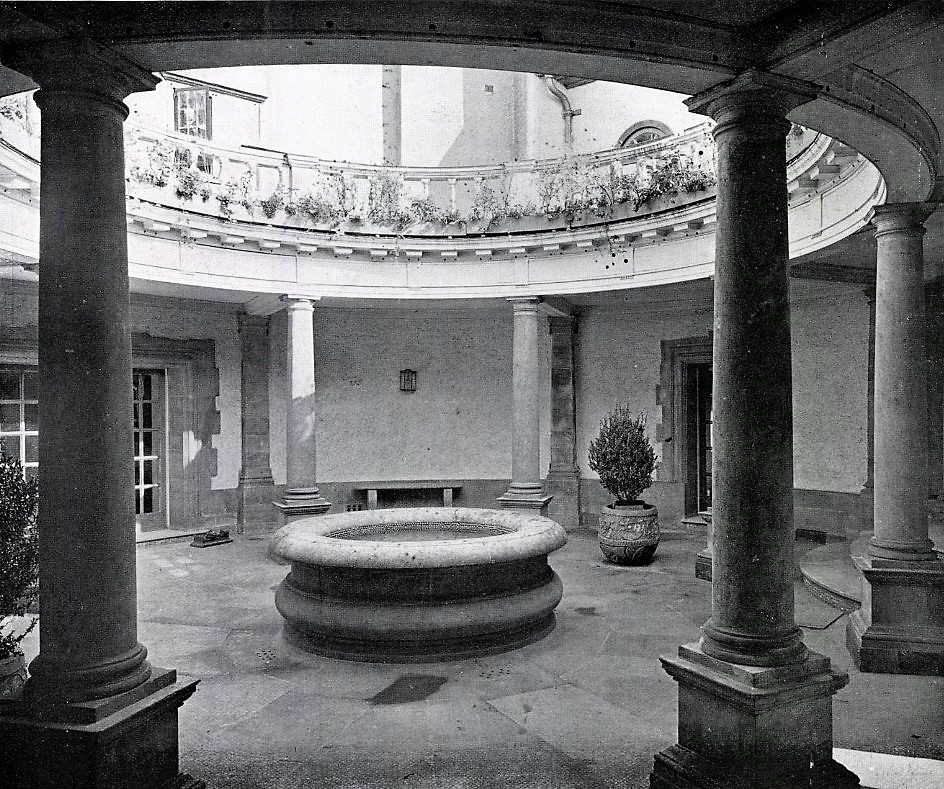
Lutyens added new radiating wings projecting to the NE, SE and SW to the old house containing a dining room, drawing room and billiard room, while the fourth axis on the NW was occupied by an existing service wing. Between the billiard room and service wing Lutyens created a circular open Basin Court connecting the new main entrance with the vestibule within the original octagon. This plan produced some interesting conjunctions of forms, where the single-storey circular court abutted the gabled polygon of the house behind. And there are deliberately shocking conjunctions of style too: while the main building was in a simple vernacular manner, with roughcast walls and a central half-timbered gable, he responded to the formal geometry of the Basin Court with a ring of Tuscan columns, and he also made the entrance itself a powerful classical composition with chunky rustication and a broad three-bay pediment, but cheekily tucked this into the ground floor of an otherwise vernacular block.

Papillon Hall: the Basin Court between the wings on the west side in 1912. Image: Country Life.

Papillon Hall: the entrance arcade created by Lutyens. Image: Country Life.

Papillon Hall: the drawing room in 1912. Image: Country Life.
In 1937 the house passed to Rupert Bellville (1904-67), who put the house up for sale the following year, but a buyer was not found before the house was requisitioned during the Second World War, when it housed American airmen. After it was returned to the family, Rupert Bellville again tried to sell it, but in post-war conditions he failed to find a buyer and it was therefore demolished in 1951. Some of the outbuildings were converted into a farm and a small fragment of the old house was rescued and installed in the gardens of Blagdon Hall in Northumberland.

Finally, an uncanny tale for those who like ghost stories. When Frank Belville moved into Papillon Hall in 1901 he found a tiny cupboard with a padlocked metal grille in the lintel of an internal window over the hall fireplace, containing an early 18th century pair of green brocade women's shoes. The title deeds stated that 'on no account to permit them to be removed from the house, or ill-fortune would assuredly befall the owner'. Despite this warning, the shoes were taken to Belville's solicitors for safe keeping during the remodelling of the house. Work on the contract went slowly, accidents happened on site and a workman was killed, the first contractor abandoned the contract, and the skeleton of a woman was found walled up in the attics of the old house (this was said to be the Spanish mistress of an early 18th century Papillon who had mysteriously disappeared in 1715). In 1905 Bellville himself was in a motor accident and fractured his skull. He recovered, but in 1908 his chauffeur was killed in another accident. During the Second World War, there were two occasions on which American airmen who had removed the shoes from their resting place did not return from missions over enemy territory. The 'cursed shoes' are now in Market Harborough Museum.

Descent: David Papillon (1581-1659); to son?, George Papillon (d. 1684); David Papillon (fl. 1717); to son, who sold 1764 to William Stevens...Charles Bosworth (fl. 1798) of Brampton (Northants); to George Bosworth (d. 1830); to widow, Mary (fl. 1863), later wife of John Breedon; sold 1866 to Lord Hopeton; sold 1872 to Thomas Halford; sold to C.W. Walker (fl. 1892) of Burwash (Sussex); sold to A.C. Isham (d. 1897);... sold 1901 to Mrs Emma Bellville for use of her son, Frank Ashton Bellville (1870-1937), kt.; to son, Rupert Bellville (1904-67), who demolished it in 1951. 

Fermyn Woods (aka Farming Woods) Hall, Brigstock, Northamptonshire

The house began as a hunting lodge in Rockingham Forest, built or remodelled between 1651 and 1656 for Sir John Robinson, 1st bt., who was Lord Mayor of London in 1662. The main front faced south and had a sequence of five gables, perhaps representing a hall range and two cross-wings of the traditional form, but only the porch and a portion of the facade to the right of it are now of the 17th century, due to successive later alterations, additions and contractions.

Fermyn Woods Hall: engraving of the house by J.P. Neale, 1826., showing it before the mid 19th century additions.
In the late 18th century the house was a hunting lodge belonging to the 2nd Earl of Upper Ossory, whose principal seat was at Ampthill in Bedfordshire. He added a dining room and library, and a long, rather plain wing at the west end in two phases of work, in 1777 and 1788. The end elevation of his new range is visible on the left in Neale's engraving above.

There were further alterations in the 1830s for Lady Anne and Lady Gertrude Fitzpatrick, and after the house passed to their illegitimate half-sister Emma, the wife of Robert Vernon Smith, 1st Baron Lyveden, Edward Browning of Stamford undertook a radical remodelling and enlargement of the house, giving it most of its later neo-Elizabethan character. His efforts were concentrated especially on remodelling the Georgian west wing, which emerged with two-storey canted bays on the west and south sides, an attic storey with gables and tall chimneystacks, and mullioned and transomed windows.

Fermyn Woods Hall: the west wing as remodelled by Edward Browning, from an old postcard.

Fermyn Woods Hall: the house from the north-west in the early 20th century, from an old postcard.
Inside, the entrance hall has an elaborate tiled centrepiece with the arms of Lord Lyveden, and his shield also appears on the newels of the staircase, which is said to be a copy of that formerly at Lyveden Old Bield. A 17th century gateway from Lyveden Old Bield, built for Sir Lewis Tresham but part of the Fermyn Woods estate until 1908, was moved in the 19th century to form a grand entrance to the stable court, which was built in 1740 but altered later.

Fermyn Woods Hall: the stable court from the south-east, showing the gate from Lyveden Old Bield.
The descendants of the Earls of Upper Ossory finally sold Fermyn Woods in 1897, and over the next twenty-five years it changed hands frequently, and was shorn of most of its 4,000 acre estate by the notorious asset-stripper, T.F. Hooley, who claimed to have made a profit of £70,000 from buying the estate, breaking it up and selling the farms separately, and felling much of the estate timber. In 1919-20, Blackwell & Riddey of Kettering (Northants) remodelled some of the interiors for Maj. Aubrey Wallis-Wright, creating new panelling with Ionic pilasters in the dining room (now the drawing room). More permanent new owners arrived in 1922 with the sale to Capt. George Bellville (1879-1967), who lived here until his death and left the house to his daughter 'Dodo'. They found the house dauntingly large, however, and pulled down the west wing in 1968. The remainder was in poor condition by the time of Dodo's death in 2002, but was lovingly restored as his home by the architect David Laing (b. 1945), later Lord Lieutenant of Northamptonshire, over the next few years.

Fermyn Woods Hall: the reduced house in 2009. Image: Michael Trolove. Some rights reserved.

Descent: Crown sold 1641 to John Mordaunt (1599-1644), 5th Baron Mordaunt and 1st Earl of Peterborough; to son, Henry Mordaunt (1621-97), 2nd Earl of Peterborough; leased 1651 and later sold to Sir John Robinson (1615-80), 1st bt.; to son, Sir John Robinson (1660-93), 2nd bt.; to daughter Anne (d. 1744), wife of Richard Fitzpatrick (c.1662-1727), 1st Baron Gowran; to son, John Fitzpatrick (1719-58), 2nd Baron Gowran and 1st Earl of Upper Ossory; to son, John Fitzpatrick (1745-1818), 2nd Earl of Upper Ossory; to daughters, Lady Anne and Lady Gertrude Fitzpatrick (d. 1841); to half-sister, Emma Mary Wilson (d. 1882), wife of Robert Vernon Smith (later Vernon) (1800-73), 1st Baron Lyveden; to son, Fitzpatrick Henry Vernon (1824-1900), 2nd Baron Lyveden, who sold 1897 to John Gardiner Muir (d. 1913); sold 1908 to T.F. Hooley; let and later sold 1912 to Maj. Aubrey Wallis (later Wallis-Wright then Wallis) (d. 1926); sold 1922 to Capt. George Ernest Bellville (1879-1967); to daughter, Dorothy Vivien Bellville (d. 2002), formerly wife of Maj. Eustace Maxwell (1913-71); sold 2003 to David Laing (b. 1945); sold 2012 to James Michael Ruston Broadbent (b. 1965). 

Bellville family of Tedstone Court


Bellville, John Benjafield (c.1793-1847). Son of John Bellville (who in 1807 was of Codford St Peter (Wilts) but who reputedly fled from France at the time of the French Revolution), said to have been born at Bath, 1793*. Apprenticed to Matthias Archibald Robinson of London, needle maker, 1807, and was made free of the Needlemakers Company, 1817. He and his former master established the firm of Robinson & Bellville, manufacturers of a patent barley drink, in 1823. He married 1st, 22 April 1827 at St George, Hanover Sq., Westminster (Middx), Mary (1804-42), probably daughter of William Bird of Westwell House, Wellington (Som.), farmer, and 2nd, 15 February 1843 at Milton-by-Gravesend (Kent), Ann (1815-80), daughter of William Clark, an official of the East India Company, and had issue:
(1.1) William John Bellville (1830-91) (q.v.);
(1.2) Archibald George Belville (1831-32), baptised at St Mark the Evangelist, Clerkenwell (Middx), 21 October 1831; died in infancy and was buried at the same church, 23 March 1832;
(1.3) Emma Bellville (1834-1906), baptised at St George-the-Martyr, Bloomsbury (Middx), 18 February 1834; married, 2 June 1863 at Christ Church, Lancaster Gate, Paddington (Middx), Henry Farrance (1824-65) (who had been one of her father's apprentices), son of Thomas Farrance, confectioner, but had no issue; as a widow, lived latterly at Dorking (Surrey); died 13 August 1906; will proved 29 October 1906 (estate £13,060);
(1.4) Frederick Bellville (1836-1922), born 6 September and baptised at St George-the-Martyr, Bloomsbury, 26 October 1836; died unmarried, 14 August and was buried at Dorking, 17 August 1922; administration of goods granted 22 November 1922 (estate £7,589);
(2.1) Alfred Bellville (1843-85), born 18 March and baptised at St Alfege, Greenwich (Kent), 5 May 1843; an officer in the merchant marine (indentured apprentice, 1859; second mate, 1863; first mate, 1867, 1870), who settled in Africa around 1870 and was elected a Fellow of the Royal Geographical Society; he joined Lt. Faulkner's ivory hunting expedition to Central Africa, 1868, and a combined Universities' Expedition to Magila and Zanzibar, 1875, after which he published two papers in the RGS transactions; in 1877 he moved to Natal and was ordained deacon in 1880, serving in various Natal parishes; he married, 25 April 1877 at Durban (South Africa) Emma Mary, daughter of T. Crowder, and had issue two sons and three daughters; he died at Sand Hill, Belair, Durban (South Africa), 19 March 1885;
(2.2) Frances Mary Bellville (1844-1917), born 11 November 1844 and baptised at St George-the-Martyr, Bloomsbury, 9 January 1845; married, 22 September 1875 at St Luke, West Holloway (Middx), John Pears Walton (1838-1915) of Alston (Cumbld.) and Acomb High House (Northbld.), mine owner, son of Jacob Walton, and had issue two sons and four daughters; died 7 July 1917; will proved 2 November 1917 (estate £4,931);
(2.3) Rosa Hamilton Bellville (1845-1909), born 14 December 1845 and baptised at St George-the-Martyr, Bloomsbury, 18 February 1846; died unmarried at Southend-on-Sea (Essex), 27 November 1909; will proved 26 May 1910 (estate £739);
(2.4) Ada Elizabeth Bellville (1847-1926), born 10 April 1847 and baptised at St George-the-Martyr, Bloomsbury (Middx), 2 May 1848; married, 2 November 1869 at St Luke, West Holloway (sep. 1890), Rowland John Atcherley (b. c.1848), analytical chemist, son of Rowland Atcherley MD, and had issue two sons and one daughter; died 12 October 1926; will proved 24 November 1926 (estate £976).
He was buried at Kensal Green Cemetery (Middx), 13 September 1847; his will was proved in the PCC, 15 December 1847. His first wife died Apr-Jun 1842 and was buried at Kensal Green Cemetery. His widow died in Holloway (Middx), 28 April 1880; her will was proved 28 May 1880 (effects under £200).
* However, his baptism has not been traced.

Bellville, William John (1830-91). Elder son of John Benjafield Bellville (1793-1847) and his first wife Mary Bird, born February and baptised at St Mark the Evangelist, Clerkenwell (Middx), 23 April 1830. Educated at the University of Bonn (Germany). Freeman of the City of London, 1866. Partner in Robinson & Bellville of Holborn (Middx), manufacturers of a patent barley drink (and ancestor of Robinson's Barley Water), which merged in 1862 with Thomas Keen & Son, an old-established mustard manufacturer; he was sole proprietor of the merged firm by 1876. At his death, the goodwill of the company passed to his widow, who sold it in 1903 to J. & J. Colman of Norwich, another mustard manufacturer. He married, 4 July 1865 at Howe with Little Poringland (Norfk.), Emma (1846-1925), daughter of John Magor of Newton Abbot (Devon), hotel keeper, and had issue:
(1) Henry Archibald Bellville (1866-1930) (q.v.);
(2) William John Bellville (1868-1937), born 4 August 1868; educated at Harrow and Jesus College, Cambridge (matriculated 1887; BA 1891); served with the Duke of Cambridge's Special Corps in the Boer War, 1900; purchased Kibworth Hall (Leics), 1918, which he bequeathed to his nephew Anthony (1902-70); with his brothers Frank and George he was a famous horseman and rider to hounds, a pursuit to which he devoted much of, and ultimately sacrificed, his life; he married, 14 November 1907 at St James, Piccadilly, Westminster (Middx), Jessie Bousfield (1871-1921), daughter of James Steains of Westminster, gent., and formerly wife of Sidney Arthur Wolton (c.1870-1940), hop merchant, and had issue one daughter who died in infancy; died from injuries received in a hunting accident, 25 February 1937; will proved 17 June 1937 (estate £393,709);
(3) Frank Ashton Bellville (1870-1937) [for whom see below, Bellville family of Papillon Hall]
(4) Emma Maud Elizabeth Bellville (1875-1952), born 18 May and baptised  at All Saints, Clapton Park, Hackney (Middx), 4 July 1875; married, 13 April 1901 at St George, Hanover Sq., Westminster (Middx), Lt-Col. Cyril Godfrey Martyr DSO (1860-1936) of Ablington Manor, Bibury (Glos), son of Godfrey Martyr of Melbourne (Australia), and had issue two sons and one daughter; died 10 August 1952; will proved 20 November 1952 (estate £26,608);
(5) George Ernest Bellville (1879-1967) [for whom see below, Bellville family of Fermyn Woods Hall];
(6) Dorothy Mary Bellville (1883-1914), born 4 March and baptised at All Saints, Clapton Park, Hackney, 12 June 1883; married, 3 July 1906 at St George, Hanover Sq., Westminster, Maj. Philip Alexander Francis Spence (1876-1960) of Oatleys Hall, Brackley (Northants) (who m2, 23 June 1923 at St Mark, North Audley Street, Westminster, Sybil May (1896-1968), daughter of Sir John Latta (1867-1946), 1st bt.), son of Col. John Spence, and had issue one daughter; died 29 November 1914 and was buried at Turweston (Bucks); administration of her goods was granted to her husband, 3 March 1915 (estate £6,748).
He lived at Porchester Terrace, Hyde Park, London and Stoughton Grange (Leics), which he leased from the Powys-Keck family; his widow gave up the lease in about 1913.
He died at Eastbourne (Sussex), 7 August 1891; his will proved 14 September 1891 (effects £631,583). His widow died 8 August 1925; her will was proved 29 December 1925 (estate £177,063).

Bellville, Henry Archibald (1866-1930). Eldest son of William John Bellville (1830-91) and his wife Emma, daughter of John Magor of Newton Abbot (Devon), born 2 November 1866 and baptised at Christ Church, Lancaster Gate, Westminster (Middx), 1 January 1867. Educated at Harrow. An officer in the 3rd battalion, East Surrey Regiment (Lt., 1886; Capt., 1896; retired 1898). He married 1st, 24 September 1896 at Whittingham (Northbld.)  (div. 1903 on the grounds of her adultery with Capt. Walter Neilson), Phyllis Mary (1878-1967), third daughter of Alexander Henry Browne of Callaly Castle (Northbld.) and 2nd, 27 October 1906 at St Peter, Harrogate (Yorks WR), his first cousin, Ethel Mary (1878-1950), eldest daughter of John Pears Walton of Acomb High House (Northbld.), and had issue:
(1.1) Lucy Monica Bellville (1898-1991), born 18 March 1898; married, 9 December 1922 at Holy Trinity, Brompton (Middx), Oswald Stuart Thompson MRCS LRCP (1892-1971) of London, anaesthetist, son of Sidney Thompson of Farnaby, Sevenoaks (Kent), solicitor, and had issue one son; died 26 July and was buried 2 August 1991; will proved 24 September 1991 (estate under £125,000);
(1.2) Colin Guy Archibald Bellville (1901-58), born 27 December 1901; educated at Harrow; steam plough engineer; Fellow of the Geological Society; married, 27 July 1928, Kathleen (1903-93), daughter of Norman John Beastall of Church Gresley (Derbys), but had no issue; died 14 July 1958; will proved 7 November 1958 (estate £36,461);
(2.1) George Dennis Arthur Bellville (1907-25), born in New Zealand, 1907; educated at Harrow; died unmarried in a motor accident, 8 October 1925;
(2.2) Miles Aubrey Bellville (1909-80) (q.v.);
(2.3) Florence Audrey Emma Bellville (1914-2003), born 26 January and baptised at Tedstone Delamere, 15 March 1914; married, Oct-Dec. 1946, Col. Douglas Robert Beaumont Kaye DSO (1909-96) of Brinkley Hall (Suffk.), son of Robert Walter Kaye of Warren's Gorse, Daglingworth (Glos), and had issue one son and one daughter; died 1 March 2003.
He purchased Tedstone Court in 1908.
He died 30 September 1930; his will was proved 22 January 1931 (estate £181,006).  His first wife married 2nd, Apr-June 1904, Maj. Walter Neilson (1866-1941) of Charlton Hall (Northbld), the co-respondent in her divorce, and had further issue two sons and one daughter; she died in Scotland, 8 June 1967 and her will was proved 14 November 1967. His widow died 13 October 1950; administration of her goods was granted 24 January 1951 (estate £13,758).

Maj. Miles Aubrey Bellville (1909-80) 
Bellville, Miles Aubrey (1909-80).
Younger son of Henry Archibald Bellville (1866-1930) and his second wife, Ethel Mary, eldest daughter of John Pears Walton of Acomb High House (Northbld.), born 28 April 1909. Educated at Malvern College and Jesus College, Cambridge (BA), where his prowess as an oarsman led to his being elected to the Leander Club. He was a keen sailor who was a member of the 
Royal Corinthian Yacht Club and the Royal Ocean Racing Club, and competed in the Americas Cup in 1934 and at the 1936 Berlin Olympic Games, where he was a crew member of the boat Lalage which won gold in the six metre class. He served in the Second World War as an officer in the Royal Marines (2nd Lt, 1940; Lt., 1940; Capt., 1945; T/Maj., 1945) and was awarded the MC, 1942 and MBE, 1943. High Sheriff of Herefordshire, 1969-70; a DL for Herefordshire. He married, April-June 1945, Nancy Catherine MBE JP (1912-96), who served as a First Officer in the Women's Royal Naval Service in the Second World War, second daughter of John Deans of Christchurch (New Zealand), and had issue:
(1) Richard John Bellville (1945-2000) (q.v.);
(2) Lalage Jane Bellville (b. 1947), born 17 March 1947; married, Apr-Jun 1975, Thomas Joseph Hawksley (b. 1945), schoolmaster, and had issue two daughters;
(3) Susan Catherine Bellville (b. 1948), born 18 August 1948; schoolteacher; member of Oxfordshire County Council, 2005-09; married, 1973 (div. 1977), Professor John Charles Robert Haffenden FBA FRSL (b. 1945), but had no issue.
He inherited Tedstone Court from his father in 1930.
He died 27 October 1980; his will was proved 30 January 1981 (estate £205,636). His widow died 3 February 1996; her will was proved 29 April 1996.

Bellville, Richard John (1945-2000). Only son of Miles Aubrey Bellville (1909-80) and his wife Nancy Catherine, second daughter of John Deans of Christchurch (New Zealand), born 21 August 1945. Educated at Malvern College. He married, May 1989, Gail H. (b. 1942), daughter of Godfrey Temple Butler (1907-78) and formerly wife of Dudley Michael Kibble-White (1939-2016), but had no issue.
He inherited Tedstone Court from his father in 1980 but sold it in 1996.
He died 3 October 2000; his will was proved 22 February 2001. His widow is now living.

Bellville family of Papillon Hall


Frank Ashton Bellville (1870-1937) 
Bellville, Frank Ashton (1870-1937).
Third son 
of William John Bellville (1830-91) and his wife Emma, daughter of John Magor of Newton Abbot (Devon), born 25 November 1870 and baptised at St Matthew, Bayswater (Middx), 18 January 1871. Educated at Harrow. An officer in the Leicestershire Yeomanry (2nd Lt., 1898; Lt., 1900; retired 1902; returned to colours, 1914; Capt. 1916; retired 1921), who served in the Boer War and First World War. In 1903 he joined the board of J. & J. Coleman of Norwich, mustard manufacturers, which had bought his family firm. He became a freemason in 1910. He was such a keen foxhunting man that it was said 'he did little else but hunt', but he was also the owner and breeder of racehorses. He married 1st, 19 October 1901 at St Mary's RC Church, Cadogan St., Chelsea (Middx) (div. 1910), Gladys Hermione (1883-1962), daughter of Dr. Arthur Cornewall Chester-Master (1854-1900); 2nd, 2 August 1915 (div. 1926 on grounds of her adultery with Nicolano Rhodes), Joan Isobel Margaret (1888-1954)*, third daughter of the Hon. Ernest Bowes-Lyon and widow of Capt. Alfred Ernest Parker (1880-1914); and 3rd, 15 August 1929, Barbara Bertha Mary (1900-80), second daughter of Maj. Herbert Marmaduke Joseph Stourton OBE and formerly wife of Capt. Eric Charlton Tunnicliffe OBE MC (c.1898-1953), and had issue**:
(1.1) Anthony Seymour Bellville (1902-70), born 10 August 1902; educated at Eton and Trinity College, Cambridge; an officer in the Grenadier Guards (Lt.); inherited Kibworth Hall from his uncle, William John Bellville, in 1937, but sold it a few years later and moved to The White House, Bembridge (IoW); married 1st, 9 April 1929 at St Margaret, Westminster (Middx) (div. 1947), Audrey Dorothy Campbell (1906-97) (who m2, Oct-Dec 1947, Peter Pleydell-Bouverie of Landford Lodge (Wilts)), daughter of Capt. Archibald Glen Kidston, and had issue one son and two daughters; married 2nd, 30 September 1947 at St Mary, Bryanston Sq., Marylebone, Diana Mary Cameron (1915-2010) (who m2, Jan-Mar 1973, Lt.-Col. Arthur Christopher Grey (1911-82) and m3, 9 October 1984, Rt. Rev. Edward James Keymer Roberts (1908-2001), formerly Bishop of Ely), elder daughter of Ewen Cameron Bruce DSO MC, and had further issue one son and one daughter; died 2 August 1970; will proved 9 October 1970 (estate £71,727);
(1.2) Rupert Bellville (1904-67) (q.v.);
(3.1) Patricia Barbara Bellville (1931-2015), born 15 April 1931; married, 31 December 1965, (Alfred) Charles Gladitz (1923-2014), and had issue one son; died 26 July 2015.
His mother bought Papillon Hall for him in 1901 and he employed Sir Edwin Lutyens to enlarge and remodel it from 1903. He also kept a summer residence at Tyne Hall, Bembridge (IoW).
He died at Tyne Hall, 22 July 1937; his will was proved 26 August 1937 (estate £394,397). His first wife volunteered as a Red Cross nurse throughout the First World War and was painted in her uniform by de Laszlo; after the war she opened a shop near Portman Sq. called Sydalg, which sold antiques and Paris fashions; she married 2nd, Oct-Dec 1923, Henry Gordon Leith (1879-1941), banker, but had no further issue, and died 6 January 1962. His second wife married 3rd, N. Grogan, and died at St Helier (Jersey), 6 July 1954; administration of her goods was granted 28 October 1954 (effects in England, £1,485). His widow married 3rd, 20 September 1946, as his third wife, Capt. Henry Stewart Macnaghten Harrison-Wallace DSO RN (1883-1963), and died 2 May 1980; her will was proved 11 July 1980 (estate £31,025).
* She was a cousin of Elizabeth Bowes-Lyon (1900-2002), who in 1923 married the future King George VI.
** Burke's Landed Gentry also mentions three daughters (Effie, Joan and Tina) by his second wife, but I can find no evidence to support their existence and family sources say this marriage was childless.

Rupert Bellville (1904-62) 
Bellville, Rupert (1904-62).
Second son of Frank Ashton Bellville (1870-1937) and his first wife, Gladys Hermione, daughter of Arthur Chester-Master, born 28 December 1904. Educated at Eton. He first joined Schroder's as a clerk, but soon quit the company for a more exciting life as a pilot. He was engaged as secretary and pilot to Rupert Byass, and in 1934 took Venetia Montagu (1887-1948) on a journey across Europe, Russia, the Middle East and Persia (where they crashed, but escaped unhurt). A profile in The Bystander in 1937 described him as "a bizarre young man. He has absolutely no fear, not much imagination, and... practically never laughs... He gambles on most things, has a real wanderlust, always looks for trouble and usually finds it". He first went to Spain as a young man to learn the language and fell in love with the country, becoming an amateur bullfighter and participating in the Spanish Civil War on behalf of General Franco's Nationalists: he arranged for all the gates on the Papillon Hall estate to be painted in Franco's colours. He was captured at Santander by the Republican Government's forces and briefly imprisoned before being released after an intervention by the Foreign Office and returned to England at considerable expense in a Royal Navy destroyer. He wrote an account of his experiences for the Leicester Evening Mail. He was a
n officer in the Royal Air Force Reserve from 1926 (Flying Officer, 1933) and during the Second World War became a test pilot. He was a considerable linguist, speaking French, German and Italian as well as fluent Spanish. He was unusually tall for the period, at 6ft 4in, and his talents included being one of the best backgammon players in Europe. A good swimmer, he is said once to have swum the River Seine in a dinner jacket, but generally took better care of his clothes, being noted as a dapper dresser when in England, although more informally attired abroad. He was twice challenged to a duel, but never fought. Despite inheriting £105,000 from his father in 1937, he was declared bankrupt in 1955. He married, 1 October 1938 in Paris (France) (div.), Jeanette (1907-95), daughter of General Stephen O. Fuqua, US military attaché in Spain, and had issue:
(1) (Rupert) Hercules Fuqua Bellville (1939-2009), born 18 June 1939 in San Diego, California (USA); educated at Ampleforth and Christ Church, Oxford; a leading film producer, working as assistant to Roman Polanski in the 1960s and 1970s and then with Michaelangelo Antonioni (1912-2007) before finishing his career with Jeremy Thomas London's Recorded Picture Co.; he lived in London and Los Angeles, California (USA) at different times, and his obituarists all remarked on his talent for personal friendships; he married, 19 February 2009 (two days before his death), his long-term partner, Ilana Shulman; died of cancer, 21 February 2009, and was buried at Highgate Cemetery (Middx), where he is commemorated by a monument; will proved 21 October 2009.
He inherited Papillon Hall from his father in 1937, twice tried unsuccessfully to sell it (before and after the Second World War) and pulled it down in 1951. The estate was subsequently sold.
He died 23 July 1962; his will was proved 14 September 1962 (estate £7,449). His widow died in London, 23 August 1995; her will was proved 22 August 1996.

Bellville family of Fermyn Woods Hall


George Ernest Bellville (1879-1967) 
Bellville, George Ernest (1879-1967).
Fourth son 
of William John Bellville (1830-91) and his wife Emma, daughter of John Magor of Newton Abbot (Devon), born 10 December 1879 and baptised at All Saints, Clapton Park, Hackney (Middx), 18 February 1880. Educated at Eton and Trinity College, Cambridge (matriculated 1897). An officer in the 16th Lancers (2nd Lt., 1900; Lt. 1900; Capt., 1904), who served in the Boer War (wounded) and First World War; adjutant of 2nd County of London Imperial Yeomanry, 1907. JP for Northamptonshire, 1927; High Sheriff of Northamptonshire, 1941-42; DL for Northamptonshire, 1946 (Vice-Lord Lieutenant, 1951). As a young man he was an accomplished polo and rugby player and like his brothers he became a prominent foxhunting man; Master of the Woodland Pytchley Foxhounds, 1920-32. He married, Oct-Dec. 1922, Madeline Henriette Ghislaine MBE (1884-1967), daughter of Count Rodolph de Kerchove de Denterghem of Belgium, and formerly wife of Baron Edouard de Crombrugghe de Looringhe (1874-1961), and had issue:
(1) Dorothy Vivian Bellville (1919-2002) (q.v.);
(2) Evelyn Hazel Rosemary Bellville (1924-2009), born Oct-Dec 1924; married, 13 December 1947, Sir John Hatherley David Page-Wood (1921-55), 7th bt., and had issue one son and one daughter; living in 1965.
He purchased Fermyn Woods Hall in 1922.
He died 28 June and was buried 3 July 1967; his will was proved 15 December 1967 (estate £85,680). His widow died 24 August 1967; her will was proved 6 February 1968 (estate £57,731). 

Dodo Maxwell (1919-2002) 
Bellville, Dorothy Vivian (k/a Dodo) (1919-2002).
Illegitimate daughter of George Ernest Bellville (1879-1967) and his future wife Madeline, daughter of Count Rodolph de Kerchove of Belgium, born before the marriage of her parents, 4 February 1919. She married, May 1940 (div. 1949), Maj. Eustace Maxwell (1913-71), second son of Lt-Col. Aymer Edward Maxwell of Monreith (Wigtowns.), and had issue:
(1) Diana Mary Maxwell (b. 1942), born 10 January 1942; partner of Patrick Helmore, by whom she had issue twin daughters;
(2) Sir Michael Eustace George Maxwell (1943-2021), 9th bt, of Monreith House (Wigtowns.), born 28 August 1943; educated at Eton and London University; Assoc. of Royal Institute of Chartered Surveyors; succeeded uncle as 9th baronet, 8 July 1987; died unmarried, 28 December 2021, when he was succeeded in the baronetcy by a distant cousin.
She inherited Fermyn Woods Hall from her father in 1967 and demolished part of the house in 1968. It was sold after her death.
She died 20 July 2002; her will was proved 17 January 2003. Her ex-husband died in Edinburgh, 11 April 1971; his will was proved in London, 28 June 1971 (estate £15,835).

Principal sources
Burke's Landed Gentry, 1945, pp. 55-56; C.J. Robinson, A history of the mansions and manors of Herefordshire, 1872, reprinted 2009, pp. 301-02; Country Life Architectural Supplement, 4 May 1912; J.A. Gotch, Squires' homes and other old buildings of Northamptonshire, 1939, pp. 7-8; D. Whitehead, A survey of historic parks and gardens in Herefordshire, 2011, pp. 353-54; A. Brooks & Sir N. Pevsner, The buildings of England: Herefordshire, 2nd edn., 2012, p. 622; B. Bailey, Sir N. Pevsner & B. Cherry, The buildings of England: Northamptonshire, 3rd edn., 2013, pp. 272-73; M. Airs, 'David Papillon: Architect, military engineer, developer, author and jeweller', The Georgian Group Journal, 2017, pp. 1-14; N. Lyon, Useless anachronisms?: a study of the country houses and landed estates of Northamptonshire since 1880, 2018, passim;

Location of archives

Bellville of Tedstone Court: deeds and papers, 18th-20th centuries [Herefordshire Archive & Records Centre, AJ49]

Coat of arms

None recorded.

Can you help?

  • If anyone can throw light on the accuracy or otherwise  of the story that John Benjafield Bellville's father John was a French émigré, I should be very pleased to learn more.
  • Can anyone provide portraits or photographs of the people whose names appear in bold above, for whom no image is currently shown?
  • If anyone can offer further information or corrections to any part of this article I should be most grateful. I am always particularly pleased to hear from current owners or the descendants of families associated with a property who can supply information from their own research or personal knowledge for inclusion.

Revision and acknowledgements

This post was first published 25 June 2023 and was updated 24 October and 27 December 2023. I am most grateful to Patrick Bellville for his additions and corrections to my post, and to Andrew Jones for a correction.