|
| Askew of Redheugh and Pallinsburn |
The marriage of Anthony Askew and Anne Storrs produced two sons and a daughter, and their elder son Adam Askew (1696-1773), after education at Cambridge, established a highly successful medical practice in Newcastle upon Tyne in about 1723. From then until his death in 1773 he invested the considerable profits from his practice in lands scattered round the north of England, including the estate at Redheugh (Co. Durham), the Middleton Hall (Westmld) estate, the advowson of Plumbland (Cumbld), and lands at Crookham (Northbld) which became the Pallinsburn estate.
Adam Askew entailed his landed property by means of trusts declared in his will. His three younger sons were all recipients of significant property; his eldest son, Dr. Anthony Askew (1722-74), a London physician and noted bibliophile, presumably received Storrs Hall under a previous entail. The second son, Rev. Adam Askew (1724-91) received Middleton Hall and the advowson of Plumbland, where he had been instituted as rector, and since he was unmarried and childless, provision was made for this property to pass to the descendants of his elder brother, Dr. Anthony Askew. Henry Askew (1730-96) received the Redheugh Estate and John Askew (1732-94) received the Northumberland property which became the Pallinsburn estate. Since Adam and Henry both died childless, their shares passed with Storrs Hall to the eldest son of Dr. Anthony Askew, another Adam Askew (1762-1844). He also died childless and left the property, according to the terms of the entail, to his brother Rev. Henry Askew (1767-1852), rector of Greystoke in Cumberland.
Henry purchased a small property on the edge of Ullswater in the Lake District where he built a new seat, Glenridding Hall, in about 1810. He later made over Storrs Hall in his lifetime to his son, Henry William Askew (1808-90), who sold it in 1848 and in 1850 bought the half-finished Conishead Priory from the bankrupt Col. Bradyll; he completed the building over the next few years (an account of Conishead is reserved for a future post on the Bradyll family). In 1854 he sold his father's house at Glenridding, which was probably surplus to his requirements, and in 1874, for reasons which are unclear, he sold Conishead Priory too and moved south to Burwood Park, a Georgian house near London which could hardly have been a greater contrast to his previous residence! Burwood was left not to his son, with whom there may have been a rift, but to his three spinster daughters, who lived there 'as virtual recluses' until they died. The youngest of them died in 1926, and the estate seems to have been sold for development the following year.
From 1852, Henry William Askew. as life-tenant of Redheugh, joined with his trustees to undertake some piecemeal disposal of parcels of the estate. When his son, Henry Hugh Askew (1847-1902) came of age in 1868 they took the opportunity to disentail the Redheugh estate in order to facilitate the disposal of the remainder. The rights to mine coal and fireclay were reserved in land sales and leased out from 1871 to the proprietors of Redheugh Colliery, who mined successfully until 1928, paying the Askews a share of the profits throughout that time.
Adam Askew entailed his landed property by means of trusts declared in his will. His three younger sons were all recipients of significant property; his eldest son, Dr. Anthony Askew (1722-74), a London physician and noted bibliophile, presumably received Storrs Hall under a previous entail. The second son, Rev. Adam Askew (1724-91) received Middleton Hall and the advowson of Plumbland, where he had been instituted as rector, and since he was unmarried and childless, provision was made for this property to pass to the descendants of his elder brother, Dr. Anthony Askew. Henry Askew (1730-96) received the Redheugh Estate and John Askew (1732-94) received the Northumberland property which became the Pallinsburn estate. Since Adam and Henry both died childless, their shares passed with Storrs Hall to the eldest son of Dr. Anthony Askew, another Adam Askew (1762-1844). He also died childless and left the property, according to the terms of the entail, to his brother Rev. Henry Askew (1767-1852), rector of Greystoke in Cumberland.
 |
| Conishead Priory in the late 19th century |
Henry purchased a small property on the edge of Ullswater in the Lake District where he built a new seat, Glenridding Hall, in about 1810. He later made over Storrs Hall in his lifetime to his son, Henry William Askew (1808-90), who sold it in 1848 and in 1850 bought the half-finished Conishead Priory from the bankrupt Col. Bradyll; he completed the building over the next few years (an account of Conishead is reserved for a future post on the Bradyll family). In 1854 he sold his father's house at Glenridding, which was probably surplus to his requirements, and in 1874, for reasons which are unclear, he sold Conishead Priory too and moved south to Burwood Park, a Georgian house near London which could hardly have been a greater contrast to his previous residence! Burwood was left not to his son, with whom there may have been a rift, but to his three spinster daughters, who lived there 'as virtual recluses' until they died. The youngest of them died in 1926, and the estate seems to have been sold for development the following year.
From 1852, Henry William Askew. as life-tenant of Redheugh, joined with his trustees to undertake some piecemeal disposal of parcels of the estate. When his son, Henry Hugh Askew (1847-1902) came of age in 1868 they took the opportunity to disentail the Redheugh estate in order to facilitate the disposal of the remainder. The rights to mine coal and fireclay were reserved in land sales and leased out from 1871 to the proprietors of Redheugh Colliery, who mined successfully until 1928, paying the Askews a share of the profits throughout that time.
 |
| View of Newcastle from the grounds of Redheugh Hall, 1836 |
The youngest son of Dr. Adam Askew (1696-1773) was John Askew (1732-94), who received from his father at the time of his marriage a number of estates in Northumberland, centred on Crookham. At some point in the next few years he built a new country house on this property, which he named Pallinsburn. By the early 19th century this had acquired Moorish-influenced finials, which may indeed have been part of the original design, although this seems unlikely. His eldest son and heir, George Adam Askew (1771-1838) continued to add to the estate but had no children, and the estate passed in fairly rapid succession to his brothers, Lt-Gen. Sir Henry Askew (1775-1847), kt., and the lawyer Richard Craster Askew (1778-1851), before passing to the son of yet another brother, Watson Askew (1834-1906), who came of age in 1855 and married the following year. His wife, the Hon. Sarah Robertson, was the daughter of David Robertson, 1st Baron Marjoribanks of Ladykirk in Berwickshire, and in 1889, on the death of her mother, they inherited that estate in addition to Pallinsburn and took the additional surname of Robertson. Ladykirk became their principal home.
Another of the properties which John Askew (1732-94) held was an estate at Berwick-upon-Tweed on the Scottish border, which he left to his widow, Bridget Askew (d. 1823). Either she or her son George Adam Askew built a new house called Castle Hills on this property to function as a dower house to Pallinsburn, and during the 19th century it was used by various members of the family at different times. Watson Askew (1834-1906) inherited it from an uncle in 1868. At his death, Watson left Pallinsburn and Castle Hills to his eldest son, David Hugh Watson Askew (1868-1932), who was a bachelor barrister. He made his home at Castle Hills and sold Pallinsburn in 1912. Ladykirk belonged to the Hon. Sarah Askew until she died in 1929, when it was left to her second son, William Haggerston Askew (1868-1942), who also took the name Askew-Robertson. He had made a career as a stockbroker in London, but in 1922 he and his partners disbanded their firm and distribute its reserves among the employees. In 1932 he inherited Castle Hills from his brother and moved there, making over Ladykirk to his only son, Major John Marjoribanks Eskdale Askew (1908-96), who sadly demolished the Georgian house and replaced it with a much smaller one, built in the former walled garden, in 1965-66. When he inherited Castle Hills during the Second World War he leased it to a local charity as a maternity home, a purpose it served until 1984, when it was sold. The Ladykirk estate passed to his son, Henry John Askew (b. 1940), who is the present owner.
Redheugh House, Gateshead, Co. Durham
 |
| Redheugh House: an engraving of 1829 shows the house when it was leased to William Cuthbert. |
The Redheugh estate was held of the Bishop of Durham from the 13th century by the Redheugh family. It passed to the Whites, then to the Liddells in 1619 and in 1748 it was bought by Adam Askew for his son Henry.
 |
| Redheugh House as shown on the OS 6" map surveyed in 1856. |
Redheugh was one of several large landed properties in Gateshead which survived as gentlemen's residences surrounded by gardens and agricultural land until the development of industry and housing in the area in the mid-19th century. The house was let from the 1820s but the estate remained in the Askews' hands until it was gradually broken up by sales for building development from the 1870s onwards.
 |
| Redheugh Hall in 1900, when it was slipping into dereliction. |
The house stood empty in the late 19th century and gradually became derelict. In 1912 it was being used as a storehouse, with hay held in the 18th century drawing room. Then it was sold to the Redheugh Colliery Company. A fire in 1920 left the Hall roofless. The ruins were demolished in 1936 by the International Voluntary Service for Peace.
Descent: sold 1748 to Adam Askew MD (1696- 1773); to son, Henry Askew (1730-96); to nephew, Adam Askew (1757-1844), who leased the house before 1829 to William Cuthbert, a Newcastle glassmaker; to brother, Rev. Henry Askew (1767-1852); to son, Henry William Askew (1808-90), who dispersed the estate while retaining the mineral rights; sold to Redheugh Colliery Company; burned 1920 and demolished 1936.
Glenridding House, Cumberland
 |
| The head of Ullswater, with Glenridding House in the foreground, by Thomas Sunderland, c.1820 |
 |
| Glenridding House, c.1900 |
A house on the shores of Ullswater in the Lake District, built between 1807 and 1814 for Rev. Henry Askew, rector of Greystoke. It is a square two-storey villa, now painted pink, with a low pyramidal roof, three broadly spaced floor-length windows on each floor on each side and two canted bays facing the lake; the back and side are encircled by a pretty iron trellis veranda and balcony, and a lower service wing is attached to the fourth side. At the back of the service wing there was originally a three-storey tower with a pointy roof which features prominently in an early drawing of the view over the lake from the hillside above the house by Thomas Sunderland and which was still there in 1900, but which has gone now.
 |
| Glenridding House from Lake Ullswater. The two bays on the right represent a modern extension, replacing part of the service range. Image: Glenridding House |
The service wing has indeed been partly rebuilt to provide extra accommodation in the house. In 1834 the house was described as a "chaste and elegant mansion" with walks and pleasure grounds running down to the lake, where Askew kept a sloop for pleasure cruises. When William Henry Askew sold in 1854 it had three reception rooms (including a 40-foot drawing room), eight bedrooms and four dressing rooms, in addition to the service accommodation, and was accompanied by some 35 acres of grounds along the lakeside. Most of the grounds were sold off for further building, so that in 1860 it was sold with five acres and in 1881 with two acres. Following the 1860 sale it became a guest house for tourists visiting the Lake District, and Charles Darwin stayed here among many others. It still offers bed & breakfast accommodation and is also a wedding venue.
Descent: built 1807x1814 for Rev. Henry Askew (1767-1852); to son, Henry William Askew (1808-90), who sold 1854... sold 1860 to Robert Bownass; sold 1881...Mrs. Dalton (fl. 1891-92); sold to Ullswater Hotel...bought c.2000 and restored by the present owners.
Burwood Park, Walton-on-Thames, Surrey
The estate, at one time in the possession of Corpus Christi College, Oxford, was sold by the president and fellows to John Carleton, from whom it was bought by King Henry VIII in 1540. The King ordered it to be made into a deer park for use in association with his palace at Oatlands, but it was later granted away from the Crown. It changed hands frequently in the 16th and 17th century until it was bought in 1720 by John Latton. Nothing is known of the house which he had here, but his arms used to be in a panel of painted glass preserved in the successor building. Latton expanded the estate to some 360 acres and sold it in 1739 to Sir John Frederick, 1st bt.
 |
| Burwood Park: entrance front in 1823. Watercolour by John Hassell. Image: Surrey History Centre 4348/4/30/4 |
 |
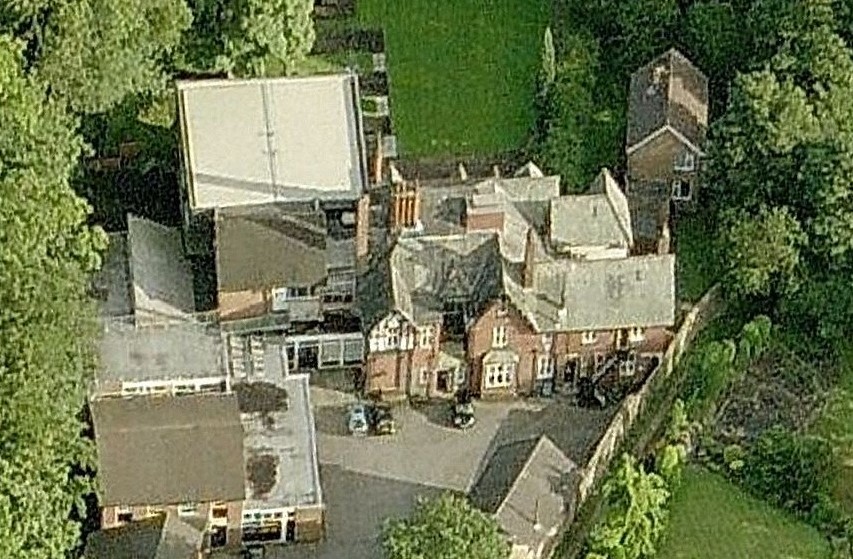
| Burwood Park: a recent aerial view. |
In about 1800 Sir John Frederick (1750-1825), 5th bt., built a large new house in the park. This had a severely plain east-facing seven bay garden front of two and a half storeys, with a central pediment, set at right-angles to a wing forming an entrance front of three widely-spaced bays. At the far end of the house another wing of similar dimensions had six windows on each floor and connected to a large service block. The interior was similarly plain, with simple cornices, reeded doorcases, and a staircase with an elegant and delicate wrought iron balustrade.
 |
| Burwood Park: entrance hall, 1955. Image: Old Burwoodian Association |
 |
| Burwood Park: staircase hall in 1955. Image: Old Burwoodian Association |
After Sir Richard Frederick, 6th bt., died in 1873 the house was sold to Henry William Askew, whose three spinster daughters lived here as virtual recluses. When the last of them died in 1926 the estate was sold to Lord Iveagh (d. 1927) for development. A few houses had been built by the late 1920s, but development began in earnest in 1934, when the Hon. Rupert Guinness, who became the first chairman of the Burhill Estates Co., divided most of the park into large plots and established a minimum value for the houses to be built on each. The roads the estate company laid out were named after the Guinness family's estates in Suffolk.
The Georgian mansion of Burwood Park was converted into a girls' school by 1934, but this closed during the Second World War. In 1955 the school reopened as a Secondary Technical School for deaf boys and girls, and a new sixth form college followed in 1975. The School was sponsored by the Guinness family, but closed in 1996 and in 1999, Octagon Developments were commissioned to re-convert the house into a dwelling and to build seven further individual houses in the grounds.
Descent: sold 1720 to John Latton; sold 1739 to Sir John Frederick (1678-1755), 1st bt.; to son, Sir John Frederick (1728-57), 2nd bt.; to brother, Sir Thomas Frederick (1731-70), 3rd bt.; to cousin, Sir John Frederick (1708-83), 4th bt.; to son, Sir John Frederick (1750-1825), 5th bt.; to first cousin once removed, Sir Richard Frederick (1780-1873), 6th bt.; sold c.1873 to Henry William Askew (1808-90); to daughters, Charlotte Elizabeth Askew (1836-1910), Emily Mary Askew (1837-1909) and Frances Louisa Askew (1845-1926); sold after the latter's death to Edward Guinness (1847-1927), 1st Earl of Iveagh; to son, Hon. Rupert Guinness, who established Burhill Estates Co. to develop the estate.
Pallinsburn House, Ford, Northumberland
 |
| Pallinsburn House: the 18th century house in about 1900, from an old postcard. |
A house that has been much altered over the centuries, and not usually to its advantage. In the later 18th century it had a three-storey three-bay centre with a canted central bay, attached by single-storey links to slightly taller pavilions with Venetian windows. By the early 19th century, every angle and junction of this facade was marked by high, thin, octagonal columns with pagoda tops, like minarets on a mosque. Later in 19th century the single-storey links were raised to three storeys and become the highest elements in the facade.
 |
| Pallinsburn: the south front of the house after the removal of the top floor c.1933, from an old postcard |
In 1912 the house was sold to Charles Mitchell. He remodelled the house in Jacobean style and then, about 1933, removed the top storey and gave the house a flat concrete roof. Of the original appearance of the house all that can now been seen on the south front is some of the original brickwork (some of it said to have come from Flanders), the canted central bay, and the lower half of one of the 'minarets'. The ground-floor window to the right retains the tripartite arrangement of the original Venetian window, but has been made Jacobean like everything else. On the north side, the two projecting wings have kept their 19th century appearance.
 |
| Pallinsburn: the north-facing entrance front in 2007. Image: Jon Whelan. Some rights reserved. |
Inside, Mitchell created some beautiful rooms, especially the dining room, with a barrel-vaulted Tudor-style plaster ceiling of intersecting ribs with reliefs of wild animals. The same room has reused Jacobean panelling with Ionic pilasters and a frieze with strapwork. The Oak Room has reused linenfold panelling and panels with medallion heads. The decoration of the hall, with its screen of Tuscan columns with acanthus necking, may be genuine late 18th century work in situ. There is much similar decoration in the other rooms.
During preparations for the sale of the estate in 2005, the so-called Codex Rootstein-Hopkins by Giovanni Battista da Sangallo, a volume of 44 highly finished, accurately measured architectural drawings in pen and ink depicting sixteen ancient buildings in Rome and the temples of Hercules and Castor and Pollux at Cori, was found in the library. It is the most important evidence of Sangallo's ambitious and celebrated project to document and recreate the threatened monuments of ancient Rome on paper, proposed to Pope Leo X in c.1515-1519. It was first recorded in 1760 by the German scholar of classical antiquity Johann Winckelmann and had belonged to Baron Philipp von Stosch (1691-1757). It is thought to have been acquired by the bibliophile Anthony Askew in the mid 18th century and not to have been sold with his other manuscripts in the 1780s. It remained in the Library when many of the contents of the house were sold with the building in 1912.
Descent: Estate assembled by Adam Askew MD (d. 1773) and given 1770 to his fourth son, John Askew (1732-94); to son, George Adam Askew (1771-1838); to brother, Maj-Gen. Sir Henry Askew (1775-1847); to brother, Richard Craster Askew (1778-1851); to nephew, Watson Askew (later Askew-Robertson) (1834-1906); to son, David Hugh Watson Askew (1863-1932), who sold 1912 to Charles Mitchell (c.1883-1959); to son, Col. Charles Hamilton Mitchell (c.1916-64); to widow, Jane (d. 2008), later wife of Toby Lyell (d. 2003); sold 2005 to George Nelson Farr (fl. 2015)
The Robertson family acquired the Ladykirk estate in c.1737-39 and nothing is known about the house that then stood on it. It was probably not all that old for Roger Robertson (d. 1782), a noted antiquarian, devoted himself to landscaping the grounds rather than remodelling the house. In 1753, he commissioned a land surveyor to plot out “inclosures” and to find the situation for a new house and avenue. In 1757 and 1758, he met a Mr Robinson, surveyor, who sketched out ideas and plans for a garden, pleasure grounds, a 'Green Walk' and a bowling green with ornamental gate for the front of the house. This was presumably the well known designer Robert Robinson, who was working on a scheme for the nearby Paxton House at about the same time. An intensive period of activity followed, during which there were schemes across the whole estate for planting, trenching, levelling, manuring, liming, gravelling roads and digging sunken ditches; the walled garden was extended in 1758; a new nursery ground was laid out to accommodate nearly 50,000 young trees, hedges and shrubs (1757-60); and plantations were planted across the estate (1761, 1766, 1780). Maps in 1771 and 1779 indicate a house with a designed landscape, including clumps of trees, and circular and oval plantations, the remnants of some of which can still be seen today.
Roger Robertson died in 1782. His son, William Robertson (c.1763-1830) inherited and became renowned for his pursuit of agricultural improvement and excellence. With much of the groundwork complete at Ladykirk, spending was channelled into the building of a new mansion house in 1797-99 by William Elliot of Kelso, who copied the design of the front elevation of William Chambers' Dundas House in Edinburgh, of 1771. It was a seven-by-three bay house of two and a half storeys, with a pedimented three-bay breakfront on the main elevations. The one-and-a-half storey pavilions may also have been built at this time. The house was altered and enlarged by William Burn and David Bryce in 1843-45 for Daniel Robertson: they presumably added the extensions to the wings, one of which included a massive conservatory, the porte-cochere on the entrance front, and the balustraded staircase across the area on the garden side.
The mansion is said to have been damaged by flooding in the early 20th century and was 'gradually demolished' between the late 1930s and 1966, when it was replaced by the present house, built in the walled garden and designed by J.D. Cairns & Ford in 1965-66 for Major J. Askew. This has Lorimer-style bellcast gables in Dutch colonial style and a long staircase window. Some fittings were reused from the previous house, including the library woodwork.
Ladykirk, Berwickshire
The Robertson family acquired the Ladykirk estate in c.1737-39 and nothing is known about the house that then stood on it. It was probably not all that old for Roger Robertson (d. 1782), a noted antiquarian, devoted himself to landscaping the grounds rather than remodelling the house. In 1753, he commissioned a land surveyor to plot out “inclosures” and to find the situation for a new house and avenue. In 1757 and 1758, he met a Mr Robinson, surveyor, who sketched out ideas and plans for a garden, pleasure grounds, a 'Green Walk' and a bowling green with ornamental gate for the front of the house. This was presumably the well known designer Robert Robinson, who was working on a scheme for the nearby Paxton House at about the same time. An intensive period of activity followed, during which there were schemes across the whole estate for planting, trenching, levelling, manuring, liming, gravelling roads and digging sunken ditches; the walled garden was extended in 1758; a new nursery ground was laid out to accommodate nearly 50,000 young trees, hedges and shrubs (1757-60); and plantations were planted across the estate (1761, 1766, 1780). Maps in 1771 and 1779 indicate a house with a designed landscape, including clumps of trees, and circular and oval plantations, the remnants of some of which can still be seen today.
Roger Robertson died in 1782. His son, William Robertson (c.1763-1830) inherited and became renowned for his pursuit of agricultural improvement and excellence. With much of the groundwork complete at Ladykirk, spending was channelled into the building of a new mansion house in 1797-99 by William Elliot of Kelso, who copied the design of the front elevation of William Chambers' Dundas House in Edinburgh, of 1771. It was a seven-by-three bay house of two and a half storeys, with a pedimented three-bay breakfront on the main elevations. The one-and-a-half storey pavilions may also have been built at this time. The house was altered and enlarged by William Burn and David Bryce in 1843-45 for Daniel Robertson: they presumably added the extensions to the wings, one of which included a massive conservatory, the porte-cochere on the entrance front, and the balustraded staircase across the area on the garden side.
 |
| Ladykirk House: the north front as extended by Burn and Bryce in 1843-45. |
 |
| Ladykirk House: south front |
The mansion is said to have been damaged by flooding in the early 20th century and was 'gradually demolished' between the late 1930s and 1966, when it was replaced by the present house, built in the walled garden and designed by J.D. Cairns & Ford in 1965-66 for Major J. Askew. This has Lorimer-style bellcast gables in Dutch colonial style and a long staircase window. Some fittings were reused from the previous house, including the library woodwork.
 |
| Ladykirk House: the house of 1965-66. Image: Cathietinn. Some rights reserved. |
The main survival from the previous mansion is the classical stable block and riding school, designed on a vast scale in 1845 by George Tattersall (d. 1849), a specialist in equestrian architecture, and built at a cost of £11,836 by the mid 1850s. It seems to have been completed after Tattersall's death by H.S. Ridley. The building is a U-shaped complex of two-storey stables with a large rectangular riding school attached to the east. The stables have a thirteen-bay centre with nine-bay projecting wings to the south, ending in open-pedimented gabled facades. The tall archway in the middle of the central block is crowned by a domed octagon with arched openings; the dome house a water tank for the house. The recently restored riding school is equally impressive in both its scale and architectural presence; although it is essentially a large two-storey shed with overhanging eaves, the walls are decorated with blind arches on the ground floor containing glazed fanlights and by circular windows on the first floor. Inside, it has a queen-post roof and a small west gallery.
 |
| Ladykirk House: stables and riding school |
 |
| Ladykirk House: the riding school |
Further survivals from the old house are the Lion Gateway and Porter's Lodge designed by William Elliot in 1799 and based on Adam's entrance screen for Syon House (Middx), even down to the Coade stone Percy lion above the central high arch. This is linked by five-bay colonnades to single-storey hipped-roof lodges, each with a niche on its principal front. The arch has decorative pilasters, and acanthus-leaf capitals which are repeated on the colonnades. The East Lodge is of 1875, with gatepiers and gates moved here c.1990, and the classical North Lodge is a fairly late work by John Dobson of Newcastle, 1850. A new lake was created in the park in the 1990s.
Descent: Roger Robertson (d. 1782); to son, William Robertson (c.1763-1830); to granddaughter, Marianne-Sarah (née Haggeston), wife of David Marjoribanks (later Robertson) (1797-1873), 1st Baron Marjoribanks; to daughter, Sarah (d. 1929), wife of Watson Askew (later Askew-Robertson) (1834-1906); to son, David Hugh Watson Askew (1863-1932); to brother, William Haggerston Askew (later Askew-Robertson) (1868-1942); to son, Maj. John Marjoribanks Eskdale Askew (1908-96); to son, Henry John Askew (b. 1940).
Castle Hills, Berwick-on-Tweed, Northumberland
 |
| Castle Hills House: the main front overlooking the River Tweed. |
 |
| Castle Hills House: the side elevation and the view downriver towards Berwick |
 |
| Castle Hills House: the first floor drawing room |
Descent: John Askew (1732-94); to widow, Bridget Askew (d. 1823), who perhaps built the house c.1810; to son, for George Adam Askew (1771-1838); to brother, Lt-Gen. Sir Henry Askew, kt. (1775-1847); to brother, Hugh Bertram Askew (1783-1868); to nephew, Watson Askew (later Askew-Robertson) (1834-1906); to son, David Hugh Watson Askew (1863-1932); to brother, William Haggerston Askew (later Askew-Robertson) (1868-1942); to son, Maj. John Marjoribanks Eskdale Askew (1908-96) who leased it for use as Berwick-on-Tweed Maternity Hospital, 1943-84...sold 2012.
Askew family of Redheugh House
Askew, Anthony (1670-c.1740), of Kendal and Storrs Hall. Second son of John Askew (1636-86) of Kirkby-in-Furness (Lancs) and his wife Margaret Cosin, baptised at Kendal, 10 July 1670. Doctor of medicine at Kendal (Westmld). JP and DL for Westmorland. He married, 11 September 1694 at Lancaster (Lancs), Anne, only daughter and heiress of Adam Storrs (1629-1702), yeoman, of Storrs Hall (Lancs) and widow of Charles Cawson (d. 1693), and had issue:
(1) Margaret Askew (b. 1695), baptised 27 August 1695 at Kendal;
(2) Adam Askew (1696-1773) (q.v.);
(3) Anthony Askew (1699-1727) of Wakefield (Yorks WR), baptised 4 July 1699; married, 10 July 1722 at Silkstone (Yorks WR), Dorothea Hopkinson of Wakefield, and had issue one son and two daughters; buried at Wakefield, 20 December 1727.
He inherited Storrs Hall, Arkholme (Lancs) in right of his wife in 1701/2.
His will was proved 18 June 1740. His wife's date of death has not been established.
Askew, Adam (1696-1773). Son of Anthony Askew MD, and his wife
Anne, daughter of Adam Storrs and widow of Charles Cawson, 'born in a house in the market place at Kendal' and baptised there, 4 November 1696. Educated at Kendal and St. John's College, Cambridge (admitted 1714; MB 1720). Physician; he moved from Kendal (Westmld) to take up practice at Newcastle-on-Tyne in c.1723, and rapidly built an extensive and highly profitable practice. He invested the proceeds of his career in purchases of land and other property for the benefit of his children.
He married, 5 June 1721 at Burton-in-Kendal (Westmld), Anne (c.1697-1778), younger daughter of Richard Crackenthorpe of Newbiggen
(Westmld) and had issue:
(1) Anthony Askew (1722-74) (q.v.);
(2) Rev. Adam Askew (1724-91), baptised at St John, Newcastle-on-Tyne, 26 March 1724; educated at St. Edmund Hall, Oxford (matriculated 1742/3; BA 1746; MA 1750); ordained deacon, 1748; curate of Elsdon (Northbld), 1748; rector of Bolton (Cumbld), 1752-60; domestic chaplain to Lady Tankerville, 1767; rector of Plumbland (Cumbld), 1760-87 (which he appears to have served by curate); he inherited the Middleton Hall (Westmld) estate from his father but lived in St. Marylebone (Middx) and latterly at Walthamstow (Essex); died unmarried, 23 February
1791 and was buried at Walthamstow, 2 March 1791; administration of his goods with will annexed was granted to his brother, John, 14 March 1791;
(3) Henry Askew (1730-96) of
Redheugh Hall (Durham), baptised 21 April 1730 at St John, Newcastle-on-Tyne; educated at Newcastle Free School and Emmanuel College, Cambridge (admitted 1749/50; MB 1755); practised briefly as a physician at Newcastle-on-Tyne; his father settled the Redheugh estate on him in 1753; appointed guardian of his eldest brother's children at the latter's death in 1774; married, 13 April 1758 at Whitby (Yorks NR), Dorothy (c.1741-92), daughter of Adam Boultby of Whitby
(Yorks NR) but had no issue; buried at St John, Newcastle-on-Tyne, 26 March 1796; will proved 6 April 1796;
(4) John Askew (1732-94) [for whom see below, under Askew of Pallinsburn and Ladykirk];
(5) Deborah Askew (1735-c.1754), baptised 27 May 1735; died
unmarried, aged 19;
(6) Anne Askew (c.1738-1814) of Whickham (Durham); she appears to have succeeded to her mother's jointure property at Whickham in 1778; died unmarried, aged 76, and was buried at St John, Hampstead (Middx), 10 June 1814.
He inherited Storrs Hall, Arkholme from his father but never lived there. He purchased various
properties in the north-east of England as investments, including Redheugh
Hall, which he gave to his third son in 1753; and in 1763 property at Crookham (Northbld) which became the Pallinsburn estate. He also purchased Middleton Hall (Westmld) and the advowson of Plumbland (Cumbld) for his second son, and lands at Ellington and Linton (Northbld).
He was buried at Newcastle, 19 January 1773; his will was proved 3 June 1775. His widow died 4 November 1778 and was buried at St John, Newcastle-on-Tyne, 8 November 1778.
 |
| Anthony Askew (1722-74) |
(2.1) Adam Askew (1757-1844) (q.v.);
(2.2) Anthony Linacre Askew
(1759-1818), baptised 15 March 1759 at St George the Martyr, Queen Sq., London; educated at Eton, Lincolns Inn (admitted 1777) and King's College, Cambridge (matriculated 1779; BA 1783; MA 1788); Fellow of King's College, Cambridge, 1781-96; he inherited the Middleton Hall (Westmld) estate from an uncle in 1791 or 1796; died unmarried, 12 June and was buried at St John, Hampstead (Middx), 18 June 1818;
(2.3) Anne Elizabeth Askew (1760-1844), baptised at St George the Martyr, Queen Sq., London, 24 April 1760; married, 19 December 1795 at Gateshead (Durham), her cousin, George Adam Askew (1771-1838) (q.v.) of Pallinsburn, but had no issue; died in Cheltenham (Glos), 15 February and was buried there, 22 February 1844;
(2.5) Sarah Askew (c.1763-c.1809); born about 1763; died unmarried about 1809;
(2.8) Amy Askew (1768-1848), born 22 June and baptised 20 July 1768 at St George the Martyr, Queen Sq., London; married, 10 February 1795 at St. Marylebone (Middx), Rev. John Washington of Winchester and had issue four sons and four daughters; died at Eastbourne, 16 November 1848; will proved 14 December 1848;
(2.9) Elizabeth Askew (b. 1769), baptised 11 August 1769 at St George the Martyr, Queen Sq., London; married, 31 May 1796 at Gateshead (Durham), Henry Percy Pulleine (1770-1833) of Carlton Hall (Yorks) and had issue three sons and eight daughters; as a widow lived at Crakehall, Bedale (Yorks); died 24 April 1839; will proved 5 August 1839;
(2.11) Thomas Askew (1771-1858), baptised 13 September 1771 at St George the Martyr, Queen Sq., London; Major in New Romney Light Dragoons and Royal Scots
Greys; lived at Down House (Kent) in 1804 but moved to Cheltenham (Glos) by 1827; married, 12 April 1796, Lucy Elizabeth (1775-1861), daughter of Robert Cary of
Hampstead (Middx) and had issue one son and one daughter; died at Cheltenham (Glos), 14 January and was buried there, 21 January 1858; will proved 18 February 1858 (effects under £40,000);
(2.12) Mary Askew (1772-86), baptised 2 October 1772 at St. George the Martyr, Queen Sq., London; died young, 9 January 1786 and was buried at Hampstead with her father.
He lived in a house in Queen Square, London, and also had a home at Hampstead (Middx). He inherited Storrs Hall, Arkholme from his father in 1773 and an interest in one of the manors of Midgham (Berks) through his mother in 1778.
He lived in a house in Queen Square, London, and also had a home at Hampstead (Middx). He inherited Storrs Hall, Arkholme from his father in 1773 and an interest in one of the manors of Midgham (Berks) through his mother in 1778.
Askew, Adam (1757-1844) of Redheugh Hall. Eldest son of Anthony Askew (1722-74) and his second wife Elizabeth, daughter of Robert Holford, born 23 December 1757 and baptised at St Anne, Soho, London, 19 January 1758. Educated at Harrow and Emmanuel College, Cambridge (admitted 1775). High Sheriff of Co. Durham, 1809. He was a regular subscriber to philanthropic causes in London, and donated £100 towards the establishment of Kings College, London. He married 1st, 7 March 1782 at St Marylebone (Middx), Amy Ann (d. 1831), daughter of Robert Cary of London, and 2nd, 20 October 1831 at All Souls, Langham Place, St Marylebone (Middx), Elizabeth (1777-1856), sixth daughter of Rev. Sir Richard Rycroft, 1st bt., but had no issue.
He inherited Storrs Hall, Arkholme from his father in 1773, Middleton Hall from his uncle Adam Askew, and Redheugh Hall from his uncle Henry Askew, but lived at 7 Wimpole St., London. Storrs Hall was let by the 1790s to tenants who rebuilt it, and Redheugh was let by the 1820s and probably earlier.
He died 21 November 1844 and was buried at Kensal Green (Middx), although he was commemorated by a mural tablet in Gateshead church (Durham); his will was proved 18 December 1844. His first wife was buried at Great Stanmore (Middx), 11 January 1831. His widow died 13 February 1856; her will was proved 23 February 1856.
He died 21 November 1844 and was buried at Kensal Green (Middx), although he was commemorated by a mural tablet in Gateshead church (Durham); his will was proved 18 December 1844. His first wife was buried at Great Stanmore (Middx), 11 January 1831. His widow died 13 February 1856; her will was proved 23 February 1856.
Askew, Rev. Henry (1767-1852) of Redheugh Hall. Fourth son of Anthony Askew (1722-74) and his second wife Elizabeth, daughter of Robert Holford, baptised 8 July 1767 at St George the Martyr, Queen Sq., London. Educated at Eton and Emmanuel College, Cambridge (matriculated 1786; BA 1790; MA 1799). Ordained deacon, 1790, and priest, 1794; rector of Greystoke (Cumbld), 1798-1852. While on a visit to Corby Castle (Cumbld), he is said to have seen the famous family ghost, which scared him so much that he left hurriedly the next morning in a state of great agitation, only explaining the reason to his host some time afterwards. He married, 29 July 1799 at Ulverston (Lancs), Anne (1776-1851), youngest daughter of the amateur artist, Col. Thomas Sunderland of Littlecroft, Ulverston, and had issue:
(1) Anne Elizabeth Askew (1800-45), born 17 July and baptised at Greystoke, 18 July 1800; married, 27 April 1831 at Greystoke, as his second wife, John Dalrymple Murray (1800-63) of Murraythwaite (Dumfriess.) and
had issue three sons and three daughters; died 14 September 1845;
(2) Eleanora Askew (b. 1801; fl. 1863), born 4 August and baptised at Greystoke, 6 August 1801; married, 3 September 1833 at Greystoke, Rear-Admiral John Washington FRS (1800-63), Hydrographer to the Navy, and had issue three sons and two daughters; living in 1863.
(3) Henry William Askew (1808-90) (q.v.).
He died 25 December
1852. His wife died 23 November 1851.
Askew, Henry William (1808-90). Only son of Rev. Henry Askew (d. 1850) and his wife Anne, daughter of Col. Thomas Sunderland of Littlecroft, Ulverston (Lancs), baptised at Greystoke (Cumbld), 13 June 1808. Educated at Harrow and Emanuel College, Cambridge (admitted 1826; BA 1832). JP for Cumberland, Lancashire and Argyllshire. He married, 11 February 1832 at Alnwick (Northbld), Lucy (1811-87), third daughter of Rt. Rev. & Hon. Hugh Percy DD, Bishop of Carlisle, and had issue:
(1) Charlotte Elizabeth Askew (1836-1910), baptised at Greystoke (Cumbld), 3 April 1836; lived with her sisters 'as virtual recluses' at Burwood Park, Walton-on-Thames (Surrey); died unmarried, 21 February 1910; will proved 7 June 1910 (estate £35,299);
(2) Emily Mary Askew (1837-1909), baptised at Patterdale (Westmld), 25 September 1837; lived with her sisters at Burwood Park, Walton-on-Thames (Surrey); died unmarried, 30 April 1909; will proved 30 June 1909 (estate £23,779);
(3) Frances Louisa Askew (1845-1926), baptised at Greystoke (Cumbld), 12 May 1845; lived with her sisters at Burwood Park, Walton-on-Thames (Surrey); died unmarried, 16 May and was buried at Walton-on-Thames (Surrey), 20 May 1926; will proved 18 August 1926 and 26 March 1927 (estate £89,300);
(4) Henry Hugh Askew (1847-1902) of Holly Cross House, Wargrave (Berks), born in Edinburgh, 1847; naval cadet, 1861; an officer in 7th Dragoon Guards (Cornet, 1868; retired 1869); married, 12 August 1868 at All Saints, St. John's Wood (Middx), Mary Edith Montague (c.1848-93), daughter of Rev. Octavius Freire Owen, and had issue four daughters; died 14 November 1902; will proved 12 December 1902 (estate £2,799);
(5) Rev. Edmund Adam Askew (1849-1901), born 25 May 1849 and baptised at Patterdale, 14 June 1849; educated at Marlborough and Trinity College, Cambridge (matriculated 1868; BA 1873; MA 1892); ordained deacon, 1873 and priest, 1874; curate of Kirk Langley (Derbys), 1873-75; rector of Greystoke (Cumbld), 1875-1901; Proctor in Convocation, Archdeaconry of Carlisle, 1898-1901; married, 14 September 1875 at Kirk Langley (Derbys), Mary Penelope Feilden, and had issue two sons and five daughters; died 26 December 1901 and was buried at Greystoke; will proved 20 February 1902 (estate £12,836).
He died at Burwood Park, 22 November, and was buried at Walton-on-Thames (Surrey), 27 November 1890; his will was proved 13 August 1891 (estate £68,600). His wife was buried at Walton-on-Thames, 1 February 1887.
Askew family of Pallinsburn and Ladykirk
Askew, John (1732-94) of Pallinsburn. Fourth son of Adam Askew (1696-1773) of Newcastle-on-Tyne and his wife Anne, daughter of Richard Crackenthorpe of Newbiggen (Westmld), born 23 July 1732. High Sheriff of Northumberland, 1776. He married, 24 September 1770, Bridget (d. 1823), daughter and heir of Thomas Watson of Berwick-on-Tweed and Goswick (Northumbld) and had issue:
(1) George Adam Askew (1771-1838)
(q.v.);
(2) Elizabeth Anne Askew (1772-1857), baptised 11 October 1772; died 20 April and was buried on Lindisfarne, 29 April 1857;
(4) Sir Henry Askew
(1775-1847), kt. (q.v.);
(5) William Askew (1776-1805), baptised 1 July 1776;
Lieutenant in the Royal Navy; unmarried and without issue; killed by an accident on board ship, November 1805;
(6) Isabella Askew (1777-1864), baptised 3 September 1777; died 12 February 1864 and was buried on Lindisfarne; will proved 8 April 1864 (effects under £16,000);
(8) Christopher Crackenthorpe Askew (1782-1848) (q.v.);
(9) Hugh Bertram Askew (1783-1868) of Castle Hills, Berwick-on-Tweed, baptised 7 December 1783; an officer in the East India Co. naval service; died 10 February 1868 and buried on Lindisfarne; will proved 17 March 1868 (effects under £90,000).
His father settled lands at Crookham which became the Pallinsburn estate on him at the time of his marriage in 1770, and he built the house there. By his will he left the castle at Berwick, the Mills, and the Castle Hills estate to his widow for life.
He died 28 October 1794 and was buried on Lindisfarne; his will has not been traced. His
widow died 30 June 1823; her will was proved 12 December 1823.
Askew, George Adam (1771-1838) of Pallinsburn. Eldest son of John Askew (1732-94) of Pallinsburn and his wife Bridget, daughter of Thomas Watson of Gostwick (Durham), born 19 July and baptised 15 August 1771. JP and DL for Northumberland; High Sheriff of Northumberland, 1800. Captain in the Glendale Gentlemen & Yeomanry Cavalry, c.1800. He married, 19 December 1795 at Gateshead (Durham), his cousin, Anne Elizabeth (1760-1844), daughter of Anthony Askew MD of London, but had no issue.
He inherited Pallinsburn
from his father in 1794 and continued to add to the estate. At his death it passed to his widow for a year and then to his brother, Sir Henry Askew. He perhaps built Castle Hills House, Berwick as a dower house for his widowed mother.
He died 'after a protracted illness', 6 February 1838; his will was proved 10 May 1838. His widow died in Cheltenham, 15 February 1844, aged 83.
Askew, Lt-Gen. Sir Henry (1775-1847), kt., of Pallinsburn. Third son of John Askew (1732-94) of Pallinsburn and his wife Bridget, daughter of Thomas Watson of Gostwick (Durham), born 7 May and baptised 15 May 1775. An officer in the Grenadier Guards, 1793-1837 (Ensign, 1793; Lt., 1795; Capt. & Lt-Col., 1807; Col., 1814; Maj-Gen. 1821; Lt-Gen., 1837); he served in the campaigns in Holland and Flanders in 1794-95, in Sicily and the Mediterranean, 1806-07, and at Walcheren, 1809; took part in the Peninsular War in 1812-14; and fought in the Waterloo Campaign, where he was wounded at the Battle of Quatre Bras, 1815. He was appointed CB and later knighted, 25 July 1821. He was unmarried and without issue.
He inherited Pallinsburn
from his elder brother in 1838. At his death it passed to his younger brother, Richard Craster Askew.
He died at Cologne (Germany), 25 June 1847 and was buried at Ford, 14 July 1847; his will was proved 5 November 1847.
Askew, Richard Craster (1778-1851) of Pallinsburn. Fifth son of John Askew (1732-94) of Pallinsburn and his wife Bridget, daughter of Thomas Watson of Gostwick (Durham), born 5 September and baptised 6 September 1778 at Ford (Northbld). Educated at Inner Temple (admitted 1803; called to bar 1807). Barrister-at-law; Recorder of Newcastle-upon-Tyne. He married, 18 April 1843 at Edlingham (Northbld), Elizabeth (c.1788-1861), daughter of Thomas Davidson, clerk of the peace for Northumberland, but had no issue.
He inherited Pallinsburn
from his elder brother in 1847. At his death it passed to his nephew, Watson Askew (later Askew-Robertson).
He died at Pallinsburn, 30 July 1851; his will was proved 30 January 1852. His widow died at Doxford House, Ellingham (Northbld), 6 May 1861; her will was proved 13 July 1861 (effects under £25,000).
Askew, Capt. Christopher Crackenthorpe (1782-1848). Sixth son of John Askew (1732-94) of Pallinsburn and his wife Bridget, daughter of Thomas Watson of Gostwick (Durham), born 24 May 1782. An officer in the Royal Navy (entered the Navy, 1798; Midshipman, 1799; Lt., 1805; Commander, 1811; retired as Capt., 1822); he was at the Battle of Copenhagen, 1801, and accompanied Lord Nelson in his pursuit of the French and Spanish fleets to the West Indies, 1805. JP for Hampshire. He married, 13 February 1828 at Berwick-upon-Tweed, Sarah (1804-86), daughter of Patrick Dickson of Berwick-on-Tweed, and had issue:
(1) Watson Askew (later
Askew-Robertson) (1834-1906) (q.v.);
(2) Christina Crackenthorpe Askew (1838-68), born 26 December 1838 and baptised 21 May 1839 at Farlington (Hants); married, 26 January 1865 at Ford (Northbld), Rev. William Chandos Pole (1833-95), rector of Radbourne (Derbys) and had issue one son and one daughter; died 23 March
1868; administration of her goods was granted 3 June 1868 (effects under £450).
He lived at Portsmouth (Hants) and later at Broadbush, Petersfield (Hants).
He lived at Portsmouth (Hants) and later at Broadbush, Petersfield (Hants).
He died 6 December 1848; his will was proved 26 March 1849. His
widow died 13 February 1886; her will was proved 8 March 1886 (effects £2,830).
Askew (later Askew-Robertson), Watson (1834-1906) of Pallinsburn and Ladykirk. Only son of Christopher Crackenthorpe Askew (1782-1848) and his wife Sarah, daughter of Patrick Dickson of Berwick-on-Tweed, born 6 August and baptised at St Mary, Portsea (Hants), 13 August 1834. Educated at Eton and Christ Church, Oxford (matriculated 1852). JP and DL for Northumberland and Berwickshire; High Sheriff of Northumberland, 1862; Chairman of Northumberland Quarter Sessions, 1895-1905; a member (later Alderman) of Northumberland County Council, 1889-1903 (Vice-Chairman 1895-1903). Master of the Northumberland & Berwickshire Foxhounds. In 1892 he stood unsuccessfully for Parliament as a Unionist in Berwick-upon-Tweed. He assumed, for himself and his wife alone, the additional surname and arms of Robertson by royal licence, 20 September 1890. He married, 20 August 1856 at Norham (Northbld), Hon. Sarah (c.1836-1929), daughter and co-heir of David Robertson, 1st Baron Marjoribanks, of Ladykirk (Berwicks.) and had issue:
(1) George Christopher Hugh
Askew (1858-62), born 10 February 1858; died young, 15 February 1862;
(2) David Hugh Watson Askew
(1863-1932) (q.v.);
(3) Bridget Watson Askew (1864-94), born in Edinburgh, 15 October 1864; married, 22 August 1894, Lt-Gen. Sir Raleigh Gilbert Egerton KCB KCIE (d. 1931), second son of Sir Robert Eyles Egerton KCSI CIE but had no issue; died in India, 20 November 1894; administration of goods granted 25 June 1895 (effects £474);
(4) Mary Marjoribanks Askew (1866-1947), born 1 June 1866; married, 6 February 1894 at Norham (Northbld), Sir James Bruce Wilkie (from 1913 Wilkie-Dalyell) (1867-1935), 9th bt., of Foulden (Berwicks.) and The Binns (West Lothian) and had issue one daughter; died 27 November 1947; will proved in Scotland and sealed in London, 16 February 1948;
(5) Isabel Sarah Askew (1867-1943), born 17 May 1867; married, 14 January 1903, Lt-Col. Rev. Preb. Robert Dixon Rosby Greene (c.1872-1961), vicar of Kington (Herefs.), son of Rev. Matthew Greene of Norham (Northbld) and had issue one son; died 10 July 1943; will proved 27 October 1943 (estate £306);
(5) Isabel Sarah Askew (1867-1943), born 17 May 1867; married, 14 January 1903, Lt-Col. Rev. Preb. Robert Dixon Rosby Greene (c.1872-1961), vicar of Kington (Herefs.), son of Rev. Matthew Greene of Norham (Northbld) and had issue one son; died 10 July 1943; will proved 27 October 1943 (estate £306);
(7) John Bertram Askew
(1869-1930), born 16 October 1869 in Edinburgh; educated at Eton and Christ Church, Oxford (matriculated 1888); writer and translator of some of the works of Karl Johann Kautsky, the Marxist philosopher; he published Pros and Cons, 1896, a compilation of views on both sides of topical political controversies, which went through several editions; he became a Marxist and was estranged from his family and separated from his first wife; he went to live in Germany, where he knew Friedrich Engels, although he later returned to London; Trotsky's life of Lenin mentions him as a London associate; he married 1st, 1 July 1893 at St Peter, Eaton Square, London,
Freda alias Frederika Louisa (1868-1918), eldest daughter of Col. George Frederick Dallas, and had issue one daughter; and after a German court had ruled that this marriage had been dissolved he married 2nd, 24 April 1912 at Lichterfelde (Germany), Anna, daughter of Robart Wengels of Berlin; died 5 February 1929; after his death the validity of his second marriage was challenged in the British courts; will proved 6 May 1929 (estate £1,406);
(8) Charles Marjoribanks Askew
(1871-1920); born in Edinburgh, 6 September 1871 (birth registered as Charles Watson Askew); died unmarried, 1920, probably abroad.
He was brought up at Broadbush, Petersfield (Hants). He inherited Pallinsburn from his uncle Richard in 1851 and came of age in 1855; he inherited Castle Hills from his uncle Hugh in 1868, and spent part of his time at Castle Hills as a young man but later lived at Pallinsburn. His wife inherited Ladykirk House in 1889 on the death of her mother and that became their principal home.
He died 20 November 1906; his will was proved 18 January 1907 (effects £144,524). His
widow died 30 May 1929; her will was proved in Scotland and sealed in London, 13 August 1929.
Askew, David Hugh Watson (1863-1932) of Pallinsburn. Second, but eldest surviving son of Watson Askew-Robertson (1834-1906) and his wife Hon. Sarah, daughter of David Robertson, Lord Marjoribanks of Ladykirk (Berwicks), born in Edinburgh, 21 October 1863. Educated at Eton, Christ Church, Oxford (matriculated 1882; BA 1885) and Inner Temple (admitted 1886; called to bar, 1888). Barrister-at-law on North-Eastern Circuit. JP for Berwickshire and Northumberland; Sheriff of Berwick, 1910-11; High Sheriff of Northumberland, 1912-13. A Conservative (Unionist) in politics. He had antiquarian and heraldic interests and his collections are now in the Bodleian Library, Oxford. He was unmarried and without issue.
He lived in London until he inherited Pallinsburn and Castle Hills from his
father in 1906, but he sold the estate in 1912 and lived at Castle Hills, Berwick-on-Tweed.
He died in Edinburgh, 6 March 1932; his will was proved 9 May and 29 October 1932 (estate £30,300).
Askew (later Askew-Robertson), William Haggerston (1868-1942). Third son of Watson Askew-Robertson (1834-1906) and his wife Hon. Sarah, daughter of David Robertson, Lord Marjoribanks of Ladykirk (Berwicks), born 4 October 1868. Educated at Eton and Christ Church, Oxford (BA 1892). Partner in Gordon, Askew & Biddulph, stockbrokers, in London until about 1922. JP for Berwickshire and Northumberland. He assumed the additional name of Robertson, 1 November 1929. He was noted for his public benefactions which included the gift of Duddingston Loch to the city of Edinburgh as a nature reserve, and the gift of £10,000 to Berwick-upon-Tweed Borough for building model houses for working people in the 1920s. He married, 28 March 1903, Katherine Marjorie Strathearn (1881-1932), daughter of Hon. John Edward Gordon MP and had issue:
(1) Mary Marjoribanks Askew (1906-2001), born 16 December 1906; married 1st, 1 December 1926 (div. 1941), John Charles Blencowe Cookson (1904-87) of Meldon Park (Northbld) and had issue one son and two daughters; married 2nd, 6 Sept. 1941, Lt-Col. Robert Macaulay Fanshawe (1904-74) of Stanton (Glos), second son of Col. Sir Edward Arthur Fanshawe KCB and had further issue one daughter; died February 2001;
He inherited Ladykirk from
his mother in 1929 but made it over to his son. He inherited Castle Hills, Berwick-on-Tweed from his elder brother in 1932 and lived there latterly.
He died 4 March 1942; his will was proved 25 July 1942 (estate £210,986). His wife
died 20 April 1932.
Askew, Maj. John Marjoribanks Eskdale (1908-96) of Ladykirk. Only son of William Haggerston Askew (later Askew-Robertson) (1868-1942) and his wife Katherine Marjorie Strathearn, daughter of Hon. John Edward Gorson MP, born 22 September 1908. Educated at Eton and Magdalene College, Cambridge. An officer in Grenadier Guards (2nd Lt., 1932; re-employed 1939; Capt., 1940); Brigadier in Royal Company of Archers. Landowner and farmer. JP and DL for Berwickshire; Vice Lord-Lieutenant of Berwickshire, 1955. He married 1st, 4 October 1933 (div. 1966), Lady Susan Alice (1913-2010), fourth daughter of John Francis Granville Scrope Egerton, 4th Earl of Ellesmere, and 2nd, Jan-Mar 1967, Rona Margaret (c.1916-85), daughter of W. Ronald Murray and widow of Maj. Henry Redvers Trotter (1902-62) of Charterhall (Berwicks.), and had issue:
(1.1) Sarah Caroline Askew (b. 1936), born 1 June 1936; married, 30 June 1959, Charles Michael Henderson (b. 1937), 3rd Baron Faringdon, of Buscot Park (Berks) and Barnsley Park (Glos), and had issue three sons and one daughter;
He received Ladykirk as a
gift from his father in the early 1930s but demolished the house in stages between 1938 and 1966 and
replaced it with a much smaller one built in the walled garden in 1965-66. He inheited Castle Hills, Berwick-on-Tweed from his father in 1942, but leased it as a maternity hospital from 1943.
He died 22 November 1996. His first wife died 29 April 2010. His second wife died 21 October 1985.
Askew, Henry John (b. 1940) of Ladykirk. Only son of Maj. John Marjoribanks Eskdale Askew (1908-96) and his wife, Lady Susan Alice Egerton, daughter of 4th Earl of Ellesmere, born 5 April 1940. Educated at Eton. An officer in the Grenadier Guards (2nd Lt., 1959). Landowner and farmer. He married, 27 January 1978 at Queen's Chapel, Savoy Palace, London (div. 1999), Rosemary Eileen, daughter of Dr. Charles Edmonds Darby Taylor of Little Shelford (Cambs), and had issue:
(1) Jack William Askew (b.
1984), born 21 August 1984; married, c.2012, Sofie (b. 1984), daughter of
Bordan Tkachuk, of Nettleden (Herts);
(2) George William Askew (b.
1986), born 25 August 1986; educated at Harrow; a contestant on the UK
television programme, Big
Brother, 2006; married,
c.2015, Lara Alexandra F. (b. 1991), daughter of Nigel Macpherson, of
Blofield (Norfk);
(3) William Henry Askew (b.
1992), born 3 November 1992.
He inherited Ladykirk from
his father in 1996.
Now living.
Sources
Burke's Landed Gentry, 1850, pp. 29-30; Burke's
Landed Gentry, 1965, pp.
25-26; J.C. Blackmore & J. Wilson, Views
on the Newcastle and Carlisle Railway, 1836, p. 73; C.R. Hudleston and R.S. Boumphrey, Cumberland Families and Heraldry, 1978, p. 8; Sir N. Pevsner, I. Richmond et al., The buildings of England: Northumberland, 1992, pp. 185, 540; P. Meadows and E.
Waterson, Lost Houses of
County Durham, 1993, p. 32; K. Cruft, J. Dunbar & R. Fawcett, The buildings of Scotland: Borders, 2006, pp. 478-79; M. Hyde & Sir N. Pevsner, The buildings of England: Cumbria, 2010, pp. 292-94, 366;
http://reed.dur.ac.uk/xtf/view?docId=ead/ded/bra0715.xml
http://reed.dur.ac.uk/xtf/view?docId=ead/ded/bra0715.xml
Location of archives
Askew family of Redheugh: deeds, 1784-1918 [Durham Univ., Special Collections, BRA 715]
Askew family of Pallinsburn: estate and family papers, 1725-1912 [Northumberland Archives, 02729]
Askew (and Askew-Robertson) family of Ladykirk: deeds, estate and family papers, 1470-19th cent. [Private Collection; enquiries to National Register of Archives for Scotland]
Coat of arms
Askew of Redheugh and Pallinsburn: Sable, a fesse or, between three asses passant argent, maned and unguled of the second.
Askew-Robertson of Ladykirk: Quarterly, 1st and 4th, Gules, three wolves' heads, erased argent, armed and langued azure, all within a bordure of the second; 2nd and 3rd, Sable, a fesse or, between three asses passant argent, maned and unguled of the second.
Can you help?
Here are a few notes about information and images which would help to improve the account above. If you can help with any of these or with other additions or corrections, please use the contact form in the sidebar to get in touch.
- Can anyone provide more information about the ownership history of Glenridding House after 1854?
- Can anyone provide further early illustrations of Pallinsburn before the rebuilding of 1912?
- If anyone is able to contribute additional career information, genealogical details or portraits for this family, I should be very pleased to hear from them.
Revision and acknowledgements
This post was first published 11th April 2016.