Sunday, 2 July 2023

(549) Belshes of Invermay House and Balmanno Castle

Belshes of Tofts and Invermay
The Belshes family (the name is also spelled Belsches, Belses and Belchis among other variants, but is standardised as Belshes for the purposes of this account) first appear in the historical record in 1606, when John Belshes (d. 1631) was admitted to the Faculty of Advocates. In the 1620s, he acquired lands at Stitchell (Roxburghs.) and Tofts (Berwicks.), which descended to his son, Sir Alexander Belshes (d. 1656), who was an advocate like his father. He became MP for Berwick-on-Tweed in 1644 and was knighted by King Charles I in 1646 on becoming one of the Senators of the College of Justice in Scotland, where he took the title Lord Tofts. He married in 1632 but had no issue, so on his death his estate at Tofts passed to his younger half-brother, John Belshes (c.1610-93), with whom the genealogy below begins. John also inherited his brother's debts, however, and over the next few years much of the estate had to be sold off to repay them, with the majority being sold in 1673 to Sir William Purves, the solicitor general for Scotland, who renamed the property as Purves Hall. The little of the estate which escaped sale passed to John's eldest son, John Belshes (fl. 1718).

It was, however, the elder John's second son, Alexander Belshes (d. 1745), who founded the branch of the family discussed here. Although there is no record of him being admitted to the Faculty of Advocates or becoming a Writer to the Signet, he was clearly trained as a lawyer as he was appointed Principal Sheriff Clerk of Midlothian, a post in which he was assisted by two of his sons, the elder of whom eventually succeeded him. The role required his routine presence in Edinburgh, which is where he normally resided, but in 1717 he bought the Invermay estate in Perthshire as a summer residence. He may have been responsible for some formal landscaping south of the house which is shown on General Roy's map of 1750, but it possible that this was already in place when he bought the estate. He seems not to have altered the old house on the estate, but his son, John Belshes (c.1700-77), set about replacing it soon after he inherited the estate in 1745. He chose a new site south of the old house, which would have required the clearance of the formal plantations shown on the 1750 map, and new informal planting was begun in the grounds soon afterwards.

On John's death in 1777, the estate passed to his son, John Hepburn Belshes (c.1745-1819), who had married earlier that year Mary Murray (1752-1823) of Balmanno Castle (Perths.), an estate which she had inherited on the death in America of her soldier brother, Sir Alexander Murray, 5th bt. in 1774. The couple seem to have lived principally at Invermay, where improvements were made c.1780 and again, on a much larger scale, in 1802-10, but they also undertook work at Balmanno, which was made more habitable by the installation of sash windows and new staircases, and the addition of a service wing. The couple had two sons, Alexander Hepburn Murray Belshes (1778-1864) and John Hepburn Murray Belshes (1782-1863). The latter forged a career in the army, retiring on half-pay as a Major in about 1820, but continuing to rise through the ranks by seniority so that he ended up as a Lieutenant-General. After his retirement he returned to Perthshire, and lived at Balmanno Castle, while his elder brother occupied Invermay (and owned both estates). Both brothers took an active part in public affairs and local charitable initiatives, but they were unmarried, so on Alexander's death the estates devolved on a distant kinsman, Sir John Stuart Hepburn Forbes (1804-66), 8th bt., of Monymusk, Fettercairn and Pitsligo, the great-great-great-grandson of John Belshes (d. 1693). He and his successors owned many other properties, and both Invermay and Balmanno seem to have been let for periods in the late 19th century, before finally being sold in 1898 and 1915 respectively.

Invermay House, Forteviot, Perthshire

When Alexander Belshes bought the Invermay (or Innermay) estate in 1717, the mansion house was a rubble-built tower house, now known as The Old House of Invermay. The tower house occupied an easily defensible site above the Water of May, and seems to have begun as a two-storey 16th century house, raised to three storeys in the early 17th century. 

Old House of Invermay: the house from the south-west in 2016, after recent restoration. Image: arjayempee. 
In the middle of the south side is a tapering bowed tower with a couple of slit windows, that now has a sloping cap. Above the entrance is a triangular panel with the Drummond coat of arms, the initials of David Drummond and his wife Elizabeth Abercrombie, and the date 1633.  On the north side is a stair tower, rising above the surrounding roofs to a crowstep-gabled cap. At the west end of the house is a crowstep-gabled coachhouse wing, perhaps added in the early 18th century, with a large segmental-arched opening in the gable end. After the present Invermay House  was built, the old house was allowed to fall into decay and some of its outbuildings were apparently demolished. The house has been restored for occupation in recent years.

In 1686 James and David Drummond of Invermay agreed a contract for the building of a new house on the estate which was to be designed by Sir William Bruce or [blank] Mill 'or any other relevant architector that the lairds shall think fit', but this never seems to have happened. Instead, a formal landscape was laid out around the old house in the early 18th century, which is recorded on General Roy's map of 1750. This shows six rectangular blocks of woodland with rides between them. The design presumably incorporated the two mid 17th century sundials which were recorded at Invermay in the 19th century. One of these (having been moved to Pitcairn and then to Wemyss Castle) is now back at Invermay and stands on a corniced pillar between the old house and its successor. 

Old House of Invermay: extract from General Roy's map of the Scottish Highlands, 1750,
showing the Invermay estate and the formal planting south of the house.
The present Invermay House was built in about 1750 for John Belshes (c.1700-77). As first built it consisted of a hipped-roofed main block of three storeys above a basement. The main front was of five bays, with a wider and slightly projecting central bay, while the garden front has six windows on the top floor. The lower floors on the garden side now have two windows either side of a semi-circular bow which is usually assumed to be part of the original design but might well be a fashionable addition of the 1770s or 1780s or even be one of the additions of 1806, when the house was altered by Robert Burn (1752-1815) - father of the more famous William Burn. At that time, single-storey bow windows and a Roman Doric porch were added to the ground floor of the entrance front, and he may also have created the tripartite first floor window above the porch. 

Invermay House: the house from the south-west in the early 20th century (after 1904).

Invermay House: aerial view of the garden front, 2012. Image: RCAHMS.
Further alterations were made in about 1904, when a single-storey over basement wing was added to the south side of the house, which has a canted bay window on the garden front. On the entrance side it is set back behind a terrace built over the basement area which formerly carried a conservatory. The approach to the house was changed at the same time, when a drive from the north was substituted for the original axial western approach. Inside, the house retains a mid 18th century staircase with turned wooden balusters, but otherwise the interiors were all altered later. The principal rooms essentially retain their early 19th century decoration, but were enriched with additional decorative plasterwork in the style of the late 18th century as part of the remodelling of 1904. The house has been well restored in recent years.

The formal landscape shown by General Roy was presumably destroyed soon after his map was drawn, as the new house stands on the site of the formal plantations. New informal planting of trees began in the later 18th century, and the octagonal doocot and an ice house to the east of the house are referred to in the 18th century and were presumably part of the 18th century landscaping. A more comprehensive landscaping scheme was carried out under the direction of Walter Nicol between 1800 and 1808 for Col. John Hepburn Belshes (c.1745-1819), which exploited the picturesque potential of the natural gorge (the Humble Bumble) formed by the Water of May as it flows through the estate. 
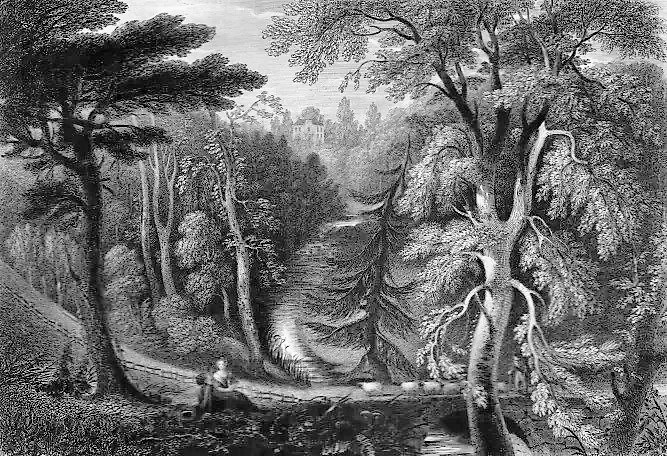
Invermay House: engraving of the Humble Bumble gorge on the estate with the house behind, from Scotland Illustrated, 1845.
In places the cliff faces of the gorge rise nearly a hundred feet above a narrow channel just a few feet wide, and paths were cut along both sides, linked by a rustic bridge just east of the gorge. The dramatic scene was a favourite place of Sir Walter Scott and has changed little since his day, except for the loss of the elm trees which formed an important element in the landscape but were a casualty of Dutch Elm Disease in the 1970s. At the same time, new estate buildings designed by Nicol, the architect Alexander Laing (1752-1823), and others were built, including a gazebo (now lost), dairy and game larder. The west lodges (of 1803) were designed by B.D. Hodge, and two sides of an intended U-shaped stable court (now a house called Hill of Invermay), the walled garden (designed in 1802 by Walter Nicol), and the Home Farm were also built at this time, while the policies were enclosed by a new wall. Nicol designed new peach and grape houses, and proposed the construction of a domed and battlemented Gothick temple and a two-storey classical tea house attached to a greenhouse, which sadly remained unbuilt.

Invermay House: unexecuted design by Walter Nicol for a tea house on the estate, c.1802. The location of the original drawing is unknown.

Descent: purchased 1717 by Alexander Belshes (d. 1745); to son, John Belshes (c.1700-77); to son, John Hepburn Belshes (c.1745-1819); to son, Alexander Hepburn Belshes (1778-1864); to kinsman, Sir John Stuart Hepburn Forbes (1804-66), 8th bt.; to daughter, Harriet Williamina Hepburn-Forbes (1835-69), wife of Charles Henry Rolle Hepburn-Stuart-Forbes-Trefusis (1834-1904), 20th Baron Clinton, who sold 1898 to John McLaren Fraser (c.1846-1941), auctioneer; requisitioned in Second World War for use as an evacuation hostel; sold c.1946 to Capt. David Wemyss (1920-2005); to son, Charles John Wemyss (b. 1952).

Balmanno Castle, Dron, Perthshire

A tall harled four-storey late 16th century L-plan tower house, built for George Auchinleck in about 1575-80, after he bought part of the lands of Balmanno from Alexander Balmanno. It has crowstepped gables and a taller square tower in the angle between the two ranges. The tower in turn has a stair-turret corbelled out in the re-entrant angle between the tower and the south range, which is crowned by a small turret with an ogee roof. As first built, the castle was surrounded by a rectangular moat which was largely intact in 1901 but has now mostly been infilled.


Balmanno Castle: ground and first floor plans from Macgibbon & Ross, 1889
Balmanno Castle: engraving from Macgibbon & Ross, 1889


Balmanno Castle: site plan from Ordnance Survey 25" map, 1901,
showing the then largely intact moat and the position and extent of the service wing of c.1800.
The castle came to John Hepburn Belshes (d. 1819) by marriage in 1777, and soon afterwards alterations were carried out. Almost all the window openings were enlarged and new sash windows were inserted. The central window on the first floor of the south front was converted into a door approached by a newly-built external stair. Inside, a new staircase was inserted between the two rooms of the first floor, leading up to the second floor, and on the north side of the castle a low extension was added to provide service accommodation. The Castle Steading was also built around this time to the east of the castle and tree-planting took place across the estate, as at Invermay.

In the later 19th century, the castle became a farmhouse, but in 1906, when the estate was inherited by Lord Clinton, he asked the leading Scottish architect Sir Robert Lorimer to make plans for the remodelling of house, though nothing was done at that time. However, after the house was sold in 1915 to the Glasgow shipbroker, William S. Miller, Lorimer was once more consulted and in 1916-21 he undertook a tactful but thorough reworking of the house that turned it from a slightly dour laird's house into a quintessentially Scottish country house. It was, in fact, one of Lorimer's favourite projects, and he later said that of all the houses he had worked on, it was the one he would most like to live in. Lorimer's work largely respected the external appearance of the tower, although he did replace the external forestair, make some changes to the fenestration and add a storey to the stair-turret to create a more dramatic silhouette. 

Balmanno Castle: the house from the east in recent times. Image: Travel Scotland.

Inside, he made extensive alterations to create a series of more formal and elaborately decorated rooms; and he also replaced the existing north service wing with a more extensive gabled and harled service range of a single storey and attics; and built a crowstep-gabled gatehouse range to the east of the castle, which artfully conceals the house from the approach. The additions effectively created an enclosed courtyard with the original tower at its south-west corner. The external face of the gatehouse has a central Gothic-arched entrance under a crowstepped gable, and short wings to either side which stand at a slight angle to the entrance, visually funnelling the visitor towards the archway. On the courtyard side, the gateway again stands under a crowstepped gable, which is flanked by two slightly lower gables which connect the gatehouse to the forecourt walls. 

Balmanno Castle: the external face of the gatehouse range in 1931. Image: Country Life.

Balmanno Castle: the gatehouse range from the courtyard in 1931. Image: Country Life.
There was always a doorway in the base of the tower, and this became Lorimer's main entrance. It leads into an entrance passage, with on its left a new hall, which Lorimer created from two vaulted basement storage rooms and gave a plaster tunnel-vault, while straight ahead was the former kitchen, which Lorimer repurposed as the dining room, although it preserves much of its original character, with a low tunnel-vault and massive fireplace. The generous spiral staircase in the tower provides access to the first and second floors, and its windows are decorated with stained glass panels of the months by Walter Camm, 1921. Over the staircase is a plaster ceiling designed by Lorimer in an early 17th century style with floral motifs modelled by either Samuel Wilson or Thomas Beattie, who were responsible for all the early 20th century plasterwork in the house. 

Balmanno Castle: the drawing room in 1931. Image: Country Life.
On the first floor, Lorimer created three rooms with panelling in the late 17th century style of Holyroodhouse. The billiard room (formed from the 16th century hall) has a beamed ceiling enriched with fruiting vines, and flowers in the panels between the beams. The drawing room ceiling has a heavily moulded central roundel surrounded by vine branches, all contained within a rectangular border, with three further panels with floral motifs beyond the border at either end. The smaller parlour has a coved ceiling, with large reliefs of baskets of flowers set against the coving. 

Balmanno Castle: bedroom at top of the tower, 1931.
Image: Country Life. 
The second and third floors are devoted to bedrooms, all decorated in the same manner as the first-floor rooms, with 17th-century style plaster ceilings and panelling, albeit more simply treated here than in the reception rooms. The Hunter's Bedroom has a frieze depicting a medieval hunting scene, and the bedroom at the top of the tower has a particularly charming plaster tunnel vault decorated with with floral motifs in roundels and curly ribbing.

Descent: Alexander Balmanno; sold before 1575 to George Auchinleck (d. 1596); to son, Sir George Auchinleck (d. c.1639), a lord of session as Lord Balmanno; to son, Sir William Auchinleck (d. 1672); to son, Sir Archibald Auchinleck (d. c.1695), who sold to Sir Thomas Murray (d. 1684), 1st bt. of Glendoick; to son, Sir Thomas Murray (d. 1701), 2nd bt.; to brother, Sir John Hepburn Murray (d. 1714), 3rd bt.; to brother, Anthony Murray (d. 1746); to nephew, Sir Patrick Murray (d. 1756), 4th bt.; to son, Sir Alexander Hepburn Murray (c.1754-74), 5th bt.; to sister, Mary (1752-1823), wife of Col. John Hepburn Belshes (c.1745-1819); to son, Alexander Hepburn Murray Belshes (1778-1864), who let it to his brother, Lt-Gen. John Belshes (1782-1863); to kinsman, Sir John Stuart Hepburn Forbes (1804-66), 8th bt.; to nephew, Sir William Stuart-Forbes (1835-1906), 9th bt., who lived in New Zealand; to kinsman, Charles Hepburn-Stuart-Forbes-Trefusis (1863-1957), 21st Baron Clinton; sold 1915 to William Scott Miller (1865-1937); given, c.1934, to son, William Scott Miller jun. (1904-76); sold 1950 with 1,000 acres to Thomas Coats (1894-1971), 2nd Baron Glentanar, who gave it to his daughter, the Hon. Jean Coats (1928-2007), wife of Hon. James Michael Edward Bruce (1927-2013); to son, John Edward Bruce (b. 1958).

Belshes family of Invermay and Balmanno


Belshes, John (c.1610-93). Younger son of John Belshes (c.1580-1631) of Tofts (Berwicks), advocate, and his first wife Janet (d. 1623), third daughter of Sir Thomas Craig of Riccarton, king's advocate, born about 1610. He married, 27 September 1666 at Dunfermline (Fife), Ann (1634-1713), daughter of Sir David Aytoun of Kinglassie (younger son of Robert Aytoun (d. 1595) of Inchdairnie), and had issue:
(1) John Belshes (b. c.1668; fl. 1718), of Tofts; succeeded his father at Tofts in 1693 and was served heir general to him, 21 October 1699; married Janet (d. 1740), daughter of Sir Alexander Swinton of Mersington, Lord Mersington, and had issue three sons and three daughters; living in 1718;
(2) Alexander Belshes (c.1670-1745) of Invermay (q.v.);
(3) William Belshes; died unmarried and without issue in Jamaica;
(4) Ann Belshes; married, 22 February 1701 at Eccles, Patrick Nisbet of Eastbank;
(5) Mary Belshes; died unmarried.
He inherited the Tofts estate in Berwickshire from his elder brother in 1656, and was infeft in these lands, 20 March 1657. Much of the estate had to be sold to meet his brother's debts, with the bulk of the property being sold in 1673 to Sir William Purves, who renamed it Purves Hall.
He was buried at Greyfriars, Edinburgh, 18 March 1693. His widow died 11 February and was buried at Edinburgh, 13 February 1713.

Belshes, Alexander (c.1670-1745). Second son of John Belshes (c.1610-93) of Tofts and his wife Ann, daughter of Sir David Aytoun of Kinglassie, born about 1670. Principal Sheriff Clerk of Midlothian. After buying the Invermay estate, he became an elder of the kirk at Forteviot, 1725. He married 1st, 27 February 1696 at Edinburgh, Emelia, daughter of Sir Thomas Murray (d. 1684), 1st bt. of Glendoick, a Lord of Session as Lord Glendoick and Lord Clerk Register, 1674-80; married 2nd, c.1723, Margaret, daughter of Sir John Clerk MP (d. 1722), 1st bt., of Penicuik, and had issue:
(1.1) John Belshes (c.1700-77) (q.v.);
(1.2) Thomas Belshes (1702-83), born at Edinburgh, 1 October 1702; deputy Sheriff Clerk for Edinburgh; admitted a burgess of the city of Edinburgh, 1739; married 1st, 8 November 1741 at Edinburgh, Margaret (d. c.1755), daughter of Robert Hepburn (1698-1756) of Baads and had issue three sons; married 2nd, 18 July 1756, his cousin, Helen (d. 1789), daughter of John Belshes of Tofts; buried at Edinburgh, 2 July 1783;
(1.3) Alexander Belshes (b. 1703), born at Edinburgh, 27 November 1703;
(1.4) William Belshes (1705-07); born at Edinburgh, 8 May 1705; died young and was buried at Edinburgh, 22 June 1707;
(1.5) Emilia Belshes (b. 1706), born at Edinburgh, 15 August 1706;
(1.6) Mary Belshes (b. 1707), born at Edinburgh, 3 October 1707;
(1.7) Elizabeth Belshes (b. 1709), born at Edinburgh, 28 April 1709;
(1.8) Anthony Belshes (b. 1711), born 4 May 1711; said to have died without issue in Bengal before 1780;
(2.1) James Belshes (b. 1725), born at Edinburgh, 20 November 1725;
(2.2) William Belshes (b. 1726), born 3 December 1726.
He purchased the Invermay estate in 1717, but lived chiefly in Edinburgh, using the Old House of Invermay as a summer residence.
He died at Invermay, 19 April 1745. His first wife probably died c.1712. His second wife's date of death is unknown.

Belshes, John (c.1700-77). Eldest son of Alexander Belshes (c.1670-1745) and his first wife, Emelia, daughter of Sir Thomas Murray, 1st bt., of Glendoick, born about 1700. Admitted an advocate, 1720. Succeeded his father as Sheriff Clerk of Midlothian, 1745. He married 1st, c.1722, Mary (d. 1740), daughter and eventual heiress of Daniel Stewart (d. 1708) of Fettercairn and 2nd, 29 May 1743, Margaret (d. 1785), daughter of Sir William Stewart of Castlemilk, and had issue:
(1.1) Margaret Belshes (b. 1727), born in Edinburgh, 11 December 1727; probably died young;
(1.2) Alexander Belshes (b. 1728), born in Edinburgh, 17 November 1728; probably died young;
(1.3) Emelia Stuart Belshes (1729-1807), born in Edinburgh, 27 December 1729; married, 22 December 1751 at Edinburgh, her cousin, William Belshes (c.1717-53), surgeon and director of the hospital at Fort St. David (India) and later of Tofts, and had issue one son (Sir John Wishart-Belshes (later Stuart) (c.1752-1821), 3rd bt.*); died 3 April 1807;
(2.1) John Hepburn Belshes (c.1745-1819) (q.v.);
(2.2) Margaret Belshes (c.1746-71), born about 1746; married, 31 January 1768, as the second of his three wives, Henry Wedderburn (1722-77) of Gosford (East Lothian), second son of Charles Wedderburn of Gosford, but had no surviving issue; died in childbirth at Calcutta (India) and was buried there, 28 July 1771;
(2.3) Mary Belshes (1748-84), born in Edinburgh, 15 December 1748; married, 1 December 1783, as the second of his three wives, Rev. Dr. Thomas Snell Jones (1754-1837), Presbyterian minister of Lady Glenorchy's Church, Edinburgh (who m3, 30 June 1787, Anne (1752-1822), daughter of George Gardner of the Custom House, Edinburgh, and had issue two sons and one daughter); she died without issue and was buried at St Cuthbert's, Edinburgh, 31 May 1784.
He inherited the Invermay estate from his father in 1745 and was served heir to him, 1 August 1746. He built a new mansion house at Invermay c.1750, as well as commencing the landscaping of the policies.
He died 29 December 1777 and was buried at Edinburgh, 1 January 1778. His first wife was buried at Edinburgh, 16 January 1740. His second wife died at Thistle Court, Edinburgh, 14 December 1785.
* He assumed the baronetcy on the death of his great-uncle, Sir William Stuart (d. 1777), 2nd bt., but some accounts state that his mother Emilia was recognised as a baronetess (with the title of Dame) and that he should be regarded as 4th baronet; the title became dormant on his death.

Belshes, John Hepburn* (c.1745-1819). Only son of John Belshes (c.1700-77) and his second wife, Margaret, daughter of Sir William Stewart of Castlemilk,, born about 1745. Educated at Edinburgh University, where he was one of five founders of its Speculative Society, 1764. An elder of Forteviot kirk. Lieutenant-Colonel of the Drummond Fencibles, 1794-1802. He married, 30 May 1777 at Queensferry, Mary (1752-1823), daughter and eventual heir of Sir Patrick Hepburn Murray (1706-56), 4th bt., of Balmanno and Blackcastle, and had issue:
(1) Alexander Hepburn Murray Belshes (1778-1864) (q.v.);
(2) John Hepburn Murray Belshes (1782-1863) of Balmanno (Perths.), born 13 August 1782; an officer in the army (2nd Lt, 1804; Lt, 1805; Capt. 1812; Maj. 1817; retired on half-pay about 1820; Lt-Col. 1837; Col., 1851; Maj-Gen. 1855; Lt-Gen., 1862) and in the Perthshire Yeomanry Cavalry (Cornet, 1820; Lt. 1821; Capt. 1822; retired 1825); a Commissioner of Supply and JP  for Perthshire; a Conservative in politics; a director of the Perth City and County Infirmary, to which he bequeathed £1,000; died unmarried and without issue at Edinburgh, 12 January 1863, and was buried in the family burying place at Muckersie chapel; his will was confirmed, 3 April 1863.
He inherited the Invermay estate from his father in 1777 and was served heir to him, 6 April 1778. He was responsible for much of the landscaping and the construction of ancillary buildings in the policies, c.1800-10. His wife inherited the Balmanno estate from her brother in 1774 and brought it to the Belshes; some alterations were made to Balmanno Castle c.1800.
He died in Edinburgh, 24 July 1819. His widow died 12 January 1823.
* He took the additional name Hepburn after his marriage in 1777.

Belshes, Alexander Hepburn Murray (1778-1864). Elder son of John Hepburn Belshes (c.1745-1819) and his wife Mary, daughter and eventual heir of Sir Patrick Hepburn Murray of Balmanno, born 22 June 1778. JP for Perthshire and East Lothian and DL (from 1819) for Perthshire. An officer in the Perthshire Yeomanry Cavalry (Capt.; Maj. 1821; disbanded 1828) but also described as Major in 1813. Convenor of Perthshire; a Commissioner of Supply (from 1812), JP and DL (from 1819) for Perthshire. A director of the Perth City and County Infirmary and a supporter of many other charitable endeavours. A Conservative in politics. He was unmarried and without issue.
He inherited the Invermay estate from his father in 1819, and the Balmanno estate from his mother in 1823, although Balmanno Castle was occupied by his brother. After his death his estates passed to his heir general, Sir John Stuart Hepburn Forbes (1804-66), 8th bt., of Monymusk, Fettercairn and Pitsligo, the great-great-great-grandson of John Belshes (d. 1693).
He died at Invermay, 17 January 1864, and was buried in the family burying place at Muckersie chapel; his will was confirmed, 26 April 1864.

Principal sources

G. MacGregor, The Red Book of Scotland, 2nd edn, 2018, vol. 1, pp. 482-88; A. Wedderburn, The Wedderburn Book, 1898, pp. 383-85; N. Meldrum, Forteviot: the history of a Strathearn parish, 1926; A.A. Tait, The landscape garden in Scotland, 1735-1835, 1980, pp. 140-43; J. Gifford, The buildings of Scotland: Perth and Kinross, 2007, pp. 181-84, 433-34;

Location of archives

Belshes of Invermay: papers of Robert Peddie WS of Perth as factor to Invermay estate, 1795-1826 [Perth & Kinross Archives B59/38/5/23]

Coat of arms

Belshes of Tofts and Invermay: Or, three pallets gules, a chief vair.
Hepburn Belshes of Invermay: Quarterly, 1st and 4th, gules, on a chevron argent, a rose between two lions combatant of the field; in base a buckle in the shape of a heart of the second (for Hepburn); 2nd, or, three pallets gules, a chief vair (for Belshes); 3rd, azure a cross pattée between three mullets, all within a double tressure flory counterflory gules (for Murray).

Can you help?

  • Can anyone provide portraits or photographs of the people whose names appear in bold above, for whom no image is currently shown?
  • If anyone can offer further information or corrections to any part of this article I should be most grateful. I am always particularly pleased to hear from current owners or the descendants of families associated with a property who can supply information from their own research or personal knowledge for inclusion.

Revision and acknowledgements

This post was first published 2 July 2023 and was updated 4 July and 18 July 2023.


Sunday, 25 June 2023

(548) Bellville of Tedstone Court, Papillon Hall and Fermyn Woods Hall

According to Burke's Landed Gentry, the first English forebear of this family was John Bellville, a French émigré who came to England at the time of the French Revolution and was the father of John Benjafield Bellville (c.1793-1847), with whom the genealogy below begins. The only certain reference to the first John which I have been able to trace, however, occurs in the apprenticeship indenture of his son in 1807, where the father is described as 'John Bellville of Codford St. Peter' (Wilts). There seems to be no evidence that the first John had any long association with Codford, however, and I have been unable to trace either his burial or his son's baptism (he is said to have been born in Bath). Although the story of John's origin as a French émigré seems perfectly plausible, it bears a slightly suspicious similarity to that of the well-known astronomer, John Henry Bellville (1795-1856), who was baptised at St Pancras (Middx) but was apparently the child of French refugees who settled at Westbury (Wilts) - less than ten miles from Codford - and came under the patronage of Lady Pulteney of Bath. This might be a coincidence, or the two families might be connected, but it also possible that the mercantile Bellvilles quietly copied the background of their namesake when they grew rich and wanted to suggest an obscure but potentially romantic lineage.

John Benjafield Bellville (c.1793-1847) was apprenticed to Matthias Archibald Robinson (1775-1838) as a needlemaker, but in 1823 the two men established the firm of Robinson & Bellville to manufacture patent barley and groats drinks - the ancestor of the modern-day Robinson's Lemon Barley Water. With the death of Robinson in 1838 and J.B. Bellville in 1847, the business was carried on by John's son, William John Bellville (1830-91), who in 1862 merged the business with Thomas Keen & Son, mustard manufacturers. By 1876 he was the sole proprietor of the merged firm of Keen, Robinson & Bellville, and he died an extremely wealthy man, leaving property valued at over £600,000. William left four sons but they had been educated as gentlemen and not for business, and he bequeathed the goodwill of the company to his widow, who sold it to J. & J. Colman of Norwich, a rival mustard manufacturer, in 1903. A connection was maintained with the business as Frank Ashton Bellville (1870-1937), became a director of Colmans at that time.

The four sons of William John Bellville all acquired country houses. Henry Archibald Bellville (1866-1930) bought Tedstone Court (Herefordshire) in 1908, while the other three all bought seats in the prime foxhunting country of the East Midlands, where they could indulge their shared passion for hunting. William's widow bought Papillon Hall (Leics) for Frank Ashton Bellville (1870-1937) in 1901, and he then employed Sir Edwin Lutyens to greatly enlarge and remodel it from 1903. William John Bellville (1868-1937) bought Kibworth Hall (Leics) in 1918 and George Ernest Bellville (1879-1967) acquired Fermyn Woods Hall (Northants) in 1922.

Kibworth Hall: the early 19th century house acquired by William John Belville in 1918 and sold by his nephew in about 1942, from an old postcard.
The sale of the family business in 1903 took place just at the moment when changes in social legislation and taxation were beginning to make it impossible to transmit inherited wealth from one generation to the next in an unimpaired fashion. As the 20th century developed, it was increasingly essential for a country house and the lifestyle associated with it to be actively supported by earned income and for inherited wealth to be husbanded with care and good fortune if it was not to be seriously depleted by capital and other taxes. The legacies left by William John Bellville were big enough to support the next generation without too many cares, but some of the successors of Henry, William, Frank and George Bellville were less fortunate. Miles Aubrey Bellville (1909-80), an Olympic sailor and wartime officer in the Royal Marines, inherited Tedstone Court in 1930. He was able to remain there throughout his life, but his son, Richard John Bellville (1945-2000) sold it in 1996. William John Bellville (1868-1937) had no surviving children, and left Kibworth Hall to his nephew, Anthony Seymour Bellville (1902-70), who sold it and moved to a smaller house on the Isle of Wight. Because Anthony received this inheritance, Frank Ashton Bellville left Papillon Hall to his younger son, Rupert Bellville (1904-62), who tried to sell it almost at once and eventually pulled down the house in 1950 before finally finding a buyer for the estate. He also inherited £105,000 from his father, but in less than twenty years had spent it and been declared bankrupt. George Ernest Bellville (1879-1967) lived for thirty years longer than any of his brothers, but had no sons to inherit Fermyn Woods, which he bequeathed to his divorced elder daughter, Dodo Maxwell (1919-2002). She reduced the size of the house soon afterwards and lived in the surviving part until her death, by which time it was in very poor condition. It was sold after her death to a local architect who was able to finance a thorough restoration thanks to being one of the heirs to a construction industry fortune. In less than a hundred years, therefore, the family have acquired and sold four significant country houses.

Tedstone Court, Tedstone Delamere, Herefordshire

A large and essentially U-shaped building, given its present form by Richard Wight after he inherited the estate in 1805, with the main fronts looking east and south towards the parish church and the wooded valley of the Sapey Brook.  Between the house and the church stood a long-deserted medieval village, and the present house seems to stand on the site of, and perhaps to incorporate elements of, the earlier manor house, which was the seat of the Wyshams from the 14th to the 17th centuries. 

Tedstone Court: the south and east fronts. Image: John Burrows/Historic England IOE01/07479/25
The south and east fronts are rendered and of two-and-a-half storeys, and have sash windows with stone architraves, but the fenestration is irregular, which is strong evidence that Wight remodelled rather than rebuilt the earlier house. The east front has a central Doric porch, mostly tripartite windows, and a two-storey canted bay at the northern end. 

Tedstone Court: west front in 2022.
On the west side the house is partly of brick, and has a three-bay centre under a big pedimental gable. In the 20th century, this part of the house became a separate dwelling (known as Gracefields), but by 2023 the two properties had been reintegrated as one dwelling.

Descent: Robert Mason (d. 1684); to son; to son, Robert Mason (d. 1738)... James Moore (d. 1805) of Shelsley Beauchamp (Worcs); to Richard Wight (c.1780-1821); to widow, Mary Maria (d. 1838), later the wife of Thomas Philip Paine Wight (d. 1834) of Collington (Herefs); to son by her first marriage, James Lane Wight (c.1818-85); to son, Edgar Wight (1845-1918); sold 1908 to Henry Archibald Bellville (1866-1930); to son, Maj. Miles Aubrey Bellville (1909-80); to son, Richard John Bellville (b. 1945); sold 1997 to Stennard Harrison, who divided the property between himself and his daughter, who sold Gracefields in 2013; main house sold 2015 and Gracefields sold 2022 to Andrew and Louise Jones.

Papillon Hall, Lubenham, Leicestershire

The original house on the site of Papillon Hall, which stood on a hillock near the western boundary of Lubenham parish, was built by David Papillon (1581-1659), a French Huguenot architect and military engineer who had prospered as a property speculator in the London area and who later also made designs for Lamport Hall (Northants). He bought the site in 1627 but it was not a manor house and was never associated with a large estate. No doubt under the influence of his military experience, Papillon built an extraordinary octagonal moated two storey house of stone, with a cross-shaped slated roof that had tall gables on the axes. The walls were treated in a remarkable manner, with broad bands in the stonework by which a few courses were alternately raised and recessed to create a primitive and Brobdingnagian rustication. The house was surrounded by a rectangular moated enclosure approached through a single central gatehouse, which is shown on a rather stark drawing that seems to be the only record of its first appearance.

Papillon Hall: a mid 18th century view of the house with its encircling moat and gatehouse.
Image: Record Office for Leicestershire, Leicester and Rutland DE2221/59.
In the years after 1780 the house was altered by George Bosworth, who installed the arched sash windows shown in later records of the building, entirely altered the ground floor layout, and added a service wing at the north-west corner. He probably also altered the surrounding landscaping, for there is no trace in later records of the encircling moat.

Papillon Hall: engraving of 1798 showing the house as altered for George Bosworth in the 1780s.

Papillon Hall: this photograph seems to be the only one showing the house before Lutyens' alterations.
In 1901 Mrs. Emma Bellville of Stoughton Grange bought the house for her son, Capt. Frank Ashton Bellville (1870-1937), who was heir to the Keen's Mustard fortune (hence the phrase, "as keen as mustard"), but who 'did little else but hunt'. He brought in Sir Edwin Lutyens in 1903 to extend the house. Since visiting Norman Shaw's Chesters (Northbld) a few years earlier, Lutyens had always wanted the chance to design a butterfly-plan house as he thought he could improve on the essays of his Arts & Crafts contemporaries. The fact that the existing house was a flattened octagon and had been built for a Papillon (which means butterfly in French) gave him the perfect opportunity. The plan was based on Chesters, which Lutyens much admired, but for the elevations he abandoned the Baroque of Chesters for a more cottagey style, influenced particularly by E.S. Prior's house, The Barn at Exmouth (1893-97), a choice which sits rather oddly with the very formal and rather mannered planning.

Papillon Hall: ground floor plan as remodelled by Lutyens.

Papillon Hall: the south front with the lily pond in 1912. Image: Country Life.
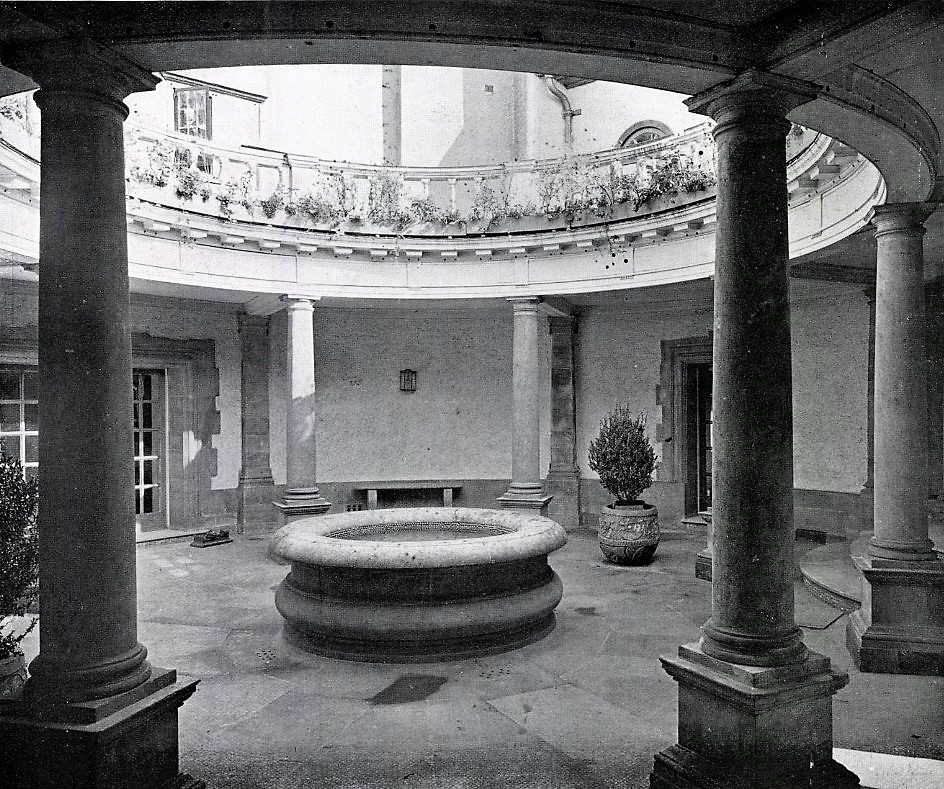
Lutyens added new radiating wings projecting to the NE, SE and SW to the old house containing a dining room, drawing room and billiard room, while the fourth axis on the NW was occupied by an existing service wing. Between the billiard room and service wing Lutyens created a circular open Basin Court connecting the new main entrance with the vestibule within the original octagon. This plan produced some interesting conjunctions of forms, where the single-storey circular court abutted the gabled polygon of the house behind. And there are deliberately shocking conjunctions of style too: while the main building was in a simple vernacular manner, with roughcast walls and a central half-timbered gable, he responded to the formal geometry of the Basin Court with a ring of Tuscan columns, and he also made the entrance itself a powerful classical composition with chunky rustication and a broad three-bay pediment, but cheekily tucked this into the ground floor of an otherwise vernacular block.

Papillon Hall: the Basin Court between the wings on the west side in 1912. Image: Country Life.

Papillon Hall: the entrance arcade created by Lutyens. Image: Country Life.

Papillon Hall: the drawing room in 1912. Image: Country Life.
In 1937 the house passed to Rupert Bellville (1904-67), who put the house up for sale the following year, but a buyer was not found before the house was requisitioned during the Second World War, when it housed American airmen. After it was returned to the family, Rupert Bellville again tried to sell it, but in post-war conditions he failed to find a buyer and it was therefore demolished in 1951. Some of the outbuildings were converted into a farm and a small fragment of the old house was rescued and installed in the gardens of Blagdon Hall in Northumberland.

Finally, an uncanny tale for those who like ghost stories. When Frank Belville moved into Papillon Hall in 1901 he found a tiny cupboard with a padlocked metal grille in the lintel of an internal window over the hall fireplace, containing an early 18th century pair of green brocade women's shoes. The title deeds stated that 'on no account to permit them to be removed from the house, or ill-fortune would assuredly befall the owner'. Despite this warning, the shoes were taken to Belville's solicitors for safe keeping during the remodelling of the house. Work on the contract went slowly, accidents happened on site and a workman was killed, the first contractor abandoned the contract, and the skeleton of a woman was found walled up in the attics of the old house (this was said to be the Spanish mistress of an early 18th century Papillon who had mysteriously disappeared in 1715). In 1905 Bellville himself was in a motor accident and fractured his skull. He recovered, but in 1908 his chauffeur was killed in another accident. During the Second World War, there were two occasions on which American airmen who had removed the shoes from their resting place did not return from missions over enemy territory. The 'cursed shoes' are now in Market Harborough Museum.

Descent: David Papillon (1581-1659); to son?, George Papillon (d. 1684); David Papillon (fl. 1717); to son, who sold 1764 to William Stevens...Charles Bosworth (fl. 1798) of Brampton (Northants); to George Bosworth (d. 1830); to widow, Mary (fl. 1863), later wife of John Breedon; sold 1866 to Lord Hopeton; sold 1872 to Thomas Halford; sold to C.W. Walker (fl. 1892) of Burwash (Sussex); sold to A.C. Isham (d. 1897);... sold 1901 to Mrs Emma Bellville for use of her son, Frank Ashton Bellville (1870-1937), kt.; to son, Rupert Bellville (1904-67), who demolished it in 1951. 

Fermyn Woods (aka Farming Woods) Hall, Brigstock, Northamptonshire

The house began as a hunting lodge in Rockingham Forest, built or remodelled between 1651 and 1656 for Sir John Robinson, 1st bt., who was Lord Mayor of London in 1662. The main front faced south and had a sequence of five gables, perhaps representing a hall range and two cross-wings of the traditional form, but only the porch and a portion of the facade to the right of it are now of the 17th century, due to successive later alterations, additions and contractions.

Fermyn Woods Hall: engraving of the house by J.P. Neale, 1826., showing it before the mid 19th century additions.
In the late 18th century the house was a hunting lodge belonging to the 2nd Earl of Upper Ossory, whose principal seat was at Ampthill in Bedfordshire. He added a dining room and library, and a long, rather plain wing at the west end in two phases of work, in 1777 and 1788. The end elevation of his new range is visible on the left in Neale's engraving above.

There were further alterations in the 1830s for Lady Anne and Lady Gertrude Fitzpatrick, and after the house passed to their illegitimate half-sister Emma, the wife of Robert Vernon Smith, 1st Baron Lyveden, Edward Browning of Stamford undertook a radical remodelling and enlargement of the house, giving it most of its later neo-Elizabethan character. His efforts were concentrated especially on remodelling the Georgian west wing, which emerged with two-storey canted bays on the west and south sides, an attic storey with gables and tall chimneystacks, and mullioned and transomed windows.

Fermyn Woods Hall: the west wing as remodelled by Edward Browning, from an old postcard.

Fermyn Woods Hall: the house from the north-west in the early 20th century, from an old postcard.
Inside, the entrance hall has an elaborate tiled centrepiece with the arms of Lord Lyveden, and his shield also appears on the newels of the staircase, which is said to be a copy of that formerly at Lyveden Old Bield. A 17th century gateway from Lyveden Old Bield, built for Sir Lewis Tresham but part of the Fermyn Woods estate until 1908, was moved in the 19th century to form a grand entrance to the stable court, which was built in 1740 but altered later.

Fermyn Woods Hall: the stable court from the south-east, showing the gate from Lyveden Old Bield.
The descendants of the Earls of Upper Ossory finally sold Fermyn Woods in 1897, and over the next twenty-five years it changed hands frequently, and was shorn of most of its 4,000 acre estate by the notorious asset-stripper, T.F. Hooley, who claimed to have made a profit of £70,000 from buying the estate, breaking it up and selling the farms separately, and felling much of the estate timber. In 1919-20, Blackwell & Riddey of Kettering (Northants) remodelled some of the interiors for Maj. Aubrey Wallis-Wright, creating new panelling with Ionic pilasters in the dining room (now the drawing room). More permanent new owners arrived in 1922 with the sale to Capt. George Bellville (1879-1967), who lived here until his death and left the house to his daughter 'Dodo'. They found the house dauntingly large, however, and pulled down the west wing in 1968. The remainder was in poor condition by the time of Dodo's death in 2002, but was lovingly restored as his home by the architect David Laing (b. 1945), later Lord Lieutenant of Northamptonshire, over the next few years.

Fermyn Woods Hall: the reduced house in 2009. Image: Michael Trolove. Some rights reserved.

Descent: Crown sold 1641 to John Mordaunt (1599-1644), 5th Baron Mordaunt and 1st Earl of Peterborough; to son, Henry Mordaunt (1621-97), 2nd Earl of Peterborough; leased 1651 and later sold to Sir John Robinson (1615-80), 1st bt.; to son, Sir John Robinson (1660-93), 2nd bt.; to daughter Anne (d. 1744), wife of Richard Fitzpatrick (c.1662-1727), 1st Baron Gowran; to son, John Fitzpatrick (1719-58), 2nd Baron Gowran and 1st Earl of Upper Ossory; to son, John Fitzpatrick (1745-1818), 2nd Earl of Upper Ossory; to daughters, Lady Anne and Lady Gertrude Fitzpatrick (d. 1841); to half-sister, Emma Mary Wilson (d. 1882), wife of Robert Vernon Smith (later Vernon) (1800-73), 1st Baron Lyveden; to son, Fitzpatrick Henry Vernon (1824-1900), 2nd Baron Lyveden, who sold 1897 to John Gardiner Muir (d. 1913); sold 1908 to T.F. Hooley; let and later sold 1912 to Maj. Aubrey Wallis (later Wallis-Wright then Wallis) (d. 1926); sold 1922 to Capt. George Ernest Bellville (1879-1967); to daughter, Dorothy Vivien Bellville (d. 2002), formerly wife of Maj. Eustace Maxwell (1913-71); sold 2003 to David Laing (b. 1945); sold 2012 to James Michael Ruston Broadbent (b. 1965). 

Bellville family of Tedstone Court


Bellville, John Benjafield (c.1793-1847). Son of John Bellville (who in 1807 was of Codford St Peter (Wilts) but who reputedly fled from France at the time of the French Revolution), said to have been born at Bath, 1793*. Apprenticed to Matthias Archibald Robinson of London, needle maker, 1807, and was made free of the Needlemakers Company, 1817. He and his former master established the firm of Robinson & Bellville, manufacturers of a patent barley drink, in 1823. He married 1st, 22 April 1827 at St George, Hanover Sq., Westminster (Middx), Mary (1804-42), probably daughter of William Bird of Westwell House, Wellington (Som.), farmer, and 2nd, 15 February 1843 at Milton-by-Gravesend (Kent), Ann (1815-80), daughter of William Clark, an official of the East India Company, and had issue:
(1.1) William John Bellville (1830-91) (q.v.);
(1.2) Archibald George Belville (1831-32), baptised at St Mark the Evangelist, Clerkenwell (Middx), 21 October 1831; died in infancy and was buried at the same church, 23 March 1832;
(1.3) Emma Bellville (1834-1906), baptised at St George-the-Martyr, Bloomsbury (Middx), 18 February 1834; married, 2 June 1863 at Christ Church, Lancaster Gate, Paddington (Middx), Henry Farrance (1824-65) (who had been one of her father's apprentices), son of Thomas Farrance, confectioner, but had no issue; as a widow, lived latterly at Dorking (Surrey); died 13 August 1906; will proved 29 October 1906 (estate £13,060);
(1.4) Frederick Bellville (1836-1922), born 6 September and baptised at St George-the-Martyr, Bloomsbury, 26 October 1836; died unmarried, 14 August and was buried at Dorking, 17 August 1922; administration of goods granted 22 November 1922 (estate £7,589);
(2.1) Alfred Bellville (1843-85), born 18 March and baptised at St Alfege, Greenwich (Kent), 5 May 1843; an officer in the merchant marine (indentured apprentice, 1859; second mate, 1863; first mate, 1867, 1870), who settled in Africa around 1870 and was elected a Fellow of the Royal Geographical Society; he joined Lt. Faulkner's ivory hunting expedition to Central Africa, 1868, and a combined Universities' Expedition to Magila and Zanzibar, 1875, after which he published two papers in the RGS transactions; in 1877 he moved to Natal and was ordained deacon in 1880, serving in various Natal parishes; he married, 25 April 1877 at Durban (South Africa) Emma Mary, daughter of T. Crowder, and had issue two sons and three daughters; he died at Sand Hill, Belair, Durban (South Africa), 19 March 1885;
(2.2) Frances Mary Bellville (1844-1917), born 11 November 1844 and baptised at St George-the-Martyr, Bloomsbury, 9 January 1845; married, 22 September 1875 at St Luke, West Holloway (Middx), John Pears Walton (1838-1915) of Alston (Cumbld.) and Acomb High House (Northbld.), mine owner, son of Jacob Walton, and had issue two sons and four daughters; died 7 July 1917; will proved 2 November 1917 (estate £4,931);
(2.3) Rosa Hamilton Bellville (1845-1909), born 14 December 1845 and baptised at St George-the-Martyr, Bloomsbury, 18 February 1846; died unmarried at Southend-on-Sea (Essex), 27 November 1909; will proved 26 May 1910 (estate £739);
(2.4) Ada Elizabeth Bellville (1847-1926), born 10 April 1847 and baptised at St George-the-Martyr, Bloomsbury (Middx), 2 May 1848; married, 2 November 1869 at St Luke, West Holloway (sep. 1890), Rowland John Atcherley (b. c.1848), analytical chemist, son of Rowland Atcherley MD, and had issue two sons and one daughter; died 12 October 1926; will proved 24 November 1926 (estate £976).
He was buried at Kensal Green Cemetery (Middx), 13 September 1847; his will was proved in the PCC, 15 December 1847. His first wife died Apr-Jun 1842 and was buried at Kensal Green Cemetery. His widow died in Holloway (Middx), 28 April 1880; her will was proved 28 May 1880 (effects under £200).
* However, his baptism has not been traced.

Bellville, William John (1830-91). Elder son of John Benjafield Bellville (1793-1847) and his first wife Mary Bird, born February and baptised at St Mark the Evangelist, Clerkenwell (Middx), 23 April 1830. Educated at the University of Bonn (Germany). Freeman of the City of London, 1866. Partner in Robinson & Bellville of Holborn (Middx), manufacturers of a patent barley drink (and ancestor of Robinson's Barley Water), which merged in 1862 with Thomas Keen & Son, an old-established mustard manufacturer; he was sole proprietor of the merged firm by 1876. At his death, the goodwill of the company passed to his widow, who sold it in 1903 to J. & J. Colman of Norwich, another mustard manufacturer. He married, 4 July 1865 at Howe with Little Poringland (Norfk.), Emma (1846-1925), daughter of John Magor of Newton Abbot (Devon), hotel keeper, and had issue:
(1) Henry Archibald Bellville (1866-1930) (q.v.);
(2) William John Bellville (1868-1937), born 4 August 1868; educated at Harrow and Jesus College, Cambridge (matriculated 1887; BA 1891); served with the Duke of Cambridge's Special Corps in the Boer War, 1900; purchased Kibworth Hall (Leics), 1918, which he bequeathed to his nephew Anthony (1902-70); with his brothers Frank and George he was a famous horseman and rider to hounds, a pursuit to which he devoted much of, and ultimately sacrificed, his life; he married, 14 November 1907 at St James, Piccadilly, Westminster (Middx), Jessie Bousfield (1871-1921), daughter of James Steains of Westminster, gent., and formerly wife of Sidney Arthur Wolton (c.1870-1940), hop merchant, and had issue one daughter who died in infancy; died from injuries received in a hunting accident, 25 February 1937; will proved 17 June 1937 (estate £393,709);
(3) Frank Ashton Bellville (1870-1937) [for whom see below, Bellville family of Papillon Hall]
(4) Emma Maud Elizabeth Bellville (1875-1952), born 18 May and baptised  at All Saints, Clapton Park, Hackney (Middx), 4 July 1875; married, 13 April 1901 at St George, Hanover Sq., Westminster (Middx), Lt-Col. Cyril Godfrey Martyr DSO (1860-1936) of Ablington Manor, Bibury (Glos), son of Godfrey Martyr of Melbourne (Australia), and had issue two sons and one daughter; died 10 August 1952; will proved 20 November 1952 (estate £26,608);
(5) George Ernest Bellville (1879-1967) [for whom see below, Bellville family of Fermyn Woods Hall];
(6) Dorothy Mary Bellville (1883-1914), born 4 March and baptised at All Saints, Clapton Park, Hackney, 12 June 1883; married, 3 July 1906 at St George, Hanover Sq., Westminster, Maj. Philip Alexander Francis Spence (1876-1960) of Oatleys Hall, Brackley (Northants) (who m2, 23 June 1923 at St Mark, North Audley Street, Westminster, Sybil May (1896-1968), daughter of Sir John Latta (1867-1946), 1st bt.), son of Col. John Spence, and had issue one daughter; died 29 November 1914 and was buried at Turweston (Bucks); administration of her goods was granted to her husband, 3 March 1915 (estate £6,748).
He lived at Porchester Terrace, Hyde Park, London and Stoughton Grange (Leics), which he leased from the Powys-Keck family; his widow gave up the lease in about 1913.
He died at Eastbourne (Sussex), 7 August 1891; his will proved 14 September 1891 (effects £631,583). His widow died 8 August 1925; her will was proved 29 December 1925 (estate £177,063).

Bellville, Henry Archibald (1866-1930). Eldest son of William John Bellville (1830-91) and his wife Emma, daughter of John Magor of Newton Abbot (Devon), born 2 November 1866 and baptised at Christ Church, Lancaster Gate, Westminster (Middx), 1 January 1867. Educated at Harrow. An officer in the 3rd battalion, East Surrey Regiment (Lt., 1886; Capt., 1896; retired 1898). He married 1st, 24 September 1896 at Whittingham (Northbld.)  (div. 1903 on the grounds of her adultery with Capt. Walter Neilson), Phyllis Mary (1878-1967), third daughter of Alexander Henry Browne of Callaly Castle (Northbld.) and 2nd, 27 October 1906 at St Peter, Harrogate (Yorks WR), his first cousin, Ethel Mary (1878-1950), eldest daughter of John Pears Walton of Acomb High House (Northbld.), and had issue:
(1.1) Lucy Monica Bellville (1898-1991), born 18 March 1898; married, 9 December 1922 at Holy Trinity, Brompton (Middx), Oswald Stuart Thompson MRCS LRCP (1892-1971) of London, anaesthetist, son of Sidney Thompson of Farnaby, Sevenoaks (Kent), solicitor, and had issue one son; died 26 July and was buried 2 August 1991; will proved 24 September 1991 (estate under £125,000);
(1.2) Colin Guy Archibald Bellville (1901-58), born 27 December 1901; educated at Harrow; steam plough engineer; Fellow of the Geological Society; married, 27 July 1928, Kathleen (1903-93), daughter of Norman John Beastall of Church Gresley (Derbys), but had no issue; died 14 July 1958; will proved 7 November 1958 (estate £36,461);
(2.1) George Dennis Arthur Bellville (1907-25), born in New Zealand, 1907; educated at Harrow; died unmarried in a motor accident, 8 October 1925;
(2.2) Miles Aubrey Bellville (1909-80) (q.v.);
(2.3) Florence Audrey Emma Bellville (1914-2003), born 26 January and baptised at Tedstone Delamere, 15 March 1914; married, Oct-Dec. 1946, Col. Douglas Robert Beaumont Kaye DSO (1909-96) of Brinkley Hall (Suffk.), son of Robert Walter Kaye of Warren's Gorse, Daglingworth (Glos), and had issue one son and one daughter; died 1 March 2003.
He purchased Tedstone Court in 1908.
He died 30 September 1930; his will was proved 22 January 1931 (estate £181,006).  His first wife married 2nd, Apr-June 1904, Maj. Walter Neilson (1866-1941) of Charlton Hall (Northbld), the co-respondent in her divorce, and had further issue two sons and one daughter; she died in Scotland, 8 June 1967 and her will was proved 14 November 1967. His widow died 13 October 1950; administration of her goods was granted 24 January 1951 (estate £13,758).

Maj. Miles Aubrey Bellville (1909-80) 
Bellville, Miles Aubrey (1909-80).
Younger son of Henry Archibald Bellville (1866-1930) and his second wife, Ethel Mary, eldest daughter of John Pears Walton of Acomb High House (Northbld.), born 28 April 1909. Educated at Malvern College and Jesus College, Cambridge (BA), where his prowess as an oarsman led to his being elected to the Leander Club. He was a keen sailor who was a member of the 
Royal Corinthian Yacht Club and the Royal Ocean Racing Club, and competed in the Americas Cup in 1934 and at the 1936 Berlin Olympic Games, where he was a crew member of the boat Lalage which won gold in the six metre class. He served in the Second World War as an officer in the Royal Marines (2nd Lt, 1940; Lt., 1940; Capt., 1945; T/Maj., 1945) and was awarded the MC, 1942 and MBE, 1943. High Sheriff of Herefordshire, 1969-70; a DL for Herefordshire. He married, April-June 1945, Nancy Catherine MBE JP (1912-96), who served as a First Officer in the Women's Royal Naval Service in the Second World War, second daughter of John Deans of Christchurch (New Zealand), and had issue:
(1) Richard John Bellville (1945-2000) (q.v.);
(2) Lalage Jane Bellville (b. 1947), born 17 March 1947; married, Apr-Jun 1975, Thomas Joseph Hawksley (b. 1945), schoolmaster, and had issue two daughters;
(3) Susan Catherine Bellville (b. 1948), born 18 August 1948; schoolteacher; member of Oxfordshire County Council, 2005-09; married, 1973 (div. 1977), Professor John Charles Robert Haffenden FBA FRSL (b. 1945), but had no issue.
He inherited Tedstone Court from his father in 1930.
He died 27 October 1980; his will was proved 30 January 1981 (estate £205,636). His widow died 3 February 1996; her will was proved 29 April 1996.

Bellville, Richard John (1945-2000). Only son of Miles Aubrey Bellville (1909-80) and his wife Nancy Catherine, second daughter of John Deans of Christchurch (New Zealand), born 21 August 1945. Educated at Malvern College. He married, May 1989, Gail H. (b. 1942), daughter of Godfrey Temple Butler (1907-78) and formerly wife of Dudley Michael Kibble-White (1939-2016), but had no issue.
He inherited Tedstone Court from his father in 1980 but sold it in 1996.
He died 3 October 2000; his will was proved 22 February 2001. His widow is now living.

Bellville family of Papillon Hall


Frank Ashton Bellville (1870-1937) 
Bellville, Frank Ashton (1870-1937).
Third son 
of William John Bellville (1830-91) and his wife Emma, daughter of John Magor of Newton Abbot (Devon), born 25 November 1870 and baptised at St Matthew, Bayswater (Middx), 18 January 1871. Educated at Harrow. An officer in the Leicestershire Yeomanry (2nd Lt., 1898; Lt., 1900; retired 1902; returned to colours, 1914; Capt. 1916; retired 1921), who served in the Boer War and First World War. In 1903 he joined the board of J. & J. Coleman of Norwich, mustard manufacturers, which had bought his family firm. He became a freemason in 1910. He was such a keen foxhunting man that it was said 'he did little else but hunt', but he was also the owner and breeder of racehorses. He married 1st, 19 October 1901 at St Mary's RC Church, Cadogan St., Chelsea (Middx) (div. 1910), Gladys Hermione (1883-1962), daughter of Dr. Arthur Cornewall Chester-Master (1854-1900); 2nd, 2 August 1915 (div. 1926 on grounds of her adultery with Nicolano Rhodes), Joan Isobel Margaret (1888-1954)*, third daughter of the Hon. Ernest Bowes-Lyon and widow of Capt. Alfred Ernest Parker (1880-1914); and 3rd, 15 August 1929, Barbara Bertha Mary (1900-80), second daughter of Maj. Herbert Marmaduke Joseph Stourton OBE and formerly wife of Capt. Eric Charlton Tunnicliffe OBE MC (c.1898-1953), and had issue**:
(1.1) Anthony Seymour Bellville (1902-70), born 10 August 1902; educated at Eton and Trinity College, Cambridge; an officer in the Grenadier Guards (Lt.); inherited Kibworth Hall from his uncle, William John Bellville, in 1937, but sold it a few years later and moved to The White House, Bembridge (IoW); married 1st, 9 April 1929 at St Margaret, Westminster (Middx) (div. 1947), Audrey Dorothy Campbell (1906-97) (who m2, Oct-Dec 1947, Peter Pleydell-Bouverie of Landford Lodge (Wilts)), daughter of Capt. Archibald Glen Kidston, and had issue one son and two daughters; married 2nd, 30 September 1947 at St Mary, Bryanston Sq., Marylebone, Diana Mary Cameron (1915-2010) (who m2, Jan-Mar 1973, Lt.-Col. Arthur Christopher Grey (1911-82) and m3, 9 October 1984, Rt. Rev. Edward James Keymer Roberts (1908-2001), formerly Bishop of Ely), elder daughter of Ewen Cameron Bruce DSO MC, and had further issue one son and one daughter; died 2 August 1970; will proved 9 October 1970 (estate £71,727);
(1.2) Rupert Bellville (1904-67) (q.v.);
(3.1) Patricia Barbara Bellville (1931-2015), born 15 April 1931; married, 31 December 1965, (Alfred) Charles Gladitz (1923-2014), and had issue one son; died 26 July 2015.
His mother bought Papillon Hall for him in 1901 and he employed Sir Edwin Lutyens to enlarge and remodel it from 1903. He also kept a summer residence at Tyne Hall, Bembridge (IoW).
He died at Tyne Hall, 22 July 1937; his will was proved 26 August 1937 (estate £394,397). His first wife volunteered as a Red Cross nurse throughout the First World War and was painted in her uniform by de Laszlo; after the war she opened a shop near Portman Sq. called Sydalg, which sold antiques and Paris fashions; she married 2nd, Oct-Dec 1923, Henry Gordon Leith (1879-1941), banker, but had no further issue, and died 6 January 1962. His second wife married 3rd, N. Grogan, and died at St Helier (Jersey), 6 July 1954; administration of her goods was granted 28 October 1954 (effects in England, £1,485). His widow married 3rd, 20 September 1946, as his third wife, Capt. Henry Stewart Macnaghten Harrison-Wallace DSO RN (1883-1963), and died 2 May 1980; her will was proved 11 July 1980 (estate £31,025).
* She was a cousin of Elizabeth Bowes-Lyon (1900-2002), who in 1923 married the future King George VI.
** Burke's Landed Gentry also mentions three daughters (Effie, Joan and Tina) by his second wife, but I can find no evidence to support their existence and family sources say this marriage was childless.

Rupert Bellville (1904-62) 
Bellville, Rupert (1904-62).
Second son of Frank Ashton Bellville (1870-1937) and his first wife, Gladys Hermione, daughter of Arthur Chester-Master, born 28 December 1904. Educated at Eton. He first joined Schroder's as a clerk, but soon quit the company for a more exciting life as a pilot. He was engaged as secretary and pilot to Rupert Byass, and in 1934 took Venetia Montagu (1887-1948) on a journey across Europe, Russia, the Middle East and Persia (where they crashed, but escaped unhurt). A profile in The Bystander in 1937 described him as "a bizarre young man. He has absolutely no fear, not much imagination, and... practically never laughs... He gambles on most things, has a real wanderlust, always looks for trouble and usually finds it". He first went to Spain as a young man to learn the language and fell in love with the country, becoming an amateur bullfighter and participating in the Spanish Civil War on behalf of General Franco's Nationalists: he arranged for all the gates on the Papillon Hall estate to be painted in Franco's colours. He was captured at Santander by the Republican Government's forces and briefly imprisoned before being released after an intervention by the Foreign Office and returned to England at considerable expense in a Royal Navy destroyer. He wrote an account of his experiences for the Leicester Evening Mail. He was a
n officer in the Royal Air Force Reserve from 1926 (Flying Officer, 1933) and during the Second World War became a test pilot. He was a considerable linguist, speaking French, German and Italian as well as fluent Spanish. He was unusually tall for the period, at 6ft 4in, and his talents included being one of the best backgammon players in Europe. A good swimmer, he is said once to have swum the River Seine in a dinner jacket, but generally took better care of his clothes, being noted as a dapper dresser when in England, although more informally attired abroad. He was twice challenged to a duel, but never fought. Despite inheriting £105,000 from his father in 1937, he was declared bankrupt in 1955. He married, 1 October 1938 in Paris (France) (div.), Jeanette (1907-95), daughter of General Stephen O. Fuqua, US military attaché in Spain, and had issue:
(1) (Rupert) Hercules Fuqua Bellville (1939-2009), born 18 June 1939 in San Diego, California (USA); educated at Ampleforth and Christ Church, Oxford; a leading film producer, working as assistant to Roman Polanski in the 1960s and 1970s and then with Michaelangelo Antonioni (1912-2007) before finishing his career with Jeremy Thomas London's Recorded Picture Co.; he lived in London and Los Angeles, California (USA) at different times, and his obituarists all remarked on his talent for personal friendships; he married, 19 February 2009 (two days before his death), his long-term partner, Ilana Shulman; died of cancer, 21 February 2009, and was buried at Highgate Cemetery (Middx), where he is commemorated by a monument; will proved 21 October 2009.
He inherited Papillon Hall from his father in 1937, twice tried unsuccessfully to sell it (before and after the Second World War) and pulled it down in 1951. The estate was subsequently sold.
He died 23 July 1962; his will was proved 14 September 1962 (estate £7,449). His widow died in London, 23 August 1995; her will was proved 22 August 1996.

Bellville family of Fermyn Woods Hall


George Ernest Bellville (1879-1967) 
Bellville, George Ernest (1879-1967).
Fourth son 
of William John Bellville (1830-91) and his wife Emma, daughter of John Magor of Newton Abbot (Devon), born 10 December 1879 and baptised at All Saints, Clapton Park, Hackney (Middx), 18 February 1880. Educated at Eton and Trinity College, Cambridge (matriculated 1897). An officer in the 16th Lancers (2nd Lt., 1900; Lt. 1900; Capt., 1904), who served in the Boer War (wounded) and First World War; adjutant of 2nd County of London Imperial Yeomanry, 1907. JP for Northamptonshire, 1927; High Sheriff of Northamptonshire, 1941-42; DL for Northamptonshire, 1946 (Vice-Lord Lieutenant, 1951). As a young man he was an accomplished polo and rugby player and like his brothers he became a prominent foxhunting man; Master of the Woodland Pytchley Foxhounds, 1920-32. He married, Oct-Dec. 1922, Madeline Henriette Ghislaine MBE (1884-1967), daughter of Count Rodolph de Kerchove de Denterghem of Belgium, and formerly wife of Baron Edouard de Crombrugghe de Looringhe (1874-1961), and had issue:
(1) Dorothy Vivian Bellville (1919-2002) (q.v.);
(2) Evelyn Hazel Rosemary Bellville (1924-2009), born Oct-Dec 1924; married, 13 December 1947, Sir John Hatherley David Page-Wood (1921-55), 7th bt., and had issue one son and one daughter; living in 1965.
He purchased Fermyn Woods Hall in 1922.
He died 28 June and was buried 3 July 1967; his will was proved 15 December 1967 (estate £85,680). His widow died 24 August 1967; her will was proved 6 February 1968 (estate £57,731). 

Dodo Maxwell (1919-2002) 
Bellville, Dorothy Vivian (k/a Dodo) (1919-2002).
Illegitimate daughter of George Ernest Bellville (1879-1967) and his future wife Madeline, daughter of Count Rodolph de Kerchove of Belgium, born before the marriage of her parents, 4 February 1919. She married, May 1940 (div. 1949), Maj. Eustace Maxwell (1913-71), second son of Lt-Col. Aymer Edward Maxwell of Monreith (Wigtowns.), and had issue:
(1) Diana Mary Maxwell (b. 1942), born 10 January 1942; partner of Patrick Helmore, by whom she had issue twin daughters;
(2) Sir Michael Eustace George Maxwell (1943-2021), 9th bt, of Monreith House (Wigtowns.), born 28 August 1943; educated at Eton and London University; Assoc. of Royal Institute of Chartered Surveyors; succeeded uncle as 9th baronet, 8 July 1987; died unmarried, 28 December 2021, when he was succeeded in the baronetcy by a distant cousin.
She inherited Fermyn Woods Hall from her father in 1967 and demolished part of the house in 1968. It was sold after her death.
She died 20 July 2002; her will was proved 17 January 2003. Her ex-husband died in Edinburgh, 11 April 1971; his will was proved in London, 28 June 1971 (estate £15,835).

Principal sources
Burke's Landed Gentry, 1945, pp. 55-56; C.J. Robinson, A history of the mansions and manors of Herefordshire, 1872, reprinted 2009, pp. 301-02; Country Life Architectural Supplement, 4 May 1912; J.A. Gotch, Squires' homes and other old buildings of Northamptonshire, 1939, pp. 7-8; D. Whitehead, A survey of historic parks and gardens in Herefordshire, 2011, pp. 353-54; A. Brooks & Sir N. Pevsner, The buildings of England: Herefordshire, 2nd edn., 2012, p. 622; B. Bailey, Sir N. Pevsner & B. Cherry, The buildings of England: Northamptonshire, 3rd edn., 2013, pp. 272-73; M. Airs, 'David Papillon: Architect, military engineer, developer, author and jeweller', The Georgian Group Journal, 2017, pp. 1-14; N. Lyon, Useless anachronisms?: a study of the country houses and landed estates of Northamptonshire since 1880, 2018, passim;

Location of archives

Bellville of Tedstone Court: deeds and papers, 18th-20th centuries [Herefordshire Archive & Records Centre, AJ49]

Coat of arms

None recorded.

Can you help?

  • If anyone can throw light on the accuracy or otherwise  of the story that John Benjafield Bellville's father John was a French émigré, I should be very pleased to learn more.
  • Can anyone provide portraits or photographs of the people whose names appear in bold above, for whom no image is currently shown?
  • If anyone can offer further information or corrections to any part of this article I should be most grateful. I am always particularly pleased to hear from current owners or the descendants of families associated with a property who can supply information from their own research or personal knowledge for inclusion.

Revision and acknowledgements

This post was first published 25 June 2023 and was updated 24 October and 27 December 2023. I am most grateful to Patrick Bellville for his additions and corrections to my post, and to Andrew Jones for a correction.