Sunday, 16 February 2014

(110) Allison of Undercliff, Cleadon

James Allison (1796-1865) was a successful businessman who began as a shipbuilder at Monkwearmouth in Sunderland.  When the lease on his shipyard ran out, he turned to brewing instead and the profits of this business allowed him to build a small country house called Undercliff set in ten acres of grounds at Cleadon, a few miles north of Sunderland. His son William Henry Allison (1827-1917) succeeded him both at Undercliff and in the brewing business, finally selling out in 1890, when Newcastle Breweries Ltd was established to buy up a number of brewery companies in the north-east.  James's elder son, James John Allison (1826-99) appears to have established a corn dealing business in Sunderland, but this became insolvent in 1861 and he too then joined the brewing company. Both James junior and William were active militia soldiers, James ending up as Colonel of the Durham Light Infantry and William as Colonel of the Newcastle Royal Engineer Volunteers and later succeeding his brother at the Durham regiment.  

From about 1906, William leased Tickford Abbey in Buckinghamshire for a number of years. It is not clear why, in his late 70s, he should suddenly move from County Durham to a rather larger house at Newport Pagnell, especially as he returned to Undercliff by 1911. His son, James John Allison (1854-1929), who was a Director of Newcastle Breweries Ltd., lived in Newcastle-on-Tyne and sold Undercliff in the early 1920s.

Undercliff, Cleadon, Durham


Undercliff: the south and east fronts, showing the unequal spacing of the bays. Image: Pete Bettess
A puzzling but attractive two-storey classical house of brick with stone dressings, which was reputedly built in 1853-56 for James Allison. The designer is unknown but could well have been an amateur as the handling of the facades, articulated by Tuscan pilasters, demonstrates several solecisms: for example, the pilasters on the main south front are irregularly spaced, as the front consists of three narrow bays and two broader ones with bay windows. 
Undercliff: entrance front. Image: South Tyneside Council

The three-bay entrance (west) elevation is markedly unbalanced, with a large Tuscan porch sat uncomfortably on the left hand bay and a blind right-hand bay, but there seems no evidence that the range has been truncated. The long east range incorporated service accommodation and a cottage. 


Undercliff: the staircase hall. Image: Pete Bettess

Inside, the house retains Tudor-style decoration in the entrance hall and a curved dog-leg stair with an elaborate cast-iron balustrade. The main rooms on the south front also have quite elaborate plasterwork and good marble fireplaces. The house became a "Home of Healing" in the 1960s and was divided into three units in 1977 to the designs of Colin Luke, architect, who subsequently lived in one of the units created.


Descent: Built for James Allison (1796-1865); to son, William Henry Allison (1827-1917); to son, James John Allison (1854-1929); who sold c.1922 to Col. Sir Robert Chapman (1880-1963), 1st bt.; to son, Sir Robert MacGowan Chapman (1911-87), 2nd bt., who gave it in the late 1960s to St Michael's Home of Healing; converted to three dwellings 1977.


Allison family of Undercliff


James Allison
Mayor of Sunderland
Allison, James (1796-1865) of Undercliff. Son of John Allison (1746-1800) of Monkwearmouth (Durham), and his wife Anne (d. 1830), daughter of John Taylor of Monkwearmouth, mariner, born 17 January 1796. Shipbuilder (1818-33), wine and spirit merchant and brewer; took over North Quay Brewery, 1833; Mayor of Sunderland 1844-45 and 1864-65. He married, 1819, Henrietta (1799-1881), second daughter of Edward Hinde, of Sunderland, attorney, and had issue:
(1) Henrietta Allison (1820-98), born 25 February 1820; married, 21 July 1840, William Gylby (1814-72) and had issue four sons and two daughters; died 18 April 1898;
(2) Edward Allison (b. 1822), born March 1822 but died in infancy;
(3) Ann Allison (1824-1909), born 2 January 1824; married, 19 March 1844, Edward Edden of Edgbaston, Birmingham and had issue three sons and one daughter; buried 15 March 1909;
(4) Col. James John Allison (1826-99) (q.v.);
(5) William Henry Allison (1827-1917) (q.v.);
(6) John George Allison (1833-1917), born 2 Jan. 1833; civil engineer; married, 3 June 1857, Mary Anne (1834-1903), daughter of George Wilkin Hall, of Boldon and had issue six sons and two daughters; died 12 February 1917; will proved 8 April 1917 (estate £921);
(7) Charles Allison (b. 1836), born 21 April 1836 but died in infancy;
(8) Albert Edwin Allison (1843-61), born 13 January and baptised 20 February 1843; sailor; drowned 10 August 1861. 
He built Undercliffe at Cleadon in about 1853.
He died 12 July 1865; his will was proved 27 January 1866 (estate under £30,000). His widow died 23 May 1881; her will was proved 20 February 1882 (estate £697).


Col. J.J. Allison
Allison, Col. James John (1826-99), of Otterburn Hall (Northbld). Second but oldest surviving son of James Allison (1796-1865) and his wife Henrietta (d. 1881), daughter of Edward Hinde of Sunderland, attorney, born 14 May 1826. JP and DL (1876) for Co. Durham; hon. Col. of 4th Bttn, Durham Light Infantry; awarded CB. He married, 20 December 1853, Jane Smith (c.1832-1914), daughter of George Wilkin Hall of Boldon (Durham) but had no issue.
He lived at Beaufront, Roker Terrace, Sunderland, and leased Otterburn Hall (Northbld) briefly in the late 19th century. 
He died 25 March 1899; his will was proved 6 June 1899 (estate £33,595). His widow died 18 April 1914; her will was proved 25 May 1914 (estate £12,864). 


William Henry Allison
Allison, William Henry (1827-1917), of Undercliffe and Tickford Abbey. Third son of James Allison (1796-1865) and his wife Henrietta (d. 1881), daughter of Edward Hinde of Sunderland, attorney, born 31 October 1827. Educated at The Grange, Sunderland. Brewer; sold company in 1890 to Newcastle Breweries Ltd. JP and DL for Co. Durham and JP for Buckinghamshire, 1906; honorary Col. of Newcastle-upon-Tyne Royal Engineer Volunteers; awarded Victoria Decoration, 1882.  He married, 21 September 1852, Margaret (d. 1917), daughter of John Clay, of Cleadon Meadows, nr. Sunderland, and had issue:
(1) James John Allison (1854-1929) (q.v.);
(2) Nina Florence Allison (1856-1907), born 17 October 1856; married, 18 April 1889, Charles Newton Lovely MD (c.1864-1947), of Dawlish (Devon), and had issue three sons and one daughter; died of pneumonia, 14 January 1907 and was buried at Dawlish Cemetery;
(3) Maud Allison (1858-1930), born June 1858; married, 25 August 1889, Horace Ridgway Harrison, of Vancouver Island, Canada, and died 1930;
(4) Oswald Allison (1860-1934), of Port Elizabeth, Cape Province (South Africa), born 25 February 1860; married, 1866, Eliza Talbot (d. 1934) and had issue; died 18 June 1934; administration granted 22 July 1935 (estate in England £1,123)
(5) Henrietta Allison (1862-1935), born 23 January 1862; married, 3 August 1886, R. M. Lambe, of Cleadon House, and died 1935;
(6) Violet Allison (1864-1927), born 17 January 1864; married, 4 August 1888 (div. 1904), Viginti Tertius Thompson (d. 1946), shipowner, of Rainton Grove, Sunderland (brother of Charles Thompson, of Morton Hall, Otterburn mentioned below) and had issue one son and one daughter; died 16 August 1927;
(7) Mabel Allison (1866-89), born 30 January 1866; married, 5 January 1889, Archibald Graham, of West Kirby (Cheshire), and died 16 August 1889.
(8) Harold Kenneth Allison (1870-1949), of Dunmoe, Navan (Meath), born 22 January 1870; married 1st, 30 August 1894, Lady Diana (d. 1914), daughter of 14th Earl of Eglinton and formerly wife of Sir Claud Alexander, 2nd bt., and had issue one son (H.A. Allison of Drumelton House) and one daughter; married 2nd, 1939, Maria Rebecca Heany; died 16 April 1949; will proved 20 October 1949 (estate in England, £1,339)
(9) Capt. Hubert Allison (1872-1956), of Little Abbots, Pewsey (Wilts), born 20 December 1872; Jockey Club starter, 1913-47; married, 6 April 1917, Mildred Clarke (1885-1969), daughter of Charles Thompson of Morton Hall, Otterburn (Northbld) and had issue three daughters; died 6 April 1956.
He inherited Undercliffe from his father in 1865 and leased Tickford Abbey c.1906-10.
He died 11 January 1917; his will was proved 16 May 1917 (estate £31,970). His wife died 25 January 1917; her will was proved 18 April 1917 (estate £1,230).

Allison, James John (1854-1929), of Undercliffe. Eldest son of William Henry Allison (d. 1917) and his wife Margaret, daughter of John Clay of Cleadon Meadows, born 19 June 1854.  Educated at Kings Sch. Canterbury.  Director of Newcastle Breweries Ltd; JP and DL for County Durham; Major and hon. Lt.-Col. 3rd Bttn. Durham Light Infantry; Mayor of Sunderland. He married, 1st, 11 April 1882, Edith Hope (1859-82), daughter of Rev. Alexander Napier, vicar of Holkham (Norfolk), and secondly, 18 September 1884, Edith Bryham (1864-1951), eldest daughter of Robert M. Davidson, of High Cross House Lodge, Newcastle-upon-Tyne and had issue:
(2.1) Henry James Noel Palmer Allison (1887-1919), born on 16 May, 1887; educated at Wellington College; Lt. in 3rd Gordon Highlanders; married, 1909, Helen May, daughter of William Jones of Knowle, Bristol, but died without issue, 3 February 1919; will proved 31 July 1919 (estate £247);
(2.2) Claude Stanley Allison (1889-1962) of Wentworth, Virginia Water (Surrey), born 3 October 1889; educated at Repton; Director of Atkinson Baldwin & Co. Ltd., wine and spirit merchants; married, 26 November 1931, Helen (d. 1960), eldest daughter of George Roper,
of Sunderland; died without issue, 4 June 1962; will proved 19 July 1962 (estate £47,334).
He lived in Newcastle-on-Tyne, but inherited Undercliffe from his father in 1917, and sold it c.1922 to Robert (later Sir Robert) Chapman.
He died 15 September 1929; his will was proved 15 September 1929 (estate £8,730). His first wife died 24 December 1882 and his widow 22 March 1951; her will was proved 4 July 1951 (estate £9,060).

Sources

Burke's Landed Gentry, 1972, p. 16; Sir N. Pevsner & E. Williamson, The buildings of England: County Durham, 2nd edn., 1983, pp. 129-30; Sir N. Pevsner & E. Williamson, The buildings of England: Buckinghamshire, 2nd edn., 1994, p. 580; M.C. Barratt, Tickford End, c.2004; http://ghgraham.org/jamesallison.html and related pages.


Location of archives


No significant archive is known to survive.


Coat of arms


None recorded.

Revision
This account was last revised 18th April 2014.

Saturday, 15 February 2014

(109) Allin of Somerleyton Hall, baronets

Allin of Somerleyton
The Allins, now almost entirely forgotten, owned Somerleyton Hall, one of the grandest houses in Suffolk, for more than a century from 1672. They owed their wealth to Admiral Sir Thomas Allin (1612-85), 1st bt., who began life as a merchant shipowner in Lowestoft and became a Royalist privateer during the Civil War. After the Restoration, he was a highly-regarded and successful naval captain, and in 1665 he was made an Admiral and knighted. He retired from the sea in 1669 (apart from a brief trick of the old rage in 1678), and was thereafter made a Navy commissioner; he became a baronet in 1673.  It is not quite clear how he made such a substantial fortune - although his appointment as Comptroller of the Navy in 1670 probably offered more opportunities for personal gain than most public appointments - but he told Pepys that he loved 'to get and to save money'. At all events, he invested substantially in land from 1668 onwards, buying the Blundeston estate in 1668, Somerleyton in 1672, and the manors of Lound and Gorleston in 1679.

This inheritance passed in 1685 to his son, Sir Thomas Allin (c.1651-96), 2nd bt., who died childless and left the estate to his nephew, Richard Anguish. Richard, who promptly changed his name to Allin in recognition of the bequest, was himself created a baronet in 1699 and served as MP for Dunwich for a few years in the first decade of the 18th century. After he died in 1725, the vigour of the family seems to have been in decline. His elder son died childless in 1764 and the estate passed to his surviving brother, an elderly clergyman. When he died in 1770 it went to his only son, who became a lunatic and died childless in 1794. The estate then passed to a distant Anguish cousin, who also died mad in 1810. By the 1840s, when it was sold to Sir Samuel Morton Peto, the house was no doubt tired too, and much in need of the dramatic makeover he gave it.


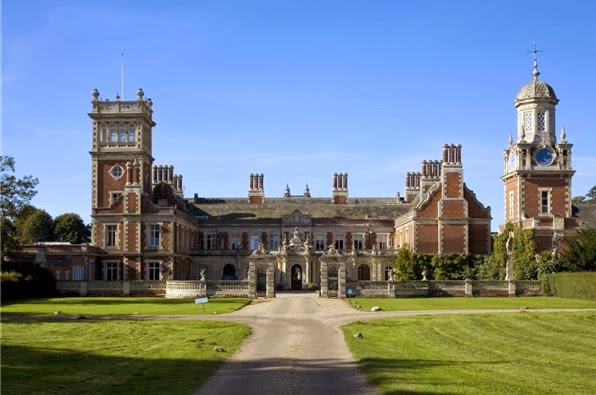
Somerleyton Hall, Suffolk


There has been a house on this site since at least 1240, but the house which the Allin family owned was built in the early 17th century by John Wentworth (d. 1618) or his son, Sir John Wentworth (d. 1651). It was a red brick house of considerable size, with a west-facing thirteen-bay main front dominated by the shaped gables over the projecting end units and a projecting two-storey porch, and two long wings running out to the east, forming a courtyard open to the east.  Although the appearance of the house would suggest a date in the 1620s or later, it is known that work was in progress on creating an elaborate garden in 1619, so the house may have been complete by then.


Somerleyton Hall before the Victorian remodelling, from an old engraving.

The house was remodelled in the early 18th century and given giant pilasters on the main front, which are just visible in the engraving above.  Inside the present house there remain from the 18th century the panelling of the staircase hall, the doorcases in the dining room, and a north-west room with very bold and deeply moulded garlands over the fireplace and doorcases. 

From the beginning the house seems to have had a significant garden layout, recorded on a map of 1652 and in a written description by the surveyor Thomas Martin of 1663, as well as by contemporary commentators. There were four main garden areas in a line north of the house, each larger than the last. The smallest and closest to the house was the square Great Garden, with a typical geometric layout with paths running from the middle of each side to a circular central feature. On the north side it had a raised terraced walk with banqueting houses at either end. Next came the larger but still roughly square North Orchard, with regularly planted fruit trees, which was presumably intended to be productive as well as ornamental. The third garden area was the Firrendale Yard, again square and larger, which was planted in 1612 with 256 fir trees arranged in regular rows either side of a central walk. By 1663 this had been largely flattened by a great wind, but Thomas Fuller, writing in 1662, was particularly impressed by the evergreen character of the trees, which, he said allowed "summer to be seen in the depth of winter". The most remarkable part of the garden, however, was the more irregularly shaped woodland to the north of the Firrendale Yard. This was not rigidly geometrical but was laid out with serpentine walks threading through the trees, an off-axis line of three fishponds (perhaps survivors from an earlier layout) with a grotto at one end, and seats and statues of people and beasts at intervals. Some of the statues were elevated on brick pillars, and a description by William Edge, who visited in 1619 while the garden was under construction, makes it clear that there was an iconographic programme to the sculpture. Edge also mentions waterworks in the garden, and another contemporary says Sir John Wentworth, having no children, "bestowed a great deale of cost in waterworkes, walks, woods and other delights", but the 1652 map betrays no sign of the waterworks, and all traces of the 17th century layout were removed in the 18th century.


Somerleyton Hall: garden front in 1995. Image: Nicholas Kingsley. Licenced under this Creative Commons licence

The present house is a remodelling and enlargement of the Jacobean house and one of the shaped gables is still visible near the Italianate tower. But to all external appearances, Somerleyton is now a Victorian house. This is due to Sir Samuel Morton Peto, the self-made building and railway contractor and MP, who transformed the house and gardens between 1844 and 1857, when the house was fully described in the Illustrated London News.  Peto got into financial difficulties shortly afterwards (he was bankrupted in 1866) and in 1863 the house was sold to a friend and fellow MP, Sir Francis Crossley, whose descendants still own it.  


Somerleyton Hall: entrance front in 2007.

The remodelling was carried out by John Thomas, a protégé of Charles Barry and the Prince of Wales, who was a sculptor and occasional architect, though his assistant Henry Parsons later claimed he did most of the work. Thomas made the courtyard side of the house the entrance front, refaced the house with new brickwork, added elaborately carved stone dressings overall, and created the colonnade with a single-storey projecting porch between the two existing wings, and the Italianate tower placed asymmetrically to the left. 


Somerleyton Hall: the side elevation and Italianate tower.
Image: Nicholas Kingsley. Licenced under this Creative Commons licence

The west-facing garden front is quieter and less Jacobean, except for the three-storey porch with superimposed orders of enriched columns, which is itself a reworking of the previous entrance porch. Inside and outside, the decoration, mainly loosely Jacobean in inspiration, and much of it carved by Thomas, is very luscious.  There is stained glass by Ballantyne of Edinburgh; carved oak in the library by Willcox of Warwick; built-in paintings by Landseer, Stanfield etc. in the dining hall (which was originally two-storeyed but has been subdivided); and marbling and graining by Moxon throughout.  The entrance hall has a glazed dome with stained glass of waterfowl found in the neighbourhood.


View of the house and grounds at Somerleyton Hall by Jonathan Myles-Lea
© J. Myles-Lea and reproduced by permission

When Samuel Peto turned his attention to creating new gardens in the mid 19th century, he again concentrated on the area north of the house, where John Thomas designed an enormous winter garden, a large fountain and other statuary, with a huge kitchen garden beyond. Sometime between 1854 and 1857, however, there was a radical redesign of the pleasure grounds: most of the statues were moved elsewhere in the grounds, the fountain was moved into the winter garden, the paths were made more serpentine and complex, and a large number of exotic specimen trees were planted. These changes may have been made under the direction of W.A. Nesfield, who is known to have created the balustraded terrace west of the house at this time, and the maze north of the kitchen garden. 


Somerleyton Hall: aerial view of the maze
The terrace originally provided the setting for elaborate box parterres, which were however grassed over in the early 20th century. Another casualty of the 20th century was the winter garden, which is now open to the sky, with only the external walls remaining. Despite these losses, the house, with its elaborate gardens, long ranges of Paxton-roofed hothouses, maze, aviary, outbuildings and model village remain a powerful evocation of the mansion of a great Victorian plutocrat.

Descent: sold 1604 to John Wentworth (d. 1618/19); to son, Sir John Wentworth (d. 1651), kt; to widow, Anne, Lady Wentworth (d. 1663); to nephew, John Garneys; to son, Thomas Garneys, who sold 1672 to Admiral Sir Thomas Allin (1612-85), 1st bt.; to son, Sir Thomas Allin (d. 1696), 2nd bt.; to nephew, Sir Richard Anguish (later Allin) of Moulton (d. 1725), 1st bt.; to son, Sir Thomas Allin (d. 1764), 2nd bt.; to brother, Rev. Sir Ashurst Allin (d. 1779), 3rd bt.; to son, Sir Thomas Allin (d. 1794), 4th bt.; to kinsman, Thomas Anguish (d. 1810); to brother, Rev. George Anguish (d. 1843); to nephew, Lord Sydney Godolphin Osborne, who sold 1844 to Sir Morton Peto, kt., who remodelled the house; sold to Sir Francis Crossley (1817-72), 1st bt.; to son, Sir Savile Brinton Crossley (1857-1935), 2nd bt. and 1st Baron Somerleyton; to son, Francis Savile Crossley (1889-1959), 2nd Baron Somerleyton; to son, Savile William Francis Crossley (b. 1928), 3rd Baron Somerleyton.


Allin family of Somerleyton, baronets


Sir Thomas Allin, 1st bt.
by Sir Peter Lely
Allin, Admiral Sir Thomas (1612-85), kt. and 1st bt. Only son of Robert Allin (d. 1613) and his wife Alice, baptised 8 November 1612. One of the most active and successful naval commanders of the Second Dutch War. A merchant-shipowner of Lowestoft, he led a Royalist rising in the town in 1643, after which he had to escape to Holland and turned to privateering in the Royalist interest; he later served as captain of a frigate under Prince Rupert. He served in the Royalist fleet until he was sunk off Cartagena in 1650. He was then court-martialled by his own side for cowardice, but escaped before sentence was passed. In 1653 he was captured and imprisoned by the Cromwellian regime in London, and his house near Lowestoft (Olderings House) was sold. At the Restoration he returned to favour and was regarded as one of the most reliable officers by Charles II, from whom he received a succession of commands. It was his attack on the Dutch Smyrna fleet of Cadiz in December 1664 which sparked off the Second Dutch War, during which he served with distinction. He was promoted to Admiral, and knighted, 24 September 1665; and his service afloat ended with two expeditions to the Mediterranean, 1668-9, in which he imposed terms upon the Barbary states. He had been at sea almost continuously for ten years, and had held eleven commissions as a captain since 1660. He later served as Comptroller of the Navy, 1671-80; captain of Sandgate Castle; and master of Trinity House, 1671-72; and was created a baronet, 7th February 1673. He stood for Parliament in the Dunwich constituency (which his son later represented) in 1669, but the disputed outcome was decided in favour of his opponent by the elections committee of Parliament. As a prominent Navy official, Allin features in Samuel Pepys' diaries, and Pepys records his cheerful admission that he loved 'to get and to save' money. He married 1st, 8 July 1635 at Redisham (Suffolk), Rebecca, daughter of Capt. William Whiting RN of Lowestoft (Suffolk) and 2nd, 1682, Elizabeth (b. 1645), daughter of Thomas Anguish of Moulton (Norfolk), who was the sister of his son-in-law, and had issue:
(1.1) Anne Allin (c.1637-64); died unmarried, 31 May 1664;
(1.2) Alice Allin (later Anguish) (1642-98) (q.v.);
(1.3) Sir Thomas Allin (c.1651-1696), 2nd bt. (q.v.);
His house near Lowestoft, Olderings, was sequestered and sold under the Commonwealth. He purchased a number of estates in Lothingland in the late 17th century, of which the main elements were the Blundeston Hall estate (including Ashby, Carlton Colville and Fritton) bought from John Tasburgh in 1668; the Somerleyton Hall estate bought from Thomas Garneys in 1672; and the manors of Lound and Gorleston, bought in 1679.
He was buried at Somerleyton, 5 October 1685; his will was proved in the PCC, 6 October 1685. His widow's date of death is unknown.

Allin, Sir Thomas (c.1651-96), 2nd bt. Son of Adm. Sir Thomas Allin (1613-85), 1st bt., and his first wife Alice, daughter of Capt. Whiting RN of Lowestoft, born about 1651. JP for Suffolk, 1677-88, 1689-94 and DL 1680-94; commissioner for assessment in Suffolk, 1677-80, 1689-90 and in Dunwich 1679-80, 1689-90; freeman of Dunwich, 1678; Tory MP for Dunwich, 1678-79, 1689; alderman of Southwold (Suffolk), 1684-88; Gentleman of the Privy Chamber, 1691-96. A supporter of the Court party, he accepted the Revolution, and was even given a place at Court under King William III, but he was one of the Tory magistrates removed from the Suffolk bench in 1694. He married, about December 1672, Mary (d. 1699), daughter of Thomas Colwall of London, scrivener, but had no issue.
He inherited the Somerleyton Hall estate from his father in 1685. At his death, the estate passed to his nephew, Richard Anguish (later Allin).
He died in October 1696, when the baronetcy became extinct. His widow died in September 1699.

Anguish (né Allin), Alice (1642-98). Younger and only surviving daughter of Adm. Sir Thomas Allin (1612-85), 1st bt., and his first wife Alice, daughter of Capt. Whiting RN of Lowestoft, born 14 July 1642. She married, 11 June 1663, Edmund Anguish (1637-99) of Moulton (Norfolk) and had issue:
(1) Thomas Anguish (b. 1664), born 12 March 1663/4 and baptised 22 June 1664;
(2) Allin Anguish (b. 1665), born 29 June and baptised 6 July 1665; educated at Corpus Christi College, Cambridge (admitted 1681);
(3) Parthenia Anguish (b. 1667), born 15 August and baptised 22 August 1667.
(4) Sir Richard Anguish (later Allin) (c.1669-1725), 1st bt. (q.v.);
(5) Edmund Anguish (1672-1708); baptised 30 April 1672; married, 29 December 1698, Mary Betts and had issue two sons and three daughters; died 1708;
She died 28 November 1698.

Allin (né Anguish), Sir Richard (c.1669-1725), 1st bt. Eldest surviving son of Edmund Anguish and his wife Alice, daughter of Adm. Sir Thomas Allin (1610-85), 1st bt, born about 1669 in London. Educated at Great Yarmouth and St John's College, Cambridge (admitted 30 April 1685, aged 15); farmer of the customs at Great Yarmouth, 1685-1709; Whig MP for Dunwich, 1709-10; High Sheriff of Suffolk, 1702; freeman of Dunwich (Suffolk), 1709. Changed his name to Allin on inheriting the Somerleyton estate, 1696, and was created a baronet, 14 December 1699. By 1710 his debts totalled some £11,775, over £3,600 of which was due to the Treasury as part of the arrears owed by Samuel Pacy, a former receiver-general for Suffolk, for whom Allin had stood surety. In June 1710 and again at the end of the year he petitioned for time to pay, ‘by reason he is only tenant for life and therefore can raise no money’, a consequence of his marriage settlement, and eventually he was obliged to obtain in 1711 a private Act to enable him to sell off part of his estate. He married, 30 September 1699 in Chapel Royal, Whitehall, London, Frances (c.1680-1743), only daughter of Sir Henry Ashurst, 1st bt. of Waterstock (Oxon) and had issue:
(1) Diana Allin (1700-86); married, 8 June 1718, Thomas Henry Ashhurst (1672-1744) of Waterstock (Oxon) and had issue three sons and five daughters; died 27 November 1786;
(2) Sir Thomas Allin (1702-1764), 2nd bt. (q.v.);
(3) Henry Allin (1703-37); died unmarried;
(4) Richard Allin (b. 1704); born 27 November and baptised 5 December 1704; died unmarried in the lifetime of his father;
(5) Rev. Sir Ashurst Allin (1708-70), 3rd bt. (q.v.);
(6) William Allin; died unmarried in the lifetime of his father.
He inherited the Somerleyton Hall estate from his uncle in October 1696 and added to it a freehold property at Blundeston shortly after 1700, but sold portions of the lands at Blundeston about 1712 to pay off his debts.
He died 19 October 1725. His widow died 23 June 1743.

Allin, Sir Thomas (1702-64), 2nd bt. Eldest son of Sir Richard Allin (c.1669-1725), 1st bt. and his wife Frances, daughter of Sir Henry Ashurst, bt. of Waterstock (Oxon), born 7 and baptised 12 May 1702. Land waiter for the port of London c.1722-29. High Sheriff of Suffolk, 1730. Serjeant-at-arms to the Treasury, 1733. He was unmarried and without issue.
He inherited the Somerleyton Hall estate from his father in 1725.
He died 11 August 1764.

Allin, Rev. Sir Ashurst (1708-70), 3rd bt. Youngest son of Sir Richard Allin (d. 1725), 1st bt. and his wife Frances, daughter of Sir Henry Ashurst, bt. of Waterstock (Oxon), born 14 July and baptised 4 August 1708. Educated at Christ Church, Oxford (matriculated 1727; BA 1731) and Emmanuel College, Cambridge (MA 1739). Rector of Blundeston-cum-Flixton (Suffolk) and Somerleyton, 1732-70. He married Thomasine, daughter of Col. Playters and widow of [forename unknown] Norris and had issue:
(1) Frances Allin (fl. 1770), of Blundeston; died unmarried;
(2) Sir Thomas Allin (d. 1794), 4th bt. (q.v.).
He inherited the Somerleyton Hall estate from his eldest brother in 1764. At his death part of the Blundeston estate passed to his daughter, whose executors sold it to Sir Nicholas Bacon of Raveningham (Norfolk); the remainder of the estate passed to his son.
He died 6 November 1770.

Allin, Sir Thomas (d. 1794), 4th bt. Only son of Rev. Sir Ashurst Allin (d. 1770), 3rd bt. Educated at Norwich and Gonville & Caius College, Cambridge (admitted, 1757). Became a lunatic. He was unmarried and without issue.
He inherited the Somerleyton Hall estate from his father in 1770.  At his death his estates passed to his kinsman, Thomas Anguish (d. 1810), great-grandson of the younger brother of the 1st bt. of the second creation.
He died 30 April 1794 and was buried at Somerleyton; the baronetcy then became extinct.


Sources


Burke's Extinct and Dormant Baronetcies, 2nd edn, 1841, pp. 4-5; M. Girouard, The Victorian country house, 2nd edn., 1979, pp. 420-21; J. Kenworthy-Browne et al., Burke’s & Savill’s Guide to Country Houses: vol. 3, East Anglia, 1981, p.262; T. Williamson, Suffolk's Gardens and Parks, 2000, pp. 16-19, 129-40; http://www.oxforddnb.com/view/article/403?docPos=4.


Location of archives


Allin family of Blundeston and Somerleyton: deeds, estate papers and manorial records, 14th-18th cents. [Suffolk Record Office, Lowestoft, HB6, HA236]; deeds and estate papers, 17th-19th cents. [Suffolk Record Office, Lowestoft, 749]
Allin, Admiral Sir Thomas (1613-85), 1st bt: correspondence and papers, 1655-68 [Bodleian Library, Oxford, MS. Tanner]. His journals, 1660-78, have been published by the Navy Records Society, 1939-40.


Coat of arms


Gules, a cinquefoil pierced or.

Revision
This account was first published 15 February 2014 and was revised 12th October 2014 and 13th February 2016.

Sunday, 9 February 2014

(108) Allhusen of Elswick Hall, Stoke Court and Bradenham Hall

Allhusen of Stoke Court
Christian Allhusen (1806-90) was the son of a merchant at Kiel (then in Denmark), and came to England in 1825. He settled at Newcastle-on-Tyne and joined his elder brother (who had come to England a couple of years earlier) in business as corn merchants there. In 1832 he branched out on his own, and was so successful that he was able to diversify his interests in several directions. His most successful venture was the establishment of the Newcastle Chemical Works at Gateshead in 1840, which earned him a fortune, so that he died in 1890 a millionaire, at a time when such riches were so rare that the term had only just been invented. Christian became a naturalised Englishman in 1835, around the time of his marriage. He had four sons, all of whom appear to have been dragged into the family businesses for at least a period. Two of them, Frederick (d. 1866) and Henry Christian (d. 1871) died relatively young; the other two seem to have abandoned day-to-day involvement in the business as soon as possible after their father died.  Christian Wilton Allhusen (1840-1924) bought the Pinhay estate near Lyme Regis from the Ames family in 1892 and William Hutt Allhusen (1845-1923) rented the first of several sporting and residential estates in Britain and South Africa at about the same time.  


Pinhay House, Lyme Regis

Christian Allhusen himself first acquired a country estate - albeit on the edge of Newcastle - as early as 1842, when he leased Elswick Hall (see below) from the Newcastle property developer, Robert Grainger. He later bought the freehold, and lived there until 1872. He seems then to have scaled back his direct involvement in business and bought Stoke Court (see below) at Stoke Poges in Buckinghamshire as a retirement home.  He originally wished to give Elswick Hall to Newcastle Corporation as a public park, but was dissuaded by his family (who apparently did not realise how rich he was and how easily he could afford this philanthropic gesture); instead he arranged for a consortium of leading citizens to buy the estate from him and donate it to the City.

Stoke Court passed at his death in 1890 to his grandson, (Augustus) Henry Eden Allhusen (1867-1925), who had been brought up by his widowed mother in comparatively straightened circumstances, but given a public school and university education. His handsome appearance and good manners brought him an advantageous marriage into the Stanley family, with its ramifying social and political connections, and his and talents as an extempore orator soon led him to be elected as Conservative MP for Salisbury, 1897-1900 and for Hackney, 1900-06. He and his wife made Stoke Court a fashionable weekending house, and further extended it to the designs of Blow & Billeray, probably in about 1905. Henry’s wife was a cousin of Sir Winston Churchill’s wife, Clementine, and the visitors’ book reflects how the rich and famous were entertained at Stoke Court. Apart from great politicians of the day the Allhusens’ guests included important writers such as Thomas Hardy, John Buchan, Somerset Maugham and John Galsworthy.  Henry's only son having died four years before his father, in 1922, Stoke Court was sold after Henry's death.

Henry's brother, Frederick Henry Allhusen (1872-1957) was the first member of the family to take up a military career, although there is evidence that many of them, including his own father, would have preferred it to a life in business. Christian Allhusen tried to tie him into the business, in which he was left shares, conditionally on his being employed by the company at the age of 21, but by the time he reached that age the company had been reconstructed and his right to the shares was denied. So Frederick abandoned the company and secured a commission in the 9th Lancers in 1893; finally retiring as a Lt-Colonel after the end of the First World War. In 1921 he bought Fulmer House in Buckinghamshire, near to his brother's estate at Stoke Court and lived there until his death in 1957, after which it was sold. His two elder sons both bought estates in Norfolk. The elder, Dick Allhusen (1910-98) bought West Bradenham Hall (see below) in 1951, which has now descended to his son, Christian Henry Allhusen (b. 1956).  The younger, Derek Swithin Allhusen (1914-2000), who became a successful Olympic equestrian at the 1968 games, bought Claxton Manor House.

Claxton Manor House, 2009. Cropped from an image by Evelyn Simak. Licenced under this Creative Commons licence.


Elswick Hall alias Elswick Lodge, Newcastle-on-Tyne, Northumberland


Elswick Hall. Image: Matthew Beckett

The estate was formed by the Jennison family, who made their first purchase of land at Elswick in 1640, but nothing is known of the first Elswick Hall, which was rebuilt in 1803 by William & John Stokoe of Newcastle for John Hodgson III. As rebuilt, the house consisted of a five bay, three-storey centre with a pediment set against the attic carried on giant Ionic columns, and lower two-bay two-storey wings. This house was later extended to the left. When Christian Allhusen decided to sell the house and estate in 1872, it was initially put on the market as building plots, but a number of prominent Newcastle merchants clubbed together, bought the estate, and presented it to the City Council for use as a public park. It was opened as a park in 1881, with the house being used initially for a display of the work of local sculptor, J.G. Lough (1798-1876), the designer of the Stephenson Monument in Newcastle. Later, as happened all too frequently, the City Council abandoned the Hall, and it was eventually demolished about 1977-80 and a swimming pool constructed on the site. At the same time, the park was refurbished and reopened in the year of its centenary as a public park.

Descent: estate fromed by Sir Ralph Jennison (1613-170o/1) from 1640; to his great-grandson, Ralph Jennison (d. 1735) sold c.1720 to John Hodgson (d. 1749); to son, John Hodgson II (d. 1781); to son, John Hodgson III (d. 1820), who rebuilt the house in 1803; to son, John Hodgson IV (1806-69), who sold 1839 to Richard Grainger; leased and later sold 1842 to Christian Allhusen; sold 1872 to a consortium which presented it to Newcastle City Council.


Stoke Court, Stoke Poges, Buckinghamshire


Stoke Court: the house before it was extended by Blow & Billeray. Image: Historic England.

The house is first recorded as a "compact box of red brick with sash windows" called West End House, which was the home of the poet Thomas Gray's mother and her sisters, and where he used to stay. Whilst there he wrote his famous ‘Elegy Written in a Country Churchyard’ and ‘Ode on a Distant Prospect of Eton’. Although sometimes referred to as a cottage, the house was grand enough to have a grotto of flints and shellwork in the garden at this time. After the death of his mother and aunts, Thomas Gray gave up the lease in 1758. 

The house was modernised after a period of abandonment about 1784 and altered for Henry Wilmer around 1830, and although in 1842 it was said to be “now a place of some pretension to elegance” it remained fairly modest in size. In 1844 it was bought by Granville John Penn, who was downsizing from the Manor House; he refaced and enlarged it about 1845 in the Tudor-Gothic style, adding the chimneys, altering the windows and raising the roof.  It was further extended in 1873 and (by Blow & Billeray) in the early 20th century in the same manner, resulting in a vast rambling irregular house with gables and big octagonal bays. 


Stoke Court: east front in the 1950s. The pierced balustrade around the top of the tall canted bay was not reinstated after the fire in 1979. Image: Historic England.
The house was sold and the estate broken up in 1927. The house remained a private dwelling for only another year, becoming Stoke Court Country Club in 1928. By the 1950s it had reached the nadir of its fortunes when it was used for storing television sets. Demolition seemed inevitable but in 1959 the house was rescued by its new owners, Miles Laboratories, who carried out a comprehensive refurbishment of the house and grounds. The house was gutted by fire in 1979 but the main (south and east) facades were restored afterwards by C.B.M. Smith & Partners, architects. No attempt was made to reinstate the appearance of the north and west sides, which are straightforwardly utilitarian elevations of reddish brown brick, and there are no surviving interiors of interest. The house has remained in commercial occupation as laboratories, offices and a training centre since the 1950s.


"Gray's Summerhouse", probably built in the 1780s,
photographed in 1899 by H.C. Shelley.
The grounds of the house extended up the hill to the north, and a path known as 'Gray's Walk' follows a circuit round the edge of a meadow which occupies the main area of the grounds. This may have existed as early as 1719 - before Gray's time - when a walk is mentioned in a lease.  A summerhouse (inevitably, Gray's Summerhouse) existed at the highest point of the walk in the 19th century, and was perhaps constructed by Capt. Salter, the late 18th century owner. The grounds were enlarged in 1812 and 1832 when highways were diverted to allow expansion, and were much improved by the Darbys and the Allhusens, who planted formal gardens south-west of the house, created a small lake, and planted a maze near the summerhouse in 1893; both maze and summerhouse have now disappeared without trace.

Descent: Elliot Salter (fl. 1721-39), who let the house 1739-58 to Jonathan & Anna Rogers and later to Anna Rogers (d. 1758) and her sister Dorothy Gray (d. 1753); to Capt. Elliott Salter (d. 1790)... sold 1828 to Henry Wilmer; sold 1844 to Granville John Penn; sold 1851 to Abraham Darby IV (1804-78); sold 1872 to Christian Allhusen (1806-90); to grandson, Augustus Henry Eden Allhusen; sold 1927 and again 1928 when it became a Country Club...sold 1958 to Miles Laboratories, later part of the Bayer Group; sold c.2010 to Comer Group.


West Bradenham Hall, Norfolk (aka Bradenham Hall)


Bradenham Hall: the main south front in 2012. Image: Ultra Panavision via Flickr

A handsome red brick double pile house, probably built about 1766 for James Smythe. It has a five bay south front with giant pilasters framing the end bays and supporting the central three-bay pediment. The entrance was moved from the south to the north side in 1819 and some consequent changes were made to the interior layout, including the relocation of the staircase. A new doorway was made in a small extension added to the east side of the house in the 1930s, and the doorcase comes from a house in Tombland, Norwich. A three-bay wing was added on the west side in 1936, and there were further additions to the north in 1956. The gardens have been entirely created since 1953. The house was the childhood home of the novelist, Sir Henry Rider Haggard (1856-1925), and is also said to have been the inspiration for 'Brandham Hall' in L.P. Hartley's novel, The Go-Between (although the film version was set at Melton Constable).

Descent: sold 1753 to James Smythe (d. 1800); to son, Rev. Edward Smith (d. 1805); to widow, who sold 1818/19 to William Henry Haggard (1757-1837); to son, William Haggard (1783-1843); to son, William Meybohm Rider Haggard (1817-93) who let the Hall; to son, Sir William Henry Doveton Haggard (1846-1926); sold 1917/18 to Alexander Penrose (1896-1950); sold 1951 to Richard Christian Allhusen (1910-98); to son, Christian Henry Allhusen (b. 1956).


Allhusen family of Stoke Court


Allhusen, Christian Augustus Henry (1806-90), of Elswick Hall (Northbld) and Stoke Court. Fourth son of Carl Christian Friedrich Allhusen, born at Kiel (then Denmark), 2 December 1806. Emigrated to England, 31 March 1825, and was naturalised by private Act of Parliament, 12 June 1835; in business with his elder brother as a corn merchant at Newcastle, 1827-32; and then independently; active in the movement for the repeal of the Corn Laws in 1840s; purchased Attwood's Chemical Works at Gateshead, 1845 and established Newcastle Chemical Works Co. Ltd, of which he remained Chairman until his death; he was also involved in the Consett Ironworks and the Newcastle & Gateshead Waterworks Co; Chairman of Newcastle Chamber of Commerce; interested himself in various European tariff reform movements and developing Free Trade; member of Gateshead Borough Council, 1849-58. DL for Newcastle-on-Tyne; JP for Durham and Buckinghamshire. He married, 9 March 1835, Anne (c.1813-89), daughter of John Shield of Broomhaugh (Northbld) and had issue:
(1) Henry Christian Allhusen (1835-71) (q.v.);
(2) Emily Allhusen (1837-1924); married 1st, 1860, Lt. S. Hall of 12th Regt. and had issue; married 2nd, 1872, Rev. Marsden Gibson (d. 1901) and had further issue; died 13 January 1924; will proved 22 February 1924 (estate £2,481);
(3) Frederic Buschek Ehrenberg Allhusen (1838-66), born 3 June 1838; Captain in 1st battn., 15th Foot; married, 1864, Isabella, daughter of W. Wright, Judge-Advocate-General of New Brunswick and had issue one daughter; died 11 July 1866; will proved 4 September 1866 (estate under £2,000);
(4) Annie Allhusen (1839-1935); married 1st, 1866, Robert Laycock MP (d. 1881) of Wiseton Hall (Notts) and had issue; married 2nd, 6 December 1887, Lord D'Arcy Godolphin Osborne (d. 1895), third son of 8th Duke of Leeds; died 9 February 1935; will proved 17 May 1935 (estate £15,563);
(5) (Christian) Wilton Allhusen (1840-1924), of Pinhay (Dorset), born 24 December 1840; chemical manufacturer; married, 7 January 1874, Adelaide (d. 1936), daughter of Maj. Thomas Pakenham Vandeleur of Belfield (Limerick) and had issue four sons and five daughters; bought Pinhay estate in 1892; died 19 December 1924; will proved 20 February 1925 (estate £136,234);
(6) Julia Allhusen (1842-1924), a nun; died 13 January 1924;
(7) William Hutt Allhusen (1845-1923), born 16 September 1845; educated at Cheltenham College and St John's (later Magdalene) College, Cambridge (admitted 1865); merchant; married, 1876, Beatrice May (d. 1918), daughter of Col. Thomas Bromhead Butt; by 1905 lived at various times in rented properties in Cape Colony (South Africa), Tullymet House (Perthshire), Twyford Abbey (Middx) and Isola Bella, Cannes (France); died 25 August 1923; will proved 13 November 1923 (estate £47,163);
(8) Blanche Alicia Allhusen (1847-1929); married, 9 June 1873, Capt. Henry Badeley (d. 1881) of Guy Harlings (Essex) and had issue (including Henry Badeley, 1st Baron Badeley, who was Clerk of the Parliaments, 1934-49); died 23 December 1929; will proved 15 January 1930 (estate £7,957);
(9) Mary Henrietta Allhusen (1849-1937); married 26 May 1870, Maj-Gen. Thomas Lloyd (d. 1921) of Beechmount (Limerick) and had issue; died 25 October 1937; will proved 14 February 1938 (estate £53,859);
(10) Alice Edith Allhusen (1854-1930); married 1 November 1882, Edward Horatio Nevile JP (d. 1934) of Skellingthorpe (Lincs) and had issue; died 27 August 1930; will proved 2 December 1930 (estate £4,414);
(11) Helena Allhusen (1858-1937); married 28 July 1880, Capt. Edward Hugh Rowley Hibbert (d. 1927) of 20th Regt., son of Leicester Hibbert of Crofton Grange; died 17 December 1937; will proved 24 February 1938 (estate £11,606).
He rented and later purchased Elswick Hall from 1842 and lived there until 1872 when he purchased Stoke Court in Buckinghamshire and sold Elswick to a consortium which presented it to Newcastle corporation as a public park.
He died 12/13 January 1890 and his will was proved 28 February 1890 (estate £1,126,852). His wife died 20 September 1889.


H.C. Allhusen in 1862
by Camille Silvy
Allhusen, Lt-Col. Henry Christian (1835-71). Eldest son of Christian Augustus Henry Allhusen (1806-90) of Elsick Hall and Stoke Court, and his wife Anne, daughter of John Shield of Broomhaugh (Northbld), born 30 December 1835. Educated at Repton School, Antwerp and Kings College, London. Employed in his father's chemical works. Captain in Northumberland Artillery Militia, 1854-60; Lt-Colonel of Newcastle Artillery Volunteer Corps, 1860-71. Member of Gateshead School Board, 1870-71. He married, 22 November 1866, Elizabeth Alice (1841-1924), daughter of Thomas Eden of Norton Hall (Glos) and had issue:
(1) Augustus Henry Eden Allhusen (1867-1925) (q.v.);
(2) Lt-Col. Frederick Henry Allhusen (1872-1957) (q.v.);
(3) Margaret Colmore Allhusen (1868-1949); married, 20 August 1891, Col. Lionel Henry Hanbury CMG VD (d. 1954), elder son of George Hanbury of Blythswood (Bucks) and had issue; died 3 March 1949; will proved 5 September 1949 (estate £2,678);
(4) Mary Millard Allhusen (1870-1943); married, 9 January 1900, Capt. the Hon. Edward Oliphant Murray (killed in South African War, 1901), younger son of 1st Viscount Elibank and had issue; died 6 December 1943; will proved 24 April 1944 (estate £25,488).
He lived at Park House, Gateshead, after his marriage. After his death his widow lived at 46 Lansdown Crescent, Cheltenham (Glos).
He died after a short illness, 7 September 1871 and was buried at Elswick Cemetery, Newcastle. His widow was granted administration of his goods (estate under £1,500) and died 3 September 1924; her will was proved 7 November 1924 (estate £5,312).

Allhusen, Augustus Henry Eden (1867-1925) of Stoke Court. Elder son of Henry Christian Allhusen (1835-71) and his wife Elizabeth Alice, daughter of Thomas Eden of Norton Hall (Glos), born 20 August 1867. Educated at Cheltenham and Trinity College, Cambridge (BA 1890); Lieutenant in Royal Buckinghamshire Hussars; Conservative MP for Salisbury 1897-1900 and for Hackney, 1900-06; Asst. Private Secretary to the Secretary of State for India, 1905; DL and JP for Buckinghamshire and member of the County Council and Slough Board of Guardians; High Sheriff of Buckinghamshire, 1913; Chairman of Royal Surgical Aid Society. 1921-24 and of Boodle's Club, 1922-25. He married, 21 July 1896, Mary Dorothy Osma (1877-1965), younger daughter and co-heir of Col. the Hon. John Constantine Stanley, and had issue:
(1) Henry Christian Stanley Allhusen (1899-1922), born 21 November and baptised 21 December 1899; educated at Eton and Trinity College, Cambridge; always 'delicate', he died unmarried, 2 March 1922; will proved 19 May 1922 (estate £251,105);
(2) Helena Madeleine Mary Allhusen (1897-1982), born 17 May 1897; married 1st, 14 October 1922, Lt-Cmdr. Sir Geoffrey Cecil Congreve RN (1897-1941), 1st bt., son of General Sir Walter Norris Congreve, VC and had issue three daughters; married 2nd, 21 October 1942, Reginald James Tyler (later Stewart-Mackenzie) (d. 1956), youngest son of Maj-Gen. Charles James Tyler; she and her husband assumed name of Stewart-Mackenzie in 1944 on inheriting the Brahan estate from Hon. Francis Alan Stewart-Mackenzie of Seaforth; died 27 July 1982; buried at Stoke Poges;
(3) Dorothea Elizabeth Allhusen (1903-26), born 4 September 1903; died unmarried, 29 January 1926; will proved 13 March 1926 (estate £86,491).
He inherited Stoke Court from his grandfather in 1890, and remodelled it to the designs of Blow & Billeray. The house was sold after his death, and his widow lived latterly at Shalbourne House (Wilts).
He died 2 May 1925; his will was proved 8 July 1925 (estate £85,481). His widow died 6 October 1965; her will was proved 3 February 1966 (estate £44,528).

Allhusen, Lt-Col. Frederick Henry (1872-1957) of Fulmer House. Second son of Henry Christian Allhusen (1835-71) and his wife Elizabeth Alice, daughter of Thomas Eden of Norton Hall (Glos), born 24 January 1872. Educated at Cheltenham College. Lieutenant in Northumberland Artillery Militia, 1891-93; entered the army, 1893; served with 9th Lancers in India and the South African War, 1899-1900 (despatches, Queen's Medal); returned wounded and was on half-pay, 1901-03; adjutant of Derbyshire Yeomanry, 1903-07; retired 1907; Brigade-Major of Highland Mounted Brigade (TA), 1908-12; served again with the same unit in WW1 in Gallipoli and Egypt, 1914-16; Quartermaster General, Home Defence, 1916-17 and Asst. Director of Forestry, France, 1917-18; retired as Lt-Colonel, 1919 (DSO 1916; CMG 1918); Chairman & Managing Director of the Eno Company, 1921-c.1930. JP for Dorset, 1915; High Sheriff of Buckinghamshire, 1932-33; member of Buckinghamshire County Council, 1934-49. He had always been a keen sportsman, writing in his autobiography "The finest life in the world is that of the man who is both soldier and sportsman".  He enjoyed big game shooting in India and South Africa in his youth, and later deer stalking and salmon fishing at home; he rode to hounds until his marriage.  He married, 15 July 1908, Enid (1887-1948), elder daughter of Cmdr. Harold Swithinbank of Denham Court (Bucks), and had issue:
(1) Lt-Col. Richard Christian Allhusen (1910-98) (q.v.);
(2) Maj. Derek Swithin Allhusen CVO (1914-2000) of Claxton Manor House (Norfolk), born 9 January 1914; educated at Eton, Chillon College, Montreux and Trinity College, Cambridge (MA); served in the army, 1935-49 with 9th Lancers (Lt., 1935; Capt., 1940; Maj., 1942); farmer, horse-breeder and Olympic equestrian; High Sheriff of Norfolk, 1958; member of HM Bodyguard, Hon. Corps of Gentlemen-at-Arms, 1963-84 (Standard Bearer, 1981-84); President of British Horse Society, 1986-88; DL for Norfolk, 1969; married, 28 April 1937, Hon. Claudia Violet (1917-2009), younger daughter of Henry Betterton (1872-1949), 1st Baron Rushcliffe, and had issue two sons and one daughter; died 24 April 2000;
(3) Frederick Eden Allhusen MC (1917-41), born 26 February 1917; educated at Eton and Trinity College, Cambridge; joined the army, 1938 and served with 15th/19th Kings Royal Hussars (Capt., 1940); died on active service, 16 June 1941; will proved 19 September 1941 (estate £104,214).
He purchased Fulmer House in 1921, which was sold after his death.
He died 13 January 1957; his will was proved 14 May 1957 (estate £60,731). His wife died 23 December 1948; her will was proved 7 March 1949 (estate £201,930).

Allhusen, Lt-Col. Richard Christian (1910-98) of (West) Bradenham Hall. Elder son of Lt-Col. Frederick Henry Allhusen (1872-1957) and his wife Enid, elder daughter of Cmdr. Harold Swithinbank, born 16 March 1910. Educated at Eton and Trinity College, Cambridge (MA). Served in WW2 in Lovat Scouts; Staff College, Camberley; and 21st Army Group HQ. Landowner and farmer. He married, 25 June 1950, (Evelyn) Jane (b. 1917), only daughter of Lt-Col. Sir Richard Henry Chenevix-Trench CIE OBE and had issue:
(1) Elizabeth Mary Allhusen (b. 1952), born 10 March 1952; married, 1977, William P. Durlacher, son of Jack Durlacher, and had issue two daughters
(2) Rosalind Jane Allhusen (b. 1954), born 9 July 1954; married, 25 April 1985, Nicholas Charles Thoresby Pawson (b. 1952), son of K.V.F. Pawson, and had issue two daughters;
(3) Christian Henry Allhusen (b. 1956) (q.v.); 
(4) Richard Frederick Allhusen (b. 1960), born 13 June 1960; married, 1989 (div.), Katrina Jane (b. c1963), daughter of Ian R.P. Haig and had issue two sons.
He purchased Bradenham Hall (Norfolk) in 1951, with the manors of Bradenham, East Bradenham and Huntingfield.
He died 2 August 1998. 

Allhusen, Christian Henry (b. 1956) of (West) Bradenham Hall. Elder son of Lt-Col. Richard Christian Allhusen (1910-98) and his wife (Evelyn) Jane, daughter of Lt-Col. Sir Richard Henry Chenevix Trench, born 17 July 1956. He married, 31 October 1986, Penelope Amanda (known as Panda) (b. 1959), daughter of Colin G.C. Rae, and had issue:
(1) Benjamin Christian Thomas Allhusen (b. 1989), born 17 May 1989;
(2) Matthew John Oliver Allhusen (b. 1991), born 28 November 1991;
(3) Natasha Sophie Tasmin Allhusen (b. 1993), born 4 November 1993;
(4) Sabrina Isabella India Allhusen (b. 1996), born 9 September 1996.
He inherited Bradenham Hall from his father in 1998.
Now living.


Sources


G. Burton & F. Allhusen, Some records of the Allhusen family of Newcastle-upon-Tyne and Stoke Court, 1925; Burke's Landed Gentry, 1965, pp. 13-14; Sir N. Pevsner, I. Richmond et al., The buildings of England: Northumberland, 2nd edn., 1992, p. 516; Sir N. Pevsner & E. Williamson, The buildings of England: Buckinghamshire, 2nd edn., 1994, p. 658; T. Faulkner & P. Lowery, Lost houses of Newcastle and Northumberland, 1996, pp. 17-18; Sir N. Pevsner & B. Wilson, The buildings of England: Norfolk - North-West and South, 2nd edn., 1999, p. 763; South Buckinghamshire District Council, West End Conservation Area: Character Appraisal, 2011, pp. 16-26; P. Dallas, R. Last and T. Williamson, Norfolk gardens and designed landscapes, 2013, pp. 416-18.


Location of archives


No significant archive is known to survive.


Coat of arms


Barry of six or and azure, four fleurs-de-lis, two and two counterchanged.

Revision and acknowledgements

This post was first published 9 February 2014 and was updated 2 January and 14 October 2017 and 30 October 2019..