Wednesday, 8 November 2023

(562) Bennett of North Cadbury Court and Sparkford Hall

Bennett of Cadbury and Sparkford 
The first of this family to achieve landed gentry status was James Bennett (1746-1815), a London wine merchant and grocer, who in 1792 invested some of his capital in the purchase of the reversion of the Cadbury House estate in Somerset. This meant that on the death of the current owner, which occurred in 1796, he came into possession of the estate, which consisted of most of the parishes of North and South Cadbury and Sparkford. It is a little surprising that James, who remained a partner in his London business until his death, chose to purchase an estate so far from the capital, but his use of the same coat of arms as the Bennetts of Widcombe Manor (with a crescent for difference) suggests that he may have wished to purchase a property in the area from which his forebears had come: the Widcombe family had long owned property at Maperton and around Wincanton, only a few miles from North Cadbury. Having acquired the estate, James invested in the improvement of Cadbury House, which was given a new garden front with a two-storey semi-circular bow. Very little is known about James' business, which was continued after his death by his partners, Henry Coape and Joseph Jellicoe, but it had obviously generated serious wealth, for the probate valuation of James' estate was £125,000. £50,000 of this was capital still invested in the partnership, and James' will gave his partners several years to release this to his executors.

James Bennett (1746-1815) and his family 
by Samuel Woodforde. Image: Tate Gallery. Some rights reserved.
James left two sons and four daughters, two of whom were married and had been provided for under their marriage settlements. His younger daughters were left portions payable from his personal estate, and his real estate was divided between the two sons. The elder, James Bennett (1792-1872), was left Cadbury House and the portion of the estate in North and South Cadbury, while the younger, Henry Bennett (1795-1874) was left the part of the estate in Sparkford, which did not have a house of any consequence but provided a useful income. At the time of his inheritance the younger James was an officer in the army, but he retired on half-pay in 1816 (when the army was being slimmed down after the defeat of Napoleon), and returned to Somerset to manage his estates. He and his wife produced five sons and two daughters, but his eldest son died in India while serving with the army, so the Cadbury estate descended to his second son, Frederick Wentworth Bennett (1827-81). He had a short career in the army too, but retired in 1850. Little is known about his career in the next twenty years, but after he inherited the Cadbury estate he indulged a taste for amateur dramatics and put on performances at Cadbury House for the entertainment of his tenants and neighbours, in which his two sons also took part. His elder son, Frederick James Wentworth Bennett (1856-1908) was noted more for his prowess as a composer and musician than as an actor, but he continued the tradition of entertainments at Cadbury, building a concert hall on the estate in the 1880s for these performances, and involving professional musicians as well as musically-talented neighbours. All went well until about 1890 when - perhaps as a result of the agricultural depression - he found that he could no longer afford to live at Cadbury House or to sustain the lifestyle of a gentleman. He resigned his commission in the Somerset Yeomanry Cavalry and leased out Cadbury House, and went to study at the Royal Academy of Music, presumably with a view to becoming a professional composer. By 1901 he was living with his wife and children in a suburban house in Bedford, but soon afterwards his wife left him on the grounds of his cruelty and adultery, and in 1906 they were divorced and she was granted custody of their children. F.J.W. Bennett then moved to Bournemouth with a mistress whom he passed off as his wife, but she too left him after many rows in 1908, taking most of their household furniture with her. By then he is said to have been an habitual drug user, and he died a couple of months later of an overdose. Press reports of the inquest into his death give the strong impression that the coroner who conducted it found the sordid descent of a gentleman of property into such circumstances unspeakably embarrassing, and prevented the full story being told in court; but happily the press had no such scruples and sought out the witnesses whom the court did not admit, and published the full story. The Cadbury estate was sold as soon as possible after his death, in 1910.

Henry Bennett (1795-1874), who inherited Sparkford at the tender age of 20, went to Cambridge and then travelled extensively on the continent with his mother. While they were in St Petersburg (Russia) he fell in love with Emily Moberly, the daughter of the British consul there, and they were married in 1821, before he returned to England and (reputedly at his father-in-law's request) took his degree and entered the church. For about ten years, he and his wife travelled around Europe to cities where he acted as Anglican chaplain to the British ex-pat community and visitors. This agreeable lifestyle took them to St Petersburg, Dresden, Genoa and Naples, and probably other places as well, but in 1836 the opportunity arose for Henry to appoint himself rector of South Cadbury and Sparkford, where the family owned the right of presentation. They lived in the rectory at South Cadbury and presumably employed a curate at Sparkford. In 1853, however, Henry built a new manor house at Sparkford and moved there. In 1866 he relinquished the living at South Cadbury and appointed one of his younger sons, the Rev. James Arthur Bennett (1835-90) in his place, but he remained rector of Sparkford until his death.

Henry and Emily had a remarkable total of fifteen children between 1822 and 1845 (who in turn gave him at least seventy grandchildren!), only one of whom died in infancy -  a considerable achievement when infant mortality was so high. Of the seven sons who survived to maturity, two (James and Charles) followed their father into the church and became the rectors of South Cadbury and Sparkford. James, at South Cadbury, became a noted antiquarian, and was one of the founders of the Somerset Record Society. Several of the daughters also married clergymen, one of whom rose to be Dean of St Paul's Cathedral. Of the other sons, William became a solicitor; Edward and George were civil servants (in Australia and England respectively) and Francis became a merchant in St Petersburg, like his maternal grandfather. The eldest son, Henry Edward Bennett (1822-97), who inherited the Sparkford Hall estate, was a barrister-at-law and a company director. In the 1850s he spent several years in Canada, where he met and married his wife Louisa, the daughter of the chief justice in Toronto. When H.E. Bennett died, he left the Sparkford estate to his seven surviving children jointly, and the property was let until the 1930s, when the remaining children agreed to sell it. Of the three sons who lived to maturity, the eldest became a solicitor in Frome (Som.) and Clerk of the Peace for Somerset, before retiring in 1905 and moving to Canada. The two younger sons both became distinguished clergymen. The Very Rev. Frank Selwyn Macaulay Bennett (1866-1947) was dean of Chester Cathedral between the First and Second World Wars and played an important role in ensuring English cathedrals were open to visitors, free of charge.

North Cadbury Court (aka Cadbury House), Somerset

The manor house, now known as North Cadbury Court but formerly as Cadbury House and The Manor House, is essentially a late 16th century U-plan Elizabethan stone mansion of two and a half storeys, although its west wing incorporates the roof (dated by dendrochronology to the years around 1300) and no doubt some of the fabric of its medieval predecessor. The house was evidently rebuilt between 1586 and 1592 for Sir Francis Hastings MP, a puritan pamphleteer and the brother of the 3rd Earl of Huntingdon, although Collinson's History of Somerset mentions a date of 1581 (perhaps a misreading of 1587) over one of the doors in the great hall. 

North Cadbury Court: late 17th century painting of the entrance front and church, showing the gatehouse demolished c.1715. 
Image: Matt Bristow © University of London.

North Cadbury Court: late 17th century painting of the garden front, showing the Tudor stair tower and gabled projecting wings.
Image: Matt Bristow © University of London
Two paintings, probably late 17th century overmantel panels in origin, that were returned to the house in the late 20th century, show the two main facades as they stood before later alterations. One shows the north front with the forecourt and two-storey gatehouse demolished in the first changes, made c.1715 for Francis Newman. The second painting shows the less regular south front overlooking an elaborate walled garden; this side was greatly altered in a radical, remodelling that was probably carried out by James Bennett (d. 1815) after he gained possession of the house in 1797. There was a careful restoration by Melville Seth-Ward in 1912-16 for Sir Archibald Langman, who also carried out alterations in the 1930s. The house was used as an evacuee nursery during the Second World War, and was a YMCA training centre between 1948 and 1966, before being returned to private occupation.

North Cadbury Court: entrance front in the early 20th century. Image: Historic England BB55/2934
The entirely Elizabethan north (entrance) front is of six bays and two storeys and attics, under four gables which do not align exactly with the bays below. The house is very similar in design to the five-bay Newton Surmaville House (Som.), built some twenty years later, which must have been modelled on North Cadbury but which is a slightly more sophisticated design. It is fenestrated with eight-light double-transomed windows to the outer bays and four-light transomed windows to the two central bays which contain the great hall. The second bay contains a porch projection, the fifth a balancing bay window lighting the dais end of the hall, both with classical cresting. Two shallow wings project to the south, and are unusual in being L-plan, making the south front two bays wider at either end than the entrance front. Any Elizabethan fabric in the south front is masked by the remodelling of c.1800, when the gap between the wings was infilled with a bow-fronted saloon and the facade was given plain sash windows and parapets concealing tiled roofs and dormers. The form of the roofs was further altered in 1914 to create a more unified, Georgian effect.

North Cadbury Court: garden front in the mid 20th century.
The Elizabethan plan was conventional in having a central two-storey great hall, perhaps reflecting the footprint of the medieval hall range, but the present hall is a neo-Elizabethan re-creation of 1912-16. At its high end, the windows of the two-storey bay contain original armorial glass showing the Hastings family connections. A substantial polygonal stair turret, which projected south from the hall at the high end and was lit by a window from the hall, was removed when the saloon was constructed c.1800. The service rooms lay to the east of the hall, the parlours and great chamber to the west. The great chamber has a 16th century fireplace, but the ribbed plaster ceiling looks like a 20th century re-creation. A long gallery (now subdivided), ran along the north front above the hall and great chamber, necessitating some resetting of the medieval roof timbers. A generously planned new staircase was inserted into the north end of the west wing in the 20th century, destroying any evidence of previous arrangements in this area. The ceiling above it has a huge plaster pendant copied from that at Chelvey Court (Som.). West of the staircase hall is an apsidal late 18th century cantilevered stone staircase, which was the main stair until 1914. The saloon in the centre of the south front, which was opened up through a screen of columns to the corridor behind in the early 20th century restoration, has an Adamish triglyph frieze with paterae and a yellow marble chimneypiece. Two early Georgian rooms have fielded panelling and bolection-moulded doorways. 

North Cadbury Court: the house and its setting as depicted on the 1st edn 25" plan of 1886.
In 1715, Francis Newman demolished the two-storey gatehouse which had faced the north front of the house, and replaced it with a pair of square Doulting stone ashlar gate piers. A late 17th century pair of gatepiers had already been constructed further north, and between the two and adjoining the churchyard to the west, he built an eleven-bay two-storey stable block of ashlar with re-used 17th century door heads. A concert hall was built north-west of the house before 1886, and fishponds were adapted as part of a woodland garden to the south-west, but unusually there seems no evidence of the grounds being landscaped in the 18th or early 19th centuries.

Descent: Mary, Lady Hungerford, Hastings, Botreaux and Moleyns, later wife of Sir Richard Sacheverell (d. 1534); to son, George Hastings (d. 1545), 1st Earl of Huntingdon; to son, Francis Hastings (1514-61), 2nd Earl of Huntingdon; to widow, Katherine (d. 1570) and then to son, Henry Hastings (c.1536-95), 3rd Earl of Huntingdon, who sold 1586 to brother, Sir Francis Hastings, who rebuilt the house; sold 1596 to Matthew Ewans (d. 1598) and his wife Frances (d. c.1611), later wife of Francis Kelway (d. 1602); to son, Alexander Ewans (d. c.1624); to son, Matthew Ewans (d. 1628); to son, Matthew Ewans (d. 1633); sold after his death to Arthur Duck (d. 1648); to daughters, Martha and Mary (d. by 1683), wife of William Harbord; to daughters Mary (d. 1684/5), Margaret and Grace, who all sold their shares by 1689 to Richard Newman, who settled the reunited estate on his son, Francis Holles Newman (d. 1714); to son, Francis Newman (d. 1768); to nephew, Francis Newman (d. 1796), whose heir, Francis Newman (d. 1818) sold the reversion of the manor in 1792 to James Bennett (1746-1815) and his wife Mary (1762-1853); to son, James Bennett (1792-1872); to son, Frederick Wentworth Bennett (1827-81); to son, Frederick Bennett (1856-1908); sold 1910 to Sir Archibald Langman (1872-1949), 2nd bt.; to widow, Eleanor, Lady Langman (1878-1963) and then to daughter Nora Elizabeth Ferrar (1919-2010), wife of John Archibald Montgomery (1912-90); to son, Archibald John Montgomery (b. 1957).

Sparkford Hall, Somerset

From the 17th century until 1815, the manor of Sparkford was attached to the North Cadbury Court estate and had no separate manor house. James Bennett (1746-1815), by his will, separated the two properties and bequeathed Sparkford to his younger son, the Rev. Henry Bennett (1795-1874), who after spending many years acting as a Protestant chaplain around Europe, settled back in Somerset. In 1853 he built, on a previously unoccupied site, a new square manor house of pale golden-grey Doulting stone, which has a three-bay entrance front and four-bay side and rear elevations. A large extension of two storeys and attics was added to the north side later in the 19th century as a service wing. 

Sparkford Hall: entrance front.

Sparkford Hall: the side and rear elevations.
The plain elevations are enlivened by an unusually deep stone cornice, and have wooden cross-windows on the ground floor and square four-pane sash windows on the first-floor, all set in moulded stone architraves. The window to the right of the front door was blocked up at some point and there is an intrusive asymmetrically-placed chimneystack rising between the porch and the windows to its right.
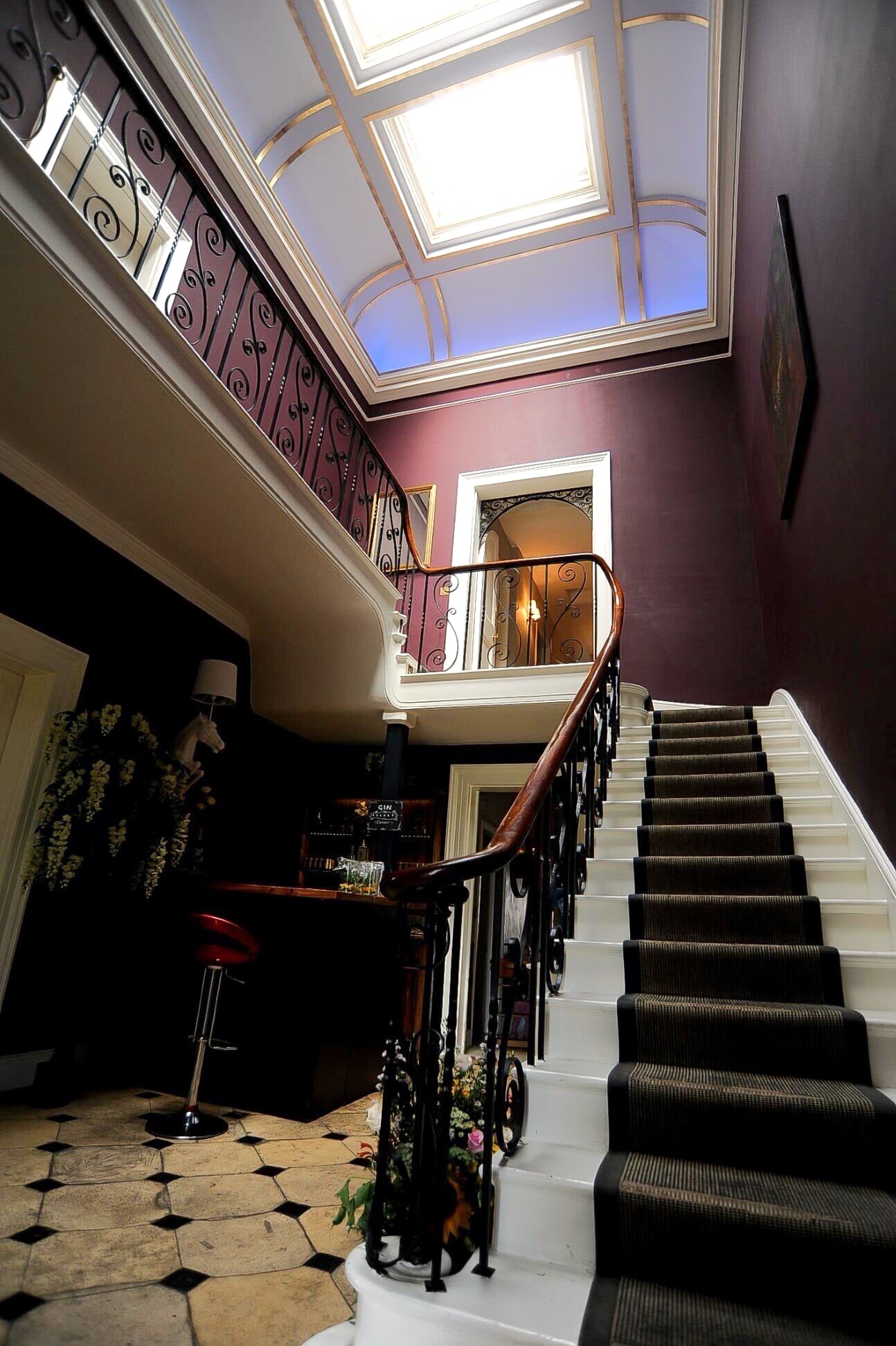
Sparkford Hall: staircase hall
The interiors are correspondingly simple, with decoration concentrated on the staircase hall in the centre of the house, where the staircase has a cast iron balustrade and rises under a coved ceiling with two large skylights in it to a first-floor balcony with a similar balustrade. The drawing room and dining room along the east front have the simplest possible cornices and can be thrown into one room for entertaining purposes. The library, in the north-west corner of the house, has bookcases recessed into the panelling. 
The grounds were landscaped at the time the house was built, and were described as having 'a park-like appearance' in the late 19th century, something which remains true today. The house has recently been available for private rental as a holiday house and for parties, but appears to have ceased trading in 2023.
Descent: built for Rev. Henry Bennett (1795-1874); to son, Henry Edward Bennett (1822-97), who left it jointly to his nine children, who let it and the survivors sold 1936 to Mrs. W.M. Watson; sold to Col. Aylmer (fl. 1947); sold to Brig. Edwyn Sandys Dawes Martin (b. 1895; fl. 1954); sold 1955 to Mr Stead Henry Stead-Ellis (1911-95)...


Bennett family of North Cadbury Court


Bennett, James (1746-1815). Son of James Bennett of London, citizen and salter, and his wife Elizabeth, baptised at Old Jewry Presbyterian Church, London, 30 September 1746. Apprenticed to his father, 1760. Wine merchant and grocer in London by 1766, latterly trading as Bennett, Coape & Jellicoe; the business was continued after his death as Coape & Jellicoe and he may have been largely a sleeping partner after moving to Somerset, although his will shows that he still had some £50,000 invested in the business at the time of his death. High Sheriff of Somerset, 1799-1800. He married, 14 August 1789 at Truro (Cornw.), Mary (1762-1853), daughter of Thomas Clutterbuck of Marazion (Cornw.), and had issue:
(1) Mary Bennett (1790-1867), born 1 November and baptised at St Gabriel, Fenchurch St., London, 24 November 1790; married, 6 July 1808 at Horsington (Som.), Rev. Thomas Wickham (1774-1855), of Horsington (Som.) and had issue four daughters; died at Weston-super-Mare (Som.), 12 December 1867; will proved 10 January 1868 (effects under £1,500);
(2) Eliza Bennett (1791-1873), born 8 November and baptised at St Gabriel, Fenchurch St., London, 1 December 1791; married, 13 September 1812 at North Cadbury, Capt. James Clarke (1788-1845) of Salcombe Regis (Devon), son of James Clarke of Ansford (Som.), and had issue two sons and six daughters; died 28 February and was buried at Bathwick (Som.), 5 March 1873;
(3) James Bennett (1792-1872) (q.v.);
(4) Rev. Henry Bennett (1795-1874) [for whom see below, Bennett family of Sparkford Hall];
(5) Juliana Sarah Bennett (1796-1878), born 26 December 1796 and baptised at St George, Bloomsbury, 28? March 1797; married, 8 August 1820 at St Marylebone (Middx), Charles Aaron Moody MP (1792-1867), son of Aaron Moody of Kingsdon (Som.), but had no issue; lived latterly at Chesterfield House, Tunbridge Wells (Kent), where she died 23 December 1878; will proved 12 April 1879 (effects under £45,000);
(6) Frances Anna Bennett (1799-1846), born 17 May and baptised at St George, Bloomsbury, 12 June 1799; married, 3 April 1827 at Bathwick (Som.), Rev. Richard Hill (1799-1880), rector of Timsbury (Som.), 1841-80; died Oct-Dec 1846; administration of goods granted in the PCC, July 1847 and a further grant was made 11 May 1881.
He purchased the reversion of the North Cadbury Court (aka Cadbury House) estate in 1792 and came into possession in 1796.
He died 8 January 1815 and was buried at North Cadbury, 18 January 1815, where he is commemorated by a funerary monument signed by Thomas Ashton of London; his will was proved in the PCC, 3 March 1815 (effects under £125,000). His widow died 14 June 1853 and was buried at North Cadbury.

Bennett, James (1792-1872). Elder son of James Bennett (1746-1815) and his wife Mary, daughter of Thomas Clutterbuck of Marazion (Cornw.), born 7 October 1792. An officer in the 14th Light Dragoons (Cornet, 1812; Lt., 1813; retired on half-pay 1816) and North Somerset Yeomanry Cavalry (Lt-Col.). JP for Somerset; High Sheriff of Somerset, 1836-37. He married, 11 January 1821 at Shepton Mallet (Som.), Annabella (1798-1878), daughter of Rev. William Provis Wickham (1767-1843) of Charlton House (Som.), and had issue:
(1) Annabella Mary Bennett (1823-81), baptised at North Cadbury, 16 May 1823; married, 5 August 1852 at West Lydford (Som.), Frederic George Urquhart (1829-81), son of Rev. Frederick Urquhart of Broadmayne (Dorset), and had issue one daughter; died 24 January 1881; will proved 12 March 1881 (effects under £800);
(2) James Wentworth Bennett (1824-49), baptised at North Cadbury, 11 July 1824; an officer in the army (Cornet, 1846; Lt. 1847); died 27 February 1849 and was buried at St John, Calcutta (India), the following day;
(3) Frederick Wentworth Bennett (1827-81) (q.v.);
(4) Charles Wentworth Bennett (1828-80), baptised at North Cadbury, 3 June 1828; lived at Pluckley (Kent); married, 15 April 1859 at Leith (Midl.), Mary Ann (1832-62), daughter of George Ellerton High of Leith, but had no issue; died 7 November 1880; will proved 9 September 1883 (effects £3,003);
(5) Edward Wentworth Bennett (1832-86), born 18 January and baptised at North Cadbury, 8 February 1832; an officer in the army (Ensign, 1850); then in the 2nd Somerset Militia (Ensign, 1854) and then in the army again (Ensign, 1855; retired 1858); died unmarried in London, 19 January 1886;
(6) Arthur Provis Wentworth Bennett (1834-73), born 11 October and baptised at North Cadbury, 26 October 1834; an officer in the Hertfordshire militia (Ensign, 1855); died unmarried, 27 April and was buried at North Cadbury, 3 May 1873; administration of goods granted 25 July 1873 (effects under £1,000); 
(7) Emma Bennett (1839-1908), baptised at North Cadbury, 11 May 1839; married 1st, 23 April 1861 at St Thomas, Portman Sq., Westminster (Middx) (div. 1882 on grounds of his cruelty and adultery), Capt. Gordon Stonhouse Hughes (1837-1901), son of Gen. Samuel Hughes, and had issue four sons and one daughter; married 2nd, 27 July 1885 at St Luke, Kentish Town (Middx), Reginald William Urquhart (1837-1910), son of Rev. Frederick Urquhart of Broadmayne (Dorset); died 8 December and was buried at Bexhill-on-Sea (Sussex), 11 December 1908; administration of goods granted 15 January 1909 (estate £273).
He inherited North Cadbury Court from his father in 1815.
He died 29 October 1872; his will was proved 22 January 1873 (effects under £30,000). His widow died 15 October 1878; her will was proved 7 December 1878 (effects under £1,500).

Bennett, Frederick Wentworth (1827-81). Second, but eldest surviving, son of James Bennett (1792-1872) and his wife Annabella, baptised at North Cadbury, 26 March 1827. Educated at Sherborne School. An officer in the army (Cornet, 1844; Lt., 1846; Capt., 1850; retired on half-pay, 1850). JP for Somerset (by 1860). He was interested in amateur dramatics, and organised occasional performances at North Cadbury for his tenants and neighbours. He married, 24 March 1855 at Sherborne (Dorset), Catherine Eliza (1827-75), only surviving child of John Croft of Wick, Brislington (Som.), and had issue:
(1) Frederick James Wentworth Bennett (1856-1908) (q.v.);
(2) Croft Charles Wentworth Bennett (1858-82), born 14 November 1858 and baptised at North Cadbury, 30 January 1859; an officer in the 1st Royal Lanarkshire Militia (2nd Lt., 1878); amateur artist and actor; died unmarried of typhoid fever at Lane's Hotel, London, 21 July 1882, and was buried at North Cadbury; administration of goods granted to his brother, 31 August 1882 (effects £1,325).
He inherited North Cadbury Court from his father in 1872, but sold some land in 1877.
He died 2 August 1881; his will was proved 3 August 1882 (effects £10,597). His wife died 5 July 1875; administration of her goods was granted to her husband, 25 April 1876 (effects under £200).

Bennett, Frederick James Wentworth (1856-1908). Son of Frederick Wentworth Bennett (1827-81) and his wife Catherine Eliza, daughter of John Croft of Sherborne (Dorset), born 21 May and baptised at North Cadbury, 22 June 1856. An officer in the army (Lt., 1875; retired 1881) and North Somerset Yeomanry Cavalry (Lt., 1882; Capt., 1886; ret. 1890). JP for Somerset, 1882. A Fellow of the Royal Astronomical Society. He was a noted amateur composer and musician, chiefly performing on the flute and cornet, and in 1882 he built a concert hall at North Cadbury at which he arranged concerts 'with the finest talent he could obtain'. After letting North Cadbury Court, he studied at the Royal Academy of Music. After his divorce in 1906 he set up home in a newly-built suburban villa in Bournemouth, with a lady who was understood to be his wife, but who was in reality a mistress, with whom he quarrelled repeatedly; she left him about two months before his death, taking most of the household furniture with her. In his last weeks he left alone, with no staff and only a few articles of furniture. He married, 12 June 1884 at Compton Pauncefoote (Som.) (sep. 1903; div. 1906 on grounds of his cruelty and adultery), Eleanor Catherine (1862-1944), daughter of Rev. James Senior, rector of Compton Pauncefoote, and had issue:
(1) Francis Montagu Wentworth Bennett (1885-1957), born 6 January 1885; died unmarried, 12 February 1957; will proved 10 May 1957 (estate £2,565);
(2) Victor Cyril Wentworth Bennett (1887-1918), born 4 June 1887; an officer in the merchant navy (second mate, 1908) and in the army in the First World War (2nd Lt., 1916; Lt., 1917); died of pneumonia, 13 October 1918 and was buried at Faenza Military Cemetery, Ravenna (Italy); administration of goods granted 22 May 1919 (estate £638);
(3) Una Violet Wentworth Bennett (1890-1970), born 18 January and baptised at St Stephen, South Kensington (Middx), 20 February 1890; married 1st, 7 September 1911 at St Stephen, South Kensington (div.), Percy Douglas Saxton (1883-1950), son of George Shadwell Saxton of the Ceylon Civil Service, and 2nd, Apr-Jun 1922, Maj. Frank James; died 27 August 1970; will proved 19 March 1971 (estate £10,014);
(4) Ivan Provis Wentworth Bennett (1891-1916), born 4 February and baptised at Compton Pauncefoote, 29 March 1891; educated at Wellington College; articled clerk to a solicitor; an officer in the army (Capt.); died on active service in France, 13 July 1916; administration of goods granted to his mother, 18 October 1916 (effects £308);
(5) Vere Dorothy Wentworth Bennett (1896-1973), born 1 November 1896; married, 24 February 1926 at All Souls, Langham Place, St Marylebone (Middx), Arthur Loraine Claude Fuller (1890-1958), private secretary, son of Henry Claude Fuller; died 2 December 1973; will proved 27 February 1974 (estate £25,257).
He inherited North Cadbury Court from his father in 1881, but let the house from 1890. Following his death, the estate was sold in 1910.
He was reputed to be an habitual drug user, and died of narcotic poisoning at his house in Bournemouth, on or about 21 June 1908 and was buried at North Cadbury; administration of his goods was granted 14 October 1908 (estate £13,080). His ex-wife died 22 May 1944 and was buried at North Cadbury; her will was proved 26 October 1944 (estate £1,056).

Bennett family of Sparkford Hall


Bennett, Rev. Henry (1795-1874). Younger son of James Bennett (1746-1815) and his wife Mary, daughter of Thomas Clutterbuck of Marazion (Cornw.), born in London, 30 October 1795 and baptised at St George, Bloomsbury (Middx), 1 January 1796. Educated at Eton and Trinity College, Cambridge (matriculated 1815; LLB 1822). He travelled in Europe with his mother c.1820. Ordained deacon, 1822 and priest, 1823. Rector of South Cadbury (Som.), 1836-66 and Sparkford, 1836-74. He married, 16 July 1821 at the British chaplaincy in St Petersburg (Russia), Emily (1800-82), daughter of Edward Moberly, British consul in St. Petersburg, and had issue:
(1) Henry Edward Bennett (1822-97) (q.v.);
(2) Emily Sarah Bennett (1823-97), born 22 December 1823; married, 28 April 1846 at Sparkford, Charles Crokat (c.1815-88), of Sydenham (Kent), merchant, and had issue four sons and ten daughters; died 28 February and was buried at Parkstone (Dorset), 4 March 1897; will proved 4 May 1897 (effects £10,094);
(3) Julia Ann Bennett (1825-1901), born at Queen Camel (Som.), 1825; died unmarried at Villa Benedetta, Alassio, Liguria (Italy), 18 April 1901; will proved 1 July 1901 (estate £113);
(4) Helen Frances Bennett (1826-1905), born in St Petersburg, 13 July and baptised at the British chaplaincy there, 8 August 1826; married, 5 July 1853 at Sparkford, Very Rev. Richard William Church (1815-90), rector of Whatley (Som.) and later dean of St Paul's Cathedral, son of John Dearman Church (1781-1828), wine merchant, and had issue one son and three daughters; died 10 May and was buried at Whatley (Som.), 15 May 1905; will proved 12 July 1905 (estate £24,440);
(5) William Henry Bennett (1827-1914), born at Dresden (Germany), 11 January 1827; educated at Winchester College; solicitor; married, 17 November 1860 at Surbiton (Surrey), Helen Charlotte (1834-1923), daughter of Charles John Shebbeare, barrister-at-law, and had issue six sons and three daughters; died 15 June 1914 and was buried at Putney Vale Cemetery (Surrey);
(6) Edward James Bennett (1829-1920), born in Genoa (Italy), 13 March 1829; educated at Winchester College; emigrated to Australia, 1850, and worked in the office of the Surveyor General of Queensland; married, 18 November 1851 at Echunga, South Australia, Anne (1824-96), daughter of Robert Gooding and had issue five sons and five daughters; died at Brisbane, Queensland, 14 August 1920, and was buried at Toowong Cemetery;
(7) Mary Isabel Bennett (1830-64), born in Naples (Italy), 1830; married, 22 September 1857 at Sparkford, Rev. James Baker (1825-97) of Croft (Yorks NR), son of Rev. James Baker, and had issue one son and four daughters; died at Winchester (Hants), 11 January 1864;
(8) George Bennett (1832-1913), born at Naples (Italy), 2 August and baptised at the British chaplaincy in Naples, 2 September 1832; educated at Winchester and New College, Oxford (matriculated 1851; SCL 1854; BA and MA 1858), where he rowed and played cricket for the University; Fellow of New College, Oxford, 1855-88; civil servant in department of woods and forests; married, 14 October 1882 at St Peter, Bayswater (Middx), Mary Grafton (1849-1916), daughter of Charles Moberly of St Petersburg (Russia), merchant, but had no issue; died 11 March 1913; will proved 19 April 1913 (estate £2,308);
(9) Arthur James Bennett (1833-34), born at Woolstone House near Wincanton (Som.), 27 October 1833 and baptised at South Cadbury, 5 January 1834; died in infancy and was buried at South Cadbury, 7 May 1834;
(10) Rev. James Arthur Bennett (1835-90), born 12 June and baptised at South Cadbury, 26 July 1835; educated at Winchester College and Durham University (BA 1856); ordained deacon, 1858, and priest, 1859; curate of Ellingham (Northbld), 1858-60 and Alvechurch (Worcs), 1860-66; rector of South Cadbury (Som.), 1866-90; a Fellow of the Society of Antiquaries of London, who acted as an inspecting officer for the Historical Manuscripts Commission, 1873-91, was Hon. Sec. of the Somerset Archaeological Society, and one of the founders of the Somerset Record Society; married, 21 June 1864 at Halton in Lonsdale (Lancs), Margaret (b. c.1831), daughter of Cdr. Thomas Benn RN, and had issue one son and one daughter; died 5 December and was buried at South Cadbury, 11 December 1890;
(11) Elizabeth Mary Bennett (1836-1922), baptised at South Cadbury, 23 October 1836; married, 11 July 1861 at Sparkford, Canon Charles Marcus Church (1823-1915), principal of Wells Theological College, sub-dean of Wells Cathedral, and antiquarian, son of John Dearman Church (1781-1828), wine merchant, and had issue three sons and five daughters; died 27 April 1922; will proved 20 May 1922 (estate £4,593);
(12) Susan Fanny Bennett (1838-73), born 26 February and baptised at South Cadbury, 7 May 1838; married, 31 January 1861 at Sparkford, Archibald Hamilton Grahame (1823-89) of Stirling, accountant, son of Thomas Grahame WS, and had issue three sons and five daughters; died in childbirth, 19 June 1873;
(13) Agnes Emily Bennett (1841-99), baptised at South Cadbury, 25 August 1841; died unmarried at Alassio, Liguria (Italy), 29 September 1899; will proved 29 December 1899 (effects £120);
(14) Francis Cayley Bennett (1842-1919), born 21 July 1842; educated at Winchester College; merchant with Messrs. Cattley & Co., St. Petersburg 1858-89 (partner 1867-89, retired 1889); married 1st, 1868, Mary (1845-96), daughter of William Blessig of St Petersburg, and 2nd, 3 August 1898 at All Saints, Maidstone (Kent), Helen Drayton, daughter of Frederic Hailey of Hanwell, and had issue one son; died 25 April 1919; will proved 16 July 1919 (estate £5,099);
(15) Rev. Charles William Bennett (1845-1934), born 26 May 1845; educated at Winchester College; ordained deacon, 1871 and priest, 1872; curate of Chesterton (Staffs), 1871-73 and Beaminster (Dorset), 1873-74; rector of Sparkford, 1874-99 and vicar of Pilton (Som.), 1899-1934; rural dean of Shepton Mallet (Som.), 1917-23; married, 26 May 1864 at Earley (Berks), Mary Anne (1840-1903), daughter of Thomas Grahame WS; died 6 March 1934; administration of goods granted 25 May 1934 (estate £2,277).
He inherited the manor of Sparkford from his father in 1815, and built a new manor house in 1853. He lived at South Cadbury rectory from 1836-53.
He died 1 September, and was buried at Sparkford, 5 September 1874; his will was proved 6 November 1874 (effects under £7,000). His widow died 12 September and was buried at Sparkford, 16 September 1882.

Bennett, Henry Edward (1822-97). Eldest son of Rev. Henry Bennett (1795-1874) and his wife Emily, daughter of Edward Moberly, British consul in St. Petersburg (Russia), born 10 September 1822 and baptised at North Cadbury, 3 January 1823. Educated at Winchester, St John's College, Cambridge (matriculated 1840) and the Inner Temple (admitted 1845; called 1848). Barrister-at-law. He was sworn in as a special constable during the Chartist riots, 1848, and was later an officer in the Somerset militia (Lt., 1868; Capt., 1872); JP for Somerset (by 1867). A director of the Albion Life Assurance Society (retired 1875) and other companies. He married, 26 November 1857 at Toronto Cathedral (Canada), Louisa Birchall (1834-92), daughter and co-heiress of Sir James Buchanan Macaulay, chief justice of Toronto, and had issue:
(1) Emily Louisa Bennett (1858-1937), born in Canada, 19 December 1858; married, 14 June 1900 at Sparkford, Rev. Trevor Griffiths (1871-1947), rector of Sparkford (Som.), but had no issue; died 14 September 1937 and was buried at Sparkford;
(2) Kate Adelaide Bennett (1860-66), born 13 December 1860; died young, 20 April and was buried at Sparkford, 28 April 1866;
(3) Harry Macaulay Bennett (1863-1920), born 7 February 1863; educated at Winchester and St John's College, Cambridge (matriculated 1881; BA 1884); admitted a solicitor, 1888 and practised at Frome (Som.); appointed Clerk of the Peace for Somerset and Clerk of Somerset County Council (retired 1905); emigrated to Canada, 1906; married, 7 November 1901 at Shepton Mallet (Som.), Evelyn (b. c.1866), third daughter of George Mackenzie Mackay of Shepton Mallet, and had issue two sons; died in Vancouver, 27 September 1920 and was buried at Mountain View Cemetery, Vancouver, British Columbia (Canada);
(4) James Buchanan Macaulay Bennett (b. & d. 1865), born 4 July and baptised at St Michael & All Angels, Paddington (Middx), 2 August 1865; died in infancy. 10 August 1865;
(5) Very Rev. Frank Selwyn Macaulay Bennett (1866-1947), born 28 October and baptised at Torquay (Devon), 28 December 1866; educated at Sherborne School and Keble College, Oxford (matriculated 1885; BA 1889; MA 1905); ordained deacon, 1892 and priest, 1894; secretary and chaplain to Bishop of Chester, 1892-97; curate of Eccleston (Ches.) and librarian to Duke of Westminster, 1895-97; vicar of Portwood (Ches), 1897-1907 and Christ Church, Chester, 1907-10; rector of Hawarden (Flints), 1910-20 and chaplain to Bishop of Chester, 1913-20; dean of Chester Cathedral, 1920-37, in which capacity he inspired and led a national movement to make cathedrals accessible to the general public 'without fence or fee', that is with long opening hours and free of charge; he was a freemason from 1911; author of M. Coué and his gospel of health (1924), A soul in the making (1925); The nature of a cathedral (1925), Expecto - an essay towards a biology of the world to come (1926) and The resurrection of the dead (1929), among other works; married, 15 November 1900 at Portwood (Ches.), Ida (1873-1951), third daughter of Clegg Livesey of Arden, Bredbury, and had issue four children, of whom one son survived infancy; died 14 November 1947 and was buried at Sparkford; will proved 30 January 1948 (estate £7,486);
(6) Mildred Rachel Bennett (1868-1954), born 11 June 1868; art lecturer and artist; apparently lived latterly with her cousin, Evelyn Mary Bennett (1864-1949) at Holmbury St Mary (Surrey); died unmarried, 22 February 1954; will proved 29 June 1954 (estate £446); 
(7) Edith Mary Bennett (1869-1946), born 13 October 1869; lived with her brother George and probably acted as his housekeeper; died unmarried, 2 February 1946, and was buried at Sparkford;
(8) Beatrice Marian Bennett (1871-1932); lived with her brother George; died unmarried, 30 October 1932, and was buried at Sparkford; will proved 6 December 1932 (estate £944);
(9) Rev. George Edward Macaulay Bennett (1873-1954), born 3 July 1873; ed. at Clifton College, Bristol and Lincoln College, Oxford (matriculated 1892; BA 1897; MA 1907), ordained deacon, 1898 and priest, 1899; vicar of Portwood (Ches.), 1907-11 and of Christ Church, Chester, 1911-34; rural dean of Chester, 1922-34; hon. canon of Chester Cathedral, 1927; vicar of Wilton (Som.), 1934-43; died unmarried, 30 May 1954 and was buried at Sparkford; will proved 29 July 1954 (estate £3,663).
He lived for some years in the 1850s in Upper Canada. He inherited Sparkford Hall from his father in 1874, but after his wife's death moved to a house in Chester. At his death Sparkford was left to his surviving children jointly.
He died 22 May and was buried at Sparkford, 26 May 1897; his will was proved 26 July 1897 (effects £2,278). His wife died 12 September and was buried at Sparkford, 17 September 1892.

Principal sources

Burke's Landed Gentry, 1925, p. 116; A.J. Jewers, 'Heraldry in the Manor House of North Cadbury, with the heraldry and monuments in the church', Proceedings of Somerset Archaeological and Natural History Soc., 1890, pp. 137-67; J. Orbach & Sir N. Pevsner, The buildings of England: Somerset - South and West, 2014, pp. 488-89; M. Siraut (ed.), VCH Somerset, vol. xi, 2015, pp. 66-70, 172-73.

Location of archives

Bennett family of North Cadbury Court and Sparkford Hall: deeds and papers, 1799-1878 [Dorset History Centre, D 148/12/62-67]

Coat of arms

Gules, a bezant between three demi-lions rampant argent, a crescent for difference.

Can you help?

  • Can anyone provide fuller information about the 20th and 21st century ownership of Sparkford Hall?
  • Can anyone provide photographs or portraits of the people whose names appear in bold above, for whom no image is currently shown?
  • If anyone can offer further information or corrections to any part of this article I should be most grateful. I am always particularly pleased to hear from current owners or the descendants of families associated with a property who can supply information from their own research or personal knowledge for inclusion.

Revision and acknowledgements

This post was first published 8 November 2023 and was updated 3 October 2024.

Tuesday, 31 October 2023

(561) Bennett of Faringdon House

Bennett of Faringdon
The Bennett family noticed here used the same coat of arms as the Earls of Tankerville, and the Bennets of Babraham, Widcombe and Tresillian, and they were presumably distantly related to them, although this branch of the family seem always to have spelled their name with two ts. The family can first be identified as landowners and farmers at Brokenborough and Westport St Mary near Malmesbury (Wilts) in the 18th century, when Daniel Bennett (c.1695-1779) evidently inherited the property from his wife's family. Their lands there descended to his son Giles Bennett (1721-95) and grandson, Giles Bailey Bennett (c.1768-1815). On the death of the latter they passed to Daniel Bennett (c.1760-1826) of Faringdon House (Berks), with whom the genealogy below begins. This Daniel was a grandson of Daniel (d. 1779) and the son of Thomas Bennett (c.1725-1800), a younger son of Daniel (d. 1779) who had moved to London and established a business as a brazier and ironmonger servicing the maritime industries at Wapping (Middx). After beginning his commercial life in the same trade as his father, Daniel (c.1760-1826) invested in the purchase of a vessel engaged in the South Sea whaling industry and built up a substantial business, owning fifteen vessels by 1796 and more than three times as many in the 1820s, when he was in partnership with his son. The firm was based in London, and from 1802 operated from Rotherhithe on the south bank of the Thames. The proceeds of his 
rather gruesome trade enabled Daniel to buy the Faringdon House estate in Berkshire in 1807, and to expand the property subsequently with additional lands at Faringdon and Eaton Hastings (Berks). He also bought a property called The Cliff at West Cowes (IoW), which he probably used as a holiday home. Daniel married three times, producing a daughter by his first marriage and a son by his second, but no other children. His daughter Sarah, who married young and was widowed in 1810, inherited his house at Cowes and one of the Wiltshire farms. His son and eventual partner, William Bennett (1790-1844), inherited the Faringdon House estate.

Vanbrugh House, Greenwich, which was William Bennett's home from 1819-27. The house was demolished in 1902.
William Bennett married in 1817 and settled soon afterwards at Mince Pie House (otherwise Vanbrugh House) at Greenwich, which had been built by Sir John Vanbrugh in 1722 for his brother Charles. The property was conveniently close to the family business in Rotherhithe, but in a select district, and several of his wife's relations also lived nearby. In 1826, William inherited his father's share of the whaling business and the Faringdon estate. He evidently put in hand some improvement works at Faringdon before moving in in 1827. Thereafter, he seems to have slowly run down the whaling business, replacing only some of the vessels that became unseaworthy. Latterly his younger sons, William (1826-48) and John Dunkin (1830-51) were named alongside him as vessel owners, but they would have been too young to be actively involved in the business. After he died in 1844 the five remaining vessels were sold to other owners. His eldest son, Daniel Bennett (1823-87), is not known to have been involved in the company at all and his career was very much the traditional one of a Victorian landed gentleman, with a short stint in the yeomanry followed by public and voluntary service. He inherited the Faringdon estate a few months before coming of age, and did not at first live in the house, but let it and occupied Sudbury House, Faringdon, which his father had acquired as a dower house.
Sudbury House, Faringdon, c.1825. The surviving right-hand part is now
part of an hotel. Image: Abingdon County Hall Museum  2007.500.22


Daniel married in 1847, but he and his wife seem to have struggled to have children, and after at least one stillbirth they produced an only daughter, Marianne Katherine Bennett (c.1858-1918), who suffered from learning difficulties from birth. When Daniel died in 1887 he left the Faringdon estate to his wife (d. 1897) for life and then to trustees for his daughter, who lived with a cousin as companion at Sudbury House. After Marianne died in 1918, both Faringdon House and Sudbury House were sold, but to different purchasers.


Faringdon House, Berkshire

The manor of Faringdon belonged to Beaulieu Abbey until the dissolution of the monasteries, and changed hands several times in the second half of the 16th century. In 1590, it was bought by Sir Henry Unton (d. 1596), the English Ambassador to France, who built a fine Elizabethan brick house between the site of the present building and the church. 

Faringdon House: the Elizabethan mansion built in the 1590s for Sir Henry Unton.
Only one drawing of this house, probably of the mid-to-late 17th century, is known to survive. It shows an irregular many gabled house, apparently consisting of a three-storey hall range with three-storey cross-wings. The windows were mainly plain mullioned windows, although the reception rooms in the right hand wing had larger mullioned and transomed windows. The roofscape was given variety by at least thirteen tall chimneys and ball finials on the gables. Sir Henry, who lived nearby at Wadley House, probably died before the house was finished, but it became the home of his widow, who lived here until her death in 1634. An inventory of 1620 mentions the hall, parlour and a great chamber hung with arras and adorned with pictures, but nothing more is known of the interiors. During the Civil War, the Parliamentarian soldier, Sir Robert Pye (c.1622-1701), who was the son of the then owner, was obliged to lay siege to Faringdon town and to attack his father's own house, which suffered considerable damage as a result.

On the death in 1766 of Henry Pye, who had been Tory MP for Berkshire for twenty years, the estate was found to be saddled with £50,000 of debt, and in the same year, the old Elizabethan house was badly damaged by fire. Rather than patch it up again, Henry James Pye decided to build a new house on a site slightly further north, on which work was begun about 1770; the architect is unknown. Perhaps because of the burden of debt on the estate, the new house was still not finished in 1785, by which time Pye was noted as a poet and dramatist, although critics have generally agreed that his appointment as poet laureate in 1790 was perhaps the weakest of all time (Sir Walter Scott waspishly remarked that Pye was eminently respectable in everything but his poetry). 

Faringdon House: entrance front

Faringdon House: garden front
The new house begun in 1770 has a south (entrance) front of five bays and two storeys over a basement, but is made memorable by the central bay, which rises to two and a half storeys and is framed by a giant blank arch surmounted by an open pediment - a motif derived from the works of Lord Burlington and his circle. In front of the central bay is a Doric porch with niches in the rusticated stonework to either side. To either side of the entrance front are rusticated stone doorways with open pediments, beyond which quadrant walls curve forward to enclose the courtyard, terminating in rusticated gatepiers. The north (garden) front is plainer, with just the first, third and fifth windows decorated by triangular pediments. On this side, the basement is hidden by a high balustraded terrace carried on five basket arches and reached by staircases at either end. Inside, the entrance hall is filled with a wooden staircase that rises in two flights and returns in one that flies across the hall to a landing carried on a Doric arcade. The main rooms have simple but elegant plasterwork, including a low-relief Rococo ceiling in the drawing room and a neo-classical plaster overmantel with an urn in the dining room. At the same time as the house was built, the setting was landscaped in a Brownian style, so that the south front has a pleasing prospect over the rolling Thamesside meadows.

Faringdon House: the entrance hall and staircase.

Faringdon House: the drawing room and sitting room along the garden front.

In 1919, the house was sold to Gerald Tyrwhitt-Wilson (1883-1950), 14th Baron Berners, the eccentric socialite, composer, artist, and bon viveur, who bought it initially for his mother and stepfather, Col. Ward Bennitt, who had been renting it since their marriage in 1908. Two years later he established the Berners Estate Co. to manage the property, since he lived abroad and had at that time no thought over ever living permanently in England. However, when his mother and Col. Ward Bennitt died within three weeks of one another in 1931, he decided to take over the house as his own home, while retaining his other homes in London and Rome. At about the same time, he met Robert Heber-Percy at a country house party at Vaynol (Flintshire). Robert, known with a mixture of affection and exasperation as 'the Mad Boy', was to become Gerald's life partner and heir. His high spirits, elegant appearance and uninhibited behaviour brought a spice to life at Faringdon which Gerald and his constant flow of guests found irresistible.
Faringdon House: dyed doves at a garden party in 1977.
Image: Mary Kingsley
The guests were notable: not just near neighbours like John and Penelope Betjeman from Uffington or Maurice Bowra from Oxford, but Sir Robert and Lady Diana Abdy, Frederick Ashton and Constance Lambert, Noel Coward, Cecil Beaton, the Princesse de Polignac, Gertrude Stein and Alice Toklas, Eva Schiaperelli, and the Marchesa Casati, who travelled everywhere with her python. Penelope Betjeman went riding with Robert Heber-Percy and liked to show off the character of her much-loved horse, Moti, by bringing him inside the house: a photograph of the white horse taking tea in the drawing room at Faringdon has become emblematic of the era. There were other jokes too: the pigeons in the dovecote were dyed pink and blue and green with non-toxic dyes (a tradition still maintained, at least until recently). An elderly parrot was trained to walk across the floor entirely covered by a bowler hat, which thus had the appearance of having acquired the power of independent motion. In 1935, a tall but plain folly tower was built on a hill on the far side of Faringdon town, to the designs of Gerald Wellesley. It was approached by a path between trees, to one of which was the memorable sign: "Please do not throw stones at this notice".

When Lord Berners died in 1950, the house and its contents were left to 'the Mad Boy', Robert Heber-Percy 
(1911-87), who maintained the contents and traditions of the house into the 1980s. He left the house to his granddaughter, the novelist Sofka Zinovieff (b. 1961), who never lived here on a permanent basis but let the house on short-term tenancies as a very grand holiday house. Her book about Faringdon and the family, The Mad Boy, Lord Berners, My Grandmother and Me, is a major source for this account. The house was sold in 2018, and regrettably a sale of many of the period contents followed.

Descent: sold 1590 to Sir Henry Unton (d. 1596); to widow, Lady Unton (d. 1634) and then to his nephew, Sir John Wentworth, who sold his reversionary interest in 1623 to Sir Robert Pye (c.1586-1662); to son, Sir Robert Pye (c.1622-1701); to son, Dr. Edmund Pye MD (c.1640-1705); to son, Henry Pye (1683-1749); to son, Henry Pye MP (1709-66); to son, Henry James Pye (1745-1813); sold before 1791 to William Hallett (1764-1842); sold 1807 to Daniel Bennett (1760-1826); to son, William Bennett (1790-1844); to son, Daniel Bennett (1823-87); to widow, Mary Elizabeth Bennett (d. 1897) and then to trustees for daughter, Marianne Katherine Bennett (1858-1918); sold 1919 to Gerald Tyrwhitt-Wilson (1883-1950), 14th Baron Berners; to partner, Robert Heber-Percy (1911-87); to granddaughter, Sofka Zinovieff (b. 1961); sold 2018 to Charles Kenneth Crossley-Cooke (b. 1967). The house was let in the mid 19th century; and again (to Col. & Mrs. Ward Bennitt) from 1908.

Bennett family of Faringdon House


Daniel Bennett (1760-1826) 
Image: Faringdon Library
Bennett, Daniel (c.1760-1826).
Son of Thomas Bennett (c.1725-1800) of Wapping (Middx), ironmonger and brazier, and his wife Elizabeth Chambers (b. c.1727), and a grandson of Daniel Bennett of Westport St Mary (Wilts), a gentleman farmer, born about 1760. At the age of 21 he set up his own business as a brazier and ironmonger in Wapping, working chiefly to support the shipping industry of east London. By 1786 he had acquired his first vessel,the Lively, built in America in 1777, which was engaged in the South Sea whaling trade. He gradually expanded his whaling fleet and in 1796 had fifteen vessels with an aggregate tonnage of 1,354 tons. His background in metalworking seems to have allowed him to keep his ships in better condition than his rivals, and he suffered fewer losses and made greater profits as a result. From 1802 he operated from the Oil Wharf at Rotherhithe, and by the 1820s he had a fleet of fifty vessels and was the largest proprietor in the whaling trade, and he had also diversified into general shipping. He married 1st, 1 January 1780 at St John, Wapping (Middx), Mary King of Wapping; 2nd, 
17 May 1786 at High Wycombe (Bucks), Elizabeth (1756-1815), daughter of William Ball of High Wycombe, and 3rd, 2 August 1820 at St Swithin, Walcot, Bath (Som.), Ann Elizabeth Boughton (c.1780-1838), widow, and had issue:
(1.1) Sarah Bennett (1780-1858), born 12 October and baptised Old Gravel Lane Independent Chapel, Stepney (Middx), 25 October 1780; married, 9 December 1801 at St Alfege, Greenwich, John Goodwin (c.1773-1810), and had issue one daughter; buried at Holy Trinity, Cowes (IoW), 15 January 1858;
(2.1) William Bennett (1790-1844) (q.v.).
He purchased the Faringdon House estate in 1807, and a property called The Cliff at West Cowes (IoW). He inherited Boakley Farm at Brokenborough and Backbridge Farm, Westport, both near Malmesbury (Wilts), from his first cousin once removed, Giles Bailey Bennett (c.1768-1815). He sold Backbridge in 1822. Boakley was offered for sale in 1816, but did not sell and was bequeathed to his daughter, who retained it in 1839.
He died 14 October 1826, and was buried at High Wycombe, where he and his two wives are commemorated by a monument designed by Richard Westmacott; his will was proved in the PCC, 2 November 1826. His first wife died 24 November 1815 and was buried at High Wycombe.  His widow died 26 July 1838 and was buried at High Wycombe.

William Bennett (1790-1844)
Image: Faringdon Library 
Bennett, William (1790-1844).
Son of Daniel Bennett (c.1760-1824) and his wife, born 1790. He was in partnership with his father in the whaling industry, but after his father's death he gradually ran the business down, so that at the time of his death he owned only five vessels. High Sheriff of Berkshire, 1836-37. He was an early patron of the artist, Samuel Palmer, who was related to his wife. He married, 25 September 1817 at Ingatestone (Essex), Marianna (d. 1840), daughter of John Dunkin of Fryerning (Essex), and had issue:
(1) Elizabeth Emma Bennett (1818-52), baptised at St Alfege, Greenwich (Kent), 29 October 1818; married, 29 July 1845 at Faringdon, Richard Meredyth Richards (1821-73), only son of Richard Richards MP of Caernywch (Merioneths.); died without issue, 10 December, and was buried at Dolgellau (Merioneths), 16 December 1852; will proved in the PCC, 26 February 1853;
(2) Marianne Bennett (1820?-37), said to have been born 5 August 1820 and baptised 6 November 1823; died unmarried, 22 March and was buried at High Wycombe (Bucks), 1 April 1837;
(3) Daniel Bennett (1823-87) (q.v.);
(4) William Bennett (1826-48), baptised at St Alfege, Greenwich, 28 July 1826; an officer in the 15th Hussars (Ensign, 1847; Lt., 1848); died at Madras (India), 29 September 1848;
(5) John Dunkin Bennett (1830-51); born 25 January and baptised at Faringdon, 8 July 1830; died unmarried, 6 November, and was buried at Faringdon, 13 November 1851; will proved in the PCC, 22 November 1851;
(6) Horace Hughes Bouverie Hill Bennet (1836-37), born about March 1836; died in infancy and was buried at High Wycombe, 23 January 1837, where he and his sister Marianne are commemorated by a monument.
He lived at Vanbrugh House alias Mince Pie House, Maze Hill, Greenwich, from 1819-27, while his wife's aunt, Mary Hays, lived in Vanbrugh Castle nearby. He inherited the Faringdon House and West Cowes properties from his father in 1826, and purchased Sudbury House, Faringdon as a dower house.
He died 18 January and was buried at High Wycombe (Bucks), 25 January 1844. His wife died 24 February and was buried at High Wycombe, 3 March 1840, where she is commemorated by a monument signed by Broughton of Wycombe.

Bennett, Daniel (1823-87). Eldest son of William Bennett (1790-1844) and his wife Marianna, daughter of John Dunkin of Fryerning (Essex), born 29 June and baptised at Faringdon, 6 November 1823. An officer in the Wiltshire Yeomanry Cavalry (Lt.) and the Berkshire Rifle Volunteers (Capt., 1860; retired 1873); JP for Berkshire (Chairman of Faringdon Petty Sessions) and Wiltshire and DL for Berkshire, and he also served as a poor law guardian, highway commissioner and local tax commissioner. A Conservative in politics, he was chairman of the Faringdon & District Conservative Association. He was a major contributor to the restoration of Faringdon church. He married, 28 October 1847 at Shifnal (Shrops.), Mary Elizabeth (c.1826-97), eldest daughter of Uvedale Corbett of Aston Hall (Shrops.), barrister-at-law, and had issue, with a stillborn son:
(1) Marianne Katherine Bennett (1858-1918), born 24 January 1858; the 1911 census stated she had been 'slightly deficient from birth'; died unmarried and without issue, 26 August 1918; her will was proved 13 February 1919 (estate £11,524).
He inherited the Faringdon House estate from his father in 1844, but at first let it and lived at Sudbury House. At his death the estate passed to his widow for life, and then to trustees for his daughter, who lived at Sudbury House. Both Faringdon House and Sudbury House were sold after her death.
He died 24 April and was buried at Faringdon, 28 April 1887; his will was proved 8 June 1887 (effects £2,820). His widow died 18 November 1897; her will was proved 2 May 1898 (estate £8,994).

Principal sources

Burke's Landed Gentry, 1894, p. 130; D.A. Crowley (ed), VCH Wiltshire, vol. 14, 1991, pp. 29-31; G. Tyack, S. Bradley & Sir N. Pevsner, The buildings of England: Berkshire, 2nd edn., 2010, pp. 300-02; S. Zinovieff, The Mad Boy, Lord Berners, My Grandmother and Me, 2014;

Location of archives

Bennett of Faringdon: deeds of manor of Faringdon, 1847-97 [Berkshire Record Office, D/EX 487]

Coat of arms

Gules, a bezant between three demi-lions rampant, argent.

Can you help?

  • Can anyone provide portraits of the people whose names appear in bold above, for whom no image is currently shown?
  • If anyone can offer further information or corrections to any part of this article I should be most grateful. I am always particularly pleased to hear from current owners or the descendants of families associated with a property who can supply information from their own research or personal knowledge for inclusion.

Revision and acknowledgements

This post was first published 31 October 2023 and updated 2 November 2023. I am grateful to Dart Montgomery for a correction.

Saturday, 28 October 2023

(560) Bennet of Tresillian

Bennet of Tresillian
This family used the same coat of arms as the Earls of Tankerville, and the Bennets of Babraham and the Bennets of Widcombe House, but the precise connection to these families is unclear. By the mid 18th century, the Rev. Thomas Bennet (d. 1767) was vicar of St. Enoder in Cornwall, and his son John (c.1735-85) followed in his father's footsteps and became vicar of Gwinear (Cornw.) in 1768. It was the Rev. John Bennet who laid the foundations of the family's rise into the landed gentry by his marriage in 1764 to Philippa Gully (1742-84?), the daughter of Samuel Gully of Tresillian, whose family had owned that estate since 1694. When Philippa's brother, Richard Gully, died unmarried in 1791, the Tresillian estate passed to John and Philippa's eldest son, the Rev. John Bennet (1765-1804), who was then just embarking on an ecclesiastical career, and held a curacy at Anthony (Cornw.). John, who had recently married Elizabeth Wallis, the daughter of another minor Cornish squarson, the Rev. Mydhope Wallis, seems to have abandoned the idea of a clerical career and embraced the life of a landed gentleman; he never proceeded to priestly orders. He and Elizabeth produced four children who were all still young when both parents died within the space of eight months in 1804-05. Under John's will, responsibility for the children - two sons and two daughters - passed to John's unmarried brother, Major William Bennet (1780-1817), and his sister Patty (1777-1851) and her husband, Joseph Norway (1774-1825), who was an attorney at St Columb Major (Cornw.). With Major Bennet serving in the army, the bulk of the responsibility for the young family fell on Patty and her husband. Everything seems to have gone well until the children approached adulthood, when the eldest daughter, Elizabeth Bennet (1792-1842), caught the eye of Francis Camborne Paynter (1785-1858). Paynter had set himself up as a solicitor at St Columb Major in competition with Joseph Norway, and there seems to have been a very real dispathy between the two lawyers. Norway naturally discouraged his ward from having anything to do with Paynter, who responded by persuading the heir to the Tresillian estate, Richard Gully Bennet (1793-1836), that his uncles had been quietly milking the estate during his long minority. Rather than raising these concerns directly with his trustees, however, Paynter helped Gully (as he was usually known), who was then an Oxford undergraduate, to launch a legal case in Chancery, seeking the appointment of Paynter as receiver of the estate revenues, and requiring a complete accounting for the estate income and expenditure since 1805. Norway, who seems to have been largely blameless, was absolutely furious at his integrity being publicly impugned in this way, and at the ingratitude exhibited by his nephew, although he seems to have recognised Paynter as the villain of the piece. The case took several years to unfold - as Chancery cases usually did - but in the end Joseph Norway's stewardship was vindicated and his relationship with Gully Bennet seems to have been repaired. Paynter may have failed to get his hands on the estate revenues, but in 1815 he did marry Elizabeth Bennet, and they went on to have four daughters.

Gully Bennet himself married in 1820, but his wife died less than two years later, leaving him with a single surviving son, called Richard Gully Bennet after his father. Gully Bennet subsequently took a mistress, Elizabeth Mountstevens Tinney, who lived with him as his housekeeper, and by whom he had four children before he died at the age of forty-three in 1836. His will appointed his friends, Edward William Wynne Pendarves MP and Thurston Collins, to be his legitimate son's guardians and trustees, and stipulated that a servant should occupy the house at Tresillian until his son came of age. He probably had Elizabeth in mind for this role, but by 1841 she had become an innkeeper at St Enoder and taken a local farmer as a husband, and Tresillian may have fallen into disrepair. Richard Gully Bennet (1820-1910) came of age in 1841 and decided soon afterwards to rebuild Tresillian House. George Wightwick had produced plans by 1846, which were used as the basis for Twycross' engraving of the intended new house, published in that year, but work did not actually begin until 1848. Part of the new house was ready for occupation in 1849, but work continued in a desultory fashion until final completion in 1862.

Richard Gully Bennet married Mary Jean Hosken in 1846 and the couple had two sons and two daughters. Both of the sons, Edward Gully Bennet (1849-1927) and Ferdinando Wallis Bennet (1850-1929) were career soldiers, achieving the ranks of Lt-Col. and Col. respectively. Edward retired from the army in 1893 and gradually took over some of his ageing father's roles in local government, but he was unmarried, and in 1921 he was living at Tresillian with just one servant. His brother, who inherited the estate in 1927, settled at Northam (Devon) on leaving the army in 1901 and became heavily involved in local government and voluntary work in north Devon for the next quarter of a century. He handed over Tresillian to his son, Major Leonard Wallis Bennet (1897-1957) shortly after his brother's death and it was Major Bennet who led a campaign of restoration work on the then neglected house and grounds, including refitting the library in 1928. Shortly before the Second World War, however, Major Bennet decided to let the house to Thomas Albert Victor Wood (1893-1978), who was looking for a property on which he could selectively breed new daffodils, and moved to Northam Lodge near where his father had lived. Wood remained as tenant at Tresillian until at least 1950, but in 1947 Major Bennet had sold the freehold to Frederick J. Davy, who brought a legal action against the sitting tenant in 1950 for breach of the maintenance conditions in the lease, and seeking possession of the property. His action was unsuccessful, but Wood seems to have left soon afterwards. In due course, the estate descended to Rex Davy (1917-2007) who created the 'Dairyland' farming theme park on the Home Farm in the 1970s. In 2000, he sold the estate to the present owner, a grandson of the Mr T.A.V. Wood who was a tenant in the 1930s and 1940s, and the house has since been thoroughly restored. The sale of the estate in 1947 brought the Bennet family's status as landed gentry to an end. Major Bennet had no son to succeed him, but produced four daughters, at least two of whom settled in Southern Rhodesia (now Zimbabwe), where in 1963 the eldest daughter, Armenell Mary Betty Bennet (1929-2000), married Clifford Walter Dupont (1905-78), a leading figure in the government of the self-styled republic of Rhodesia and its President, 1970-75.

Tresillian House, St Newlyn East, Cornwall

A substantial manorial barton or farm on this site belonged in the medieval period to the Tresilian family, of whom Sir Robert Tresilian was Lord Chief Justice before his execution at Tyburn in 1388. It subsequently passed through the hands of the Hawley and Davies families, before being bought in 1694 by Samuel Gully. Instructions were given for repairs and alterations to the house in 1777, and some accounts suggest that part of the 18th century house is incorporated in the present building, which is a solidly-built but severely plain L-shaped house with a five-bay entrance front, designed by George Wightwick for Richard Gully Bennet (1820-1910), but there is nothing obvious in its plan or appearance to suggest the existence of older fabric. 

Tresillian House: entrance front.
The present building was illustrated in Twycross' Mansions of England and Wales volume on Cornwall, published in 1846, although construction did not actually begin until 1848: his illustration was based on sight of the architect's drawings. The family were able to move into part of the house in 1849, but it was not completely finished until 1863. 

Tresillian House: engraving of the house built for Richard Gully Bennet in 1848-50, from Twycross' Mansions of England & Wales: Cornwall, 1846.

The main block of the house is a double pile, with a central spine wall dividing a hall, dining room and library along the front from a large drawing room and a dramatic top-lit staircase hall at the back. The service wing lies behind the staircase hall and is connected to the dining room by a small room under the staircase which at one time was the butler's pantry. 

Tresillian House: staircase hall. Image: Tresillian House.

Tresillian House: drawing room. Image: Tresillian House.

Tresillian House: library, remodelled in 1928. Image: Tresillian House.
The house has recently been nicely restored, and it seems to have been very little altered since it was first built, apart from a refitting of the library in 1928. The main house and two cottages are now available for holiday lets. A walled kitchen garden was laid out in woodland a short distance from the house in the mid 19th century and is immaculately maintained today. It featured on television recently as part of the Rick Stein's Cornwall series, in which the presenter interviewed the characterful head gardener, John Harris.

Descent: sold 1694 to Samuel Gully; to son?, Enodor Gully (d. 1748); to great nephew, Richard Gully (d. 1791); to nephew, Rev. John Bennet (1765-1804); to son, (Richard) Gully Bennet (1793-1836); to son, Richard Gully Bennet (1820-1910); to son, Edward Gully Bennet (1849-1927); to brother, Ferdinando Wallis Bennet (1850-1929), who gave it to his son, Maj. Leonard Wallis Bennet (1897-1957); sold 1947 to Frederick J. Davy; to son, Rex Davy (1917-2007), creator of the DairyLand Farm World theme park; sold 2000 to George Edward Silvanus Robinson (b. 1956), hedge fund manager and grandson of Thomas Albert Victor Wood (1893-1978), who leased the property from 1937 until after 1950. 

Bennet family of Tresillian


Bennet, Rev. John (c.1735-85). Son of Rev. Thomas Bennet (d. 1767), vicar of St Enoder (Cornw.) 1735-67, and his wife Dorothy Vinicombe, born at Exeter about 1735. Educated at Clare College, Cambridge (matriculated 1754; BA 1758; MA 1761). Fellow of Clare College, Cambridge, 1761-64. Vicar of Gwinear (Cornw.), 1768-85. He married, 22 May 1764 at Newlyn East, Phillippa (1742-84?), daughter of Samuel Gully and sister of Richard Gully (d. 1791) of Tresillian House, and had issue:
(1) Rev. John Bennet (1765-1804) (q.v.);
(2) Philippa Bennet (b. 1766), born 20 September and baptised at St Enoder, 2 October 1766; probably died unmarried;
(3) Dorothy Bennet (1767-1815), baptised at St Ewe, 2 December 1767; married, 29 July 1790 at Fowey (Cornw.), Rev. James Pascoe (c.1765-1807), vicar of St Keverne (Cornw.), 1789-1807, and had issue seven sons and three daughters; buried at St Keverne, 22 March 1815; will proved in the PCC, 17 July 1815;
(4) Mary Bennet (b. 1769), baptised at Gwinear, 26 July 1769;
(5) Elizabeth Bennet (b. 1772), baptised at Gwinear, 27 March 1772;
(6) Ann Bennet (b. & d. 1773), baptised at Gwinear, 11 December 1773; died in infancy and was buried at Gwinear, 18 December 1773;
(7) Ann Bennet (1776-1862), baptised at Gwinear, 17 April 1776; died unmarried at Wadebridge (Cornw.), 19 September 1862;
(8) Patty Bennet (1777-1851), baptised at Gwinear, 31 October 1777; married, 28 April 1801 at St Keverne, Joseph Norway (1774-1825) of St Columb Major (Cornw.), attorney, who acted as one of the guardians and trustees of his brother-in-law, Rev. John Bennet's, children from 1805, son of Neville Norway of Lostwithiel (Cornw.), and had issue one son and four daughters; died at St Columb Major, Jul-Sept. 1851;
(9) William Bennet (1780-1817), baptised at Gwinear, 2 March 1780; an officer in the army (Maj.), who acted as one of the guardians and trustees of his brother, Rev. John Bennet's, children from 1805; died 20 April 1817;
(10) Kitty Bennet (1783-1819), baptised at Gwinear, 9 February 1783; died unmarried and was buried at St Columb Major, 22 February 1819.
He was buried at Gwinear, 17 February 1785. His wife is said to have died in 1784, but I have been unable to trace a matching burial in that year.

Bennet, Rev. John (1765-1804). Son of Rev. John Bennet (c.1735-85) and his wife Phillippa, daughter of Samuel Gully of Tresillian House, born 6 June and baptised at St Enoder (Cornw.), 18 June 1765. Educated at Clare College, Cambridge (matriculated 1785; BA 1789). Ordained deacon, 1789. Curate of Antony (Cornw.). He married, 31 October 1791 at Stoke Damerel (Devon), Elizabeth (1770-1805), daughter and heir of Rev. Mydhope Wallis (d. 1791) of Trethill in Sheviock (Cornw.) and vicar of Rame (Cornw.), and had issue:
(1) Elizabeth Bennet (1792-1842), baptised at Anthony, 3 October 1792; married, 2 November 1815 at Newlyn East, Francis Camborne Paynter (1785-1858) of St Columb Major, solicitor, and had issue four daughters; died 4 November 1842;
(2) Richard Gully Bennet (1793-1836) (q.v.);
(3) Rev. Mydhope Wallis Bennet (1795-1824), baptised at Newlyn East, 13 April 1795; educated at Pembroke College, Oxford (matriculated 1813; BA 1817); ordained deacon, 1818 and priest, 1819; curate of Talland, 1818; died unmarried at East Looe (Cornw.) and was buried at Morval (Cornw.), 8 November 1824; will proved in the PCC, 10 December 1824;
(4) Ann Bennet (1796-1870?), born 3 November 1796 and baptised at Newlyn East, 2 January 1797; married, 30 December 1818 at St Martin by Looe (Cornw.), Rev. James Pascoe (c.1792-1839), vicar of St. Keverne, and had issue six sons and two daughters; probably the 'Ann Pascoe' buried at Sithney (Cornw.), 10 August 1870.
He inherited Tresillian House from his maternal uncle, Richard Gully in 1791.
He died 31 December 1804 and was buried at Newlyn East, 7 January 1805; his will was proved in the PCC, 28 May 1805. His widow died 17 August and was buried at Newlyn East, 24 August 1805.

Bennet, Richard Gully (1793-1836). Elder son of Rev. John Bennet (1765-1804) and his wife Elizabeth, daughter and heir of Rev. Mydhope Wallis of Trethill, born 13 November and baptised at Newlyn East, 21 December 1793. Educated at Pembroke College, Oxford (matriculated 1811). JP for Cornwall. He married, 3 January 1820 at St Enoder (Cornw.), Loveday (1798-1821), daughter of William Basset of Pencorse, St Enoder, and had issue:
(1) Richard Gully Bennet (1820-1910) (q.v.);
(2) John Bennet (1821-22), baptised at Newlyn East, 27 December 1821; died in infancy and was buried at St Columb Major, 22 September 1822.
After the death of his wife he seems to have taken as his housekeeper and mistress, Elizabeth Mountstevens Tinney, by whom he apparently had four illegitimate children (mentioned but not named in his will):
(X1) Francis Tinney (b. 1830), baptised at Cuby with Tregony (Cornw.), 13 August 1830; living in 1841 but apparently died in the lifetime of his mother;
(X2) Millicent Tinney (b. 1832), said to have been born in May 1832; baptised at St Columb Minor, 16 March 1837;
(X3) Melissa Tinney (b. c.1834); living in 1841; 
(X4) John Wallis Tinney (b. 1836; fl. 1895), baptised at Newlyn East, 30 August 1836; living in Truro in 1895.
He inherited Tresillian House from his father in 1805 and came of age in 1814.
He died 2 December and was buried at Newlyn East, 9 December 1836; his will made provision for his housekeeper and her children. His wife died 22 December and was buried at Newlyn East, 28 December 1821. His partner became the innkeeper of the Anchor Inn, St. Enoder, and married, Oct-Dec 1841 at Stoke Damerel (Devon), Anthony Cock of St Enoder (Cornw.), yeoman, and had further issue one son; she was buried at St Enoder, 24 October 1846 and her will was proved in the PCC, 27 July 1847.

Bennet, Richard Gully (1820-1910). Only surviving legitimate son of Richard Gully Bennet (1793-1836) and his wife Loveday, daughter of William Bassett of Pencorse, St Enoder (Cornw.), born 31 October 1820 and baptised at Newlyn East, 12 January 1821. Educated at Taunton, Trinity College, Cambridge (matriculated 1839; BA 1843) and the Inner Temple (admitted 1843). JP and DL for Cornwall; County Councillor, 1889-98; chairman of St Columb Board of Guardians, 1845-95. He married, 21 April 1846 at Cubert (Cornw.), Mary Jean (1821-1906), fourth daughter of Richard Hosken of Carines House, Cubert (Cornw.), and had issue:
(1) Kathleen Tryphena Bennet (1848-1931), baptised at Newlyn East, 12 June 1848; married, 9 August 1871 at Newlyn East, William Vigor Fox (1832-95) of Comberbach House (Ches.), son of Rev. William Fox, but had no issue; died 13 April 1931; will proved 16 May 1931 (estate £3,227);
(2) Edward Gully Bennet (1849-1927) (q.v.);
(3) Ferdinando Wallis Bennet (1850-1929) (q.v.);
(4) Edith Mary Bennet (1858-1941), born 27 May 1858; lived with her sister at Comberbach; died unmarried at Newquay (Cornw.), 28 February 1941.
He inherited Tresillian House from his father in 1836, came of age in 1841, and rebuilt the house in 1848-63.
He died aged 89, on 11 January 1910; his will was proved 6 April 1910 (estate £22,179). His wife died 2 June 1906.

Bennet, Edward Gully (1849-1927). Elder son of Richard Gully Bennet (1820-1910) and his wife Mary Jean, fourth daughter of Richard Hosken of Carines House, Cubert (Cornw.), born 24 October and baptised at Newlyn East, 4 December 1849. An officer in the army (Ensign, 1868; Lt., 1871; Capt., 1881; Maj. 1886; retired as Lt. Col., 1893). JP (Chairman of St Columb Petty Sessions) and County Councillor for Cornwall. He was unmarried and without issue.
He inherited Tresillian House from his father in 1910.
He died 1 August 1927 and his body was cremated at Golders Green Crematorium, London; his will was proved 12 November 1927 and 19 April 1928 (estate £35,660).

Col. F.W. Bennet (1850-1929) 
Bennet, Ferdinando Wallis (1850-1929).
Second s
on of Richard Gully Bennet (1820-1910) and his wife Mary Jean, fourth daughter of Richard Hosken of Carines House, Cubert (Cornw.), born 13 December 1850 and baptised at Newlyn East, 17 January 1851. Educated at Sherborne School, 1862-67, and Royal Military Academy, Woolwich. An officer in the Royal Engineers (2nd Lt., 1871; Capt., 1883; Maj. 1889; Lt. Col., 1900 retired as Br. Col., 1901). He served as British Vice-Consul at Adana in Anatolia, 1880-82, and later in Egypt, 1882, 1884-85 and the Boer War, 1899-1901. In retirement he was much involved in public affairs in north Devon, serving as a JP for Devon (Chairman of Bideford Petty Sessions); Vice-Chairman of Northam Urban District Council, and as a poor law guardian and hospital trustee. After joining the army he had a brief but spectacular career as a cricketer, playing regularly for the Royal Engineers and also in four first class matches, and he was also a keen golfer. He married, 18 February 1896 at All Saints, Paddington (Middx), his cousin, Evelyn Mary (1865-1944), a nurse in Hong Kong, daughter of Maj-Gen. Henry Spencer Palmer RE (1838-93), and had issue:
(1) Maj. Leonard Wallis Bennet (1897-1957) (q.v.);
(2) twin, Charles Hosken Bennet (1898-1919), born in Belfast (Co. Down), 6 July 1898; educated at Marlborough and Royal Military Academy, Woolwich; an officer in the Royal Artillery (2nd Lt., 1915; Lt. 1917); died of pneumonia, 25 February 1919;
(3) twin, Mary Kathleen Bennet (1898-1985), born in Belfast, 6 July 1898; married, 3 October 1928, Vice-Adm. John Guy Protheroe Vivian CB (1887-1963) of Northmoor (Oxon), son of Rev. Charles Henry Gerald Vivian of Grampound (Cornw.), but had no issue; died 10 July 1985; will proved 16 September 1985 (estate £67,209);
(4) Evelyn Marjorie Bennet (1902-96), born 17 June and baptised at Northam, 23 July 1902; married, 22 December 1923, Wing-Cdr. John Allan Ferguson OBE (1889-1953), who served in the Indian Army (Col.) and later in the RAF, and had issue one son; died 16 January 1996.
After retiring from the army, he settled at Fairlea, Northam (Devon). He inherited Tresillian House from his elder brother in 1927, but handed it on to his elder son in his lifetime.
He died 17 October 1929; his will was proved 15 February 1930 (estate £57,898). His wife died 25 October 1944; her will was proved 23 May 1945 (estate £4,310).

Bennet, Leonard Wallis (1897-1957). Elder son of Col. Ferdinando Wallis Bennet (1850-1929) and his wife Evelyn Mary, daughter of Maj-Gen. Palmer RE, born 3 January and baptised at St Philip, Kensington (Middx), 10 February 1897. Educated at Marlborough, 1910-14, and Royal Military Academy. An officer in the Royal Artillery (2nd Lt., 1915; Lt., 1916; Capt. 1917; A/Maj., 1918; retired 1928; returned to colours, 1939; Br. Maj., 1944; retired 1949), who served in the First World War from 1916 and throughout the Second World War. He was a freemason from 1920. He married, 4 September 1928, Armenell Betty (1897-1958), only daughter of Gerald Merritt Wynter of Luxstowe, Liskeard (Cornw.), and had issue:
(1) Armenell Mary Betty Bennet (1929-2000), born 10 August 1929; married, 23 May 1963 at Salisbury (Southern Rhodesia, now Zimbabwe), as his third wife, Clifford Walter Dupont (1905-78)*, but had no issue; died at Harare (Zimbabwe), 10 April 2000;
(2) Evelyn Jennifer Bennet (b. 1931), born 2 November 1931; married, Jan-Mar 1954, Peter David Raymond (1926-93), stockbroker, son of Joseph Raymond of Kensington (Middx);
(3) Rosemary Ann Bennet (b. 1934), born 29 November 1934; married, 11 August 1954, Thomas Ian Fraser Sandeman (1931-95) of Kilkhampton (Cornw.), farmer, and had issue four children; emigrated to Southern Rhodesia (later Zimbabwe) with her husband, 1959;
(4) Jeanette Elizabeth Bennet (b. 1936), born 21 March 1936.
He was given Tresillian House by his father in about 1927 and undertook repairs to the house and grounds before letting the house in 1937 to Thomas Albert Victor Wood (1893-1978). He lived subsequently at Northam Lodge (Devon).
He died 5 February 1957; administration of his goods was granted 15 May 1957 (estate £18,712). His widow died 2 August 1958; her will was proved 9 October 1958 (estate £9,996).
* After the Unilateral Declaration of Independence by Ian Smith's government in Southern Rhodesia in 1965, Dupont was appointed 'Acting Officer Administering the Government'; he served as President of Rhodesia, 1970-75.

Principal sources

Burke's Landed Gentry, 1952, p. 156; E. Twycross, The mansions of England & Wales: County of Cornwall, 1846, pl. facing p. 83; R.G. Kerswell, The Bennets of Tresillian, 1994; D.E. Pett, The parks and gardens of Cornwall, 1998, pp. 180-81; P. Newberry, The country houses of Cornwall, 2023, pp. 165-67;

Location of archives

Bennet family of Tresillian: deeds and papers, 1565-1884 [Kresen Kernow/Cornwall Record Office WH1/5014-5085]

Coat of arms

Gules, three demi-lions rampant couped argent in the centre chief point a bezant.

Can you help?

  • Can anyone demonstrate the connection between this family and another of the other Bennet families which used the same coat of arms?
  • Can anyone provide portraits of the people whose names appear in bold above, for whom no image is currently shown?
  • If anyone can offer further information or corrections to any part of this article I should be most grateful. I am always particularly pleased to hear from current owners or the descendants of families associated with a property who can supply information from their own research or personal knowledge for inclusion.

Revision and acknowledgements

This post was first published 28 October 2023.