Showing posts with label Inverness-shire. Show all posts

Saturday, 3 October 2020

(432) Bass of Rangemore Hall and Byrkley Lodge, baronets and Barons Burton

Bass family
The Basses are a classic example of a family which rose from modest origins to great wealth and a seat in the House of Lords through entrepreneurial skill in a manufacturing industry. Their story begins with William Bass (c.1721-87) of Hinckley (Leics), who appears to have possessed a flair for business. He inherited a smallholding and then moved into the carrying trade, at first in partnership with his elder brother John, but later on his own. With the growth of the brewery trade around Burton-on-Trent, the carriage of beer became an important part of his business, but when he realised there was better money to be made from making beer than from moving it, he sold his business to a rival concern and invested the profits in buying a brewery in the High Street at Burton. He was already sixty years of age when he embarked on his new venture, but he threw himself into it with vigour, exploiting his understanding of transport infrastructure to develop a profitable new market for his product in Russia. He was succeeded by his sons Michael and William, but the latter was not a businessman by temperament and sold his interest to Michael Bass (1759-1827) in 1795. Michael expanded the Russian and domestic markets, and when war with France disrupted the overseas trade, he developed a new type of beer, Indian Pale Ale, which was suited to the needs of British officers and civil servants in the Indian sub-continent and could stand the long journey to its market.

Michael Thomas Bass was succeeded as head of the firm by his son and namesake, Michael Thomas Bass (1799-1884), who not only inherited the entrepreneurial gene but added to it a phenomenal energy. He joined the firm in 1817 and by the time he died sixty-seven years later, he had made the firm the largest brewery in the world, operating from three plants at Burton and producing more than a million barrels of beer a year. Although he remained actively engaged in the business until his death, from about 1850 he delegated more to his partners and managers and made time for a political career as MP for Derby, 1848-83. His growing wealth enable him to move out of the town of Burton and to lease first Byrkley Lodge and later Rangemore Hall (which he rebuilt), as well as a shooting lodge in Scotland where he took his annual holiday. His wealth also supported wide-ranging philanthropic projects, especially in Derby and Burton, and the industries associated with those towns. He is reported to have turned down both a baronetcy and a peerage, and at his death his wealth was estimated at £1.8m, making him one of the richest commoners in the country. 

The younger Michael Bass left two sons, Michael Arthur Bass (1837-1909) and Hamar Alfred Bass (1842-98), although only the former was judged to have the temperament for business, and took over the management of the brewery. Both men also had political careers, although Hamar's principal focus was on horse-racing and breeding. In 1882, while his father was still alive, Michael accepted the baronetcy which his father had rejected, and it was probably because this was a vicarious honour for his father that the patent included a special remainder to Hamar and his descendants. Although the brewing industry generally faced difficult trading conditions in the late 19th century, with declining demand as a result of the temperance movement and a more hostile legislative climate, Bass continued to do well by offering a premium product, and Sir Michael's munificent gifts to his home town were on an even larger scale than those of his father. In 1886, he was advanced to the peerage, as 1st Baron Burton, and in 1897, since he had no son to succeed him, he was granted a second barony with a very similar title, with a special remainder to his daughter. With the peerage came a whole new social standing, and Lord Burton invested heavily in his properties to ensure they reflected his status. In London, he acquired Chesterfield House - one of the grandest of the Mayfair town houses - as his residence, and filled it with paintings by 18th century British masters. He bought the freehold of Rangemore in 1886 and more than doubled it in size in 1898-1901 ahead of a visit by King Edward VII in 1902. The King also visited his leased estate at Glenquoich in Scotland, where he enlarged the lodge at the same time as work was in progress at Rangemore. With the death of Lord Burton in 1909, the brewery company passed out of family control, but his peerage and property passed to his daughter, Nellie Lisa Bass (1873-1962), Baroness Burton, whose first husband was Col. James Evan Bruce Baillie (1859-1931) of Dochfour. They had two sons and one daughter, and on Lady Burton's death the peerage passed to their descendants. Lady Burton sold Chesterfield House in London in about 1920, but kept Rangemore until 1949, when she moved to a smaller house on the estate and sold the big house to Staffordshire County Council, which turned it into a residential school for the partially sighted.

Lord Burton's younger brother, Hamar Alfred Bass (1842-98), purchased Byrkley Lodge after his father's death and rebuilt it on a much larger scale to the designs of Col. R.W. Edis in 1887-91. At his death it passed to his only son, William Arthur Hamar Bass (1879-1952), who in 1909 inherited Lord Burton's baronetcy under the special remainder of 1882. Sir William saw military service during the Boer War and First World War, but had no involvement with the management of the brewery and did not follow his father into politics. He invested in the nascent British film and cinema industry, but his chief love was horse-racing, and he filled many roles in that sport, including being a steward of the Jockey Club. His marriage to a daughter of the 14th Earl of Huntingdon was childless, and at his death he bequeathed Byrkley Lodge to her nephew, who promptly sold it, and it was demolished shortly afterwards.

Rangemore Hall, Staffordshire

The first house on the site was a small Georgian house called Rangemore House of 1822, which was evidently replaced or incorporated within a two-storey Italianate mansion with tall dormer windows breaking through the parapet to light an attic storey, built in about 1850 for John Barton. This was described, when the lease was sold in 1853 after Barton's death, as "delightfully situated on a rising lawn in Rangemoor Park, commanding views of the immediate park scenery, comprising a fine lake of ornamental water, rich greensward aud noble oakwoods".  The accommodation consisted of a spacious entrance hall, drawing room, dining-room, library, numerous principal and secondary edrooms and dressing rooms, together with the usual "domestic offices, stabling, coach houses, and granaries upon an extensive scale". The architect is unknown. 

Rangemore House: the house built for John Barton in about 1850. Image: Chris Pywell.

Rangemore House: a side by side comparison of the 1st and 2nd edition 25" maps of 1881 and 1901
shows how much the house was enlarged by Lord Burton.

The house was monstrously enlarged and internally redecorated by Col. Robert William Edis (1839-1927) for Lord Burton in 1898-1901, when it was more than doubled in size to accommodate a visit by King Edward VII, who came in 1902 and again in 1907. The overall style remains loosely Italianate, but the external elevations lack coherence and the many different facades created by running out wings in several different directions do not relate meaningfully to one another. 

Rangemore Hall: the house as massively enlarged for Lord Burton in 1898-1901 by Col. R.W. Edis.

Rangemore Hall: a detail of the elevation demonstrates the cavalier juxtaposition of irregular elements.
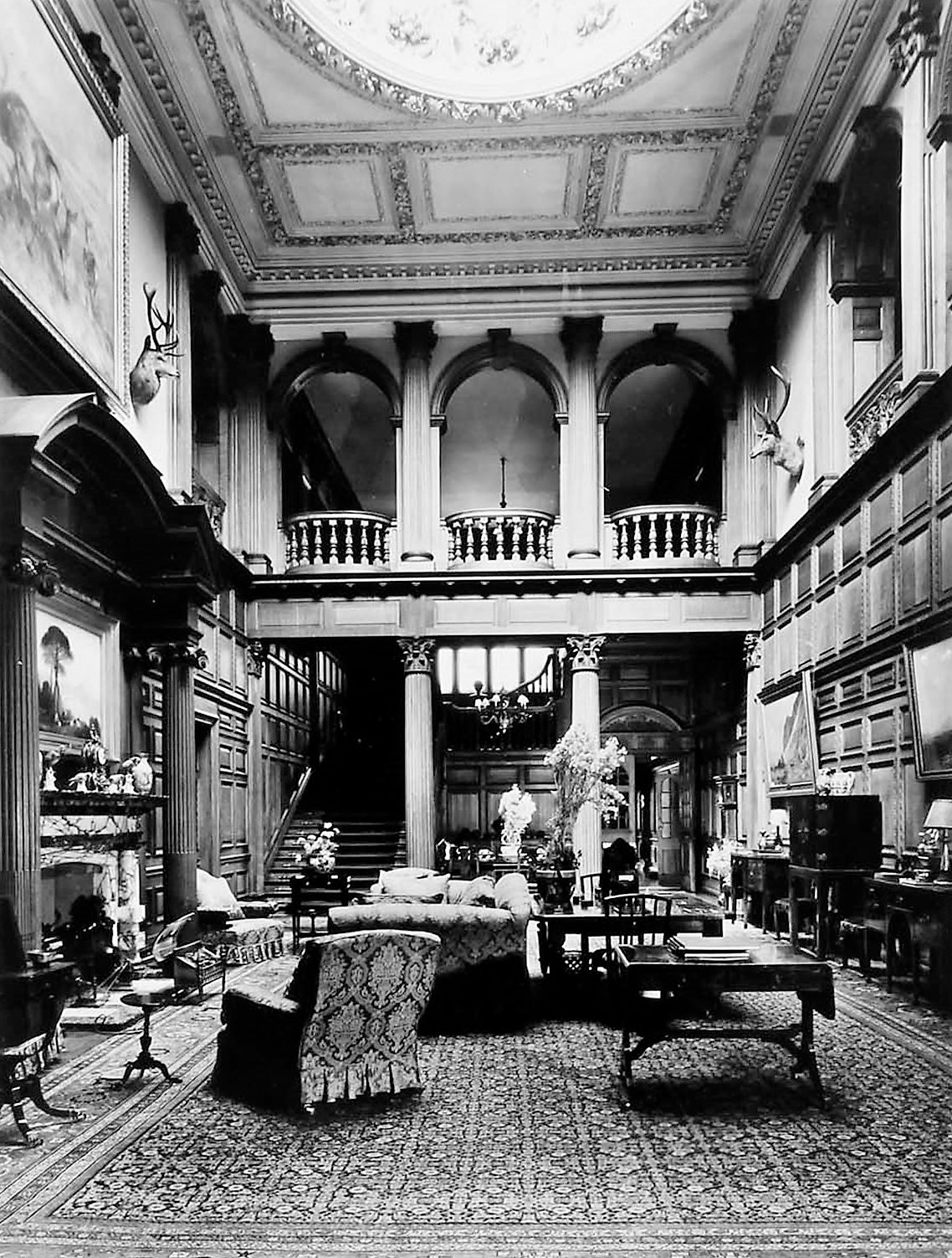
The interior is much better, with richly detailed and beautifully executed plasterwork and woodwork in a generally mid-18th century style. Lord Burton is said to have spent £200,000 on the place, but this seems an excessive estimate, even considering the scale and the quality of the internal finish.

Rangemore Hall: the drawing room and dining room of one of the apartments into which the house has been divided.

Rangemore Hall: the principal staircase is an example of the excellent Edwardian craftsmanship.
The roadway adjoining the house was moved to allow the enlargement of the gardens at the time of the 1850s rebuilding, but a more extensive landscaping was commissioned from Edward Milner in 1875. In the grounds are the stables, dated 1895, and a large brick-lined ice house approached by a long tunnel, with a pit said to be eighteen feet deep, which is a survival from the Georgian landscape. In Victorian times, there was an extensive complex of more than forty glasshouses, including an orchid house, which were heated by three large boilers and three and a half miles of pipes.

Descent: Duchy of Lancaster leased to John Rigby (fl. 1834); lease sold by 1835 to Henry Barton (1806-52) and then to Michael Thomas Bass (1799-1884); the Duchy sold the freehold after his death to his son, Sir Michael Arthur Bass (1837-1909), 1st bt. and 1st Baron Burton; to daughter, Nellie Lisa (1873-1962), 2nd Baroness Burton, wife of Col. James Evan Bruce Baillie (1859-1931) of Dochfour, and later of Maj. William Eugene Melles (d. 1953); she sold it 1949 to Staffordshire County Council, which operated it as Needwood School for the partially deaf, 1954-85; subsequently sold and divided into eight self-contained houses.

Byrkley Lodge, Rangemore, Staffordshire. 

In the medieval period, the estate formed part of Needwood Forest, and the first house here was a hunting lodge built in the 13th century. The property became part of the Duchy of Lancaster lands and was favoured as a royal hunting preserve by King James I and others. In the late 17th and 18th centuries the timber trees were harvested and much of the Forest was converted to pasture, and Byrkley Lodge was rented to Lord Townshend, whose wife had inherited the nearby Tamworth Castle estate. He seems to have engaged William Wyatt (1734-80) to rebuild the house on a somewhat larger scale as an occasional residence; the grounds were also landscaped at the same time, and included a cascade. A series of late 18th century drawings show the house with a one-and-a-half storey neo-classical front of three wide bays and two-storey service range behind, while a long detached stable block is visible behind. Edward Sneyd made improvements in the 1790s, perhaps including a long curving wall or covered passage linking the house to the stable block. There was also considerable internal remodelling in the 1820s, and further landscaping work in the grounds: the two pools south-east of the house were created in 1826. When advertised to let in 1834, the house contained “an eating room, library and drawing room, seven bedrooms, two with dressing rooms, five servant’s rooms, housekeeper’s room, and all other domestic offices”, and in 1852 the main reception rooms were still the hall, drawing room, library and dining room.

Byrkley Lodge: detail of a watercolour by John Spyers of 1786, showing the house designed by William Wyatt for Lord Townshend.
Image: British Library Maps K.Top.38.49.a

Byrkley Lodge: entrance front as rebuilt by R.W. Edis for Hamar Bass, 1887-91. Image: Historic England/Knight Frank & Rutley BB83/4292
The Georgian house was replaced by a large Elizabethan-style hous
e designed by R.W. Edis for Hamar Bass, the brother of the 1st Lord Burton, and built in 1887-91 by Walker & Slater of Derby, builders, reputedly at a cost of £150,000. The new house was constructed of intensely red Ruabon brick with Hollington stone dressings. The main block was planned around a central hall, with a service wing attached to one corner. The quality of the internal fittings and decoration - which ranged from the Jacobethan to neo-Adam in style - was uniformly high.

Byrkley Lodge: the central hall in the early 20th century. Image: Historic England/Knight Frank & Rutley BB83/4297

Byrkley Lodge: the library in the early 20th century. Image: Historic England/Knight Frank & Rutley BB83/4298
From the beginning the house had six bathrooms on the principal bedroom floor - an early example of such generous provision - and when advertised for sale in 1913, it was said to contain ‘a beautiful hall, 52ft by 43 ft, [a] suite of magnificent entertaining rooms, including the ballroom, study, boudoir, drawing room and library; well-lighted bedrooms and dressing rooms; and eleven bathrooms’, as well as the service accommodation.  

The house was put on the market in 1913 but failed to sell, although much of the estate was sold off, two farms going back to the Duchy of Lancaster. The house then remained the property of Sir William Bass until his death, but was sold and demolished soon afterwards. The site is now occupied by St George's Park National Football Centre.

Descent: Duchy of Lancaster leased 1754 to Field Marshal George Townsend, 4th Viscount Townshend; sold 1786 to Arthur Chichester (d. 1799), 1st Marquess of Donegall; sold in 1790s to Rear Admiral Edward Sneyd (d. 1832), who acquired the freehold; to widow, Maria Sneyd (d. 1848); to daughter, Mary Emma Sneyd (d. 1858), who leased it in 1850 to Michael Bass (1799-1864) and later sold to Col. Francis William Newdegate (1822-93); sold 1886 to Hamar Alfred Bass (1842-98); to son, Sir William Arthur Hamar Bass (1879-1952), 2nd bt.; to nephew by marriage, Peter Hastings (later Hastings-Bass) (d. 1964) who sold 1952; demolished soon afterwards.

Glenquoich Lodge, Invernesshire

In 1838 Edward Ellice MP bought the western half of the McDonnell estate from the impoverished lairds of the clan, who had already 'cleared' their tenantry from the estate through programmes of assisted, and later forced, emigration to Canada. Ellice (d. 1863), who was a 53-year old widower, was deeply influenced by the Romantic enthusiasm for Scotland, encouraged by Sir Walter Scott and later by Queen Victoria, and perhaps by his own early experiences in Canada. He built a modest shooting lodge in this wild and remote corner of the Highlands, on the shores of Loch Quoich. 

Glenquoich Lodge: the house as first built for Edward Ellice. Image: Chris Pywell.

Glenquoich House: two watercolours of the original shooting lodge, showing the simple exterior and spartan interior in the 1840s,
from Janie Ellice's album of sketches.

As first built, it was a one-and-a-half storey building with dormer windows lighting the upper floor, sash windows and a slate roof. The interior, recorded in a number of family sketches from the 1840s, was sparsely and simply furnished with cane-bottomed chairs and iron bedsteads, suggesting that simple living was part of the attraction of highland life at this time. 

On Edward Ellice's death in 1863, the estate passed to his son of the same name, who later the same year purchased the eastern half of the former McDonnell estate, around Invergarry. He commissioned a new house there (Invergarry House) from David Bryce and made it his principal home. Glenquoich was let from 1873 to Michael Arthur Bass, later 1st Lord Burton, who had been brought up on holidays in the Highlands, and enjoyed stalking, shooting and fishing from an early age. 

Glenquoich Lodge: the house as enlarged and remodelled by Alexander Ross c.1900.
At first, he seems to have been content with the rather spartan conditions of Glenquoich Lodge, but after he became friends with Edward, Prince of Wales in the 1890s, he transformed the house into a luxurious highland mansion to the designs of Alexander Ross. The work was carried out at the same time as he was doubling the size of Rangemore Hall (Staffs), also with a view to royal visitors. At Glenquoich, the improvements (to what was still only a rented estate) went far beyond the enlargement of the house. Lord Burton laid out 130 miles of roads and carriage drives on the estate, and even bankrolled the construction of the Invergarry and Fort Augustus railway (opened in 1903) to provide access to it, via the station at Invergarry. King Edward VII came to Glenquoich in 1904 and 1905, but after the King's second visit Lord Burton gave up the lease. The lodge survived until 1955, when the construction of a new dam turned Loch Quoich into a much larger reservoir. The house was demolished and the site was flooded later that year. Any remains now lie several fathoms deep.

Bass family of Rangemore, baronets and Barons Burton


Bass, William (c.1721-87). Second son of William Bass (1695-1732) of Hinckley (Leics), plumber, glazier and smallholder, and his wife Hannah Fish, born about 1721*. He succeeded to his father's smallholding, and later established a carrying business between London and Manchester with his elder brother, John Bass. John withdrew from this concern in 1755, and after William's marriage he moved to Burton-on-Trent, where he was increasingly concerned with the carriage of beer from the town's growing brewery industry. In 1777 he sold his carrying business to Pickfords, and invested the proceeds in a house and brewery in the High St. at Burton-on-Trent (Staffs), from which he produced a premium quality beer for the English market. In 1784 he began exporting a strong warming ale to Russia via the River Trent and the port of Hull, and this remained an important market for the firm until the Napoleonic Wars. He married, 4 December 1757 at St Michael, Wood St., London, Mary Gibbons (d. 1786), the daughter of a London publican, and had issue:
(1) Michael Thomas Bass (1759-1827) (q.v.);
(2) William Bass (b. 1763), baptised at Burton-on-Trent, 2 July 1763; partner with his brother in the Bass brewery, Burton-on-Trent, 1787-95, but then sold his interest to his brother; his later career has not been traced.
He lived at Hinckley until 1758 and thereafter at Burton-on-Trent.
He was buried at Burton-on-Trent, 2 September 1787. His wife was buried at Burton-on-Trent, 2 March 1786.
*Some sources state he was born in 1717 but his parents were only married (at Derby) in that year, and he was their second son.

Michael Thomas Bass (1760-1827) 
Bass, Michael Thomas (1759-1827).
Elder son of William Bass (c.1721-87) and his wife Mary Gibbons, born 23 July and baptised at Burton-on-Trent, 26 July 1759. He and his brother inherited his father's brewery at Burton-on-Trent in 1787, but he bought out his brother in 1795, and 
entered into partnership with John Ratcliff (d. 1834) the following year. He continued to develop the Baltic trade with Russia and North Germany, exporting via the River Trent and Hull, and in 1799 he built a second brewery at Burton. After the decline in his export trade caused by the Napoleonic Wars, he and his son developed Indian Pale Ale for the south Asian marketHe married, 2 January 1794 at Burton-on-Trent, Sarah (1763-1837), daughter of Abram or Abraham Hoskyns of Newton Solney (Derbys), and had issue:
(1) Mary Bass (1795-1879), baptised at Burton-on-Trent, 7 August 1795; married, 4 October 1843 at Barton-under-Needwood (Staffs), Walter Joseph Gisborne (1797-1887) of Yoxall Lodge (Staffs) and Lingen, Presteigne (Radnors), but had no issue; died 20 December 1879; administration (with will annexed) granted, 13 February 1880 (effects under £8,000);
(2) Sarah Bass (1796-1858), baptised at Burton-on-Trent, 11 January 1797; lived at Derby; died unmarried, 17 December, and was buried at Burton-on-Trent, 22 December 1858; will proved 2 February 1859 (effects under £7,000);
(3) Frances Bass (1798-1881), baptised at Burton-on-Trent, 26 October 1798; married, 26 June 1837 at Barton-under-Needwood (Staffs), Archibald Fox (1800-71) of Derby, and had issue one son; lived latterly at 7 Vanbrugh Park, Blackheath (Kent); died 17 July 1881; administration of goods (with will annexed) granted 3 September 1881 (effects £14,874);
(4) Michael Thomas Bass (1799-1884) (q.v.);
(5) William Bass (1801-80), born 20 July 1801 and baptised at Burton-on-Trent, 13 January 1802; educated at Middle Temple (admitted 1839; called 1843); barrister-at-law; from 1852 land agent to Francis Dukinfield Palmer Astley of Dukinfield Lodge; lived at The Lakes, Dukinfield (Ches) and later at Duffield (Derbys); died unmarried, 23 September and was buried at Duffield, 27 September 1880; will proved 8 November 1880 (effects under £12,000);
(6) Abraham Bass (1804-82), of Moat Bank, Burton-on-Trent, born 23 February and baptised at Burton-on-Trent, 20 July 1804; solicitor; an amateur cricketer who played three first class matches and was chiefly responsible for the formation of Burton Cricket Club; married, 11 May 1852 at Stapenhill (Derbys), Margaret Jane (1816-78), daughter of Rev. George Wood Lloyd DD, vicar of Gresley (Derbys), and had issue one son; died 15 August 1882 and was buried at Stapenhill; will proved 14 December 1882 (estate £17,991);
(7) Rev. Roger Bass (1805-44), born 15 April and baptised at Burton-on-Trent, 31 July 1805; educated at Repton and Trinity College, Cambridge (matriculated 1826; BA 1830; MA 1834); ordained priest, 1836; vicar of Austrey (Warks), 1839-44; married, 17 August 1835 at Burton-on-Trent, Anne (1795-1859), daughter of William Worthington of Burton, but had no issue; died suddenly while riding, 8 April, and was buried at Austrey, 9 April 1844; will proved 15 February 1845.
He lived at Burton-on-Trent.
He died 9 March and was buried at Burton-on-Trent, 14 March 1827; his will was proved 14 February 1828. His widow died 22 August and was buried at Burton-on-Trent, 28 August 1837.

Michael Thomas Bass (1799-1884)
Image: Parliamentary Archives.
Bass, Michael Thomas (1799-1884).
Eldest son of Michael Thomas Bass (1759-1827) and his wife Sarah, daughter of Abraham Hoskyns of Newton Solney (Derbys), born 6 July 1799. Educated at Burton on Trent Grammar School and later at Nottingham. As a young man he was an officer in the Staffordshire Yeomanry Cavalry (Lt., 1824), and assisted in putting down riots before the passage of the Great Reform Act in 1832. He entered the family brewery business at Burton-on-Trent in 1817 and succeeded his father as head of the firm in 1827. When he joined the firm it was not flourishing because the Napoleonic wars had disrupted sales to its important Russian market. To substitute for this trade, a beer (the famous Indian Pale Ale) was developed for export to south Asia, which was the salvation of the firm. Between 1830 and 1880 
Bass and his partners (two generations of Ratcliffs and Grettons, and later his sons) expanded the business until it was the largest brewery in the world, eclipsing the major London brewers and producing about 1,000,000 barrels a year by the latter date. Bass increasingly delegated the day-to-day operation of the firm to his partners and managers, and became an advocate for the brewing trade in general, and this led him into politics. He served as Liberal MP for Derby, 1848-83, and although opposed to the hostile policy of his party on licensing, he was in other respects a committed Liberal, advocating free trade, low taxation, and improved working-class living standards. As his wealth grew in proportion to the success of the brewery, he became a generous benefactor to both Burton-on-Trent and Derby, and in the latter town he paid for a new library, art gallery, recreation ground, and swimming-baths. No doubt as a result of this generosity, he was enormously popular with his electorate. His growing wealth allowed him to assimilate to the landed elite, and he was JP and DL for Staffordshire from 1852, and a keen field sportsman, hunting until just a few years before his death. From the 1840s, he spent between four and six weeks a year in Scotland to shoot grouse, stalk deer, and catch salmon, latterly leasing Tulchan Lodge, Strathspey. He married, 8 December 1835, Eliza Jane (1812-97), daughter of Maj. Samuel Arden of Longcroft (Staffs), and had issue including:
(1) Sir Michael Arthur Bass (1837-1909), 1st bt. and 1st Baron Burton (q.v.);
(2) Emily Frances Anne Bass (1841-1915), baptised at Burton-on-Trent, 28 May 1841; married, 30 September 1862 at Tatenhill, Sir William Chichele Plowden KCSI (1832-1915) of Aston Rowant (Oxon), and had issue one daughter; died 29 November 1915; administration of goods granted 23 March 1916 (estate £15,518);
(3) Hamar Alfred Bass (1842-98) (q.v.);
(4) Alice Jane Bass (1843-1919), born 1 August and baptised at Yoxhall (Staffs), 16 December 1843; married, 21 October 1868 at Rangemore, Sir George Chetwode (1823-1905), 6th bt., and had issue two sons and three daughters; died at Lucerne (Switzerland), 27 November 1919; will proved 27 January 1920 (estate £4,385);
(5) Mary Arden Bass (1846-89), born 2 December 1846 and baptised at Barton-under-Needwood, 6 April 1847; she seems to have been excluded from the family circle and lived as a boarder with families in the London area, latterly at Sutton (Surrey), although she was not completely ostracized as her father bequeathed her an annuity; she died unmarried and was buried at Norwood Cemetery, 7 March 1889.
He lived at Brewery House, High St., Burton-on-Trent until 1848 and then leased Byrkley Lodge, where he lived during the 1850s. He leased Rangemore Hall from about 1853 and moved there in about 1860.
He died 29 April 1884, and was buried at Rangemore; his will was proved 27 May 1884 (effects £1,830,291). His widow died 7 August 1897; her will was proved 16 September 1897 (effects £5,406).

Sir Michael Arthur Bass (1837-1909),
1st Baron Burton. Image: NPG.
Bass, Sir Michael Arthur (1837-1909), 1st bt. and 1st Baron Burton. 
Elder son of Michael Thomas Bass MP (1799-1884) and his wife Eliza Jane, daughter of Maj. Samuel Arden of Longcroft (Staffs), born 12 November 1837 and baptised at Burton-on-Trent, 20 April 1838. Educated at Harrow and Trinity College, Cambridge (matriculated 1856; BA 1860; MA 1864). On leaving university he entered the family brewing business of Bass, Ratcliff and Gretton at Burton-on-Trent, eventually succeeding his father as Chairman in 1884, and ensuring that the business continued to thrive by offering a quality product at a time of increasing competition and decreasing demand for beer. He was also Deputy Chairman of the South-Eastern Railway, JP and DL for Staffordshire and Hon. Col. of 6th battalion, North Staffordshire Regiment (retired 1881). He entered politics as Liberal MP for Stafford, 1865-68, East Staffordshire, 1868-85, and Burton-on-Trent, 1885-86, and became a personal friend of Gladstone, although he joined the Liberal Unionists in 1894 in protest at the Liberal party's growing hostility to the brewing interest. His father having declined both a baronetcy and a peerage, he was created a baronet in his father's lifetime, 1882, and this explains why he was able to secure a remainder to his younger brother and the latter's heirs male. He was later raised to the peerage as Baron Burton of Rangemore and Burton-on-Trent, 13 August 1886. As he had no male issue, this peerage died with him, but he obtained a new grant as Baron Burton of Burton-on-Trent and Rangemore, 29 November 1897, with a special remainder to his daughter. A genial man, he became a personal friend of the Prince of Wales (later King Edward VII), who stayed at Rangemore, his London house, and Glenquoich, and who appointed him KCVO, 1904. He was a freemason from a young age and became a prominent contributor to masonic charities, and well as continuing the tradition established by his father of munificent benefactions to the town of Burton, where his major projects including the new town hall (£65,000), St Paul's church (£120,000 and a £40,000 endowment) and a bridge across the River Trent (£30,000). He formed a notable art collection of works by the leading English 18th century painters (which were housed in 18th century surroundings at Chesterfield House) and also collected the work of contemporary artists (which was kept at Rangemore). He married, 28 October 1869, Harriet Georgina (1842-1931), fourth daughter of Edward Thornewill of Dove Cliff (Staffs), and had issue:
(1) Nellie Lisa Bass (1873-1962), 2nd Baroness Burton (q.v.).
He inherited the lease of Rangemore Hall from his father in 1884, purchased the freehold in 1886, and doubled it in size in 1898-1901 in anticipation of a visit by the Prince of Wales: it was estimated that the works cost £200,000. He bought Chesterfield House, Mayfair in about 1880, and also leased an estate in Scotland (Glenquoich Lodge) from 1873-1905, employing Alexander Ross to make additions to it c.1900, laying out 130 miles of roads and carriage drives on the estate, and even bankrolling a railway to provide access to it (from Invergarry station).
He died following an operation, 1 February 1909, when his was succeeded in his baronetcy by his nephew, Sir William Bass, 2nd bt. (q.v.) and in the 1897 barony by his daughter; his 1886 barony became extinct on his death; his will was proved 11 March 1909 (estate £1,000,000). His widow died 21 January 1931; her will was proved 12 May and 30 September 1931 (estate £207,027).

Bass, Nellie Lisa (1873-1962), 2nd Baroness Burton. Only child of Sir Michael Arthur Bass (1837-1909), 1st bt. and 1st Baron Burton, and his wife Harriet Georgina, fourth daughter of Edward Thornewill of Dove Cliff (Staffs), born 27 December 1873. She succeeded her father as 2nd Baroness Burton of Burton-on-Trent and Rangemore, 1 February 1909. She married 1st, 31 January 1894, Col. James Evan Bruce Baillie (1859-1931) of Dochfour, and 2nd, 25 July 1932 at St George, Hanover Sq., London, Maj. William Eugene Melles (d. 1953), eldest son of Joseph William Melles of Gruline, Isle of Mull (Argylls), and had issue two sons and one daughter by her first husband [for whom see my post on that family].
She inherited Rangemore Hall from her father in 1909, and on the death of her first husband inherited his estates at Dochfour (Inverness-shire) and Redcastle and Tarradale (Ross & Cromarty) for life. She sold Rangemore Hall to Staffordshire County Council in 1949 but to replace it she purchased Needwood Hall from her cousin, Sir William Bass. She inherited Chesterfield House from her father but sold it to Lord Lascelles in about 1920.
She died 28 May 1962; her will was proved 15 June 1962 and 2 May 1963 (estate £215,230). Her first husband died 6 May 1931; his will was confirmed in Scotland and sealed in England, 23 June 1931 (effects £33,669). Her second husband died 20 February 1953; his will was proved 26 August 1953 (estate £25,644).

Bass, Hamar Alfred (1842-98). Second son of Michael Thomas Bass MP (1799-1884) and his wife Eliza Jane, daughter of Maj. Samuel Arden of Longcroft (Staffs), born 30 July and baptised at Yoxhall (Staffs), 30 September 1842. Educated at Harrow. He was a director of Bass, Ratcliff, Gretton & Co., brewers, of Burton-on-Trent, but was effectively excluded from its management on account of his 'addiction to the Turf', which was thought to make him unreliable. He became Liberal (later Liberal Unionist) MP for Tamworth, 1878-85 and for West Staffordshire, 1885-98, and was Hon. Col. of 4th battalion, North Staffordshire Regiment and a JP and DL for Staffordshire. He was a keen racehorse owner and breeder and won the Ascot Gold Cup in 1896; he was also Master of the Meynell Hunt for 12 years. He married, 22 February 1879, the Hon. Louisa (1853-1942), daughter of William Bagot, 3rd Baron Bagot, and had issue:
(1) Sir William Arthur Hamar Bass (1879-1952), 2nd bt. (q.v.);
(2) Alexander Michael Bass (1885-91), born 10 February 1885; died young, 9 March 1891;
(3) Sibell Lucia Bass (1881-1957), born 28 June 1881; married, 2 June 1900 at St Peter, Eaton Sq., London, Capt. Berkeley John Talbot Levett (1863-1941) of London, second son of Col. Theophilus John Levett of Wychnor Park (Staffs), and had issue two sons and one daughter; died 23 January 1957.
He purchased Byrkley Lodge and Needwood House, Rangemore, and rebuilt the former to the designs of Col. R.W. Edis in 1887-91. He also had a town house at 145 Piccadilly, London.
He died of complications arising from a form of rheumatism, 8 April 1898; his will was proved 8 July 1898 (estate £196,547). His widow married 2nd, 28 Nov 1901, Rev. Bernard Day Douglas Shaw (1856-1922), vicar of The Annunciation, Bryanston Street, London; she died aged 88, from shock as the result of breaking her leg while alighting from a train at Lichfield, 18 May 1942; administration of her goods (with will annexed) was granted 16 November 1942 (estate £17,232).

Bass, Sir William Arthur Hamar (1879-1952), 2nd bt. Only surviving son of Hamar Alfred Bass (1842-98) and his wife the Hon. Louisa, daughter of William Bagot, 3rd Baron Bagot, born 24 December 1879.  Educated at Harrow, and entered Trinity College, Cambridge but gave up his place and joined the army instead. An officer in the 10th Hussars (2nd Lt., 1899; Lt., 1900; retired 1904; returned to colours, 1914; Capt., 1915; retired 1919), who served in the Boer War and First World War. He was Chairman of Provincial Cinematograph Theatres, from 1909, and also gave financial support to the London Film Co., but was chiefly associated with the horse-racing industry. He was a racehorse owner from 1901, a member and steward of the Jockey Club, joint Master of the Meynell Hunt, a Steward of the Pony Turf Club, and was involved in the foundation of Northolt Park Racecourse in 1929. He married, 9 June 1903 at Clewer (Berks), Lady Wilmot Ida Noreen (1880-1949), youngest daughter of Francis Power Plantagenet Hastings, 14th Earl of Huntingdon, but had no issue.
He inherited Byrkley Lodge from his father in 1898.
He died 28 February 1952, when the baronetcy expired; his will was proved 30 May 1952 (estate £269,900). His wife died 25 May 1949; her will was proved 23 July 1949 (estate £2,246).

Principal sources

Burke's Peerage and Baronetage, 2003, pp. 598-600; Sir N. Pevsner, The buildings of England: Staffordshire, 1974, p. 224; N. Tringham (ed.), The Victoria County History of Staffordshire: vol. X: Tutbury and Needwood Forest, 2007, pp. 70-71; T. Mowl & D. Barre, The historic gardens of England: Staffordshire, 2009, pp. 255-57; M. Miers, Highland Retreats, 2017, pp. 59, 66, 140, 210; Oxford Dictionary of National Biography entries for Michael Thomas Bass (1799-1884) and Sir Michael Arthur Bass (1837-1909), 1st Baron Burton.

Location of archives

Bass family, baronets and Barons Burton: deeds of Staffordshire estates, 1617-1924 [Staffordshire Record Office, D1165]

Coat of arms

Gules on a chevron cottised argent, between three plates each charged with a fleur-de-lys azure, a demi-lion couped of the first.

Can you help?

  • Can anyone provide a view of the 1822 predecessor of Rangemore Hall?
  • Does anyone know what happened to William Bass (b. 1763) after he sold his partnership in the brewery to his brother; or any more about the history of Mary Arden Bass (1846-89) and why she was treated so differently from her siblings in her father's will?
  • I should be most grateful if anyone can provide photographs or portraits of people whose names appear in bold above, and who are not already illustrated.
  • Any additions or corrections to the account given above will be gratefully received and incorporated. I am always particularly pleased to hear from members of the family who can supply recent personal information for inclusion.

Revision and acknowledgements

This post was first published 3 October 2020 and updated 4-8 October 2020 and 1 May 2021. I am most grateful to Chris Pywell for supplying additional images.


Sunday, 11 February 2018

(321) Baillie of Dochfour and Redcastle, Barons Burton

Baillie of Dochfour
The Baillie family are said to have originated at Bailleul, close to the Belgian border in northern France, and trace their descent from Guy de Balliol who was granted lands in Northumberland after the Battle of the Standard in 1139. John Balliol, king of Scotland at the close of the 13th century, was a member of the family. John's great-uncle, Sir Alexander de Balliol, served as Great Chamberlain of Scotland, and his grandson, William, settled at Lamington (Lanarks) and took the name Baillie. In the mid 15th century, William's great-great-grandson, Alexander Baillie, and two of his younger brothers, murdered the priest who was their tutor and fled abroad. Alexander later returned, under the protection of his cousin, Alexander Gordon, 1st Earl of Huntly, and fought for his cousin in the forces of King James II of Scotland at the Battle of Brechin in 1452. For his part in that significant victory, Alexander Baillie is said to have been rewarded with a grant of lands at Dunain, Dochfour, Leys and Torbreck, a fairly compact group of estates south and south-west of Inverness, which descended to Alexander's successors through several generations.
Dunain House: garden front before 2014. Dunain passed out
of the family in 1872 and became a hospital in the 20th century.
It was burned out in a suspicious fire in 2014.
The family seat was at Dunain, but nothing seems to be known of their castle there, which was rebuilt as a five-bay mansion house in the late 18th century and much altered later.


Over time, the component parts of the Baillie estate were used to provide for younger sons, and further properties, acquired by marriage and purchase, augmented their original patrimony, but Dunain and Dochfour remained at the centre of their holdings. However, in 1657, Dochfour was bequeathed to David Baillie, a younger son of Dunain, and the separate branch of the family which is the subject of this article was established. David and his son Alexander (fl. 1659-1737) adhered to the Roman Catholic religion, and this was one factor which led to tensions and a certain rivalry with their Protestant relatives at Dunain. It also encouraged the development of close ties of marriage between the Baillies of Dochfour and the Catholic Frasers of Reelig. By the time of the second Jacobite rising in 1745 Hugh Baillie (c.1710-50) was the owner of Dochfour, and he came under pressure from Simon Fraser, 11th Lord Lovat, the chief of Clan Fraser, to declare for the Jacobite cause. Hugh resisted this pressure and chose to give active support to neither side, and he is said to have watched the Battle of Culloden on the far side of Inverness with his young sons from the hill above Dochfour. A strategy of neutrality may have saved him from the fate of Lord Lovat, who was executed in 1747, but the victorious Hanoverian troops believed Hugh Baillie to be a Jacobite supporter, and as they passed down the Great Glen Dochfour was burned and the estate was subsequently seized by the Crown. Like many forfeited estates, Dochfour was later returned to the family. The date when this happened seems to be obscure, but it was probably in the mid 1750s, by which time Hugh Baillie had died and been succeeded by his young son, Alexander Baillie (c.1732-99).

It was Alexander Baillie who built a new house at Dochfour to replaced the mansion burned after the '45. It was a relatively modest five bay house, but as the first modern classical house with a landscaped park in the Great Glen, it attracted some attention, and in 1780 William Baillie of Dunain was urged to emulate his cousin in building a new house to rival Dochfour: the Georgian house illustrated above was presumably the result. At much the same time, the new house at Dochfour and its parkland setting were painted by Alexander Nasymth. In other respects, Alexander Baillie is one of the most obscure members of the family. Contrary to what is stated in many earlier genealogies, he was married, but he had no surviving legitimate children, and when he died in 1799 he left only an illegitimate son. He left a rather complicated will, which gave his younger brother Evan Baillie (c.1741-1835) an option to buy the Dochfour estate from his executors for the advantageous price of £10,000; if Evan exercised his option, the illegitimate son received the cash; if not, he received the estate. Evan, who had sought his fortune in the West Indies and was well-established in Bristol as a West India merchant, had already bought the adjoining Kinmylies estate in 1774 and did agree to buy Dochfour as well, although he did not move north to live on his estates until he retired in 1812. A few years later, in 1818, he bought also bought the Tarradale estate in Ross & Cromarty.

Evan Baillie, who died aged 93, was the most long-lived of a family remarkable at the time for its vigour and longevity. His eldest son, Peter Baillie (1771-1811), was an exception to this tradition, being plagued with ill-health, which limited his political ambitions, for some years before his premature death at the age of forty.  When Evan Baillie died in 1835, he therefore divided his property between Peter's eldest son, another Evan Baillie (1798-1883), and his own surviving second and third sons. Evan Baillie the younger received Dochfour, while Col. Hugh Duncan Baillie (1777-1866) was left Tarradale and a share of the Bristol and West Indian interests, and James Evan Baillie (1782-1863) the rest of the Bristol and the West Indies property. All three men prospered, but James, who was reported to be a workaholic who devoted every waking hour to the increase of his wealth, left a very substantial fortune - said in the press as £730,000 - at his death.
Redland Court, Bristol: an engraving by J.H. Storer showing the house
shortly before James Evan Baillie acquired it in 1829.
Much of this had been invested in further Scottish estates (Glentrome, Glenelg, Glenshiel and Letterfinlay) as well as Redland Court in Bristol and an estate in Glamorganshire. While he left significant legacies to dependents (some of whom may have been illegitimate children), the majority passed to his nephew, Evan Baillie of Dochfour, who at his death in 1883 owned 92,648 acres in Inverness-shire and Ross & Cromarty. It is no surprise, therefore, that he was able to afford greatly to enlarge Dochfour House in 1838-41 and again in 1870-71, creating the house that exists today.


Col. Hugh Duncan Baillie (1777-1866) was a partner in the Bristol Old Bank from 1812 until his death in 1866 and also had interests in more than twenty plantations in Guiana and the West Indies. He inherited Tarradale (Ross & Cromarty) from his father in 1835 and three years later bought the adjoining estate of Redcastle and at once brought in William Burn to remodel the 17th century castle as a modern country house. Once work on the house was complete, he seems to have spent an increasing proportion of his time there, rather than in Bristol or London, where he also had a house. Redcastle and Tarradale were entailed upon his eldest son, Henry James Baillie (1803-85), who for was MP for the Inverness Burghs for twenty-eight years, and served as a member of Conservative governments in the 1850s. Soon after coming into his inheritance he retired from Parliament, although it would seem that he continued to live largely in London. He had the misfortune to see all three of his sons predecease him without leaving male heirs, and so on his death in 1885 the Redcastle and Tarradale estates passed to his kinsman, Col. James Evan Bruce Baillie (1859-1931), who had also inherited the Dochfour property on the death of his grandfather, Evan Baillie, in 1883. This marked the apogee of the estate, as the Dochfour, Redcastle and Tarradale estates amounted in total to some 105,000 acres. In 1894, Col. Baillie made a highly advantageous marriage, to Nellie Lisa (1873-1962), the only daughter of Sir Michael Arthur Bass (d. 1909), the brewing magnate, who in 1886 had been raised to the peerage as 1st Baron Burton.  The original peerage grant was made in the usual terms, with a limitation to male issue, of whom Lord Burton had none, but realising after his daughter had given birth to two sons that he would have descendants, Lord Burton obtained a new grant of the peerage in 1897 with a special remainder to his daughter and her male descendants. As a result, Nellie Baillie became Baroness Burton in her own right on her father's death in 1909, and held the peerage until her own death in 1962. She also inherited the Bass family properties in Staffordshire, an account of which is reserved to a future post on the Bass family. When he died in 1931, Col. Baillie left her Dochfour and Redcastle for life, and when she died in 1962 these Scottish estates passed to her grandson, Michael Evan Victor Baillie (1924-2013), who also inherited the peerage as 3rd Baron Burton. An old-fashioned, paternalistic and sometimes curmudgeonly Highland laird, he vested his property interests in a trust which was set up in 1984 after his eldest son (now the 4th Baron Burton) decamped to Australia. When he died in 2013 he was succeeded at Dochfour by his second son, the Hon. Alexander Baillie (b. 1963), who has begun putting the estate on a more commercial footing, meeting the challenges of the 21st century. It is to be hoped that measures will now be taken to stabilise or restore Redcastle, which has slipped from neglect to dereliction to ruin since the Second World War.


Dochfour House, Inverness-shire


The Dochfour estate has belonged to the Baillie family since about 1452, but it became the seat of a branch of the family only in the mid 17th century, when David Baillie, a younger son of the Baillies of Dunain, came to live here. He may have built a new house or remodelled an existing one: nothing seems to be known of this building except that it was burned by British forces in 1745 in reprisal for Hugh Baillie's assumed support of the Jacobite cause. 


Dochfour House: Alexander Nasmyth's painting of the estate from the north in 1780, showing the new house built for Alexander Baillie (c.1732-99).

Before 1780, Alexander Baillie (c.1732-99) began building an unpretentious harled laird's house which still forms the centre of the south-east front of the present building. It has two storeys and five bays, with paired windows in the outer bays. When Alexander's great-grandson, Evan Baillie (1798-1883), inherited in 1835, he brought in William Robertson of Elgin (c.1786-1841) to enlarge the house. 


Dochfour House: the original 18th century block (on the left) with the rooftop pavilions and tower added by William Robertson in 1839-41, from an old postcard.

In 1839-40, Robertson gave the existing building an Italianate flavour by adding low pavilions with wide eaves to the ends of the roof (sadly since removed), and a square three-storey Italianate entrance tower, fronted by a balustraded and urn-topped porte cochère to its north-east side. He also added a large new block west and north of the original house, containing the principal new rooms (library, drawing room and dining room). His new south-west front has shallow wings at either end with low hipped roofs and open pedimental gables above groups of three windows on the ground and first floors. In the recessed centre between these wings is a first-floor balcony above the garden door. Rising behind the centre is a big tower, originally with a shallow pavilion roof of two stages and broad bracketed eaves; the combination of wide projection and two-tiers of roof has a faintly Chinoiserie air.


Dochfour House: the west range added by Robertson in 1839-41 and extended in 1871, from an old postcard.

In 1871-72 there were further extensions and additions by Matthews & Lawrie, who extended Robertson's range further north-west and repeated at its end the facade of one of his shallow wings. The linking block connecting this to the original wing has a loggia-like ground floor and a recessed first floor. Matthews & Lawrie also built new stables to the north of the house, dated 1872, in the form of a courtyard of single-storey and attic ranges, with a tower rising in the centre of the south side, and they were presumably responsible for the ornamental dairy nearby of 1875. 


Dochfour House: the site as shown on the Ordnance Survey 6" map surveyed in 1870, before the house was extended.

The gardens of Dochfour were at first an open landscaped park. At the same time as Robertson enlarged the house, a series of formal terraced gardens were cut into the steep slope between the house and the lake. These were complete by the time Prince Albert visited in 1847, when he pronounced Dochfour 'beautiful, the house elegant, with a fine garden'. In the 1880s, the walled garden south of the house was extended and equipped with a variety of specialist glasshouses. 20th century developments concentrated on the area between the house and walled garden, where an Edwardian formal garden was laid out, enclosed by yew hedges which survive, although the formal bedding has long gone, and then in the 1930s a water garden was created. 


Dochfour House from the loch, showing the terraces below the house. Image: Des Colhoun. Some rights reserved.

In the late 20th century the formal gardens were in part revived and the fountain on the terrace below the house was restored. The gardens were briefly opened to the public in the 1980s.

Descent: bequeathed 1657 to David Baillie; to son, Alexander Baillie (fl. 1709); to son, Hugh Baillie (fl. 1730); to son, Alexander Baillie (d. 1798); to brother, Evan Baillie (1740-1835); to grandson, Evan Baillie (1798-1883); to grandson, Col. James Evan Bruce Baillie (d. 1931); to widow, Nellie Lisa Baillie (1873-1962), Baroness Burton; to grandson, Michael Evan Victor Baillie (1924-2013), 3rd Baron Burton; to son, The Hon. Alexander Baillie (b. 1963).

Tarradale House, Urray, Ross & Cromarty

A minor laird's house which stands close to the site of the former Tarradale Castle, which was an earthwork fortification guarding the end of Beauly Firth. The area has evidently been settled since the Stone Age, and the Tarradale estate is currently the focus of an intensive programme of archaeological investigation funded by the Heritage Lottery Fund. 


This engraving of Tarradale House was published in 1875 but may reproduce a much earlier drawing showing the original form of the house.

The present Tarradale House is said to have been built in the 1680s for the Mackenzies of Applecross. It was sold in 1788 to Dr. Kenneth Murchison (d. 1796), who had made money while working in India for the East India Co. His son, Sir Roderick Impey Murchison (1792-1871) was born in the house in 1792, and there is a 19th century engraving of the house commemorating that fact, which, if accurate and not idealised, may indicate its original appearance. However, this engraving certainly does not represent the house as it was at the time of publication, since there are other 19th century views in which the house looks quite different and is recognisably the building that exists today. To be accurate, therefore, it must have been based on an earlier drawing which has not survived. Having said that, the house depicted is a very believable depiction of a late 17th century building, and its form could easily have developed into the building recorded later. It had a five bay, two-storey centre with closely spaced windows and a central porch, clasped between gabled wings of different heights, both of which are shown with chimneystacks in the front gable ends.


Tarradale House: by the time this mid 19th century view was sketched, the house had recognisably taken on its present form.
Having grown up at Tarradale, Sir Roderick Murchison sold Tarradale in 1818 to Evan Baillie of Dochfour (1740-1835), who spent most of his life as a West Indies merchant and banker in Bristol, and was evidently building up his estates in his native Scotland in his retirement. At his death, he left Tarradale to his second son, Col. Hugh Duncan Baillie (1777-1866), who bought the adjoining Redcastle estate in 1838. He made his Scottish home at Redcastle rather than Tarradale, but like his father spent most of his life in Bristol. Given that he was a wealthy man and had an interest in building, he may have been responsible for a mid 19th century remodelling of Tarradale, which is first recorded in an undated but apparently mid 19th century drawing of the quay on Beauly Firth, which shows the house in the background. By this time, the centre has been rebuilt or remodelled as a three bay, one-and-a-half storey range, with the doorway in the left-hand bay, a narrow gable-end on the right-hand bay, and gabled dormers on the two left-hand bays. The flanking wings of the previous view are still evident, but the left-hand one has been rebuilt taller and given a bay window, and the right-hand one has acquired windows either side of the gable-end stack on both floors.


Tarradale House: the house as extended by W.C. Joass for Miss Yule in c.1902-11.
Col. Baillie left Redcastle and Tarradale to his son, the Rt. Hon. Henry James Baillie, who was the long-serving MP for Inverness from 1840-68 and a member of the Conservative governments of the 1850s. His career meant that he lived chiefly in England until he retired from politics. He outlived all three of his sons, and as the property was entailed on male descendants, when he died in 1885 it reverted to the Baillies of Dochfour. They let Tarradale from 1896 to Miss Amy Frances Yule (d. 1916), who bought the freehold in 1900, and in 1902-11 made various improvements to the house to the designs of William C. Joass of Dingwall. In particular, he added the so-called Murchison wing, a tower containing a large library linked to the left-hand side of the house, and built a walled garden.


Tarradale House: the house as restored by the present owner.
On Miss Yule's death, the house became the property of the Murchison of Tarradale Trust which for half a century lent it out to Scottish academics as a place where they could work quietly. When the Trust found it could no longer afford the maintenance costs it was transferred in 1958 to Aberdeen University, which used it as a field studies centre. The University sold it in about 2000 to the present owner, Dr. Eric Grant, who has restored the house and lets the Murchison wing as self-catering accommodation.

Descent: Alexander Mackenzie; gifted 1743 to son, Roderick Mackenzie; gifted 1778 to John Mackenzie; sold 1788 to kinsman, Dr. Kenneth Murchison (d. 1796); to son, Sir Roderick Impey Murchison (1792-1871); sold 1818 to Evan Baillie (1740-1835) of Dochfour; to son, Col. Hugh Duncan Baillie (1777-1866); to son, Rt. Hon. Henry James Baillie (1803-85); to kinsman, Col. James Evan Bruce Baillie (1859-1931), who let 1896 and sold 1900 to Miss Amy Frances Yule (d. 1916); to Murchison of Tarradale Memorial Trust, which transferred the property in 1958 to Aberdeen University; sold c.2000 to Dr. Eric Grant (fl. 2014).

Redcastle, Muir of Ord, Ross & Cromarty

The house stands on a naturally defensible site on the edge of a ravine close to the north shore of Beauly Firth, and it was probably built (as the castle of Edradour) by David, Earl of Huntingdon, brother of William the Lion, by 1179. It later came into the possession of the Douglas family, who held it until it was confiscated by the Crown on the execution of the Earl of Ormond in 1455. The Crown retained it (and Mary Queen of Scots came here in 1562) until it was granted in 1570 to the Mackenzies of Kintail. Roderick, a younger son of Kenneth Mackenzie of Kintail, obtained a Crown grant of the castle in 1599 and his descendant, Rory Mackenzie, built the present L-plan castle in about 1641 (datestone in the east gable). In 1649 the 'new strong house of Redcastle' was besieged and burnt by Covenanting troops, but it was repaired soon afterwards.


Redcastle: pencil drawing by Alexander Nasmyth, showing the house before it was remodelled by William Burn.
Image: National Gallery of Scotland. D3727/84.

The 17th century house is a large three-storey L-shaped building of deep red rubble stone, the colour of which has given the house its name. In the inner angle is a rectangular stairtower, once crowned with a balustraded parapet. At the south-east corner is a second tower, also rectangular except for an awkwardly wide canted west side, the top of which is corbelled out to support a square cap-house. Other angles of the building have corbelled angle-turrets too.


Redcastle: sketch proposal by William Burn for the remodelling of the castle, 1839. Image: RIBA.

In 1790 the Mackenzies sold the estate to the Grants, who improved the estate so much that they are said to have sold it c.1828 for six or seven times what they paid for it. Col. Hugh Baillie (1777-1866) bought the estate in 1838 and brought in William Burn to remodel the old castle into a comfortable house over the next three years. Burn's alterations included the addition of a lower tower in front of the 17th century stairtower, the building of a loggia (since removed) across the south front of the main block, and the addition of a round north-east tower and utilitarian service extensions at the rear. The windows were enlarged, and the structure generally repaired and overhauled.


Redcastle: the house in the 1920s. 

Redcastle: the ruins of the house in 2013.

Redcastle was requisitioned during the Second World War and was returned to the family in poor condition. It was, however, then still occupiable, and indeed was let for some years immediately after the war. It was partially stripped in the 1950s and has not been occupied since, slipping slowly from decay into dereliction and now ruin over the decades. The early 19th century former factor's house nearby, Greenhill House, has been used as a residence by the family instead. Regrettably, the Baillie estate trustees have done very little to arrest the deterioration of the house, and although it would have been perfectly possible to find a commercial restoration solution, have repeatedly declined to sell the freehold. This dog-in-the-manger attitude to a significant heritage asset is incredibly short-sighted and can only add fuel to the fire of Scottish land reform.

Descent: ...Kenneth Mackenzie (d. 1789); sold 1790 to James Grant (d. 1808) of Shewglie; to cousin, Lt-Col. Alexander Grant (d. 1816); to son, Patrick Grant, who sold c.1828 to Sir William Fettes (d. 1836); sold 1838 to Col. Hugh Baillie (1777-1866); to son, Rt. Hon. Henry James Baillie (1803-85); to kinsman, Col. James Evan Bruce Baillie (d. 1931); to widow, Nellie Lisa Baillie (1873-1962), Baroness Burton; to grandson, Michael Evan Victor Baillie (1924-2013), 3rd Baron Burton; to son, The Hon. Alexander Baillie (b. 1963).


Baillie family of Dochfour


Baillie, David (fl. 1673). Younger son of Alexander Baillie of Dunain and his wife Catherine Munro of Milltown. He was a Roman Catholic in faith. He married 1st, 1629, Janet, daughter of William Paterson of Inverness, and 2nd, Margaret, daughter or more probably sister of Hugh Fraser, 8th Lord Lovat, and had issue including:
(2.1) Alexander Baillie (fl. 1659-1737) (q.v.).
He made his home at Dochfour and subsequently inherited the estate from his father.
His date of death is unknown. 

Baillie, Alexander (fl. 1659-1737). Eldest son of David Baillie (fl. 1673) and his second wife Margaret, daughter of Hugh Lovat, 8th Lord Lovat, born before 1659. He was a Roman Catholic in faith. He was blind for many years before his death. He married 1st, c.1689, Mary, daughter of Alexander Grant of Milntown of Ballachastel, and 2nd, 1709, Hannah, daughter of Alexander Fraser of Reelig and widow of James Grant of Sheuglie, and had issue:
(1.1) William Baillie; died young;
(2.1) Alexander Baillie (fl. 1711); died young in the lifetime of his father;
(2.2) Hugh Baillie (c.1710-50) (q.v.);
(2.3) Evan Baillie (d. c.1769), of Aberichan;
(2.4) William Baillie, of Rosehall (Sutherland); married 1st, Elizabeth, daughter of Alexander Sutherland of Cleyn, and had issue three sons (including Gen. Sir Ewan Baillie, bt.); married 2nd, Robina, daughter of Hon. Hugh Mackay of Bighouse, and had further issue; died before 1785;
(2.5) James Baillie;
(2.6) David Baillie; ancestor of the Leicestershire family of Baillies;
(2.7) Isabella Baillie; married, 1723, John Grant of London and Torndow.
He inherited the Dochfour estate from his father.
He died after 1737. His first wife died before 1709. His second wife's date of death is unknown.

Baillie, Hugh (c.1710-50). Eldest son of Alexander Baillie (fl. 1659-1737) and his second wife Hannah, daughter of Alexander Fraser of Reelig and widow of James Grant of Sheuglie, born about 1710. He is recorded as fighting a duel in 1737. Branded as a papist and a Jacobite in the '45 because of his close relationships with the Frasers, although he took no active part in the rebellion; as a result he lost his house and, temporarily, his estates. He married, 10 June 1730, Emilia, daughter of Alexander Fraser of Reelig and had issue:
(1) Isabella (or Jean) Baillie (c.1731-1813); married Duncan Grant (c.1730-1812) of Bught, cashier of the Independent Trades of Inverness; died 7 December 1813;
(2) Alexander Baillie (c.1732-99) (q.v.);
(3) Catherine Baillie; married, c.1775, as his second wife, Dr. William Chisholm (1717-1807), provost of Inverness, son of Roderick Chisholm of Chisholm, and had issue one son (who died young in the Caribbean) and four daughters;
(4) James Baillie (1737-93) of Ealing Grove (Middx), born 1737; he worked in the Caribbean (chiefly St Kitts and Grenada) as a plantation manager (owner from 1765) and agent for other plantation owners from 1755; then a partner (with his brother) in Smith & Baillies, West India merchants; agent in England for the island of Grenada from 1792; MP for Horsham (Sussex), 1792-93; married, 26 April 1772 in Grenada, Colina, daughter and heiress of Colin Campbell of Glenure (Argylls), and had issue three sons and three daughters; died 7 September 1793; will proved 21 October 1793;
(5) Hannah Baillie (1739-97); married, 1766, Col. James Fraser (1732-1808) of Belladrum and had issue three sons and three daughters;
(6) Evan Baillie (c.1741-1835) (q.v.);
(7) Christiana Baillie (d. 1776); married, 24 April 1769, Lt-Col. Alexander Duff (1737-78) of Muirtown, and had issue three sons and two daughters; died 19 December 1776;
(8) Duncan Baillie.
He inherited the Dochfour estate from his father. In 1745 Dochfour House was burnt by Hanoverian troops in the aftermath of the Jacobite rebellion, and the estate confiscated, but it was returned about a decade later.
He was buried at Greyfriars Cemetery, Inverness, 30 March 1750. His wife's date of death is unknown.

Baillie, Alexander (c.1732-99). Eldest son of Hugh Baillie (c.1710-50) and his wife Emilia, daughter of Alexander Fraser of Relig, born before 1737. West India merchant based in Nevis, in partnership with James Smith (d. 1778) of Nevis and his brothers (as Smith & Baillies) in the 1770s. He was a Commissioner of Supply for Inverness-shire by 1793 and an officer in the Easter Ross Volunteers (Capt., 1795; Maj.; Lt-Col., 1798). He married Sarah (d. 1781), the daughter of his first partner in Nevis, James Smith, and had issue:
(1) Alexander Baillie; died in the lifetime of his father on a transatlantic voyage, of yellow fever
He also had illegitimate issue by his 'cousin', Janet Chisholm: 
(X1) Emilia Baillie (d. 1816); lived at Southampton (Hants); died unmarried and was buried at Millbrook, Southampton (Hants), 29 June 1816; will proved 24 July 1816;
(X2) Janet Baillie (c.1783-1848); married, 6 April 1812 at Southampton, Maj-Gen. John Lindsay (1772-1820); buried at Kensal Green Cemetery, 13 October 1848; will proved 21 October 1848;
(X3) Alexander Baillie (c.1791-1839), born about 1791; West Indies merchant; partner in Campbell, Harper & Baillie (which failed in 1819) and later in Baillie & Kerr; married, 9 September 1815 at St Luke, Chelsea (Middx), Marianne (1788-1830), travel writer and poet, daughter of George Wathen of Jamaica, and had issue one son and two daughters; died in Demerera (Guiana); will proved 25 April 1839.
He recovered the Dochfour estate from the Crown in about 1755 and rebuilt the house about 1770. At his death, he provided for his brother Evan to buy Dochfour for £10,000 and if he chose not to do so for the property to pass to his illegitimate son. Evan Baillie made the purchase.
He died at Bath aged 68, 23 February 1799, and was buried in Bath Abbey, 27 February 1799. His wife died at Edinburgh, 22 February 1781.

Baillie, Evan (c.1741-1835). Third son of Hugh Baillie (c.1710-50) and his wife Emilia, daughter of Alexander Fraser of Reelig, born about 1741. As a child, he witnessed the smoke and gunfire from the Battle of Culloden from the hill above Dochfour, and shortly afterwards the family home was burned by Hanoverian troops. Perhaps as a result of the dislocation this caused, Baillie had little formal education and entered the army in about 1756; he was an infantry officer with the 4th (Ensign) and 19th Foot (Lt.) and in 1762 was acting as an ADC to General Howe at the Siege of Havana (Cuba); but he retired on half-pay in about 1763. He then joined his brothers Alexander and James in a partnership (Smith & Baillies) based on St Kitts, Grenada and St. Vincent (latterly as Garraway & Baillie) as sugar planters. In about 1774 he returned to Britain and set up home in Bristol, where he became one of the leading West India merchants, trading as Evan Baillie, son & Co; he also developed business interests in Scotland, becoming a partner in Mackintosh, Grant & Co.'s Inverness hemp manufactory and an associated thread mill. He lived mostly in Bristol, where he was a common councilman by 1785 and an alderman from 1802-21. He was Sheriff of Bristol in 1786-87, but he declined the mayoralty in 1796. In 1789 he was a member of the committee of merchants formed to defend the slave trade, in which he had invested heavily, and it was probably his concerns over this, and the effects of war with France on trade that encouraged him to stand for Parliament. He was elected unopposed and served as MP for Bristol, 1802-12, but he was not one of the last ditch opponents of the abolition of slavery. He was also an officer of the Royal Bristol Volunteers (Lt-Col., 1797; Col., 1798). He retired from parliament and business in 1812, handing on his interests to his sons and retiring to his Scottish estates. In 1834, when the emancipation of slaves finally took place, he and his sons received a total of £110,000 compensation for the 3,100 slaves they had lost. He married, c.1775 in the West Indies, Mary, daughter of Peter Gurley of the island of St. Vincent, and had issue:
(1) Peter Baillie (1771-1811) (q.v.);
(2) Col. Hugh Duncan Baillie (1777-1866) [for whom see below, Baillie of Redcastle and Tarradale];
(3) James Evan Baillie (1782-1863), baptised at St Augustine the Less, Bristol, 26 June 1782; an officer in the Royal Bristol Volunteers (Lt., 1803); merchant (with Evan Baillie, sons & Co.) and banker (with Bristol Old Bank) at Bristol and London; Whig MP for Tralee, 1813-18 and for Bristol, 1830-35; President of the Whig Anchor Club in Bristol; in 1835 he received over £55,000 of slave compensation (as well as receiving a share of a further £57,000 which was awarded to partnerships in which he had an interest), which he invested with other funds in the purchase of estates in Scotland, buying Glentrome in Badenoch in 1835 for £7,350; Glenelg in 1837 for £77,000; Glenshiel in 1838 for £24,000; and Letterfinlay in 1851 for £20,000; he also owned an estate in Glamorganshire and in 1829 purchased Redland Court in Bristol (which he let and which was sold after his death), but lived mostly in London; died unmarried, 14 June 1863, but provided in his will for ten individuals who may have been his illegitimate children; according to newspaper reports probate of his will valued his estate at £730,000, although there had been expectations it could be as much as £2m;
(4) Catherine Baillie (b. 1785), baptised at St Thomas in the East, Jamaica, 1785; married, 25 May 1807 at Inverness, Alexander Fraser of Balconie Castle (Ross-shire), who had been one of the managers of her father's plantations in Grenada, and had issue; 
(5) Maria Baillie (1786-1808), baptised at St Augustine the Less, Bristol, 31 May 1786; died unmarried in Bristol, 23 November 1808.
He bought the Kinmylies estate (Inverness) in 1774; and purchased the adjoining Dochfour estate from his elder brother's estate after his death in 1799. He purchased the Tarradale estate in 1818.  At his death, Dochfour passed to his grandson and namesake, and Tarradale to his second son.
He died 28 June 1835. His wife's date of death is unknown.

Baillie, Peter (1771-1811). Eldest son of Evan Baillie (c.1741-1835) and his wife Mary, daughter of Peter Gurley of the island of St. Vincent, born 1771. He was sent to France to complete his education by learning French, 1788-89, and then joined his father in business as a West India merchant; partner in Bristol Old Bank, 1806-12. An officer in Bristol Volunteers (Ensign, 1797; Capt., 1803). Whig MP for Inverness burghs, 1807-11. In 1811 he travelled to Ireland and Madeira in an unsuccessful search for an improvement in his health. He married, 9 March 1797 at St Augustine the Less, Bristol, Elizabeth (1774-1852), daughter of John Pretor Pinney of Somerton Erleigh (Somerset), and had issue:
(1) Evan Baillie (1798-1883) (q.v.);
(2) Jane Baillie (1799-1889), baptised at St Augustine the Less, Bristol, 3 August 1799; married, 17 October 1826 at Richmond (Surrey), Hon. & Rev. Baptist Wriothesley Noel (1798-1873), son of Sir Gerard Noel, 2nd bt., and his wife Baroness Barham, and brother of 1st Earl of Gainsborough, and had issue four sons and four daughters; died 18 May 1889; administration of her goods granted 18 July 1889 (effects £978);
(3) John Frederick Baillie (1800-65), baptised at St Augustine the Less, Bristol, 8 December 1800; came into Leys Castle (Inverness) on his marriage; JP and DL for Inverness-shire; married 1st, 29 July 1835 at St George, Hanover Square, London, Anne (1811-47), illegitimate daughter and principal heiress of Col. John Baillie MP of Leys, and had issue two sons; married 2nd, 25 June 1855 at St George, Hanover Square, London, Georgina Anne, daughter of William Brummell  of Wivenhoe (Essex) and widow of Sir Thomas Pigot (1796-1847), 2nd bt., of Denston Hall (Suffk); died 6 February 1865; administration of goods granted 4 April 1865 (effects under £14,000);
(4) Mary Baillie (1802-92), baptised at St Augustine the Less, Bristol, 16 October 1802; married 1st, 4 October 1825 at Richmond (Surrey), John Morritt (c.1801-27) of Rokeby Park (Yorks NR) and had issue one daughter; married 2nd, 28 April 1832, Capt. George William St. John-Mildmay RN (1792-1851), third son of Sir Henry Paulet St. John-Mildmay, 3rd bt.; died at Dochfour, 19 January 1892; will proved 3 March 1892 (estate £2,316).
He died in the lifetime of his father, 1 September 1811; his will was proved 3 April 1812. His widow died 27 June and was buried at Hornsey (Middx), 2 July 1852; her will was proved 26 August 1852.


Evan Baillie (1798-1883)
Baillie, Evan (1798-1883). Elder son of Peter Baillie (1771-1811) and his wife Elizabeth, daughter of John Pinney of Somerton Erleigh (Somerset), born 1 April and baptised at St Augustine the Less, Bristol, 28 April 1798. Educated at Harrow and Trinity College, Cambridge (matriculated 1816). Landowner, and by his death one of the largest landed proprietors in the north of Scotland. JP for Cromarty and Inverness-shire, and DL for Inverness-shire (from 1835) and Ross-shire (from 1846). Founding Chairman of the Northern Protestant Association, 1835. Received HRH Prince Albert at Dochfour, September 1847. Partner in Bristol Old Bank, 1863-68. A Conservative in politics, but did not take a very active part in local or national political affairs. He married 1st, 9 August 1821 at Mellerstain House (Roxb.), Charlotte Augusta (1802-22), daughter of Ven. Charles Baillie-Hamilton, archdeacon of Cleveland, and 2nd, 11 October 1823 at Kimbolton Castle (Hunts), Lady Georgiana Frederica Montagu (1803-92), fourth daughter of William Montagu, 5th Duke of Manchester, and had issue:
(2.1) Evan Peter Montagu Baillie (1824-74) (q.v.);
(2.2) William Montagu Baillie (1827-1902), of Laggan Lodge (Inverness), born 11 October 1827; educated at Trinity College, Cambridge (matriculated 1846; BA 1850; MA 1854) and Lincoln's Inn (admitted 1850); partner in Bristol Old Bank, 1852-74; Vice-President of Bristol Chamber of Commerce, 1859-61; High Sheriff of Bristol, 1859-60; an officer in 1st Gloucestershire Artillery Volunteers (Capt., 1860); managed his father's estates in Scotland, 1863-74; JP for Inverness-shire; sequestered for bankruptcy with debts exceeding £80,000, 1877; married, 10 September 1859, Lady Theodosia Gertrude Proby (1832-1902), youngest daughter of Granville Leveson Proby, 3rd Earl of Carysfort, and had issue one son and three daughters; died 11 September 1902; will confirmed at Inverness, 7 March 1902 (estate £1,081);
(2.3) Caroline Eliza Montagu Baillie (1829-1913), baptised at Chalfont St. Giles (Bucks), 26 October 1829; married, 17 December 1857, William Draper Mortimer Best (1826-99), 3rd Baron Wynford, and had issue one son (who died in infancy); died 16 January 1913; administration granted 5 March 1913 (estate £188,869);
(2.4) Georgiana Mary Montagu Baillie (1831-1918), baptised at Chalfont St Giles (Bucks), 10 February 1831; married, 20 January 1857 at St George, Hanover Square, London, Col. the Hon. William James Colville, second son of Gen. Sir Charles Colville, and had issue one son and one daughter; died 29 March 1918; will proved 18 June 1918 (estate £1,847);
(2.5) Mary Emily Baillie (1832-1923), baptised at Wooburn (Bucks), 21 April 1832; married, 1 July 1856 at St George, Hanover Square, London, Francis Henry Beaumont, of Buckland Court (Surrey) and had issue two sons and four daughters; died 11 January and was buried at Buckland, 16 January 1923; her will was proved 8 February 1923 (estate £446).
He inherited the Dochfour estate from his grandfather in 1835. He enlarged the house at Dochfour in 1839-43, and extended it again in 1870-71. He also owned Glenelg on the west coast and much of Kingussie, which estates he inherited from James Evan Baillie in 1863.
He died at Florence (Italy), 6 April and was buried at Dochfour, 19 April 1883; his will was confirmed 19 March 1884 (effects £50,058). His first wife died 25 March 1822 and was buried at Greyfriars Cemetery, Edinburgh. His widow died at Brighton (Sussex), 30 July 1892; her will was confirmed at Inverness, 13 February 1893 (estate £2,653).

Baillie, Evan Peter Montagu (1824-74). Elder son of Evan Baillie (1798-1883) and his second wife, Lady Georgiana Frederica Montagu, fourth daughter of William Montagu, 5th Duke of Manchester, born 27 August and baptised at Goldington (Beds), 10 October 1824. Educated at Cheam (Surrey) and Trinity College, Cambridge (matriculated 1844). Served in the diplomatic corps, 1846-73 (attaché at embassies in Vienna, 1846, Frankfurt, 1852 and Paris, 1858; secretary of legation to Brazil, 1859-62 and to Wurttemburg, 1862-71; chargé d'affaires, Hesse-Darmstadt and Baden, 1871-73). He married, 15 February 1855 at the British Embassy in Paris (France), Lady Frances Anna Bruce (1831-94), daughter of Thomas Bruce, 7th Earl of Elgin, and had issue:
(1) Victoria Matilda Susan Baillie (1857-1938); maid of honour and Extra Woman of the Bedchamber to HM Queen Victoria; appointed a member of the Royal Order of Victoria & Albert; married, 6 May 1884 at St George, Hanover Square, London, her cousin, Cdr. Alaric Frederick Grant RN (1844-1918) of Ballindarroch (Inverness), but had no issue; died 4 November 1938; will proved 7 February 1939 (estate £17,020);
(2) Col. James Evan Bruce Baillie (1859-1931) (q.v.);
(3) Augustus Charles Baillie (1861-1939), born 25 March 1861; educated at Royal Military Academy, Sandhurst; an officer in the Royal Horse Artillery (Lt., 1880; resigned 1886) and Lord Lovat's Scouts, Imperial Yeomanry (Capt.; Bt. Lt-Col., 1902; Maj., 1903; Lt Col, 1908; resigned 1910; Hon. Col. of 2nd Lovat Scouts, 1914); awarded DSO, 1901; with Carlyle Gifford, founded legal firm of Baillie Gifford WS in 1907, which founded and managed the Straits (later Scottish) Mortgage & Trust Co. Ltd. (which is now a FTSE 100 company); after he left the army he leased and later purchased Harleyburn, Melrose, from where he hunted frequently with the Buccleuch and Lauderdale Hunts; married, 26 January 1905 at St Paul, Knightsbridge (Middx), Meta (1868-1944), daughter of Maj-Gen. Sir Henry Trotter, kt., and had issue one son and one daughter; died at Melrose (Roxb.) 8 January 1939; will confirmed in Scotland and sealed in London, 13 May 1939 (estate £66,737);
(4) Very Rev. Albert Victor Baillie (1864-1955), born at Karlsruhe (Germany), 5/6 August 1864; godson of Queen Victoria; educated at Marlborough and Trinity College, Cambridge (matriculated 1883; BA 1886; MA 1891; hon. DD 1918); ordained deacon, 1888 and priest, 1889; curate in South Sheilds (Northbld), 1889-90; curate of Walworth (London) and domestic chaplain to Bishop of Rochester, 1891-95; vicar of Plumstead (Kent), 1895-98; rector of Rugby (Warks) and rural dean of Rugby (Warks), 1898-1912; hon. canon of Worcester Cathedral, 1905-08; canon and Chancellor of Coventry collegiate church, 1908-12; vicar and rural dean of Coventry and sub-dean of Coventry collegiate church, 1912-17; vicar of Styvechall (Warks), 1917-35; Dean of Windsor, Registrar of the Order of the Garter and domestic chaplain to the King, 1917-45; appointed CVO 1921 and KCVO, 1932; author/editor of A Victorian Dean, Letters of Lady Augusta Stanley, My first eighty years etc.; married, 9 August 1898 at Westminster Abbey, the Hon. Constance Elizabeth Hamilton-Russell (1866-1924), daughter of Gustavus Russell Hamilton-Russell, 8th Viscount Boyne, and had issue three sons (two of whom predeceased him); retired to Baldock (Herts) and died 3 November 1955; will proved 17 May 1956 (estate £26,918).
He died at Edinburgh in the lifetime of his father, 9 November 1874; his will was confirmed at Inverness, 10 July 1874 and sealed in London, 24 July 1874. His widow died in London, 16 August 1894; her will was confirmed 14 January 1895 (effects £1,390) and sealed in London, 19 January 1895.

Baillie, Col. James Evan Bruce (1859-1931). Eldest son of Evan Peter Montagu Baillie (1824-74) and his wife Lady Frances Anna, daughter of Thomas Bruce, 7th Earl of Elgin, born 8 January 1859. An officer in Northumberland Fusiliers (2nd Lt., 1879; Lt., 1880; Capt., 1885; resigned 1885) and Inverness-shire Royal Horse Artillery (TF) (Hon. Col., 1904); he was also a Brigadier in the Royal Company of Archers. Unionist MP for Inverness-shire, 1895-1900. JP and DL for Inverness-shire. He was appointed MVO, 1905. He was a keen huntsman and a noted breeder of horses for hunting, with stables at his wife's home, Rangemore Hall (Staffs). He married, 31 January 1894 at Holy Trinity, Chelsea (Middx), Nellie Lisa (1873-1962), who in 1909 succeeded, by special remainder, as 2nd Baroness Burton in her own right, daughter and heir of Sir Michael Arthur Bass (1837-1909), 1st bt. and 1st Baron Burton, and had issue:
(1) Hon. George Evan Michael Baillie (1894-1941) (q.v.);
(2) Hon. Arthur Malcolm Augustus Baillie (1896-1963), born 4 July 1896; educated at Eton; an officer in the Royal Artillery and later 1st Life Guards (2nd Lt., 1915; Lt., 1918; Capt., 1924; retired 1934; returned to colours, 1939; Bt Maj, 1940; retired 1946); served in First and Second World Wars; married, 17 March 1927 at Wiseton (Notts), Rosemary (1905-87), elder daughter of Brig-Gen. Sir Joseph Frederick Laycock, kt., DSO, of Wiseton Hall, and had issue one son; died 14 February 1963; will proved 15 July 1963 (estate £43,362);
(3) Hon. Victoria Frances Maud Baillie (1899-1931), born 14 March 1899; a keen participant in amateur dramatics, which she used for charity fundraising; married, 2 November 1922, Sir Digby Lawson (1880-1959), 2nd bt., and had issue two sons; died at Inverness, 10 January 1931.
He inherited the Dochfour estate from his grandfather in 1883 and the Redcastle and Tarradale estates from his kinsman, Rt. Hon. H.J. Baillie, in 1885. At his death his property (stated to be some 92,000 acres) passed to his widow for life.
He died 6 May 1931; his will was confirmed in Scotland and sealed in England, 23 June 1931 (effects £33,669). His widow married 2nd, 25 July 1932 at St George, Hanover Square, London, Maj. William Eugene Melles (d. 1953), eldest son of Joseph William Melles of Gruline, Isle of Mull; she died 28 May 1962; her will was proved 15 June 1962 and 2 May 1963 (estate £406,537). His widow's second husband died 20 August 1953; his will was proved 26 August 1953 (estate £25,644).

Baillie, Col. the Hon. George Evan Michael (1894-1941). Eldest son of Col. James Evan Bruce Baillie (d. 1931) and his wife Nellie Lisa, Baroness Burton, daughter and heir of Sir Michael Arthur Bass, 1st bt. and 1st Baron Burton, born 19 December 1894. Educated at Eton. An officer in the Royal Horse Artillery (2nd Lt., 1912; Lt., 1914; Capt. 1917; Acting Maj., 1917; retired 1919), Lovat Scouts (Lt., 1921) and the 24th (Derbyshire Yeomanry) Armoured Car Co. (Capt., 1922; Maj., 1936), 1922-37; Lt-Col. of 4th Battn, Cameron Highlanders (TA), 1937-41; awarded MC, 1918. DL for Derbyshire and Ross & Cromarty. Director of Bass, Ratcliff & Gretton Ltd., brewers. In the 1920s, he and his wife were joint masters of the High Peak Harriers. He married, 15 November 1923, Lady Maud Louisa Emma CBE JP (1896-1975), eldest daughter of Victor Christian William Cavendish, 9th Duke of Devonshire, and widow of Capt. Angus Alexander Mackintosh (1885-1918), and had issue:
(1) Michael Evan Victor Baillie (1924-2013), 3rd Baron Burton (q.v.);
(2) Hon. Judith Evelyn Maud Baillie (b. 1925); served with ATS, 1944-47; granted rank of a baron's daughter, 1964; married, 5 September 1949, Lt-Col. Angus Ewan Selwyn Cameron MC (1914-2001) of Aldourie Castle (Inverness), only son of Capt. Allan George Cameron, and had issue one son and one daughter;
(3) Hon. Peter Charles Baillie (1927-2017) of Wootton Hall, New Milton (Hants), born 26 June 1927; educated at Eton; an officer in the Life Guards (Maj.); granted rank of a baron's younger son, 1964; married, 15 November 1955, Jennifer Priscilla (1933-2014), younger daughter of Cdr. Harold Reginald Newgass GC of Winterbourne, West Stafford (Dorset) and had issue four daughters; died aged 89, 15 March 2017; will proved 14 July 2017.
He lived at Ashford Hall, Ashford-in-the-Water (Derbys).
He died on active service in the lifetime of his mother, 6 June 1941; his will was confirmed in Edinburgh and sealed in England & Wales, 7 April 1942. His widow died 30 March 1975.

Baillie,  Michael Evan Victor (1924-2013), 3rd Baron Burton. Elder son of Col. the Hon. George Evan Michael Baillie (1894-1941) and his wife Lady Maud Louisa Emma CBE JP, eldest daughter of 9th Duke of Devonshire and widow of Capt. Angus Alexander Mackintosh, born 27 June 1924. Educated at Eton. An officer in Scots Guards (Lt., 1943) and Lord Lovat Scouts (TA). County Councillor for Inverness-shire, 1948-75; a member of the executive of Scottish Landowners Federation, 1963-92; JP, 1961-75; DL 1963-65. As a freemason, he was Grand Master of the Grand Lodge of Scotland, 1993-99. Landowner, farmer, and field sports enthusiast, whose gruff and eccentric manner are said to have provided the model for the laird in the television series, Monarch of the GlenHe was founder of the Inverness Pony Club and established the Highland Field Sports Fair. He was fiercely protective of his estates, but would tolerate no opposition to the way he saw fit to manage them: what he saw as interference could make him intransigent. He earned a degree of notoriety from a string of run-ins with pressure groups, walkers, poachers and public officials which occasionally brought him into court and led to accusations of bullying. He married 1st, 28 April 1948 (div. 1977), his second cousin, (Elizabeth) Ursula Forster (d. 1993), elder daughter of Capt. Anthony Forster Wise of Lochloy, and 2nd, 1978, Coralie Denise (1937-2022), daughter of Claud R. Cliffe of Natal (South Africa), and had issue:
(1.1) Evan Michael Ronald Baillie (b. 1949), 4th Baron Burton, born 19 March 1949; educated at Harrow and Royal Agricultural College, Cirencester; emigrated to Australia after 1984; married 1st, 17 October 1970 (div. 1984), Lucinda Anne (b. 1950), eldest daughter of Robert Law of Turnpike House, Withersfield (Suffk) and had issue two sons and one daughter; married 2nd, 2 October 1998, June, daughter of Finlay Gordon;
(1.2) Hon. Alexander James Baillie (b. 1963) (q.v.);
(1.3) Hon. Elizabeth Victoria Baillie (1950-86), born 9 March 1950; married, 8 August 1970, Hon. Angus Grenfell Maclay, youngest son of 2nd Baron Maclay and had issue two sons and one daughter; died 24 May 1986;
(1.4) Hon. Philippa Ursula Maud Baillie (b. 1951), born 30 August 1951; married, 17 December 1980, (Richard) Ian McCowan of North Lodge, Caldra (Berwicks), son of Donald Henry Ewan McCowan of Bighton Manor, Alresford (Hants), and had issue two sons;
(1.5) Hon. Georgina Frances Baillie (b. 1955); married, 30 October 1998, as his third wife, Hugh Leopold Seymour (b. 1943) of Home Farm, Stobo (Peebles), son of Leopold Seymour, but had no issue;
(1.6) Hon. Fiona Mary Baillie (1957-2004), born 31 October 1957; married, 1982, Alasdair Malcolm Douglas Macleod Hilleary (b. 1954), cartoonist, son of Ruaraidh Edward Macleod Robertson Hilleary, and had issue one son and two daughters; died 9 October 2004.
He inherited the Dochfour and Redcastle estates from his grandmother in 1962, along with the Bass brewing fortune. He and his second wife moved to Dochgarroch Lodge on the estate.
He died 30 May 2013. His first wife died in 1993. His widow died 17 January 2022.

Baillie, Hon. Alexander James (b. 1963). Second son of Michael Evan Victor Baillie (1924-2013), 3rd Baron Burton, and his first wife, (Elizabeth) Ursula Forster, elder daughter of Capt. Anthony Forster Wise of London W8, born 1 July 1963. Educated at Eton and Magdalen College, Oxford. Landowner and director of Dochfour Enterprises Ltd. He married, 30 October 1998, Gigina Parente-Addison, daughter of Dr. John Thomas Parente of Palm Beach, Florida (USA) and Mrs. Archibald Addison of Monikie (Angus), and had issue:
(1) Isabella Victoria Baillie (b. 1999), born 27 January 1999;
(2) Jamie Archibald Baillie (b. 2001), born 8 March 2001;
(3) India Ione Baillie (b. 2005), born 17 January 2005.
He inherited the Dochfour and Redcastle estates from his father in 2013.
Now living.

Baillie of Redcastle and Tarradale

Baillie, Col. Hugh Duncan (1777-1866). Second son of Evan Baillie (c.1741-1835) of Dochfour and his wife Mary, daughter of Peter Gurley of the island of St. Vincent, born 31 May 1777. An officer in the army (Ensign, 1793; Lt., 1793; Capt., 1794; Maj., 1794; Lt-Col., 1800; half-pay from 1802; Col., 1810; retired 1825). Briefly a farmer at Tickenham (Somerset) after 1802; a partner in the Bristol Old Bank from 1812, when he and his brother took over the running of the firm from his father, until his death in 1866, when he was the senior partner. In 1817 he entertained Queen Charlotte at his house in Bristol when she visited the city. He had interests in more than twenty plantations in Guiana and the West Indies, and in the 1830s received some compensation for the freeing of slaves there. He stood for Parliament unsuccessfully in Bristol in 1818 and in Fowey (Cornwall) in 1826, but was elected MP for Rye (Sussex), 1830-31 and as a Conservative at Honiton (Devon), 1835-47. Lord Lieutenant of Ross-shire, 1843-66. He married 1st, 13 December 1796 at the Cape of Good Hope (South Africa), Elizabeth (d. 1818), daughter of Rev. Dr. Henry Reynett DD, and 2nd, 2 July 1821, Mary (c.1791-1857), daughter of Thomas Smith of Castleton Hall (Lancs), and had issue:
(1.1) Rt. Hon. Henry James Baillie (1803-85) (q.v.);
(1.2) James Baillie (1808-18), baptised at St Augustine the Less, Bristol, 20 March 1808; died young and was buried at the same church, 10 October 1818;
(1.3) Maria Ann Baillie (1809-91), born 22 April and baptised at St Augustine the Less, Bristol, 24 May 1809; recorded as 'bad-tempered' by her husband's family; married, 8 March 1831 at St George, Hanover Square, London, Hon. (Anthony) William Ashley-Cooper (1803-77), second son of Cropley Ashley-Cooper, 6th Earl of Shaftesbury, but had no issue; died 10 January 1891;
(1.4) Augusta Vesey Baillie (1816-54), born 24 January 1816 and baptised at St Augustine the Less, Bristol, 13 December 1817; died unmarried at Westport House (Sligo), 31 August 1854;
(1.5) Elizabeth Baillie (1818-1914), baptised at St Augustine the Less, Bristol, 5 August 1818; she was one of the last people living to have attend the coronation of Queen Victoria; married, 27 November 1838 at St George, Hanover Square, London, William Brodie (1799-1873) of Brodie Castle (Nairn) and had issue four sons; died aged 95, 30 January 1914; will confirmed at Edinburgh Sheriff Court, 2 May 1914;
(2.1) Lt-Col. Hugh Smith Baillie (1822-98), born 1822; educated at Eton; an officer in Royal Horse Guards (Cornet, 1840; Lt., 1843; Capt., 1846; Maj., 1858; Lt-Col., 1859; Col., 1864; retired 1866); inherited an estate at Tops of Spotland and Grimes (Lancs) from his aunt, Lady Arbuthnot, in 1862; racehorse owner; declared bankrupt with debts of some £400,000, 1867 (discharged 1868, after paying 2/- in the £); JP; a member of the Richmond Driving Club, he contributed to the Badminton Library volume on Carriage-driving, 1889; married, 29 December 1847, Eve Maria (1803-1903), Viscountess Glentworth, daughter of Henry Villebois of Marham House (Norfk) and widow of Edward Henry Pery, 'Viscount Glentworth'*; died at Marham House, 15 August 1898; will proved 30 August 1898 (effects £2,830);
(2.2) Frederica Penelope Baillie (1823-61), born 28 December 1823 and baptised at St Mary, St Marylebone (Middx), 5 July 1824; married, 1 July 1843 at St Mary, St Marylebone (Middx), Philip Perceval (1813-97), eldest son of Col. Perceval of Temple House (Sligo) and had issue two sons and one daughter; died in London, 13 June 1861.
(2.3) Lt-Gen. Duncan James Baillie (1826-90) of Lochloy (Nairn), born 18 October 1826; educated at Eton; an officer in the army (Cornet, 1845; Lt., 1847; Capt., 1854; Lt-Col., 1866; Col. 1871; retired as Lt-Gen, 1875); inherited a moiety of the Hunter's Hall estate (Yorks) from his aunt, Lady Arbuthnot, in 1862; JP and DL for Nairnshire and Convenor for the County; married, 24 July 1862, Anna Glentworth, daughter of Rev. Gustavus Burnaby of Somerby Hall (Leics) and had issue five sons and six daughters; died 27 July 1890; will proved 25 September 1890 (estate £54,730);
(2.4) Alfred William Baillie (1830-67), born 22 June 1830; educated at Eton, Trinity College, Cambridge (matriculated 1849; BA 1854; MA 1857) and Inner Temple (admitted 1854; called to bar, 1859); barrister at law; secretary of the Marylebone Cricket Club, 1858-63; inherited a moiety of the Hunter's Hall estate (Yorks) from his aunt, Lady Arbuthnot, in 1862; died unmarried, 10 May 1867; will proved 25 November 1867 (effects under £40,000).
He inherited the Tarradale estate from his father in 1835 and bought the Redcastle estate in 1838. He remodelled Redcastle as his principal residence, c.1840.
He died at his home in London, 21 June 1866; his will was proved 10 August 1866 (effects under £50,000). His first wife died 21 July 1818. His second wife was buried at Highgate Cemetery (Middx), 21 January 1857.
* Edmond Henry Pery (1809-44) was the grandson (and from 1834 heir apparent) of Edmond Henry Pery (1758-1844), 2nd Baron Glentworth, who was created 1st Viscount Limerick in 1800 and 1st Earl of Limerick in 1803. His father, Henry Hartstonge Pery (1789-1834) was correctly styled Baron Glentworth in his lifetime, but Edmond, evidently wanting a different courtesy title to avoid confusion with his father, chose to be known as Viscount Glentworth, which was, as the Complete Peerage puts it, 'an anomalous and improper assumption', as no viscountcy of Glentworth had ever existed. His widow continued to use the style 'Viscountess Glentworth' after her remarriage.

Baillie, Rt. Hon. Henry James (1803-85). Only son of Col. Hugh Duncan Baillie (1777-1866) of Redcastle and Tarradale, and his first wife, Elizabeth, daughter of the Rev. Dr. Henry Reynett DD, born March 1803. Educated at Eton and Christ Church, Oxford (sent down for rioting in 1823, perhaps unjustly). An officer in the 2nd Somerset Militia (Capt., 1826). JP and DL for Ross-shire; Conservative MP for Inverness, 1840-68; Joint Secretary of the Board of Control, 1852-58; Under-Secretary of State for India, 1858-59. Sworn of the Privy Council. He was a close friend of Benjamin Disraeli as a young man, and was described as 'somewhat cold of manner, but of a fine aristocratic and intellectual appearance'. He married 1st, 29 December 1840 at All Souls, Langham Place, St Marylebone (Middx), Hon. Philippa Eliza (c.1819-54), elder daughter of Percy Clinton Sydney-Smythe, 6th Viscount Strangford, and 2nd, 6 August 1857 at St George, Hanover Square, London, Clarissa (c.1820-75), daughter of George Rush of Elsenham Hall (Essex) and Farthinghoe Lodge (Northants), and had issue:
(1.1) Hugh Sydney Baillie (1842-76), born 2 April and baptised at All Souls, Langham Place, 2 May 1842; an officer in the Royal Navy (midshipman, 1859; Sub-Lt., 1863; Lt., 1865; resigned 1867) and Highland Rifle Militia (Capt., 1867); inherited the Westenhanger estate in Kent on the death of 8th Viscount Strangford in 1869; married, 28 April 1870 at Trinity church, Pau (France), Selina Catharine (d. 1871), only child of Arthur Nugent of Portaferry (Co. Down), but had no issue; stood unsuccessfully for Parliament at Sandwich (Kent), 1874; cited as co-respondent in divorce proceedings between Viscount Ashbrook and his wife, 1875, in the course of which it was claimed that he had fathered a son (who died in 1877) born to Lady Ashbrook; in 1876 he emigrated to Malta with Lady Ashbrook and their child, but died at sea of tubercular laryngitis on the first day out of port; he died in the lifetime of his father, 2 November 1876 and his will (in which he left Lady Ashbrook an annuity of £500 a year) was proved 30 November 1876 (effects under £9,000);
(1.2) Francis Henry James Baillie (1843-79), born 29 June 1843 and baptised at All Souls, St Marylebone (Middx), 25 July 1843; an officer in the King's Royal Rifle Corps (Ensign, 1862; Lt., 1866; Instructor of Musketry, 1869; Capt. by 1874; half-pay, 1874; retired 1877) and in Highland Light Infantry (Capt., 1874); married, 1 September 1877 at the British Embassy, The Hague (Netherlands), Lady Blanche Harriet Emma (1851-1911), daughter of Admiral the Hon. Sir Edward Alfred John Harris, kt., and sister of Edward James Harris, Earl of Malmesbury (who was granted the title and precedence of an earl's daughter in 1890), and had issue one daughterdied at Villa Mont Fial, Cannes (France), 6 November 1879; administration of his goods was granted to his widow, 8 December 1881 (effects £1,829);
(1.3) George John Baillie (1845-72), born 30 October and baptised at All Souls, Langham Place, 3 December 1845; educated at Fettes College; emigrated to New Zealand; died unmarried, 14 July 1872 and was buried at Symonds St. Burial Ground, Auckland (New Zealand);
(1.4) Elizabeth Ellen Baillie (1847-85), born 1 June and baptised at All Souls, Langham Place, 29 June 1847; married, 26 October 1872 at St Peter, Eaton Square, Westminster (Middx), as his first wife, Sir Charles Grant (1836-1903), kt., son of the Rt. Hon. Sir Robert Grant, and had issue two sons; died 5 September 1885; administration of goods granted 4 May 1886 (effects £5,067);
(1.5) Philippa Augusta Maria Baillie (1854-1935), born 19 May and baptised at All Souls, Langham Place, 13 June 1854; married, 1 September 1888, Maj-Gen. Francis Shirley Russell (1840-1912) of Aden House, Old Deer (Aberdeens.), and had issue one son; died 2 April 1935; will proved 31 May 1935 (estate £12,495).
He inherited the Redcastle and Tarradale estates from his father in 1866, but lived chiefly in London. At his death, his sons having all predeceased him, his properties passed by entail to his kinsman, Col. James Evan Bruce Baillie (d. 1931) of Dochfour.
He died at Villa Merville, Cannes (France), 16 December 1885; his will was proved 21 June 1886 (effects £48,107). His first wife died in 1854. His second wife died 19 June 1875; her will was proved 18 January 1876 (effects under £800).


Sources


Burke's Peerage & Baronetage, 2003, pp. 598-600; Burke's Landed Gentry, 1898, vol. 1, pp. 54-55; J. Gifford, The buildings of Scotland: Highlands & Islands, 1992, pp. 163, 446-47; M. Coventry, The castles of Scotland, 4th edn., 2006, p. 550; G. Clark, Redcastle: a place in Scotland's history, 2009;
https://www.ucl.ac.uk/lbs/person/view/2146665321.


Location of archives


Baillie family of Dochfour, Barons Burton: legal and estate papers, 1767-1880 [National Records of Scotland, GD128/4; GD1/120]; probate records, 1797-99 and estate papers, 19th cent. [Highland Archives, Inverness, D3o4, D348]; Glen Quoich estate papers, 1873-1907 [Lochaber Archives Centre, Fort William, CL/A/12]. Further estate and family papers are believed to remain in the possession of the family.


Coat of arms


Azure, nine stars (three, three, two and one) argent within a bordure or charged with six cinquefoils of the field.


Can you help?


Here are a few notes about information and images which would help to improve the account above. If you can help with any of these or with other additions or corrections, please use the contact form in the sidebar to get in touch. Can anyone:

  • Supply additional images of Dochfour House before it was enlarged in the 1830s?
  • Provide additional genealogical information for the earlier generations of this family recorded above?
  • Provide portraits or photographs of members of the family whose names are given in bold above?

Revision and acknowledgements


This post was first published 11 February 2018, and was updated 29 March and 16 April 2018, 9 January 2019, 6 February 2022 and 3 March 2023. I am grateful to Jim Brennan and Steve Smith for additional information.