Thursday, 28 March 2013

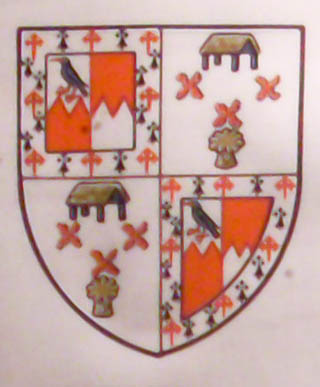
(20) Acton of Lower Wolverton Hall

The Actons of Wolverton were a Recusant family who followed the Catholic faith consistently through the 17th, 18th and 19th centuries; many of their daughters took the veil in convents in Belgium and France.  Because of their faith, the men of the family were, until the 19th century, denied a University education and the public offices which their prominence in the county would otherwise have delivered.  

The family can be traced back to the medieval Actons of Ombersley in Worcestershire, but derived its association with Lower Wolverton from William Cooksey (d. c1581), who reunited the divided moieties of the manor of Wolverton in the parish of Stoulton (Worcs).  Following his death the property passed first to his widow and then, by 1585, to his nephew, John Acton (d. 1615), son of Humphrey Acton of Burton and Alice Cooksey.  It then passed from father to son down to the early 20th century.  

From John the estate passed to his grandson, Thomas Acton (d. by 1657), a Royalist who was obliged to compound for his estates in the 1650s.  It was his grandson, William Acton (1677-1725) who rebuilt the house, reputedly in 1709.  Subsequent generations all seem to have been resident until the death of William Robert Acton in 1908.  After that, the house was intermittently let, and during the Second World War it was requisitioned and used by the van Moppes brothers to process diamonds.

William Walter Acton (1862-1946) gave the house to his son, William Anthony Acton (b. 1904) in 1925.  He lived at the hall in the 1930s but later moved to London, where he had a house in Eaton Square.  He restored Lower Wolverton c.1963 before giving it in 1965 to his daughter Caroline, wife of Major Sir Trevor Dawson, 3rd bt. (d. 1983), and they subsequently lived in the house until they sold it in the 1970s to Peter Purton. He in turn sold it Ian Elliot (b. 1938), whose widow, Mrs Suzie Elliot sold it in 2004 to the present owner, Nicholas Coleridge CBE, the novelist and magazine publisher.


Lower Wolverton Hall, Worcestershire


Lower Wolverton Hall in 2012. © Peter Reynolds.


The estate belonged to the Acton family from 1585, but nothing is known of the Tudor or Elizabethan house that stood here.  The present three storey brick house is early 18th century (reputedly of 1709).  It is absolutely plain except for stone quoins and stone keystones linked to narrow stone platbands.  A tall parapet hides the shallow hipped roof.  

Lower Wolverton Hall in snow. © Nicholas Coleridge

The south front has seven bays and the east side six, with a moulded doorcase with a large segmental pediment.  The entrance is now on the west side, which has three bays, with a lower attached service wing and a later Georgian doorway, with Tuscan columns and an open pediment.  The interior was much restored c.1963, but retains a wide, plain early 18th century staircase and other fittings.  To the south-west is a five-bay brick outbuilding with a hipped roof, dated 1714; a date which gives some support to the traditional date of 1709 for the house. Most recently, the current owners have built a delightful two-storey Gothick folly tower in the  grounds to the designs of Quinlan Terry Architects. The interior forms a delightful retreat, with a first-floor sitting room, a small kitchen and loo opening off the ground-floor hall, and a rooftop viewing platform. The interiors have been charmingly decorated by Rosanna Bossom.

Descent: William Cooksey (d. c1581); to widow, Alice Cooksey (d. by 1585); to nephew, John Acton (d. 1615); to grandson, Thomas Acton (d. by 1657); to son, William Acton (1640-79); to son, William Acton (1677-1725); to son, William Acton (d. 1763); to son, William Acton (d. 1814); to son, William Joseph Acton (1803-71); to son, William Robert Acton (1835-1908); to son, William Walter Acton (1862-1946); who gave it in 1925 to his son, William Anthony Acton (b. 1904); who gave it in 1965 to his daughter, Caroline Jane Acton (1933-2010), wife of Major Sir (Hugh Halliday) Trevor Dawson, 3rd bt. (1931-83); sold 1970s to Peter Purton; sold to Ian Elliot (b. 1938), whose widow, Mrs Suzie Elliot sold 2004 to Sir Nicholas Coleridge (b. 1957), kt. The house was frequently let after about 1860, with tenants including Robert Berkeley (d. 1897) & Lady Catherine Berkeley (1829-1924) in the 1860s, Sir Edward Walter Greene (1842-1920) in the 1880s, the Hon. Charles Leigh Adderley (1846-1926), later 2nd Baron Norton (in 1890s), Capt. Anthony Hungerford Lechmere (1868-1954) (from c.1900-25), John Sidney Mason (d. 1974) and his wife Hon. Diana Mason (1910-90) (in the 1930s) and Lewis and Edwin van Moppes from 1941.


The Actons of Lower Wolverton


Acton, John (d. 1615) of Lower Wolverton Hall.  Eldest son of Humphrey Acton of Burton and his wife Alice, daughter and ultimately heiress of John Cooksey of Evesham and sister of William Cooksey of Lower Wolverton.  He married and had issue:
(1) William Acton (d. 1615) (q.v.)
He inherited Lower Wolverton Hall from his aunt, Alice Cooksey, in 1585.
He died in 1615.

Acton, William (d. 1615) of Lower Wolverton Hall.  Son of John Acton (d. 1615).  He married Amy Bartlett and had, with one other son:
(1) Susan Acton (c.1602-83), a nun, admitted to Franciscan convent in Brussels, 1629; died 7 February 1683, aged 81;
(2) Thomas Acton (d. c.1657) (q.v.);
(3) Judith Acton (c.1611-44), a nun, admitted to Franciscan convent in Brussels, 1631; died at Nieuport, 2 February 1644 aged 33.
He died in 1615, in the lifetime of his father. His will was proved 12 February 1616.

Acton, Thomas (d. c.1657) of Lower Wolverton Hall.  Elder son of William Acton (d. 1615).  Fought as a Royalist in the Civil War.  His estates were sequestered in 1650.  He married 1632 Elizabeth, daughter of John Weedon of Sarsden (Oxfordshire) and had issue:
(1) Elizabeth Acton (b. c.1636), a nun, admitted to Sepulchrine convent at Liege, 1655 but left 1658/9 because of problems with her dowry; she returned to England to secure it but never returned;
(2) Dorothy Acton (b. c.1637), a nun, admitted to Franciscan nunnery at Nieuport 1656 but left 1658/9 with her sister;
(3) William Acton (1640-79) (q.v.).
He inherited Lower Wolverton Hall from his grandfather in 1615.
He had died by 1657.

Acton, William (1640-79) of Lower Wolverton Hall.  Son of Thomas Acton (d. c.1657) and his wife Elizabeth, daughter of John Weedon of Sarsden (Oxfordshire).  He married Barbara, daughter and co-heiress of John Vincent, a bencher of Grays Inn, and had issue including:
(1) William Acton (1677-1725) (q.v.).
He inherited Lower Wolverton Hall from his father c.1657.
He died 12 April 1679, aged 39.

Acton, William (1677-1725) of Lower Wolverton Hall.  Son of William Acton (1640-79) and his wife Barbara, daughter and co-heiress of John Vincent of Grays Inn, born 31 May 1677.  He married Margaret (d. 1721), daughter and co-heiress of Richard Perkins of Beenham (Berks) and had issue:
(1) William Acton (d. 1763) (q.v.);
(2) Perkins Richard Acton, m. Philadelphia Stapleton;
(3) Vincent Acton (d. 1764) of Harrington and St. Martin's, Worcester;
(4) Barbara Acton (d. 1785), a nun, entered Dunkirk Abbey 1732; died 14 October 1785;
(5) Anne Acton (d. 1736), a nun, entered Dunkirk Abbey 1734; died 7 August 1736.
He inherited Lower Wolverton Hall from his father in 1679 and rebuilt the house c.1709.
He died 16 July 1725, aged 48.

Acton, William (d. 1763) of Lower Wolverton Hall.  Son of William Acton (1677-1725) and his wife Margaret, daughter of Richard Perkins of Beenham (Berks).  He married Anne, daughter of William Tyler, and had issue:
(1) William Acton (d. 1814) (q.v.).
He inherited Lower Wolverton Hall from his father in 1725.
He died 3 December 1763.

Acton, William (d. 1814) of Lower Wolverton Hall.  Son of William Acton (d. 1763) and his wife Anne, daughter of William Tyler.  He married 1801 Ann Constantia Davies, a descendant of the Fowlers of St Thomas (Staffs) and had issue:
(1) William Joseph Acton (1803-71) (q.v.);
(2) Mary Acton, died unmarried.
He inherited Lower Wolverton Hall from his father in 1763.
He died 22 February 1814, and was buried at Stoulton (Worcs), where he is commemorated by a monument designed by Michael Crake of London and a hatchment.

Acton, William Joseph (1803-71) of Lower Wolverton Hall.  Only son of William Acton (d. 1814) and his wife Ann Constantia (nĂ© Davies), born 27 June 1803.  JP for Worcestershire.  He married 22 October 1833 Mary Monica (d. 1876), widow of William Trafford of Pleremore (Worcs), and had issue:
(1) William Robert Acton (b. & d. 1834);
(2) William Robert Acton (1835-1908) (q.v.);
(3) Thomas Vincent Acton JP (1836-1916), m. 1876 Margaret (d. 1915), daughter of Sir Arnold Knight MD of Six Hills (Lincs); lived at Berkeley House, Overbury (Worcs);
(4) Rev. Edward Charles Acton (1839-99), RC priest in Stafford; died unmarried and without issue; commemorated by a brass in the 'memorial tree' at Oscott College.
He inherited Lower Wolverton Hall from his father in 1814.
He died 30 May 1871.

Acton, William Robert (1835-1908) of Lower Wolverton Hall.  Eldest son of William Joseph Acton (1803-71) and his wife Monica, born 16 November 1835.  JP for Worcestershire.  He married 1861 Sarah Margaret (d. 1897), daughter of Robert Dand of Gloster Hill, Northumberland and had issue:
(1) William Walter Acton (1862-1946) (q.v.);
(2) Robert Matthew Acton (b. 1864), died unmarried?;
(3) Henry Edward Acton (b. & d. 1867);
(4) Vincent Henry Acton (1868-70);
(5) Edward Vincent Joseph Acton (1871-1912), m. Gertrude, daughter of Thomas M. Field of Boston (USA) and had issue one son;
(6) Charles Joseph Acton (b. 1872)
(7) Roger David Acton (1874-1959), colonial administrator, m. Beatrice Ena, daughter of Baron Zilz and widow of C.W. Mead, but died without issue; died 17 February 1959;
(8) Mary Margaret Acton (b. 1876), died unmarried;
(9) Winifred Mary Acton (1878-1959), m. 1913 Philip Vincent Baines;
(10) Richard Joseph Acton (b. 1880); lived in Malaya.
He inherited Lower Wolverton Hall from his father in 1871.
He died 14 March 1908.

Acton, William Walter (1862-1946), of Lower Wolverton Hall.  Eldest son of William Robert Acton (1835-1908) and his wife Margaret, daughter of Robert Dand; born 10 November 1862.  Educated at Oscott and Cooper's Hill College.  Colonial administrator with Federated Malay States, 1886-1913.  He married 1903 Edith Mary Dolores, daughter of William Francis Bourne Paul of Kensington (Middx) and had issue:
(1) William Anthony Acton (1904-93) (q.v.).
He inherited Lower Wolverton Hall from his father in 1908 but never occupied it and gave it to his son as a 21st birthday present in 1925. 
He died 3 February 1946 at Uxbridge (Middx) and was buried at Stoulton (Worcs).

Acton, William Anthony (1904-93), of Lower Wolverton Hall.  Only child of William Walter Acton (1962-1946) and his with Edith Mary Dolores, daughter of William Francis Bourne Paul; born 8 April 1904.  Educated at Eton and Trinity College, Cambridge.  High Sheriff of the County of London, 1955.  He married 1932 Joan Cinnetta, only child of Hon. Francis Geoffrey Pearson and had issue:
(1) Caroline Jane Acton (1933-2010), m. 1955 Maj. Sir (Hugh Halliday) Trevor Dawson, 3rd bt. (d. 1983), only son of Cdr. Sir Hugh Trevor Dawson CBE RN, 2nd bt. and had issue two sons.
He was given Lower Wolverton Hall as a 21st birthday present in 1925 and was living there in the 1930s.  He gave it to his daughter in 1965, shortly after restoring the interior in c.1963. He lived subsequently in Eaton Square, London, at Midhurst (Sussex) and in Corfu.
He died 3 March 1993 in Kensington (Middx) and was buried at Stoulton (Worcs).


Sources


VCH Worcs vol 3, 1913, pp. 532-37; Burke's Landed Gentry, successive editions; P. Reid, Burke’s & Savill’s Guide to Country Houses: vol. 2, West Midlands, 1980, p. 233; B. Lowry & M. Wilks, The Mercian Maquis, 2002; A. Brooks & Sir N. Pevsner, The buildings of England: Worcestershire, 2nd edn., 2007, pp. 521, 610 http://www.telegraph.co.uk/lifestyle/9661297/My-perfect-weekend-Nicholas-Coleridge-novelist-and-president-of-Conde-Nast-International-magazine-group.html


Where are their papers?


No significant archive is known to survive.


Revision and acknowledgements

This post was first published on 28 March 2013, and was updated 2015, 10 March and 2 December 2021, 31 December 2022 and 8 September 2023. I am grateful to Sir Nicholas and Lady Coleridge for additional information and pictures.

Monday, 25 March 2013

(19) Acton (later Ball-Acton) of Kilmacurragh alias West Aston


Acton coat of arms
© Jimmy Nicolle CC licence

Thomas Acton (d. 1671) (whose presumed relationship to the Actons of Aldenham has never been established, although the family used the same coat of arms; a possible link is suggested here) went to Ireland with the army in 1640 and leased Bog Hall at Ballyshannonbeg (part of the later estate).  By 1716 his grandson, Thomas Acton (d. 1750) was established at Kilmacurragh (also known as West Aston until the 19th century), where he built the centre of the present house.  The property then descended from father to son to Thomas Acton (1826-1908), who created an important garden with the assistance of David and Sir Fredrick Moore, directors of the Botanic Gardens in Dublin.  On his death, the estate passed in quick succession to two of his nephews, both killed in the First World War, and then to Charles Acton (1914-99), who inherited at the age of two and later became the literary critic of the Irish Times.  He sold it in 1944.  

Charles Ball-Acton (1830-97), a younger son of Lt-Col. William Acton (1789-1854), owned Syddan (Meath) and Eggington House (Beds); Charles Acton (1914-99) also lived at Stradbrook House, Blackrock (Dublin).

Kilmacurragh, Wicklow

Kilmacurragh House before the addition of the wings. Image: Peter Acton.

The five bay, two storey pedimented centre of the present house was built on a new site for Thomas Acton (d.1750), traditionally in 1697 and to the designs of Sir William Robinson (1645-1712).  However it would seem that Acton did not acquire the lands on which the house was built from the Parsons family until 1716, and the house looks more likely to date from the 1720s or 1730s.  

Kilmacurragh House, probably in the 1930s. Image: National Botanic Garden of Ireland

Kilmacurragh House in 2006. Image: Terence Reeves-Smyth.

Col. William Acton (1789-1854) added the single-storey two bay wings in 1848, and his son Thomas created an important garden with the assistance of David and Sir Fredrick Moore, directors of the Botanic Gardens in Dublin.  The house was leased in the 1930s to Charles Budina, a German who used it as an hotel where various Nazi gatherings were held before the War, and it was finally sold in 1944.  It served a variety of uses in the 1950s and 1960s but became ruinous after a fire in 1978.  In 1996 the house and arboretum were purchased by the Office of Public Works and the shell of the house has been partially stabilised.  The grounds are open to the public as an arboretum. In 2016 plans were announced for the restoration of the house when funds permit.

Descent: Thomas Acton (d. 1671); to son Thomas Acton (1655-1750); to son William Acton (1711-79); to son Thomas Acton (1742-1817); to son Lt-Col. William Acton (1789-1854); to son, Thomas Acton (1826-1908); to nephew, Maj. Charles Annesley Acton (1876-1915); to brother, Maj. Reginald Thomas Annesley Ball-Acton (1877-1916); to son, Charles Ball-Acton (later Acton) (1914-99), who sold it in 1944...sold 1996 to Office of Public Works.

Syddan House, Meath

Syddan House. © National Inventory of Architectural Heritage

A three bay two storey Classical house, built c.1880 for Col. Charles Ball-Acton, but still maintaining a Regency look.  It is built of limestone rubble with red brick surrounds to the windows, and was no doubt originally rendered.  In the centre is a round-arched stone doorcase with carved keystone and fanlight above.  The setting of the house is enhanced by the wrought- and cast-iron entrance gates and by the stone outbuildings.


Eggington House, Bedfordshire

Eggington Hall in 2009.

Eggington House in Bedfordshire is an unassuming but extremely attractive house, believed to have been built for a Huguenot, John Renouille alias Reynal (fl. 1696-1722), who after being forced to flee Montauban in France following the Revocation of the Edict of Nantes, became a prosperous tailor in London. The date traditionally ascribed to the house is 1696, but there seems to be nothing to support this, and both stylistically and on the grounds of the limited archival evidence a date in the 1710s seems much more probable. A property consisting of two houses and about 60 acres of land at Eggington seems to have been bought by Reynal from Richard Andrews between 1710 and 1717, and the building of the present house probably followed shortly afterwards. It had definitely been built by 1728, when it was depicted on a survey plan of the estate. It is a three-storey house of brick with a panelled parapet with urns; the entrance front has seven closely-spaced segment-headed windows and a central door-hood carried on carved brackets, while the garden front has five bays, more widely-spaced. Inside, the house is panelled throughout and has four main rooms on each floor; the drawing room has shell-headed niches. The fine staircase has three twisted balusters per step. The house has been almost continuously let since it was built, which may have preserved it from later alterations. It was restored by Mr & Mrs J.L. Hodgson, tenants from 1918, and again by later 20th century owners. Sir Albert Richardson, who was a friend of the Hodgsons, greatly coveted the house, which he admired because it was so unspoilt.


Eggington House: drawing room in 2009.


Descent: John Renouille alias Reynal (fl. 1696-1722); to son, John James Reynal (1714-62); to son, John Sayer Weale Reynal (1749-84); to widow, Sarah (1749-1835), later wife of Col. Francis Moore (1746-1810); to nephew, Millard Adams (1792-1871); to son, John Warner Adams (1823-1903); to son, John James Reynal Adams (1848-1909) who left the house in trust for his housekeeper, Sarah Mann (d. 1925); to Groom Cooper Bunker (1857-1932); to children, who sold 1950 to Sir Gilbert Inglefield (1909-91); sold 1976 to Gordon Slynn, Baron Slynn of Hadley (1930-2009); to widow, Odile, Lady Slynn, who sold 2010 to Olivier and Suzie Garrigue. The tenants including Charles Ball-Acton (1830-97) and Mr & Mrs John Lawrence Hodgson (fl. 1918-36).

The Actons of Kilmacurragh

For portraits of several members of the Acton family, see here.

Acton, Thomas (d. 1671).  Only son of Thomas Acton, a soldier in Cromwell's army, who settled at Bog Hall, Ballyshannonbeg (Wicklow).  He married Alice Coventry and had issue:
(1) Thomas Acton (q.v.).
He inherited the estate at Ballyshannonbeg in co. Wicklow from his father.
He died in 1671.

Acton, Thomas (fl. late 17th cent.) Only known son of Thomas Acton (d. 1671).  He married and had issue:
(1) Thomas Acton (d. 1750) (q.v.).
He inherited the estate at Ballyshannonbeg in co. Wicklow from his father in 1671.
He died at an unknown date before 1697.

Acton, Thomas (d.1750).  Only son of Thomas Acton (fl. late 17th cent.).  He married Elinor (d.1747), daughter of Col. Nicholas Kempston of Dunmurry (Cavan) and had issue:
(1) William Acton (1711-79) (q.v.); 
(2) Grace Acton, m. Thomas Ball of Sea Park (Wicklow), barrister; 
(3) Elinor Acton, m. Rev. John Blackford DD (d. 1748); 
(4) Alice Acton, m. her cousin, Henry Kempston.
He acquired the estate of Kilmacurragh (Wicklow) in 1716, also known until 19th century as West Aston, and built the central portion of Kilmacurragh House.
He died 2 January 1750.

Acton, William (1711-79). Only son of Thomas Acton (d. 1750) and his wife Elinor (d.1747), daughter of Col. Nicholas Kempston of Dunmurry (Cavan); born 1711.  Educated at Trinity College, Dublin (admitted 1726). He was Keeper of Writs in the Court of Common Pleas in Ireland and Serjeant of the Coif.  He married 2nd?, 4 March 1756, Jane, daughter of William Parsons and granddaughter of Sir William Parsons of Birr Castle (Offaly) and had issue:
(1) William Acton, dsp; 
(2) Thomas Acton (1742-1817) (q.v.)
(3) Martha Acton, died unmarried and without issue; 
(4) Maria Acton (d. 1837), m. 1783, Thomas Walker (d. 1837) of Tykillen (Wexford), Master in Chancery; 
(5) Jane Acton (d. 1794), died unmarried and without issue.
He inherited the Kilmacurragh (Wicklow) estate from his father in 1750.
He died in 1779, aged about 68.

Acton, Thomas (1742-1817).  Only surviving son of William Acton (1711-79) and his 1st wife, born 1742.  Barrister at law in Dublin; High Sheriff of Co. Wicklow, 1781. He married, 1780, Sidney (d. 1837), daughter of Joshua Davis of Dublin, barrister and had issue:
(1) Lt-Col. William Acton (1789-1854) (q.v.); 
(2) Rev. Thomas Acton (d. 1846) of Dunganstown Glebe (Wicklow), married, September 1818 Sidney, daughter of Hampden Evans of Portrane (Co. Dublin) and had issue three sons and two daughters (one of whom married Henry Lambert Bayly (1808-1905)); died 1846; 
(3) Anna Maria Acton, m. 1800 Maj. George Warburton of Aughrim (Galway), Inspector-General of Royal Irish Constabulary; 
(4) Jane Acton, m. George Mears John Drought (d. 1844) of Glencarrig (Wicklow), younger son of John Drought of Whigsboro, Birr (Offaly) and had issue.
He inherited the Kilmacurragh (Wicklow) estate from his father in 1779, and changed the name to West Aston.
He died 21 November 1817. His widow died 27 May 1837.

Acton, Lt-Col. William (1789-1854).  Elder son of Thomas Acton (1742-1817) and his wife Sidney, daughter of Joshua Davis of Dublin, barrister.  He was a JP for Co. Wicklow and High Sheriff of the county in 1820.  He served as Lt-Col. of the Wicklow militia and as MP for the county 1841-48.  He married 16 June 1818 his first cousin, Caroline (d. 1879), daughter of Thomas Walker of Tykillen (Wexford), Master in Chancery, and had issue:
(1) Maria Acton (1819-35); died unmarried and without issue;
(2) Sidney Acton (1820-41); died unmarried and without issue;
(3) Caroline Acton (1822-34); died unmarried and without issue;
(4) Janet Acton (1824-1906); died unmarried and without issue, 5 November 1906;
(5) Thomas Acton (1826-1908) (q.v.); 
(6) Col. William Molesworth Cole Acton (1827-1904), born 29 December 1827; Col. of 77th Regiment; for an account of his role in the Battle of Inkerman see here; married 7 August 1861 Elizabeth Frances (d.1928), daughter of Capt. Frederick Adolphus Robinson, but died without issue, 22 April 1904;
(7) Col. Charles Ball-Acton CB (1830-97) (q.v.) .
He inherited the Kilmacurragh (Wicklow) estate from his father in 1817, and added the wings to the house in 1848.
He died 10 April 1854.

Acton, Thomas (1826-1908).  Eldest son of Lt-Col. William Acton (1789-1854) and his wife Caroline, daughter of Thomas Walker of Tugunnan (Wexford), Master in Chancery.  He was a JP and Deputy Lieutenant of Wicklow, and served as High Sheriff of the county, 1857.  He inherited Kilmacurragh (Wicklow) on the death of his father in 1854 and created the gardens with the assistance of David and Sir Fredrick Moore.  On his death in 1908, unmarried and without issue, the estate passed to his nephew, Maj. Charles Annesley Acton (1876-1915).

Ball-Acton, Col. Charles (1830-97) of Syddan House (Meath) and Eggington House (Bedfordshire).  Born 17 December 1830, youngest son of Lt-Col. William Acton (1789-1854) and his wife Caroline, daughter of Thomas Walker of Tugunnan (Wexford), Master in Chancery.  Educated at Rugby and Cheltenham College.  Col. of 51st Kings Own Yorkshire Light Infantry; for a biography of his life, see here.  He assumed the additional surname of Ball by deed poll in 1875.  He married 31 July 1869 Georgina Cecilia (d. 1912), daughter of George Annesley of London and had issue:
(1) William Parsons Annesley Ball-Acton (1871-83), dsp; 
(2) Evelyn Caroline Annesley Ball-Acton (1873-1965), m. 1898 Edward Nixon Wynne JP (d. 1923) of Wentworth House (Wicklow) and had issue one son and one daughter; 
(3) Grace Annesley Ball-Acton (1874-1923), born in India; died unmarried and without issue 5 December 1923;
(4) Maj. Charles Annesley Ball-Acton (1876-1915) (q.v.); 
(5) Maj. Reginald Thomas Annesley Ball-Acton (1877-1916) (q.v.)
(6) Vere Annesley Ball-Acton (1879-1900), 2nd Lt, Oxford Light Infantry, killed in action at Paardeberg, South Africa, 19 February 1900; 
(7) Irene Annesley Ball-Acton (1883-1966) of Glencapple, Kilmacanogue (Wicklow), died unmarried and without issue, 21 April 1966.
He died 3 February 1897.

Ball-Acton, Maj. Charles Annesley (1876-1915).  Born 14 February 1876, eldest surviving son of Col. Charles Ball-Acton (1830-97) and his wife Georgina Cecilia, daughter of George Annesley.  Educated at Rugby School and the Royal Military College, Sandhurst.  He served in the Royal Welsh Fusiliers and was part of the China expedition in 1900, and returned to his regiment during the First World War; for a summary of his career see here.  He was a JP for Co. Wicklow and served as High Sheriff of the county in 1913.  
He inherited the Kilmacurragh estate (Wicklow) from his uncle in 1908; on his death unmarried and without issue it passed to his younger brother.
He was killed in action at the Battle of Loos, 25 September 1915.

Ball-Acton, Maj. Reginald Thomas (1877-1916). Born 2 October 1877, second surviving son of Col. Charles Ball-Acton (1830-97) and his wife Georgina Cecilia, daughter of George Annesley.  Educated at Rugby and the Royal Military College, Sandhurst.  He served in the Kings Own Yorkshire Light Infantry during the Boer War, 1899-1902 and during the First World War. He married 1913 Isabel (d. 1971), daughter of Rev. William Richmond, rector of Rockhampton (Glos) (who m.2, 1920, Hugh Norman Digues La Touche) and had issue:
(1) Charles Acton (né Ball-Acton) (1914-99) (q.v.).
He inherited the Kilmacurragh estate (Wicklow) from his elder brother in 1915, but died the following year, leaving an infant son and heir.
He was killed in action at the Battle of Ypres, 22 May 1916; buried at White House Cemetery, Belgium.

Acton (nĂ© Ball-Acton), Charles (1914-99).  Only son of Maj. Reginald Thomas Ball-Acton (1877-1916) and his wife Isabel, daughter of Rev. William Richmond; born 25 April 1914 at Iron Acton (Glos).  Educated at Rugby School and Trinity College, Cambridge. He changed his name from Ball-Acton to Acton by deed poll in 1939.  Had a varied career including periods as lecturer, broadcaster and music critic of the Irish Times from 1955; Governor of the Royal Irish Academy of Music from 1954; Vice-President of the Association for the Promotion of Music in Education, 1970.  He married 1951 Carol, daughter of Francis Thompson Little of Clabby (Fermanagh), but died without issue.  For an obituary and appreciation, see here.
He inherited the Kilmacurragh estate (Wicklow) from his father in 1916, but let it in the 1930s and sold it in 1944.
He died in 1999.

Sources

Burke's Irish Family Records, 1976, pp. 1-3; Sir N. Pevsner, The buildings of England: Bedfordshire and the county of Huntingdon and Peterborough, 1968, p. 83; M. Bence-Jones, A guide to Irish country houses, 2nd edn, 1988, pp. 174, 266; http://www.botanicgardens.ie/kilmac/kilmhist.htm; http://www.parsonsfamily.co.uk/acton.php; http://www.turtlebunbury.com/history/history_family/hist_family_acton.html.

Where are their papers?

Acton family of Kilmacurragh: deeds and papers, 1643-1850 [Private collection: enquiries to National Library of Ireland]


Revision & Acknowledgements


This account was first published 25 March 2013, and revised 14 May 2014, 15 January and 9 July 2017, 27 November 2018 and 15 August 2021.

Saturday, 23 March 2013

(18) Acton of Gatacre Park

Acton coat of arms
© Jimmy Nicolle. CC licence
Thomas Acton (1623-77), second son of Sir Edward Acton, 1st baronet of Aldenham (see previous post), inherited Gatacre Park at his father’s death in 1659.  The estate passed by descent to Edward Farrer Acton (1805-90), who inherited in 1822 and rebuilt the house in 1849-50, and who created a small Italianate formal garden and terrace and a larger woodland garden.  His son, Capt. Edward William Frederick Acton (1834-1920), whose only daughter, Helen Beatrice (1855-97), wife of John Kendall Brooke of Sibton Park (Suffolk) predeceased him, seems to have sold the estate c.1900.


Gatacre Park (Shropshire)


Gatacre Park.  © Roger Kidd.  Licenced under a Creative Commons Licence.
The late 16th century house on this site, once ‘celebrated for its curious rooms and hiding places’ where the Earl of Derby was concealed before the Battle of Worcester in 1651, was pulled down in 1849.  No illustration of it has been found and if anyone knows of one I should be most interested to see it.  The present two storey five bay Classical house of red brick with stone dressings and a slate roof was built in 1850.  It has a heavy stone eaves cornice and stone string courses, and rather resembles houses on the Calthorpe estate at Edgbaston.  The west (entrance) front has a projecting bays at either end and a porch on the fourth bay which projects further.  The first floor windows have architraves and the ground floor ones cornice hoods on console brackets.  The east elevation has a large stone semi-circular bay window on ground floor, and there is a three-storey service wing to the north. The interior contains some re-set panelling, probably from the former house on the site.  The gardens have all been created since 1923.  There is a woodland garden renowned for its profusion of azaleas, rhododendrons, and mature specimen trees, a small Italianate garden on the left of the lawn, with steps down to a pond and clipped yews, and a terrace walk with topiary of clipped yews, featuring eccentric shapes such as screws, teapots, teddy bears, and toadstools.  The house should not be confused with Gatacre Hall, nearby.

Descent: Humphrey Elliott; to son, John Elliott (b. 1625; fl. 1655); sold to Sir Edward Acton of Aldenham, 1st bt. (d. 1659); to younger son, Thomas Acton (1623-77); to son Thomas Acton (1665-1734); to nephew, Edward Acton (1704-67); to daughter, Frances Acton (1747-1803), wife of Elijah Barrer; to son, Edward Acton Barrer (1767-1822), who took the name Acton in lieu of Barrer in 1791; to son, Lt-Col. Edward Farrer Acton (1805-90); to son, Edward William Frederick Acton (1834-1920), who sold the house between 1891 and 1901 but retained the estate until after 1909...sold 1923 to Albert Edward Thompson (1866-1937); to son, Sir Edward Walter Thompson (1902-89); to son, Edward Martin Amphlett Thompson (b. 1933).


The Actons of Gatacre Park


Acton, Sir Edward (1600-59), 1st baronet, of Acton Scott Hall and Aldenham Park.  Son of Walter Acton (c.1575-1641) and his wife Frances, daughter of Edward Acton of Acton Scott; baptised at Morville, 20 July 1600.  MP for Bridgnorth, 1640-44; deprived of his seat as a Royalist.  Created a baronet, 17 January 1643/44.  In the Civil War he was a Colonel in the Royalist Dragoons and saw action at the Battle of Edgehill and the siege of Bridgnorth Castle (which he surrendered in 1646); compounded for his estates in 1646 for £5,242, later reduced to £2,000.  He married c.1620 Sarah (1598-1679), daughter of Richard Mytton of Halston (Shropshire) and had, with an unnamed daughter who died in infancy:
(1) Sir Walter Acton (1621-65), 2nd bt. (q.v.); 
(2) Edward Acton (b. 1621/22), baptised 2 January 1622; died young; 
(3) Thomas Acton (1623-77), from whom descend the Actons of Gatacre Park
(4) Frances Acton (1625-26), baptised 13 November 1625; buried 25 May 1626;
(5) Robert Acton (1628-54), baptised 2 November 1628; died without issue and was buried 29 March 1654;
(6) William Acton (1629-59) of Buildwas (Shropshire), draper; baptised 2 March 1629; m. 29 December 1653, Mary (d. 1715), daughter of Arthur Weaver and had issue, one son and one daughter; 
(7) Capt. Richard Acton RN (1633-74), baptised 21 April 1633; fought in First and Second Dutch wars; m. Lydia Pearson of London and had issue a daughter; buried 25 April 1674.
He inherited Aldenham Park and Acton Scott Hall from his father in 1641.  He also bought Gatacre Park after 1655.
He died in 1659 and was buried 29 June 1659.  His will was proved in the Prerogative Court of Canterbury, 20 December 1659.

Acton, Thomas (1623-77). Second son of Sir Edward Acton (1600-59), 1st bt. and his wife Sarah, dau of Richard Mytton of Halston (Shropshire); baptised 25 January 1623.  Educated at Alban Hall, Oxford (matriculated 1640).  He married c.1661, Mabel, daughter of Clement Stonor, of London, mercer, and had issue:
(1) Edward Acton, (b. c.1662), d. young;
(2) Sarah Acton (c.1663-1752), m. John Whitmore of Luston (Shropshire) and had issue; died 20 June 1752;
(3) Thomas Acton (1665-1734) (q.v.);
(4) Clement Acton (1669-1727) (q.v.);
(5) Rachel Acton (1671-1706), m. Rev. John Eyton and had issue.
He inherited Gatacre Park from his father in 1659.
He died in 1677, aged 56, and was buried at Tasley (Shropshire).

Acton, Thomas (1665-1734).  Elder son of Thomas Acton (1623-77) and his wife Mabel, daughter of Clement Stonor of London, mercer.  Educated at Merton College, Oxford (matriculated 1683/4).  He inherited Gatacre Park from his father in 1677, but died unmarried and without issue, whereupon the estate descended to his nephew, Edward Acton (1704-67).  He died 4 October 1734 and was buried at Tasley (Shropshire), 7 October 1734.  His will was proved in the Prerogative Court of Canterbury, 9 July 1735.

Acton, Clement (1669-1727), ironmaster at Halesowen.  Younger son of Thomas Acton (1623-77) and his wife Mabel, daughter of Clement Stonor of London, mercer.  He married 1690 Mary Hickman (d. 1742) and had issue:
(1) Thomas Acton (1701-41);
(2) Edward Acton (1704-67) (q.v.);
(3) Clement Acton (1706-64), m. his cousin, Jane Whitmore;
(4) Walter Acton (b. 1710); died before 1726;
(5) Mary Acton (1713-63), m. Peter Habberley and had issue;
(6) James Acton (1716-50);
(7) Mabel Acton (1720-72), died unmarried.
He died 13 February 1726/7.

Acton, Edward (1704-67).  Eldest son of Clement Acton (1669-1726) and his wife Mary (nĂ©e Hickman), baptised 16 August 1704.  He married 1745 Anne York (1708-94) and had issue:
(1) Mabel Acton (1746-1831), m.1st, Rowland Hill, m.2nd, John Zouch, m.3rd, Thomas Haslewood, and m.4th Joseph Sparkes, but had no issue;
(2) Frances Acton (1747-1803), m.1st, 1767 Elijah Barrar (q.v.) and had issue and m.2nd, Goodwin Zouch.
He inherited the Gatacre Park estate from his uncle in 1734.
He died 22 November 1767 and was buried at Tasley (Shropshire).

Barrar (nĂ©e Acton), Frances (1747-1803).  Younger daughter and heir of Edward Acton (1704-67) and his wife Anne (nĂ©e York), baptised 22 April 1747.  She married 1st, at St. Dunstan, Stepney (Middx), 16 February 1767 Elijah Barrar (1733-69) of Amblecote in Oldswinford (Worcs), glassmaker, who was declared bankrupt the same year, and she married 2nd, 27 April 1775 at Claverley (Shropshire), Goodwin Zouch.  She had issue:
(1.1) Edward Acton Acton (né Barrer) (1767-1822) (q.v.);
(1.2) Mabel Barrar (b. 1768), m. 1794 John Bretland Hollings of Berington (Shropshire) and had issue 2 daughters.
She inherited the Gatacre Park estate from her father in November 1767, but let it.  The tenant in 1777 was Benjamin Stokes.
She died 24 April 1803, aged 56.

Acton (nĂ© Barrar), Edward Acton (1767-1822). Only son of Elijah Barrer and his wife Frances, daughter of Edward Acton, born 11 December 1767.  He assumed the name Acton in lieu of Barrer in 1791.  Captain in the Shropshire Militia.  He married at St Paul, Covent Garden, London, 27 December 1804 Frances Elizabeth (1784-1879), daughter of Rev. John Grove Spurgeon, rector of Clopton, and had issue:
(1) Lt-Col. Edward Farrer Acton (1805-90) (q.v.); 
(2) Frances Amelia Acton (1807-88), m. 1854 John James Harris of Hayne (Devon) and had issue; 
(3) Henry Spurgeon Acton (b. 1813);
(4) Emily Anne Acton (b. 1817).
He inherited Gatacre Park from his mother in 1803 but continued to let it and lived in Ipswich and later Lowestoft (Suffolk).
He died 5 April 1822, aged 54 and was buried at Oulton (Suffolk).

Acton, Lt-Col. Edward Farrer (1805-90). Only son of Edward Acton (1767-1822) and his wife Frances Elizabeth, daughter of Rev. John Grove Spurgeon; born 25 September 1805 in Ipswich (Suffolk).  Educated at Trinity Hall, Cambridge (matriculated 1825; scholar 1827; LLB 1832) and Lincolns Inn (admitted 1827); DL and JP for Shropshire; Lt-Col. of the Shropshire Militia.  He married, at St George's, Hanover Square, London, 10 April 1832, Mary Anne (1808-90), daughter of Rev. Horace Suckling, rector of Barsham (Suffolk) and had issue:
(1) Mary Henrietta Acton (c.1833-88), m. 1859 Rev. George Ayton Whittaker, rector of Henstead (Suffolk)
(2) Edward William Frederick Acton (1834-1920) (q.v.).
He inherited the Gatacre Park estate from his father in 1822 and rebuilt the house in 1849-50.
He died 28 November 1890 and was buried at Tuck Hill (Shropshire). Will proved in the Principal Probate Registry, 24 February 1891; estate £12,270.

Acton, Capt. Edward William Frederick (1834-1920).  Only son of Lt-Col. Edward Farrer Acton (1805-90) and his wife Mary Anne, daughter of Rev. Horace Suckling.  Captain in 76th Regiment, which was stationed in Canada, 1853-57, where he married and lived for a time after retiring from the regiment.  JP for Shropshire.  He married, 1855, Helen Maria (c1830-1887), daughter of William Parker Ranney of St. John's, New Brunswick (Canada) and had issue:
(1) Helen Beatrice Acton (1855-97), born 24 November 1855 in New Brunswick; married, 18 April 1882 at St George's, Hanover Square, London, John Kendall Brooke (1856-1939) of Sibton Park (Suffolk) and had issue five sons and three daughters; died in childbirth, 4 February 1897.
He inherited the Gatacre Park estate from his father in 1890; but sold it after his daughter's death in 1897.
He died 30 December 1920 aged 86 at The Leasowes, Tasley (Shropshire) and was buried 3 January 1921 in Bridgnorth Memorial Cemetery. Will proved in London, 24 February 1921; estate £45,724.


Sources

The London Magazine or Gentleman's Monthly Intelligencer, vol. 36, 1767, p. 691; Burke's Landed Gentry, 1898, vol 1, p. 2; http://www.britishlistedbuildings.co.uk/en-255049-gatacre-park-claverley-; http://www.liberoricercatore.it/Storia/personaggiillustri/Genealogy-of-the-Acton-family.pdf


Where are their papers?

Acton family of Gatacre Park: No significant archive is known to survive.

Revision and acknowledgements


This post was first published on 23 March 2013 and revised 4th July 2015 in the light of information provided in the comment below.


Thursday, 21 March 2013

(17) Acton of Acton Scott

Acton of Acton Scott and
Aldenham coat of arms.
© Jimmy Nicolle. CC licence
Coat of arms granted to Thomas
Stackhouse Acton in 1990.
Courtesy of William Acton
The Acton family were in residence at Acton Scott by 1255.  Richard Acton (d. 1590) replaced the medieval manor house with the present building shortly before he died.  His granddaughter, Frances Acton, married her cousin, Walter Acton of Aldenham Park, uniting the two estates for around a hundred years.  (An account of the Actons of Aldenham will be given in a forthcoming post).  Their son, Sir Edward Acton (d. 1659), was created a baronet in 1644.  With the death of Sir Edward Acton, 3rd bt., in 1716, Aldenham passed with the baronetcy to his elder son, but Acton Scott passed first to his second son, Edward Acton (d. 1747), and then to Edward Acton (1724-75), who was the son of their youngest brother, the Rev. John Acton, vicar of Clun.  Edward’s daughter and heir, Theresa Susannah Acton, wife of John Stackhouse of Pendarves (Cornwall), inherited in 1780, and on her death in 1834 Acton Scott, together with her property at How Caple Court and Sollers Hope (Herefs) passed to their youngest son, Thomas, who assumed the additional surname Acton.  Thomas seems already to have been in occupation at Acton Scott by c.1810-20, when he commissioned a remodelling of the house by Joseph Bromfield.  When he died without issue in 1835 How Caple and Sollers Hope and the Acton Scott estate passed to his brother Edward, but Acton Scott Hall devolved on his widow Frances (d. 1881), and at her death on his great-nephew, Augustus Wood (1842-1918), who again took the additional surname Acton on receiving the inheritance.  He had already inherited the How Caple estate in 1853 and the Acton Scott estate in 1873.  His daughter Joyce (b. 1899) married Richard Charles Fullarton-Smith (d. 1970), who took the surname Acton in 1941.  The estate now belongs to their son, Thomas Stackhouse Acton (1925-2020), who featured prominently, with his son and heir Francis (b. 1967), in the BBC TV series Victorian Farm, broadcast in 2009.  The Home Farm is now operated by a charitable trust as the Acton Scott Heritage Farm.


Acton Scott Hall, Shropshire


Acton Scott Hall: north front. © Peter Whatley.  Licenced under a Creative Commons Licence.

A square gabled house of brick with mullioned and transomed windows, traditionally said to have been built c.1580-90, perhaps by Walter Hancock, for Richard Acton (d. 1590).  The house is an exceptionally early example of a double pile plan, and similar to Whitehall, Shrewsbury (of 1578-82).  In 1672 the house was taxed on ten hearths.

Acton Scott Hall: the south front.

The south front was originally the entrance side, and has a narrower central bay between canted bay windows.  On this side the house is of two storeys plus the gables, but at the back the fall of the land means that there is an extra full storey, so the facade towers to four storeys; the basement level provided service accommodation.  When Thomas Pendarves Stackhouse made the Hall his home in 1807, he found a building that had become dilapidated after many years of occupation by tenants. As his new wife Frances put it in 1812, “The small paned leaded windows with no shutters let in wind and rain so that the candles blew out unless protected by a screen. The drawing room carpet was often soaked with the rain that beat in during the night. In winter the only habitable room was the Smoking Room”. The main entrance was moved to the north front in c.1811, when Joseph Bromfield remodelled the interior and added a large new east wing, containing a new dining room.  The main staircase with turned balusters is mid 18th century, and the Jacobean woodwork, including the arcaded overmantel in the hall was probably imported by Frances Stackhouse Acton in the mid 19th century.  The late 16th century wainscot in the Justice Room, with miniature arcading in the frieze, may be indigenous.  Most of the 19th century additions were demolished in 1961-62.  The Gothick home farm (now the Acton Scott Heritage Farm) was built in 1768 and is unusually ambitious for its date.  The grounds were laid out between 1807 and 1822 in the gardenesque style, probably largely to the designs of the Stackhouse Actons themselves, and apparently replaced an open parkland setting.

Previous owners: Richard Acton (d. 1590); to Edward Acton; to daughter Frances Acton, wife of Walter Acton of Aldenham (d. 1641); to son, Sir Edward Acton of Aldenham, 1st bt. (1600-59); to son, Sir Walter Acton of Aldenham, 2nd bt. (d. 1665); to son, Sir Edward Acton of Aldenham, 3rd bt. (d. 1716); to second son,  Edward Acton (d. 1747); to son, Edward Acton (1724-75); to widow, Anne Acton (d. 1780);  to daughter Theresa Susannah Acton (1754-1834), wife of John Stackhouse of Pendarves (Cornwall) (1741-1819); to son Thomas Pendarves Stackhouse (Stackhouse Acton after 1834) (1778-1835); the Hall then passed to his widow, Frances Stackhouse Acton (d. 1881) and the estate to his elder brother Edward William Wynne-Pendarves (d. 1853); and then to the latter's sister, Catherine Holt (1790-1873) before passing to her great-nephew, Augustus Wood (Wood-Acton or Stackhouse Acton after 1881) (1842-1918), who also inherited the Hall; to daughter, Joyce Stackhouse Acton (b. 1899), wife of Richard Charles Fullerton-Smith (later Acton) (1882-1970); given 1966 to son, Thomas Stackhouse Acton (1925-2020); to son, Lt-Col. Francis Stackhouse Acton (b. 1967).


How Caple Court, Herefordshire


How Caple Court: the late 17th century facade overlooking the gardens.

The house is basically the three bay two and a half storey house built in the late 17th century for Sir William Gregory, with continuous string courses, moulded cornice and tiled hipped roof.  The mullioned and transomed windows and canted bays are of c.1885, when Nicholson & Son enlarged the house.  Further large extensions were carried out from 1902 for Lennox B. Lee in a vernacular Arts & Crafts spirit, at least in part to his own designs.  


How Caple Court: the gatehouse of 1923. © Trevor Rickard.  Licenced under a Creative Commons Licence.

The attractive NW gatehouse of 1923, probably by Bettington & Son, has a decorative half-timbered upper floor, and provided access to a new entrance on the north side of the house.  The outbuildings further north incorporate the 17th century stables and 17th-18th century barns.  The house is now noted chiefly for its gardens.  The formal terraced gardens south of the house which may be 17th century in origin but which in their present form were created by Lee; they sit on four levels linked by flights of steps and overlooked by an attractive gazebo in the NW corner.  The main early 20th century gardens lie in a narrow valley to the west, and form a sequence from the north to the south, following the fall of the ground.  Above, on the rising ground up to the house is an impressively craggy rock garden, laid out c.1885 to designs by F.W. Meyer, executed by Veitch & Sons of Exeter.

Previous owners: Sir William Gregory MP (1624-96); to grandson, William Gregory (1676-1702); to son, William Gregory (1700-65); to daughter Anne Gregory (d. 1780), wife of Edward Scott of Acton Scott (Salop) (d. 1775); to daughter Susannah Acton (d. 1834), wife of John Stackhouse of Pendarves (Cornwall) (1741-1819); to son, Thomas Pendarves Stackhouse (Stackhouse Acton after 1834) (1778-1835); to brother, Edward William Wynne-Pendarves (né Stackhouse) (1775-1853); to great-nephew, Augustus Wood (1842-1918), who sold before 1885 to Rev. Thomas Bevill Paynter of Wadham College, Oxford; sold 1900 to Lennox Bertram Lee (1864-1949); to son, Roger Malcolm Lee (b. 1902); to son, Peter Lennox Lee (1936-c.1996); to son, Roger Lennox Auesperg Lee (fl. 2012)


The Actons of Acton Scott


Acton, Richard (1536-90).  Son of Thomas Acton (b. c.1510) and his wife Mary, daughter of Peter Newton.  He married Cecily (b. 1536), dau of Richard Mitton (1502-91) of Shrewsbury and had (possibly with other issue):
(1) Edward Acton (b. c.1560) (q.v.).
He inherited Acton Scott from his father in the mid 16th century and rebuilt the house c.1580-90.
He died in 1590.

Acton, Edward (b. c.1560, fl. 1621).  Son of Richard Acton (1536-90) and his wife Cecily, daughter of Richard Mitton.  He married Katharina, dau of Thomas Powell, and had issue:
(1) Frances Acton (c.1580-1632), m. her cousin, Walter Acton (c.1575-1641) (q.v.).
He inherited Acton Scott from his father in 1590.
His date of death is unknown.

Acton, Walter (1572-1641) of Acton Scott Hall and Aldenham Park.  Eldest son of Robert Acton (1534-97) of Aldenham Park (Shropshire) and his wife Brigitt, daughter of Robert Doddington alias Detton; baptised 24 April 1572.  JP for Shropshire; Escheator for Shropshire, 1610-11; High Sheriff of Shropshire, 1630.  He married c.1598 his cousin, Frances Acton (c.1580-1632) and had issue:
(1) Sir Edward Acton (1600-59), 1st bt. (q.v.).
He inherited Aldenham Park from his father and Acton Scott Hall in right of his wife. He is thought to have made major alterations to Aldenham Park in the 1620s.
He died in 1641; buried 29 April 1641.  His will was proved in the Prerogative Court of Canterbury, 1 June 1641.

Acton, Sir Edward (1600-59), 1st baronet, of Acton Scott Hall and Aldenham Park.  Son of Walter Acton (c.1575-1641) and his wife Frances, daughter of Edward Acton of Acton Scott; baptised at Morville, 20 July 1600.  MP for Bridgnorth, 1640-44; deprived of his seat as a Royalist.  Created a baronet, 17 January 1643/44.  In the Civil War he was a Colonel in the Royalist Dragoons and saw action at the Battle of Edgehill and the siege of Bridgnorth Castle (which he surrendered in 1646); compounded for his estates in 1646 for £5,242, later reduced to £2,000.  He married c.1620 Sarah (1598-1679), daughter of Richard Mytton of Halston (Shropshire) and had, with an unnamed daughter who died in infancy:
(1) Sir Walter Acton (1621-65), 2nd bt. (q.v.); 
(2) Edward Acton (b. 1621/22), baptised 2 January 1622; died young; 
(3) Thomas Acton (1623-77), from whom descend the Actons of Gatacre Park
(4) Frances Acton (1625-26), baptised 13 November 1625; buried 25 May 1626;
(5) Robert Acton (1628-54), baptised 2 November 1628; died without issue and was buried 29 March 1654;
(6) William Acton (1629-59) of Buildwas (Shropshire), draper; baptised 2 March 1629; m. 29 December 1653, Mary (d. 1715), daughter of Arthur Weaver and had issue, one son and one daughter; 
(7) Capt. Richard Acton RN (1633-74), baptised 21 April 1633; fought in First and Second Dutch wars; m. Lydia Pearson of London and had issue a daughter; buried 25 April 1674.
He inherited Aldenham Park and Acton Scott Hall from his father in 1641.  He also bought Gatacre Park after 1655.
He died in 1659 and was buried 29 June 1659.  His will was proved in the Prerogative Court of Canterbury, 20 December 1659.

Acton, Sir Walter (1621-65), 2nd baronet, of Acton Scott Hall and Aldenham Park. Eldest son of Sir Edward Acton (1600-59) and his wife Sarah, daughter of Richard Mytton of Halston (Shropshire), baptised 2 September 1621.  JP for Shropshire, 1660-65; MP for Bridgnorth, 1660-61.  He married, before 1648, Catherine, daughter of Richard Cressett of Cound (Shropshire) and had issue:
(1) Sarah Acton (1648-1702), m. Thomas Gatacre and had issue; buried at Claverley 26 February 1702;
(2) Sir Edward Acton, 3rd bt. (1649-1716) (q.v.); 
(3) Capt. Walter Acton (1651-1718), m. 1678 Catherine, daughter of Oliver Pocklington MD and had issue ten sons and six daughters, from whom descended the 6th and subsequent baronets - see below;
(4) Richard Acton (1653-1703), vintner and linen draper in London; member of the Royal African Company; m.1, c.1652, Anne Llewellyn of Bristol and and had issue six sons and two daughters; m.2, 1698, Hester, daughter of Thomas Abrahall of Barking; died 14 March 1703; buried at Acton Round, where is commemorated by a monument erected in 1713 by his widow to the design of Edward Stanton;
(5) William Acton (1654-89), probably author of A new journey of Italy, containing what is most remarkable...; died without issue;
(6) Thomas Acton (1654-85), haberdasher in London; m. 1678 Anne, daughter of Michael Widdrington of Morpeth (Northumberland) and had issue one son;
(7) Robert Acton (1655-c.1694) of Stepney, mercer; nonconformist; m. Hester Coleman (1656-1722) and had issue four sons and one daughter; died before 1695;
(8) Francis Acton (1657-1733), banker of London; director of the South Sea Company, 1712-15; Deputy Governor of Royal African Company, 1721; a strong Tory and possibly banker to Jonathan Swift; died at Putney, 24 August 1733;
(9) Elizabeth Acton, m.1 John Betkin (d. by 1686) and m.2, 1686, Peter Crouch, apothecary and had issue; died after 1695;
(10) Catherine Acton (b. 1664), m.1 Capt. Robert Thomas (1654-91), second son of Sir Robert Thomas, 2nd bt. and m.2, Thomas Evans of London, draper.
He inherited Aldenham Park and Acton Scott Hall from his father in 1659.
He died in 1665 and was buried at Morville, 3 September 1665.

Acton, Sir Edward (1649-1716), 3rd baronet, of Acton Scott Hall and Aldenham Park.  Elder son of Sir Walter Acton (1621-65), 2nd bt., and his wife Catherine, daughter of Richard Cressett of Cound (Shropshire), baptised 6 February 1649.  Educated at Queens College, Oxford (matriculated 1666; BA 1667) and Inner Temple (admitted 1670); a freeman of Bridgnorth from 1673 and of Ludlow from 1697; JP for Shropshire, 1678-88; High Sheriff of Shropshire 1684-85; MP for Bridgnorth 1689-1705; Recorder of Bridgnorth 1686-1716.  He married 8 December 1674, Mary (1650-1713), daughter and heiress of John Walter of Elberton (Glos) and had issue: 
(1) Sarah Acton (b. 1675), m.1 Thomas Child of Kinlet and had issue; m.2 Rev Robert Philips DD and had further issue; 
(2) Sir Whitmore Acton (1678-1732), 4th bt. (q.v.); 
(3) Mary Acton (1678-1748), twin to Sir Whitmore Acton;
(4) Frances Acton (1679-1718), m. Rev. Timothy Collins MA; died in childbirth;
(5) Edward Acton (1680-1747) (q.v.); 
(6) Elizabeth Acton (1683-1738), baptised at Morville, 16 May 1683; married, 12 June 1708 at Morville, Richard Fleming (1680-1748) of Shadwell and Sibdon Carwood, and had issue three sons and two daughters; buried at Morville, 6 February 1738;
(7) Catherine Acton (1684-1743), m. Robert Philips of Meole (Salop) and had issue;
(8) Rev. John Acton LLD (1687-1746), vicar of Clun; m. Beatrix, sister of Richard Fleming of Sibden and Shadwell (Shropshire) and had issue a son, Edward Acton (q.v.).
He inherited Aldenham Park and Acton Scott Hall from his father in 1665, and rebuilt Aldenham Park. In 1710 he settled Aldenham on his heir and Acton Scott on his second son, Edward.
He died 28 September 1716; buried at Morville, 4 October 1716 where he is commemorated by a monument.  His will was proved in the Prerogative Court of Canterbury, 31 October 1716.

Acton, Edward (1680-1747).  Second son of Sir Edward Acton, 3rd bt. (d. 1716) and his wife Mary, daughter and heiress of Mr Walter; born 2 February 1680.  Married Mary Gibson, but died without issue.
He acquired the Acton Scott estate from his father under a settlement of 1710.  At his death the property passed to his nephew, Edward Scott (1724-75).
He died 29 November 1747; buried at Acton Scott where he is commemorated by a standing wall monument designed by William Baker and executed by William Hiorne. 

Acton, Edward (1724-75).  Only son of Rev. John Acton (1687-1746), vicar of Clun, and his wife Beatrix, sister of Richard Fleming of Sibden and Shadwell (Shropshire); baptised 24 May 1724.  He married Anne (1729-80), daughter and heiress of William Gregory of Woolhope (Herefs) and had issue:
(1) Anne Acton (b. and d. 1751);
(2) Theresa Susannah Acton (1754-1834), m. John Stackhouse (1741-1819) (q.v.), second son of Rev William Stackhouse DD, rector of St Erme (Cornwall), and had issue.
He inherited Acton Scott Hall from his uncle in 1747 and the How Caple Court and Sollers Hope estates in right of his wife.  At his death his wife had a life interest in his estates.
He died on 23 July 1775, aged 51, and is commemorated by a monument in Acton Scott church.

Stackhouse, John (1741-1819). Second son of Rev William Stackhouse DD (1720-71), rector of St Erme (Cornwall).  Educated at Exeter College, Oxford (matriculated 1758) and  travelled around the Mediterranean studying marine biology; Fellow of Exeter College, 1761-64; Fellow of the Linnean Society.  He married 20 April 1773 Theresa Susannah Acton (1754-1834), only child of Edward Acton (1724-75) and his wife Anne, daughter of William Gregory of Woolhope (Herefs), and had issue:
(1) John Stackhouse (1775-81), dsp;
(2) Edward William Stackhouse (from 1814 Wynne-Pendarves) MA, MP (1775-1853); MP for Cornwall 1826-32, West Cornwall 1832-53; m. 1804, Tryphena, daughter of Rev. Browse Twist of Bowden, Devon but died without issue;
(3) Thomas Pendarves Stackhouse (later Acton) (1778-1835) (q.v.);
(4) Anne Gregory Stackhouse (1785-1862), m. Rev. Thomas Bernard Coleman, rector of Church Stretton (Salop) and had issue one son and four daughters;
(5) Catherine Stackhouse (1790-1873), m. 1831 Rev. William Fowler Holt (1797-1853), but died without issue.
He inherited the Pendarves estate in Cornwall in 1763; the Acton Scott (Shropshire) and How Caple Court (Herefordshire) estates and the manor of Icomb (Gloucestershire) in right of his wife in 1780, and built Acton Castle (Cornwall) in 1773, which he used as a home and as a laboratory for the study of seaweeds.  In the early 19th century he and his wife settled at Acton Scott, remodelled the house and laid out the grounds. He gave Pendarves to his elder son in 1804 and sold the manor of Icomb in 1807, and at his death the remainder of his property passed to his widow.
He died at Bath, 22 November 1819.

Acton (nĂ© Stackhouse), Thomas Pendarves (1778-1835).  Born 9 August 1778, third son of John Stackhouse (1741-1819) and his wife Theresa Susannah, daughter of Edward Acton of Acton Scott.  Educated at Rugby and Harrow Schools and Jesus College, Cambridge (admitted 1798; BA 1804; MA 1807).  JP and DL for Shropshire.  He changed his name to Acton on inheriting the Acton Scott estate in 1834.  He married 28 January 1812 Frances (d. 1881), dau of Thomas Andrew Knight of Downton Castle (Herefs), but died without issue.
He lived at Acton Scott (Shropshire) from 1807, but did not inherit it from his mother until 1834; at his death in 1835 the Hall passed to his widow (d. 1881) and then to his great-nephew, Augustus Wood (q.v.)., but the estate passed to his elder brother, Edward William Wynne-Pendarves (d. 1853), then to his sister, Catherine Holt (1790-1873) and then to Augustus Wood.
He died 11 February 1835 at Acton Scott.

Wood-Acton (nĂ© Wood), Augustus (1842-1918). Second son of John Wood (d. 1872) of Ashfield, Martock (Somerset) and his wife Mary Anne, daughter of Rev. Thomas Bernard Coleman and his wife Anne Gregory Stackhouse.  He added Acton to his surname in 1874 after inheriting the Acton Scott estate.  He served as Honorary Chief Constable of Shropshire during First World War.  He married 1880 Laura Charlotte, daughter of Rev. Richard Surtees, rector of Holtby (Yorks) and had issue:
(1) Joyce Stackhouse Acton (1899-1992) (q.v.).
He inherited the How Caple Court estate from his great-uncle in 1853, the Acton Scott estate from his great-aunt in 1873, and Acton Scott Hall in 1881.  He then sold the How Caple estate to Rev. T.B. Paynter.
He died 24 March 1918; will proved in London, 14 September 1918; estate valued at £19,593.

Acton (nĂ©e Wood-Acton, then Fullerton-Smith), Joyce (1899-1992).  Only child of Augustus Wood Stackhouse Acton (1842-1918) and his wife Laura Charlotte, daughter of Rev. Richard Surtees; born December 1899.  She married 1923 Richard Fullarton-Smith (1882-1970), son of Arthur Weston Fullarton-Smith of Thrybergh, Marton (New Zealand), who took the name Acton in lieu of Fullarton-Smith in 1941, and had issue:
(1) Lt-Cdr. Thomas Stackhouse Acton RN (nĂ© Fullerton-Smith) (1925-2020) (q.v.);
(2) Richard Gregory Acton (b. 1926), m. 1954 Daphne Mary, dau of Thomas Nuttall Halstead of Altrincham (Cheshire) and had issue.
She inherited the Acton Scott estate on the death of her father in 1918, and gave it to her elder son in 1966.
She died in July 1992, aged 92.

Fullerton-Smith (later Acton), Lt-Cdr. Thomas Stackhouse (1925-2020). Elder son of Richard Fullarton-Smith (later Acton) (1882-1970) and his wife Joyce, only child of Augustus Wood Stackhouse-Acton, born 1925. An officer in the Royal Navy (Lt-Cdr.). He married, 
1966, Ella Lucy (d. 2019), adopted daughter of Miss I. S. Stavely, of Trevor House, Church Stretton (Salop) and Nottingham, and had issue:
(1) Capt. Francis Stackhouse Acton (b. 1967) (q.v.);
(2) Rupert Staveley Acton (b. 1969), married 1st, Jul-Sept. 2001 (div. 2010), Louise Adele Cumber (b. 1972), and has issue one daughter; married 2nd, 13 September 2014, Hortense Marandet.
He was given Acton Scott Hall by his mother in 1966. 
He died aged 95 on 27 May 2020; his will was proved 8 March 2023. His wife died 2 March 2019; her will was proved 9 October 2020.

Acton, Lt-Col. Francis Stackhouse (b. 1967). Elder son of Lt-Cdr. Thomas Stackhouse Fullerton-Smith (later Acton) (1925-2020), and his wife Ella Lucy, adopted daughter of Miss I.S. Stavely of Trevor House, Church Stretton (Salop) and Nottingham, born 1967. An officer in the Grenadier Guards (Lt., 1988; Capt., 1992; retired 1994) and later in the Territorial Army (Capt., 1999; Maj., 2002; Lt-Col., 2008). He married, Jul-Sept. 1997, Alison Ruth (b. 1967), daughter of Rev. George Samuel Beck of Coniston (Cumbld.), and had issue:
(1) Edward George Stackhouse Acton (b. 1999), born Oct-Dec 1999;
(2) Sophie Grace Acton (b. 2002), born Apr-Jun 2002.
He inherited  Acton Scott Hall from his father in 2020.
Now living.


Sources


Burke's Peerage and Baronetage, 1970; P. Reid, Burke’s & Savill’s Guide to Country Houses: vol. 2, West Midlands, 1980, pp. 40, 73;  D. Wheeler, ‘Rise up among the roses’, Country Life, 17 July 1997, pp. 66-69; VCH Shropshire, vol. 10, 1998, pp. 9-22; J. Newman & N. Pevsner, The buildings of England: Shropshire, 2006, p. 96; Sir H.M. Colvin, Biographical dictionary of British architects, 1600-1840, 4th edn., 2008, p. 164; A. Brooks & Sir N. Pevsner, The buildings of England: Herefordshire, 2nd edn., 2012, pp. 374-75.


Location of archives


Acton family of Acton Scott: deeds, family and estate papers relating to Shropshire (Acton Scott etc.), 18th-20th cents. [Shropshire Archives, D3651/B/145]

Revision and acknowledgements

This post was first published on 21 March 2013 and was updated 3 June 2015, 9 July and 23 August 2020, 30 July 2021, 10 January 2022 and 16 January 2025. I am grateful to William Acton, Rupert Staveley Acton and Mark Bolton for additional information and corrections.